
 By Frank Picarello
 I continue my digital music journey and remain optimistic about where things are headed as recording quality, high-definition music source options, and the playback gear continue to improve. I love the high-def streaming services, with Qobuz being my personal favorite for sound quality. Between quality streaming and roughly six terabytes of local music, I have managed to build a decent collection that would make a younger, vinyl version of me very happy. Whether streaming or playing local networked music, the digital-to-analog converter is the heart of any good digital audiophile system. Which brings me to Denafrips and its Terminator Plus 15th.
I have come to accept that there is no single best DAC topology, as it really does come down to engineering execution, especially in areas of the analog circuit and low noise power. The two big converting topologies are delta-sigma and R2R. A simple way to think about the difference: R2R DACs convert the digital signal directly, using precision resistors, building the analog voltage one bit at a time. Delta-sigma designs use very high-speed processing and noise shaping to reconstruct the signal. Both can sound extraordinary. Both can also disappoint. Again, execution matters. The improvements in precision resistor tolerances, low-noise power supply technology, and ultra-stable clocking over the last several years have allowed R-2R to shine in a way it simply could not a decade ago. And no company has made better use of those improvements than Denafrips.
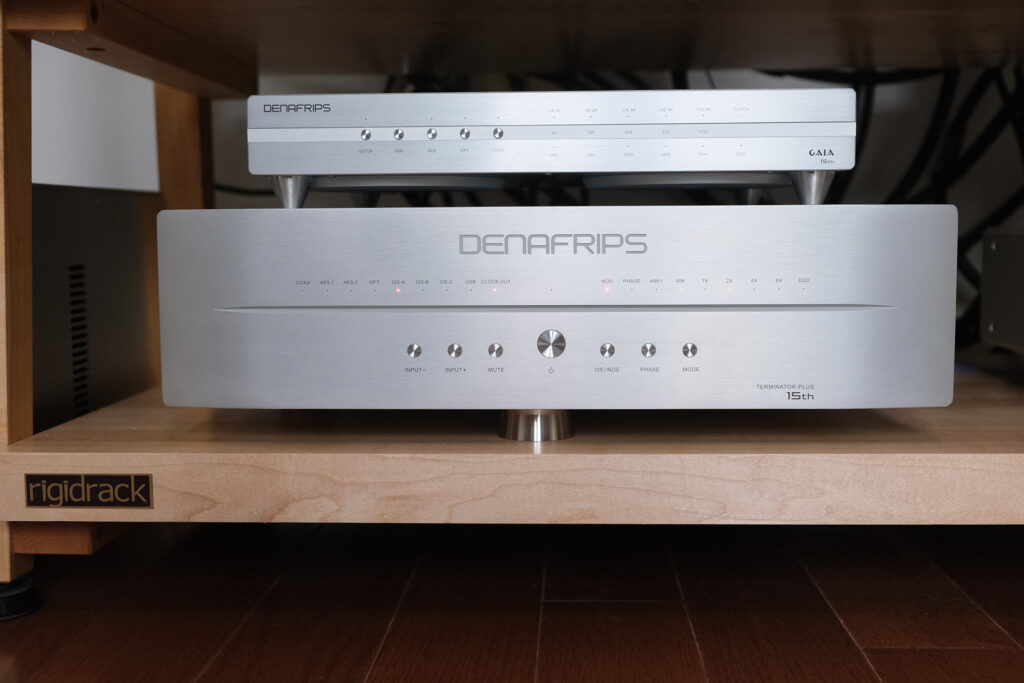
This review is for the Denafrips Terminator Plus 15th DAC. Denafrips Audio is a high-end audio manufacturer best known for its R2R ladder DACs, digital audio processors, re-clockers, DDC and, more recently, amplifiers and streamers. Founded in 2012 by Zhao Bing Ran and based in the Panyu district of Guangzhou, China, Denafrips has built a strong reputation in the audiophile community for delivering ultra-high-end engineering and build quality at prices well below most traditional European and American competitors. The Denafrips DAC family runs from the entry-level Ares and Enyo up through the Pontus, Venus, and the flagship Terminator lines. There are two physically identical versions of the Terminator DAC. This review covers the Denafrips Terminator Plus 15th, which is the 15th anniversary edition of their top-of-the-line discrete R2R DAC, with a list price of $8,599. It sits squarely in the higher-end DAC category and competes with both ladder and delta-sigma DAC configurations.
What Makes the Denafrips Terminator Plus 15th DAC So Special?
- Across the Denafrips family, there are recognizable characteristics: purposeful design, high build quality, and a smooth, analog-like sound. As their top DAC, the Terminator Plus 15th does everything better, with a massive CNC-machined aluminum chassis and oversized linear power supplies, delivering exceptional value relative to brands costing two to three times more.
- The Denafrips Terminator Plus 15th DAC supports virtually all high-resolution audio formats, including PCM up to 24-bit/1536 kHz and native DSD 1024, making it one of the most capable DACs available for digital music playback.
- It has fully discrete R2R ladder architecture. Where most chip DACs use off-the-shelf silicon from ESS, AKM, or Burr-Brown, the Denafrips Terminator Plus 15th builds its conversion stage from matched resistor networks, with true balanced R2R topology, with separate ladders for each channel. Why does this matter? An R2R DAC physically builds the analog voltage one bit at a time, using precision resistors. This direct, ladder-based approach helps deliver natural tonal density, smoother decay, and reduced digital glare.
- Dual oven-controlled crystal oscillators (OCXO) are a big plus. The Plus version of this DAC steps up from very good internal clocks to dual OCXO ultra-precision oscillators that are normally found in studio-grade or six-figure digital gear. Why does this matter? Clock precision directly affects jitter, and jitter is the enemy of a stable, focused soundstage. The result is extremely low phase noise and excellent measured jitter performance, which translates into sharper imaging, a more stable soundstage, and noticeably cleaner transients.
- In-house FPGA digital processing is another unique design element. Instead of canned digital filters, the Denafrips Terminator Plus 15th uses a proprietary FPGA platform with custom oversampling algorithms, user-selectable filters, and a true NOS (non-oversampling) mode. The benefit is that the Denafrips controls the entire digital processing chain. In practice, NOS sounds more organic and relaxed; NOS mode is tighter and more precise. The flexibility is genuinely useful and lets you tune the sound to the rest of your system, specific recordings, and your own listening preferences.
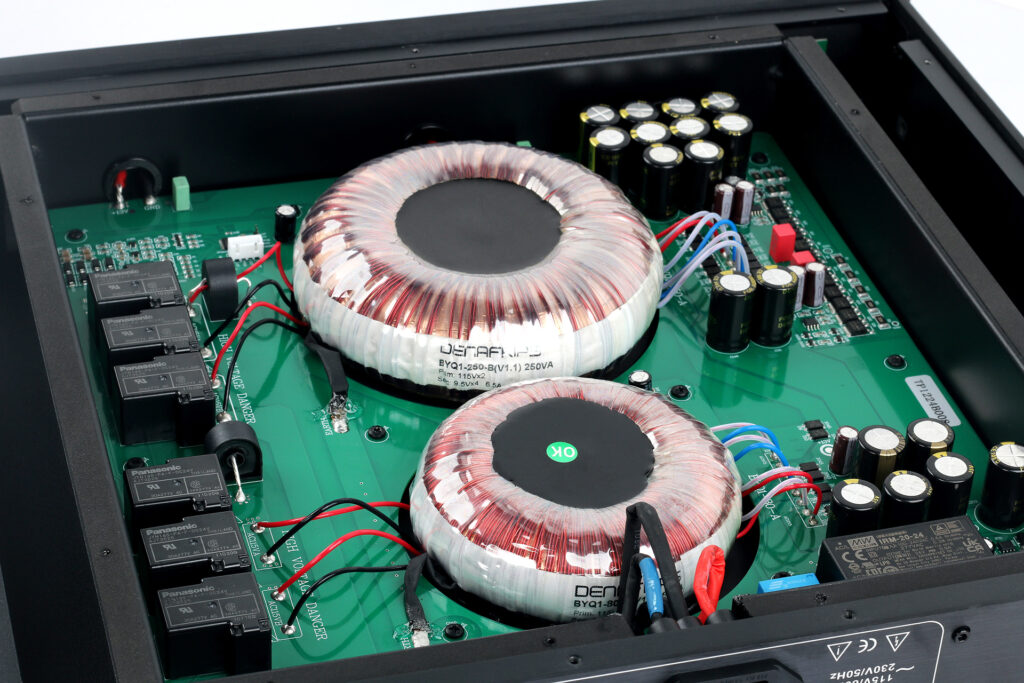
- Massive, fully isolated linear power supplies benefit all digital audiophile components. Denafrips overbuilds the power section with multiple linear supplies, separate transformers for digital and analog stages, and extensive regulation and isolation between domains. This is a big part of why the unit is heavy and, more importantly, why the noise floor is so low. Result: a blacker background, more dynamic contrast, and stronger bass authority. Even at low volumes, music shows up from nowhere.
- Hand-selected, tighter-tolerance parts are not very Chi-Fi but they do make for a much better digital audiophile component. The Denafrips Terminator Plus 15th uses hand-matched components with extremely tight resistor tolerances. In an R2R design, where the entire system depends on the precision of the resistor ladder, this is not cosmetic. Better matching means lower distortion, better linearity at low signal levels, and more resolution where it counts.
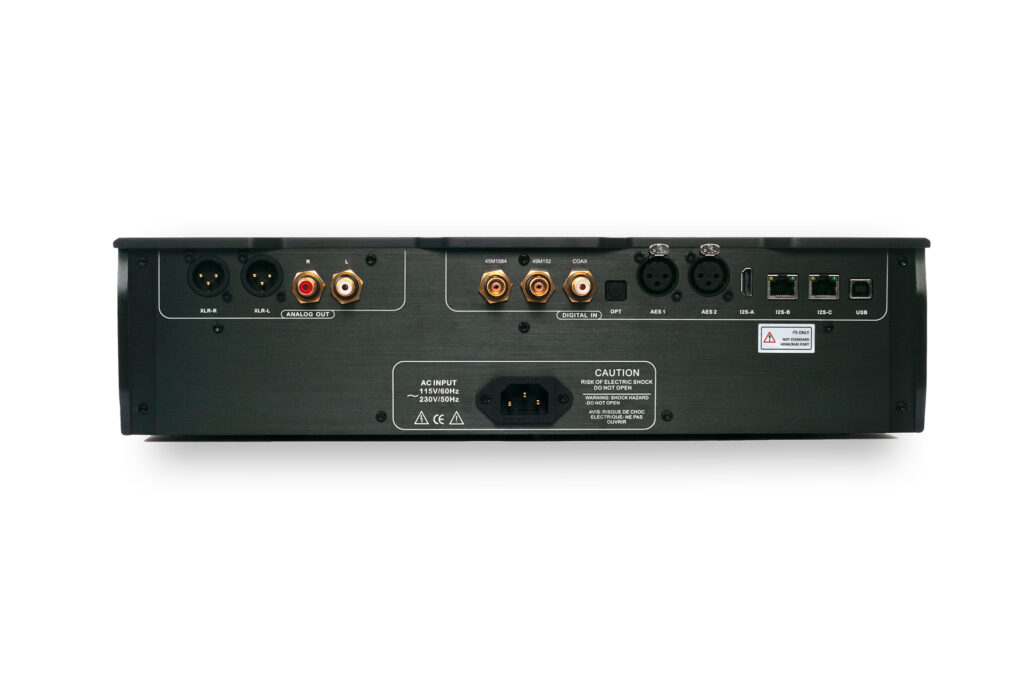
- The unit has unusually flexible digital inputs. The Denafrips Terminator Plus 15th accepts USB, I2S over HDMI, AES/EBU, coaxial (RCA and BNC), and optical. Both balanced XLR and single-ended RCA analog outputs are provided. I2S is, I can confirm, the best-sounding input.
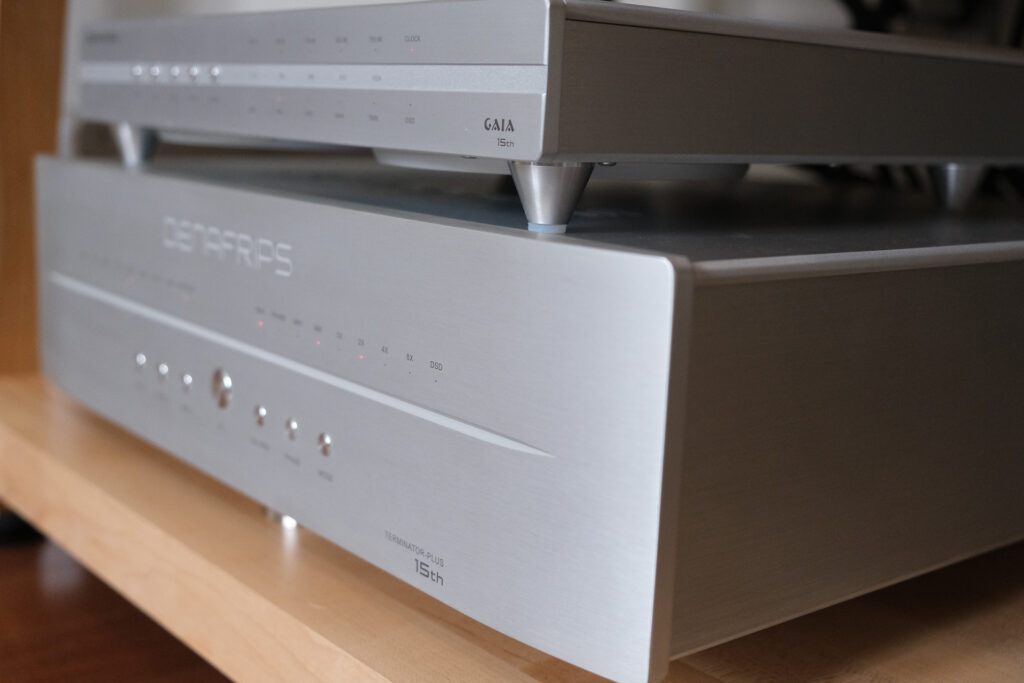
- The build quality of the Terminator is rock-solid: full CNC-machined aluminum chassis, vibration-resistant construction, and roughly 40 pounds of solid mass. The front panel is clean and minimalist, thus more purposeful than jewelry-like, but absolutely solid. The engineering investment is clearly inside the box. For this price, that is exactly the right place for it. Denafrips’ design philosophy is to minimize reliance on mass-market DAC chipsets and to over-engineer the power and clocking sections.
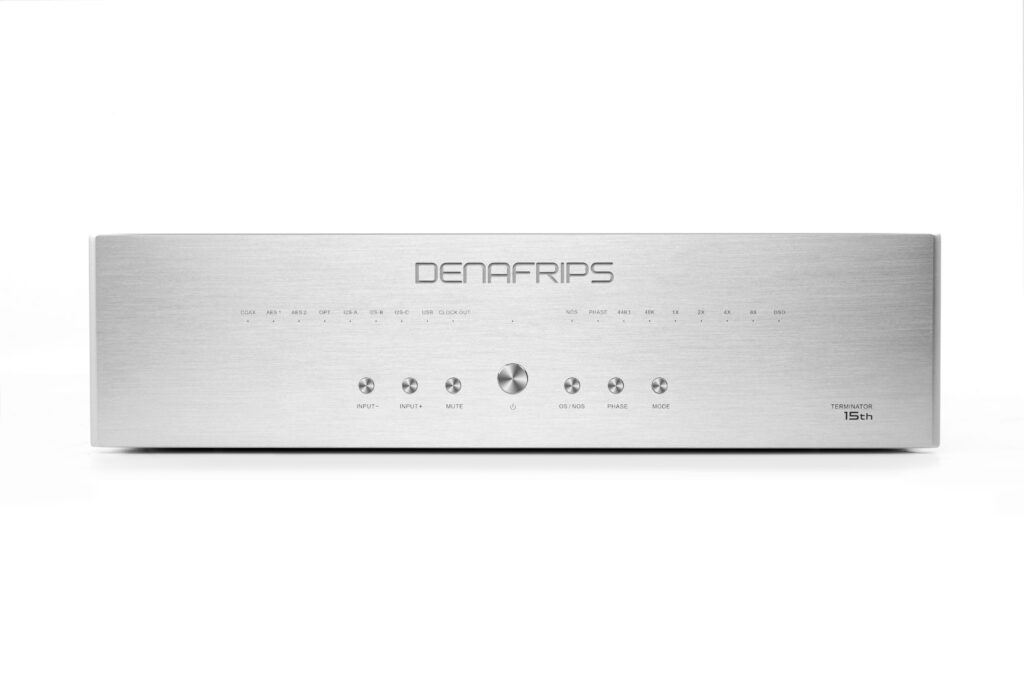
Denafrips Terminator Plus 15th R2R DAC Specifications
| Architecture | Balanced 26-bit R2R plus 6-bit DSD |
| Digital inputs | Coaxial, optical, two AES/EBU, USB, I2S |
| Sample rates | PCM to 1,536 kHz; DSD1024 (USB/I2S) |
| Outputs | RCA (2V) and XLR (4V) |
| THD | Less than 0.0015% |
| Signal-to-noise ratio | Greater than 127 dB |
| Dynamic range | Greater than 132 dB |
| Dimensions (W x H x D) | 16.9 x 4.9 x 15 inches |
| Weight | 41.9 pounds |
| Price | $8,599 at review |
Why Should You Care About the Denafrips Terminator Plus 15th DAC?
While this is a purist DAC, with no preamp or volume control, the front panel hides a lot more flexibility than it first suggests. Input selection, phase inversion, standby mode, oversampling on or off, and filter choices are all available. The real option of impact is oversample or not and, if so, which filter to use. I reviewed the DAC in all configurations and found that, well over 90 percent of the time, NOS (non-oversampling) produced the most musical results for my ears. Whether NOS sounded better was largely a function of recording quality, not a universal preference. I typically have employed enhanced dynamic range, punch, and bottom-end prowess to amplification components. The Denafrips Terminator Plus 15th added a level of strength to the reproduction of music I have not heard since adding the Allnic L-7000 preamp (read my review) to my system. This allows for uncompromised low-volume listening, in addition to creating a lot more energy in my listening room. This was a pleasant surprise from the Denafrips.
The Denafrips Terminator Plus 15th is the most musically convincing DAC I have heard at (or near) its price. R2R DACs have a reputation for sounding warm and romantic at the expense of resolution. The Terminator Plus 15th does not fall into that paradigm. The presentation is dense, layered, and harmonically rich, with the kind of timing precision and dynamic authority usually associated with much more expensive reference DACs. It does what the best R2R designs do, providing natural tone, smooth decay, and no digital glare while sounding fast, detailed, and very well-controlled.
The Denafrips Terminator Plus 15th does something I associate with really good analog front-end components. It resolves detail in a way that delivers a sound with body and roundness that is believable and authentic. Voices and instruments have a three-dimensional depth on top of the very good front-to-back layering within the soundstage. Many recordings I had written off as sounding flat came to life. Recordings I had dismissed as sounding poor simply do not through the Denafrips. This is a purist DAC for the audiophile who values, above all else, fidelity.
Some Things You Might Not Like About the Denafrips Terminator Plus 15th DAC
- The Denafrips Terminator Plus 15th DAC is not a streamer, preamp, or all-in-one digital audiophile solution. There is no built-in streaming module, no volume control, no headphone amp. If you want one box that does everything, the Denafrips is not it.
- The Denafrips Terminator Plus 15th is brutally honest about the rest of your system. This DAC rewards careful system matching. It reveals weaknesses in your front end, your cables, your power conditioning, your room. If your supporting cast is mediocre, you will hear it.
- The Denafrips Terminator Plus 15th DAC is big and heavy. At roughly 40 pounds, you will need a sturdy shelf and a willing back. The physically large size also means you’ll need decent space on your equipment rack.
- The industrial design of the Denafrips Terminator Plus 15th DAC is utilitarian. Compared to many alternatives at this price, the Terminator Plus 15th looks more like serious lab equipment than a showpiece. For some buyers at this price, that is exactly the right look. Others will want more eye candy for the money.
- The Denafrips Terminator Plus 15th DAC is not the last word in pure detail retrieval. Against the most analytical delta-sigma flagships, the Terminator Plus 15th has slightly softer leading edges. You get a more natural, more layered, more musically satisfying presentation in return. But if your top priority is forensic, etched detail above all else, a well-engineered delta-sigma design might be more to your liking.
- Denafrips brand recognition is still growing in the United States. Denafrips is respected in serious audiophile circles, but it does not yet have the name recognition of the established European or American brands. Regional distributors and authorized service are available, yet the market presence is light. Marketing is pretty slim, which hurts resale, but it is hoped this can be fixed, to the delight of legacy Denafrips customers.
Listening to the Denafrips Terminator Plus 15th DAC
I used a Pass Labs XA30.8 amplifier (read the review), Allnic L-7000 preamp (read the review), Marten Parker Trio speakers (read the review), and the Matrix Audio NT-1 streaming transport for this review. Source duties were handled by a Matrix Audio NT-1 non-DAC streaming transport over both USB and I2S. Music was both Qobuz-streamed and local USB-attached storage. After about 20 hours of playing, the Terminator Plus 15th settled in for me to a sound that was rich, dimensional, and effortless. Vinyl lovers, take note. Toward the end of my review time, I added the Denafrips Gaia 15th DDC (Digital-to-Digital Converter), which took an already stunning presentation to the next level. I spent most of my listening time on full albums rather than cherry-picked reference tracks, because this was where the Denafrips Terminator Plus 15th really showed its hand, as it is a DAC that pulls you into the music and makes you forget about the gear – the listening just continues. I spent countless hours listening to music through the Denafrips.
Pearl Jam’s Dark Matter (buy at Amazon). On “Dark Matter,” PROSTUDIOMASTERS Studio Masters download, the Terminator Plus 15th laid out the band with real front-to-back layering. Matt Cameron’s drum kit sat solidly at the back of the stage with proper space around it, Mike McCready’s lead guitar lived just left of center, and Eddie Vedder’s voice locked into the middle with that characteristic chesty growl completely intact. The rhythm of the song had grip and timing. This is exactly the kind of dense, dynamic modern rock recording where lesser DACs flatten and harden everything. The Denafrips delivered a sound that was open, three-dimensional, and alive. The ability to see into the music is startingly good with the Denafrips.
Adrianne Lenker’s Bright Future (buy at Amazon). On “Sadness as a Gift,” Qobuz 24/96, the Denafrips Terminator Plus 15th did something I have only heard from a small handful of digital sources: it gave Lenker’s voice breath, body, and harmonic weight without artificially pushing it into the room. The acoustic guitar had real wood and what sounded like old strings in exactly the right proportion, and the small room-tone cues — chair creaks, finger noise on the fretboard, the faint hush before each line — were rendered as part of the music, rather than as details. The DAC’s R2R nature is obvious here: the sound is continuous and flowing, without a sense of being stitched together.Having heard this recording several times prior, it sounded different through the Denafrips. “Different,” as in way better.
Kamasi Washington’s Fearless Movement (buy at Amazon). On “Prologue,” Qobuz 24/96, the Denafrips Terminator Plus 15th showed off its dynamics and bass control. The bottom-end groove on this record is enormous, and other DACs make it sound either bloated or thin. Through the Denafrips, the sound was tight, fast, and tonally complete, with bass notes that started and stopped cleanly. Washington’s tenor saxophone had real grit and brass texture, and the keyboards and percussion stayed clearly separated, even when the arrangement got busy. There is a lot going on in this music, and the Denafrips kept composure. Everything is in its place, yet no restriction of the musical energy that makes this band and song amazing. There is nothing polite about this album and the Denafrips showed it can play along, not making anything sound reserved.
Khruangbin’s Mordechai (buy at Amazon) Khruangbin is a trio from Houston, Texas, known for blending global music influences, including Thai rock and Iranian pop, with American soul, rock, and psychedelia. On “Time (You and I),” Qobuz 24/96, the Terminator Plus 15th reminded me what I love about this band. The bass line had that rubbery-like, round fundamental weight you want, and the skin of the kick drum was felt rather than just heard. Mark Speer’s guitar floated in its own pocket of space, and Laura Lee’s vocal sat right where it should – forward but not pushed. The soundstage was wide, deep, and remained focused at higher volumes. This is the DAC’s sweet spot: pace of the music, clarity, tonal accuracy, and lots of air, all at once. As happened throughout my listening sessions, I easily forgot to evaluate the gear and instead simply enjoyed the music. The emotion and vibe came through completely.
Will the Denafrips Terminator Plus 15th DAC Hold Its Value?
The Terminator Plus 15th should hold its value reasonably well, though there are a few things worth keeping in mind. Denafrips has built a strong, loyal following, and the flagship Terminator line is the model audiophiles most often cross-shop against DACs costing two to three times more. That kind of reputation tends to support resale. The 15th anniversary edition is also, as I understand it, something of a limited run, an effort to build the best possible version of this design without compromise. That should matter for long-term resale.
On the other hand, this is still a relatively niche brand in the United States, the distribution model is still being built out, and the pool of used buyers for DACs at higher price points is smaller than for mass-market brands. The build quality and over-engineering should make this a safe bet from a reliability perspective, serving the owner for years to come.
What is the Competition for the Denafrips Terminator Plus 15th DAC?
At $8,599, the Denafrips Terminator Plus 15th sits in a very stacked part of the market. Both ladder DAC specialists and reference-grade delta-sigma designs are present, and buyers in this segment usually know exactly what sound signature they prefer. The Denafrips is the strong pick for those who lean toward musicality and tonal density over clinical precision.
Holo Audio May KTE/Level 3 ($5,000) DAC is arguably the closest design-philosophy rival, with discrete ladder architecture with a separate power supply chassis for excellent noise isolation. The Holo Audio tends to sound a little more relaxed and fluid; the Denafrips is more precise, with noticeably better timing and transient grip. Both are exceptional options, even if from less than household name audiophile companies.
Rockna Wavedream Edition XLR ($9,600) FPGA-based R2R hybrid DAC is known for explosive dynamics and visceral punch (that’s a lot to expect from a DAC but …). More forward and exciting-sounding than the Denafrips, the Rockna Wavedream Edition XLR sounds a little less refined, yet very engaging.
Lampizator Baltic 5 ($7,000 and up, depending on configuration) DAC is a Polish tube-output DAC. It is unique in using a directly heated triode output stage, extremely musical and very warm, yet not as musically truthful as the Denafrips.
The Meitner MA3 (read the review), while slightly higher-priced, offers a solid comparison. TheMeitner emphasizes speed, transparency, precision, and effortless musical flow, neutral and refined. In the pro audio world and in audiophile circles, this is a really well-respected DAC and a no-miss for nearly any audiophile looking for a more blue-chip investment.
T+A DAC 200 ($7,500) has German-engineered hybrid quad-DAC architecture with a dedicated pure single-bit DSD mode alongside traditional PCM conversion. This makes for a fine audiophile DAC. Built-in preamp functionality, excellent build quality, and very competitive technically adds to the value proposition. This is a strong alternative for buyers who want more features alongside the sound. Reviews, including ours, have been exceptional. This DAC was used by our publisher Jerry Del Collilano for his donation to Harvard (read more here).
Final Thoughts on the Denafrips Terminator Plus 15th DAC
The Denafrips Terminator Plus 15th DAC is the best DAC I have heard in my personal system and an under-the-radar killer at its price. The combination of true discrete R2R conversion, dual OCXO clocking, in-house FPGA processing, a massive isolated linear power supply, and hand-selected components delivers the tonal density and natural decay R2R fans love without the softness or vagueness for which those designs sometimes draw accusations. The Denafrips Terminator Plus 15th DAC sounds fast, dynamic, layered, and emotionally engaging, is built like a tank, and dead quiet in terms of background noise. If you are building a reference-level two-channel system, the Denafrips Terminator Plus 15th DAC belongs on your short list.
Read more about distortion and how it affects an audiophile system from FutureAudiophile.com editor, Paul Wilson




Another great and informative review on Future Audiophile for this present day audiophile. I enjoy Mr Picarello’s writing. Informative and precise without the fluff I sometimes read from other reviewers. If I didnt just buy a dac, I would seek out the Denafrips for a listen. We done!
This is very kind feedback.
We are very happy to have Frank on our editorial team and as I mentioned above – he has some really good reviews pending and coming. ARC, Aurender, 3x Audiolab (affordable stuff) and more other affordable items.
Frank goes DEEP into the descriptions of how the music sounds which is great!
it is supposed to say “Well Done, not we done.. We done here!
Steven, thanks for the feedback and I appreciate the support. My approach is the Future Audiophile approach tied to thorough listening, research, and bringing together everything to help inform a reader. The music is the denominator and connecting the dots between it and the equipment being reviewed is what matters most It is where as a reviewer I spend most of the time. Thanks!
Very well written and reviewed, nice work Frank. And having heard all the Denafrips products over many years by now, overall I find myself in much agreement with the review. In general all Denafrips DACs are very good at what I call organic naturalness and uniquely so. This is largely because they have no output stage colorations. Another little known aspect, they will not up sample a signal that is already coming in at 4x or higher; 4x and higher will remain NOS even if OS is selected. Personally I like and agree with that design choice.
Thanks, TK of TEKAudioSpecialties.com
Thank you for this amazing feedback.
We try to balance more well-known products with others that are more up and coming. With 102 spots in the schedule each year – this is a challenge that we are up to.
Frank will be thrilled to see your kind words. He’s got a lot more reviews coming. Top of the line Aurender Streamer, ARC preamp and more.
Thanks TK. and I second Jerry’s comments about balancing well known with the up and coming. What I like about what Denafrips is doing in the US is establishing several exceptional dealers and in-country service. It’s a statement of the commitment to the market.
Hi, I agree with your experience & I have found to my taste the r2r do offer a organic sound sadly my funds are not great enough to afford the denafrips range but at the other end of the market I discovered FIIO warmer r2r dac is quite impressive via my Quad esl speakers with there Altera pre & Quad forty’s mono blocks via Qobuz.
After forty years of listening you are right on the button that technology can & does keep surprising with better sound quality.
Kind regards Malcolm.
we love selling Denafrips at JM AUDIO and the legacy they provide to customers by building a no non-sense line up from the Erato all the way up the line stays true to the music- The Terminator 15th Plus one of the all time best DACS I ever heard as well
John,
Thanks for your comments
I LOVE the energy that this product is getting in the DEAD of SUMMER.
I am inspired for another story about giving smaller brands a chance as I was given a chance by people like Christopher Hansen and Mark Levinson
Spot on Frank ! I agree 1000%
Spot on Frank ! I agree 1000% on your thoughtful opinion.