
 By
Power conditioners often fall into the category of snake oil in the minds of some audiophiles. And I can certainly see how some come to this conclusion. Power conditioners all promise to do these wonderful things to your dirty AV power that will make your system sound better. Some AC power products can work wonders, but many simply do nothing or – worse yet – have a negative impact on our systems. As audiophiles, we are always seeking the next level of performance. At some point, we get to no rock left unturned status and we really need to look at AC power as a place for improvement. The good news is that, when done right, there can be big gains.
Clarus has released an MKII version of its well-regarded Concerto power conditioner that offers several new technologies and capabilities. It also costs double what the original MKI component cost. The new unit promises to, first of all, do no harm to how your system performs. This means that it doesn’t strip the life out of the music the way some conditioners do, which is a good starting place. They claim it will increase dynamics, and won’t round off the upper and lower ends of the audio band. That’s a great start, but it needs to do more than that. Clarus promises it will produce a quieter background and clearer low-level detail while maintaining musicality, thanks to better power coming into your audiophile system. Let’s see if it lives up to these claims.
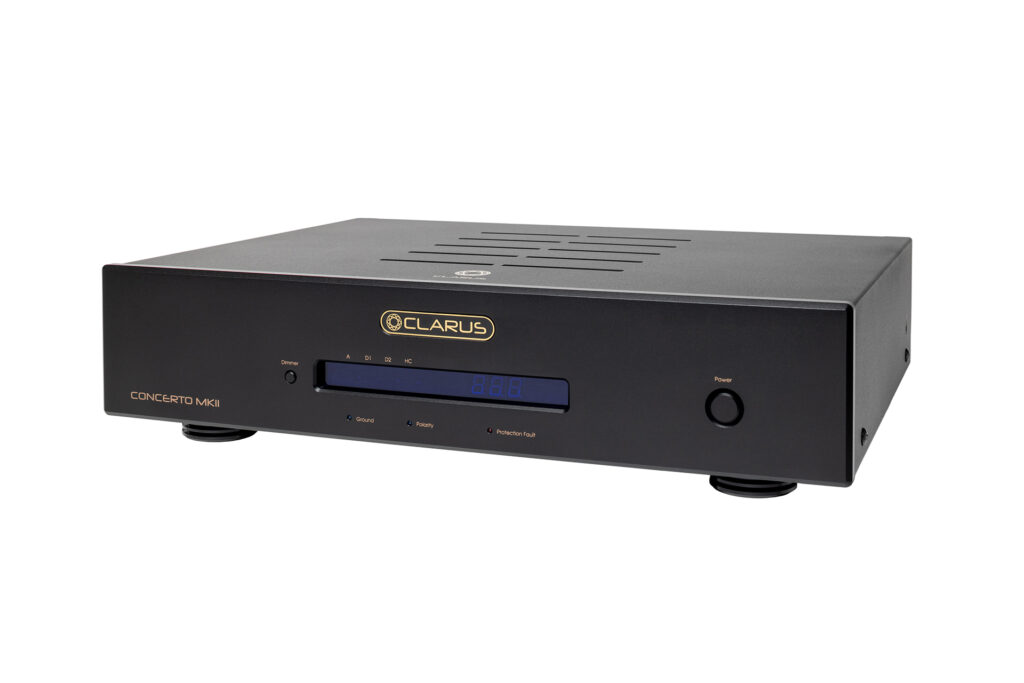
What Makes the Clarus Concerto MKII Power Conditioner So Special?
- The Clarus Concerto MKII Power Conditioner is designed to reduce electrical noise in your system without affecting musicality. While this may seem like an obvious goal that all power conditioners aim to achieve, I’ve found very few that are able to actually pull it off. Most can do an excellent job of removing noise, but the second part of the equation is quite challenging. When audiophile AC power is done wrong, your music loses its vigor and can sound flat and lifeless. That is no good and not what we get here, by design as well as implementation.
- The Clarus Concerto MKII is effectively three power conditioners in one chassis. Their filtering strategies and circuit design change based on the type of components connected, and are separated into analog, digital and high-current types. This makes a lot of sense, considering the nature of the different types of audiophile components in our systems.
- As one would expect from a component with a MKII designation, it is an upgrade over the original Concerto power conditioner, which I admittedly have no experience with. Most notably, the MKII is designed for 20-mp service compared to 15 amps for the MKI. The MKII also employs new grounding strategies and has a hydraulic-magnetic circuit breaker, compared to the more typical thermal breaker in the MKI. Filter types are also new in the MKII, which uses multistage nanocrystalline FluxCore inductors, compared to single-stage filters in the MKI.
- The Clarus Concerto MKII uses oil-filled capacitors, which offer several benefits over standard electrolytic capacitors. The oil acts as a coolant, which improves thermal stability and acts as a quench against electrical arcs within the capacitor. The oil also protects internal components from moisture and corrosion. Finally, oil-filled capacitors reportedly offer a smoother presentation and improved tonal density.
- The Clarus Concerto MKII uses ferrite bead filters to remove electromagnetic interference, which finds its way into wiring via magnetic fields. Ferrite beads act as high-frequency inductors, which dissipate the interference into a ceramic material, while leaving the audio signal pure.
- The Clarus Concerto MKII uses star grounding, which isolates each outlet with a dedicated ground path. This prevents noise from, say, a digital component, affecting an analog component. It also prevents ground loops and improves signal integrity, providing a blacker background for improved transparency and detail.
- The Clarus Concerto MKII uses heavy-duty copper bus bars for power distribution while most power conditioners use point-to-point wires. The tin-plated copper bus bars offer lower resistance and voltage drops to all outlets. The larger surface area of the bus bars provides superior current flow capabilities for power-hungry devices like power amplifiers.
- A hydraulic-magnetic circuit breaker is used in the MKII, which also adds additional performance over the common thermal circuit breaker or fuse. They are not affected by ambient temperatures, which reduce trips under sustained loads. They also are more tolerant of large inrush currents, which happen when high-current devices are powered on – think power amplifiers.
- The analog filter design is optimized to protect delicate signals. Clarus chose not to employ the typical differential-mode filters that are commonly used and may produce better measurements. They claim these flatten dynamics, reduce tonal density and wash the musicality from the music. I have heard this about many power conditioners, and it’s why I typically prefer to plug my gear directly into the wall. The Clarus Concerto MKII uses FluxCore common-mode filters, which reduce noise referenced to ground but do not restrict current flow. Ferrite bead filters and oil-filled capacitors are also used in the analog circuitry. All of this is designed to keep the magic in the music.
- Digital component power outlets have a very different filter strategy compared to the analog. Where the analog outlets avoid differential-mode filtration, the digital outlets include it. The reason is that digital components typically draw consistent low current from the Concerto MKII; the differential-mode filtration does not affect dynamics. Clarus doesn’t stop there, however. After the differential-mode filtration, there is an additional common-mode FluxCore filter. The combination is reported to provide superior attenuation of high-frequency noise without effecting audible performance.
- High-current outlets also have a unique filtering protocol designed to provide clean unrestricted power. High-permeability FluxCore common-mode filters are used to remove noise referenced from ground. A 30-amp inductor is used in the filter design, so there is no restriction of current. A sophisticated combination of differential and common mode filtration is used to eliminate noise referenced to ground and between hot and neutral lines without reducing dynamics.
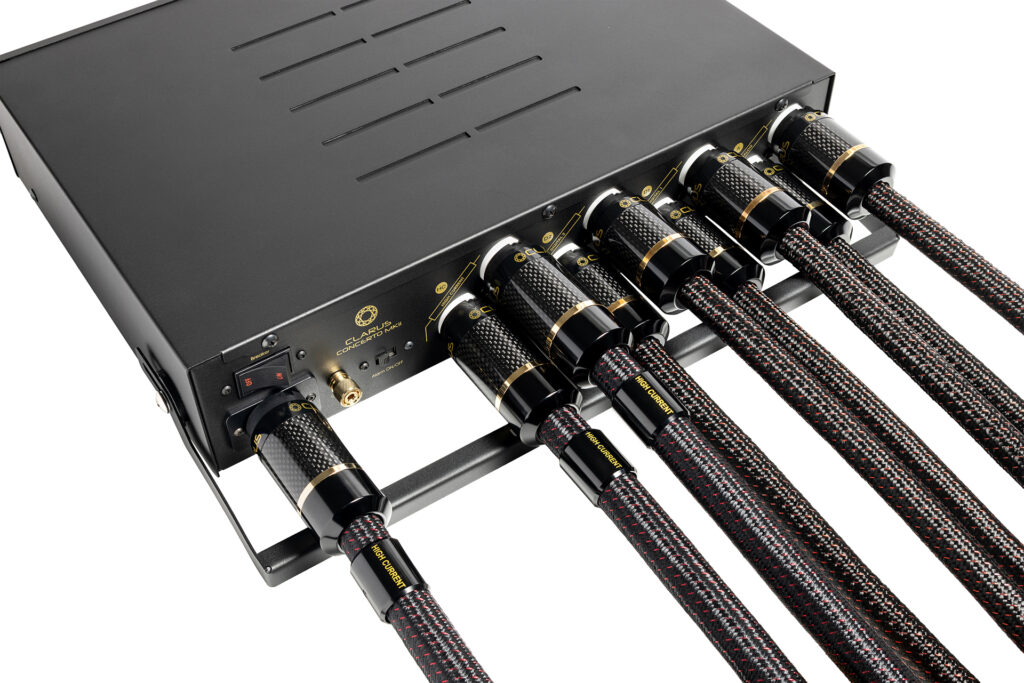
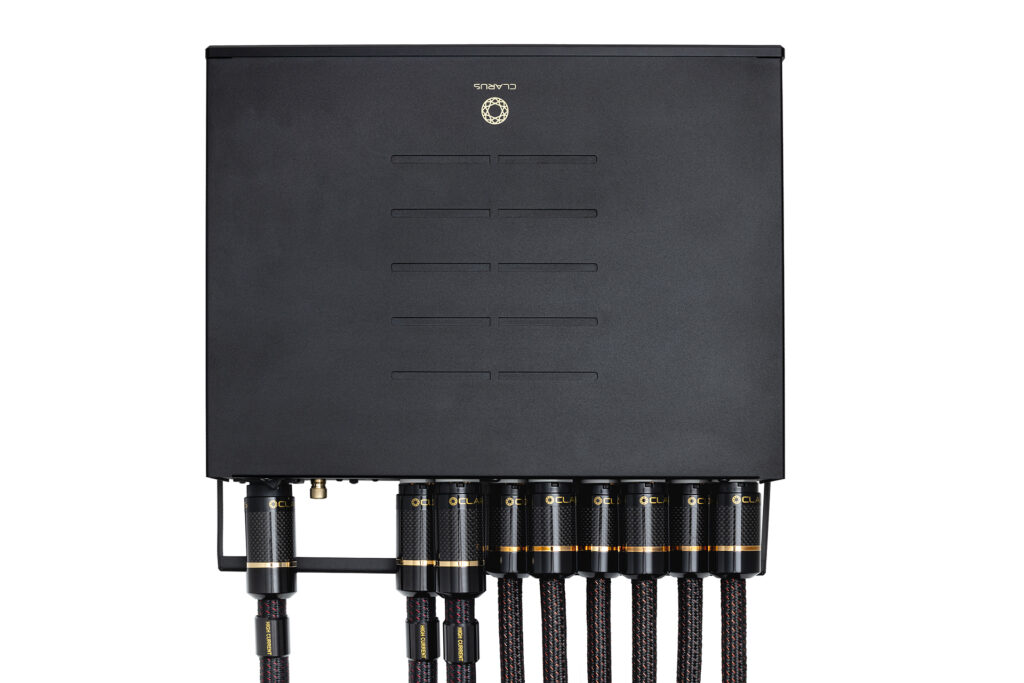
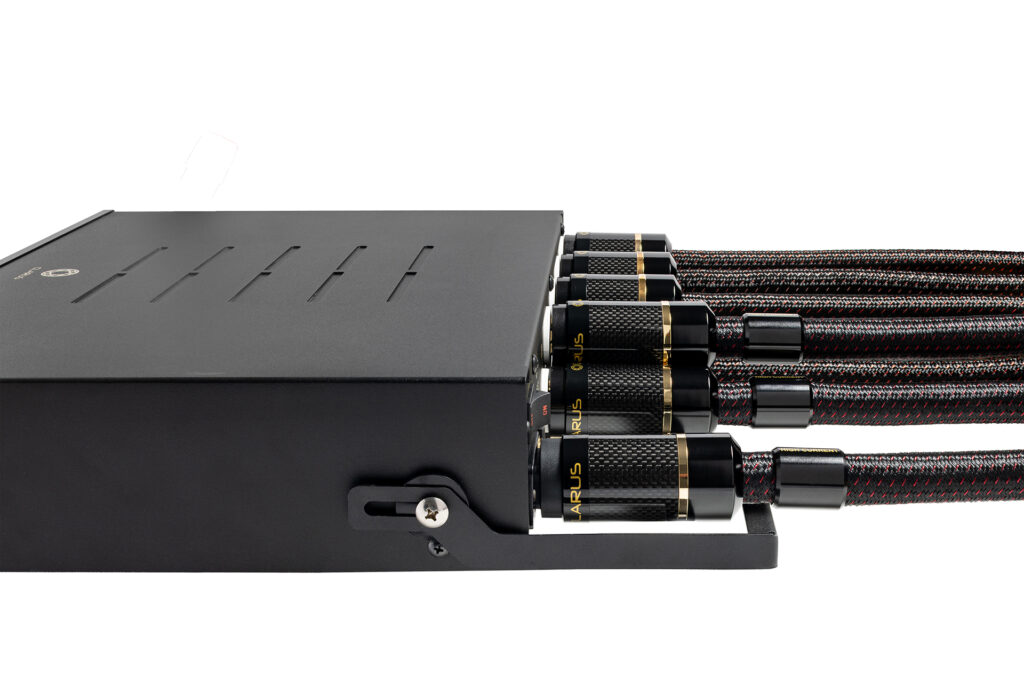
- The outlets are installed at 45-degree angles, which at first may seem odd, but is actually brilliant. If you have chunky power cords, you know that they don’t really like to bend much, and getting them to line up with an outlet can be a challenge, putting strain on the cord. The angled outlets fix that by allowing a gentle twist of the cable to line up perfectly with the outlet. This is one of the smartest design features of this swanky audiophile accessory.
- This Clarus conditioner includes an optional support bar to hold those chunky cables and relieve strain. The support holds the weight of the cable so that it doesn’t pull itself out of the outlet under its own weight. Again, super-smart for those of us with beefy power cables that come stock on expensive audiophile equipment, as well as those of us who have invested in after-market AC power cables, thus everybody wins.
Why Should You Care About the Clarus Concerto MKII Power Conditioner?
The Clarus Concerto MKII power conditioner takes a no-holds-barred approach to audiophile power conditioning. This is not designed for an entry-level system, although it certainly could be used in one. Its target is someone who is looking to raise the performance of a highly-resolving system. While certainly not in the easily affordable at $12,000, you can spend a lot more in other places and not get the return on investment that the Clarus Concerto MKII delivers.
Some Things You Might Not Like About the Clarus Concerto MKII Power Conditioner
- The Clarus Concerto MKII is only available in black, so if you want it to match the rest of your silver gear, you’re out of luck.
- Clarus does not include a power cord with the Concerto MKII, not even a cheap one. I wouldn’t say this is a big deal, but it was a bit of a surprise. Luckily, Clarus included a Crimson high-current power cable. However, I did not use it for my listening portion of this review, as that would have drastically increased the retail price of the component. I used a quality but standard power cord for my review purposes here.
Listening to The Clarus Concerto MKII Power Conditioner …
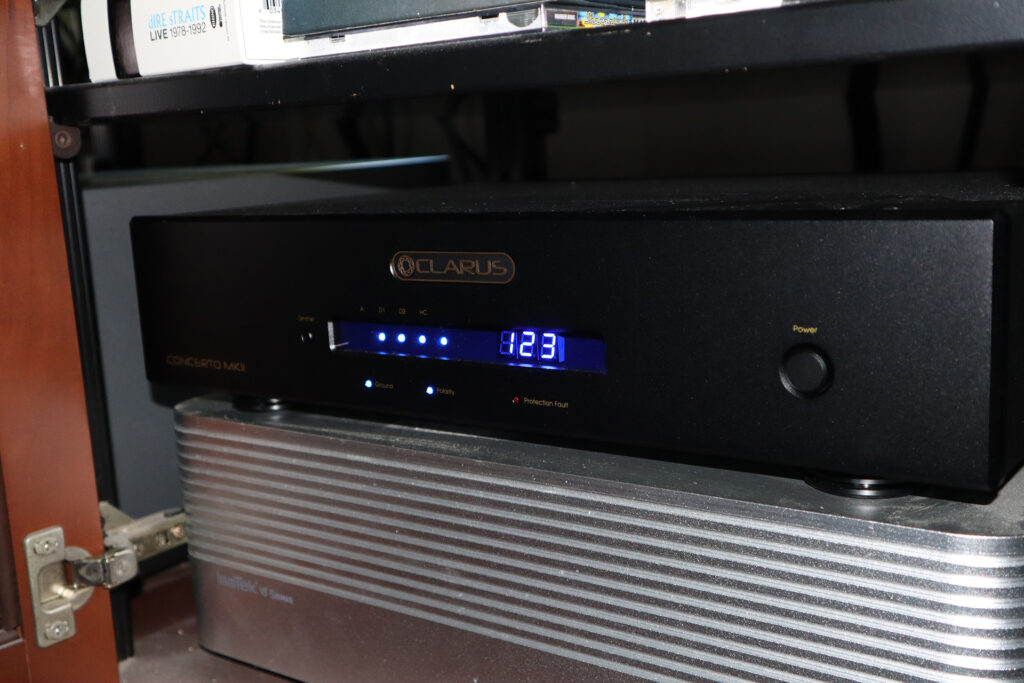
Setup was easy in terms of connecting all my gear to the Clarus Concerto MKII. Be warned that the hospital-grade outlets of the Clarus require some serious force to get the power cords seated. This is a good thing, as it’s obvious the connections are solid. I had no fear of accidentally pulling the power cords out once connected. I used the analog outlets for my CH Precision L1/X1 Preamp (read the review here), digital outlets for my Wattson Madison DAC and Lumin U1 mini-streamer. Two of the high-current outlets powered my CH Precision M1.1 power amplifier. I had one unused outlet after powering up the entire system. During my review, I spent quite a bit of time adding and removing the Concerto MKII from my system. This was not a trivial task, and I actually got quite proficient at it after much practice, but I’m glad I don’t have to do it anymore. I don’t know of another way to truly test the claims of the Clarus folks.
Johnny Cash easily has one of the most recognizable voices of the 20th century. His final album, American IV – The Man Comes Around, was his 67th studio album, the last before his death. Produced by Cash’s son John Carter Cash and Rick Rubin, it’s a stripped-down, raw recording of the country legend who would die less than a year later. There is no autotune or other studio voodoo applied to these performances – just Cash, a guitar and a microphone, as it should be. “I Hung My Head” is a favorite of mine from this album, and I know it well, but there are many classic and cover tracks that offer wide musical appeal to those who might not be big fans of country. If there is an audible penalty with the Clarus Concerto MKII, I would know it instantly with this track. Cash’s voice sounded just as I remembered it, only better. It was more pronounced and carried more texture. It was also fuller and had more weight. The song features a lone acoustic guitar and a piano. Both sounded clearly better with the conditioner in the system than without. Like the vocals, they too had more presence and texture, but most significant was the focus that the Concerto MKII brought to the entire performance. I detected no softening of the guitar strings’ attack or reduced power of the piano’s bass notes. Quite the opposite, in fact. Because there was a layer of noise that had been removed, the guitar strings had a more percussive presentation. The piano dug deeper and held those low notes more prominently. It was somewhat shocking, as I didn’t think my system had a noise problem before.
“Overkill” from the 1983 Men at Work album Cargo, the follow-up to the 1981 smash Business as Usual is a favorite of mine. The track’s drums are always quick and snappy, but with the Clarus Concerto MKII in the system, they are perhaps best described as sounding faster. The beautiful saxophone work of Ron Strykert is on full display throughout the track. With the Clarus in the loop, I heard more body, richness and soul from it. As with the Cash track, I heard absolutely no downside with the Concerto MKII, but plenty of upside.
Will the Clarus Concerto MKII Power Conditioner Hold Its Value?
Power conditioners typically do well on the used market, as they’re an easy way to potentially upgrade one’s developing or already-advanced stereo system. Not to mention, AC power products are a viable insurance policy against damaging power surges, which are a real concern here in North Carolina. I checked Audiogon and found a Concerto MKI listed, but no other history of Clarus power conditioners being sold there. If I were to guess, the seller likely wants to upgrade to the MKII. The MKII is a big step up in cost over the MKI, so that will limit the pool of potential buyers. As with most upper-high-end products, sales are hard to predict, but this is a very well-built product that should last a lifetime.
What is the Competition for the Clarus Concerto MKII Power Conditioner?
The first power conditioner that comes to mind as a competitor to the Clarus is the highly-regarded 12-outlet AudioQuest Niagara 7000 (read the review), which was reviewed by my colleague Paul Wilson. Similarly priced at $12,500, the AudioQuest Niagara 7000 also offers dedicated high-current outlets for amplifiers, as well as low-power source components. Regarding the performance, Paul said, “What the 7000 did for me was one of the more transformational improvements I have ever made in my audio journey. Basically, it made listening to music easier, more organic, and more natural.” Like the Clarus, the Niagara does not include a power cord.
Another high-end power conditioner is the $15,000 Shunyata Everest-X, which looks nothing like a traditional power conditioner or audio component, for that matter. It stands like a pyramid, with its eight power outlets stacked vertically on the rear. Don’t fear its unique design, as the folks at Shunyata also offer it in a more conservative chassis that will fit into a standard equipment rack. The Shunyata Everest-X also promises not to detract from your system performance, but rather to elevate it. I would like to get one of these in for testing, as they have an excellent reputation in the audiophile community.
Taking a different approach is the $10,000 PS Audio Power Plant 20. This doesn’t simply “clean” the incoming AC power from your wall; it creates an entirely new AC waveform right before it goes to your audio components, thereby eliminating the noise that comes from your power traveling down miles of cables from your power-generation plant. Be warned that it’s a big unit and looks more like a power amplifier than a power product. Weighing in at a very stout 95 pounds, moving it around will take the help of a friend. I would say a “the help of a dealer,” but PS Audio ditched their dealers for a factory-direct model years ago, so a friend, somebody from Thumbtack or even a piano mover would be a smart way to preserve your back.
How Clarus Power Cables Factored Into My Listening
Audio equipment reviews should only introduce a single variable to a reference system. That is, the particular product that is under review. Otherwise, how can the reviewer know what is responsible for the changes they hear if more than one component changes? They can’t.
During my review of the Clarus Concerto MK2 power conditioner this was the same process I follow for all of my reviews. I only moved the components power cords from the wall outlets to the Concerto MK2. Considering the Clarus conditioner does not include a power cord, I used a cheap generic cord that I had in my box of cables to provide power to it as I suspect that’s what most audiophile clients would do. The rest of my system uses factory cords that shipped with all the components in my system, as I’ve always been a power cord skeptic. This was the configuration I used to arrive at the conclusions I wrote in the Concerto MK2 review.
With that said, the kind folks at Clarus also included enough Crimson MKII high current power cords (priced from $2,950 to $3,640) to upgrade my entire system. These cords were substantial in every way, meaning they were thick, heavy and extremely well built. They felt luxurious and offered major pride of ownership even if they lived behind equipment racks never to be seen. The urge to plug these into my CH Precision gear was overwhelming, and when finished with my review I was excited to try them out, but first let’s look at what technologies are built into the Crimson power cords.
The Crimson MK II high current power cords use beefy 8AWG pure continuous cast copper (PCCC) solid conductor material and multiple enamel-coated conductors. The PCCC process creates single-crystal copper that is directional and free of impurities. The geometry is according to Clarus “Multi-Stage Alternating Twist Architecture Designed to Minimize Magnetic Field Interaction and Time-Align Frequency Propagation. Individual Conductors Are Selectively Twisted Based on Frequency Role, With Counter-Rotational Core Twisting to Cancel Induced Distortion.” This allows for high current delivery while maintaining dynamics, the same philosophical approach as the Concerto MK2. Each conductor is individually insulated and the cable includes dual shielding layers to minimize RF and electromagnetic noise.
The connector contacts are made with gold plated C1100 pure copper which is rated as 101 percent electrical conductivity by the International Annealed Copper Society (IACS). IACS is a standard for copper performance and achieving 101 percent is a big deal. It means that it shows material advancement above the reference of annealed copper, using advanced refining methods and perfect control of impurities resulting in some of the highest performing copper on the planet. The connector housing is made from polymethylene, brass and carbon fiber which look fantastic but also are extremely strong and reduce vibrations.
Now, back to analyzing how they sound. I started with the main cord between the Concerto MK2 and the wall. Then replaced the cord between the Concerto MK2 and my preamplifier, then the amplifier and finally my digital source. Each time I changed a cord I spent time listing to a few reference tracks that I know very well. As I replaced a stock cord with a Crimson cord, things changed for the better. Backgrounds got blacker and musical details popped a bit brighter than before. The most noticeable change came from replacing the main cord to the Concerto MK2. The music seemed to flow in a more natural way with a greater sense of ease.
While replacing the power cords to my CH Precision L1 and X1 power supply, I noticed more of what I heard with the first cord. There seemed to be more information (or the ability to hear the musical information) between notes and instruments creating a more musical presentation. I then replaced the power cords to my M1.1 amplifier and felt as if there was more harmonic texture. There was an additional weight and drive to the music that was obvious. Replacing the power cord to my Wattson Madison power supply resulted in the smallest change, but still audible. I heard a touch more sparkle and just a bit more definition around instruments.
To say I was surprised by the improvement the Crimson MK2 power cords made to my system is an understatement. I have been converted to a believer in the value of high-quality power cords like the Clarus Crimson MK2’s. They took my system to a higher level. My system has undergone some big upgrades in the past year or two and I have absolutely no business considering investing anymore on it. However, the Crimson MK2’s have me seriously looking for a way to keep them in my system permanently.
Final Thoughts on the Clarus Concerto MKII Power Conditioner …
The Clarus Concerto MKII power conditioner made a meaningful sonic improvement to my system, especially when I used the excellent Clarus Crimson MKII high-current power cord with it. Without a standard power cord, the improvements were still there, but the Clarus power cord elevated performance several more notches. The power cord is a no-brainer investment at this level once you hear what it adds, assuming that this is in your budget.
With the Clarus Concerto MKII in my system, music was sounded better. It was more palpable and more lifelike. Instruments sounded fuller and more vivid, but not in an artificial way. Low-level detail improved across the board, from guitar strings to brushes on a snare drum to the sound of a kick-drum beater. The Clarus Concerto MKII produced a substantial reduction in noise and electronic grunge that masks all those subtle nuances that make music more enjoyable. Coherence was also better with the Clarus Concerto MKII working its magic.
If you have a highly revealing system and are considering a conditioner to elevate things, then you should audition the Clarus Concerto MKII. If your experience is like mine, then you will likely not want to go back to your system without it.



