
 By Frank Picarello
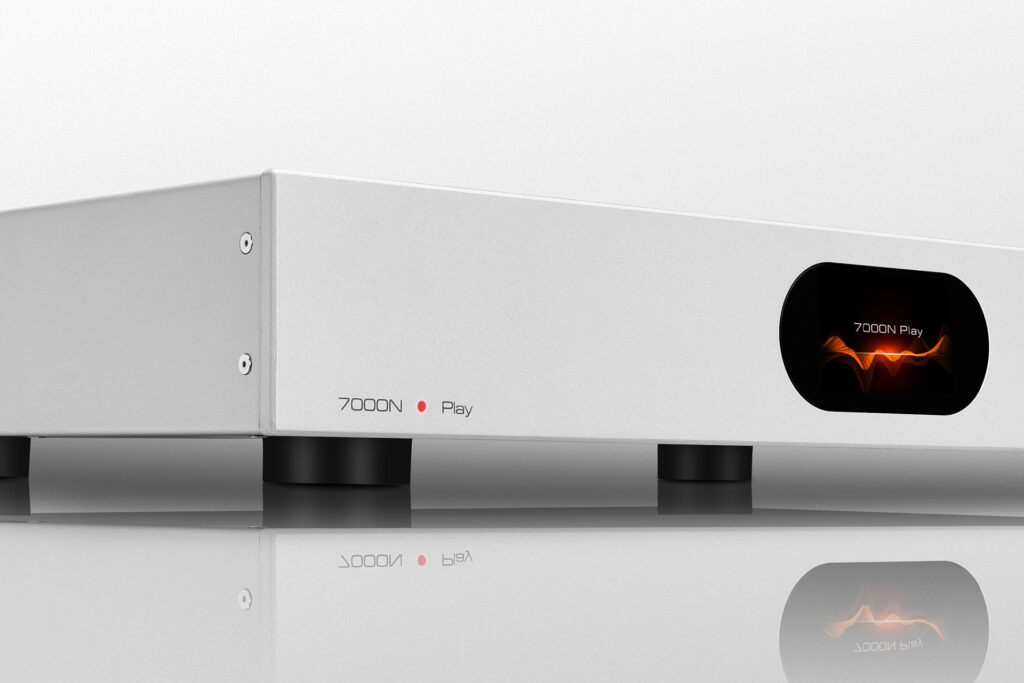
 Audiolab 7000N Play (buy at Crutchfield) is a $999 networked audiophile music streamer, built around an ESS Sabre ES9038Q2M DAC, DTS Play-Fi wireless streaming, and Apple AirPlay 2. Its design approach allows for it to be part of a product series platform, Audiolab’s own 7000A integrated amplifier (read our review) (buy at Crutchfield) and 7000CDT CD transport (buy at Crutchfield) as part of a matched three-piece system, and its heritage: U.K.-engineered, built under the International Audio Group (IAG) since the early 1980s. I found the seamless integration, aligned feature and function set, and the obvious bloodline in strengths and very appropriate price point compromises, to be well-thought-out. Product engineering and sonic voicing remain U.K.-led, while manufacturing takes place in IAG’s Chinese facilities. The quality is very good, supporting IAG’s reputation for efficient and exacting manufacturing.
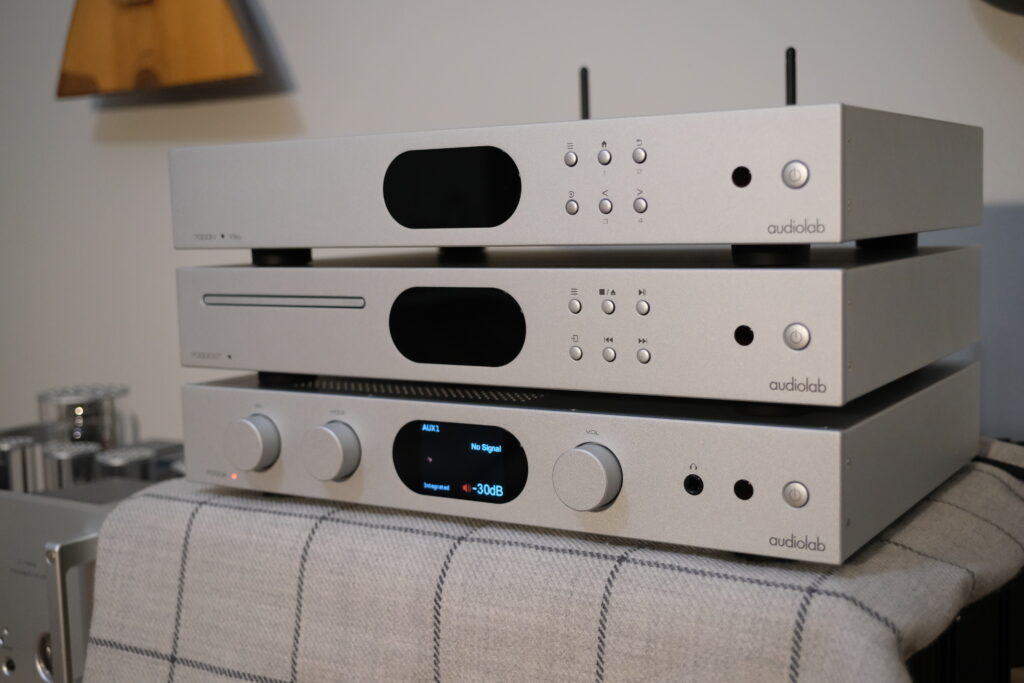
I ran the Audiolab 7000N Play two ways over my two-month review period: first through my reference system, pairing it with my Allnic L-7000 (read the review) preamp and Pass Labs XA30.8 (read the review) power amp, and then again feeding Audiolab’s own 7000A integrated amplifier directly, with my Marten Parker Trio (read my review) loudspeakers doing the work throughout.My review sample was silver and looked understated yet modern; I also ran the 7000CDT into the system as a source, playing physical CDs – more on that pairing below. Having listened to all the Audiolab 7000 family products individually and as a system, it’s nice to see that lower-priced, value-based equipment for audiophiles is a reality.
What Makes the Audiolab 7000N Play Network Streamer So Special?
- It uses the same reference-grade DAC chip found in Audiolab’s own 7000A integrated amplifier. The ESS Sabre ES9038Q2M is rated at less than 0.0005 percent total harmonic distortion and has a signal-to-noise ratio above 115dB (A-weighted), giving the Audiolab 7000N Play flagship-adjacent digital-to-analog conversion at a fraction of flagship pricing.
- DTS Play-Fi handles the streaming duties, with native support for Spotify, Tidal, Amazon Music, Deezer, Qobuz, and Internet radio, plus multi-room grouping with any other Play-Fi-enabled speaker, regardless of brand. Simple, yet effective.
- Apple AirPlay 2 and Spotify Connect are both built in, covering listeners who would rather skip the Play-Fi app altogether.
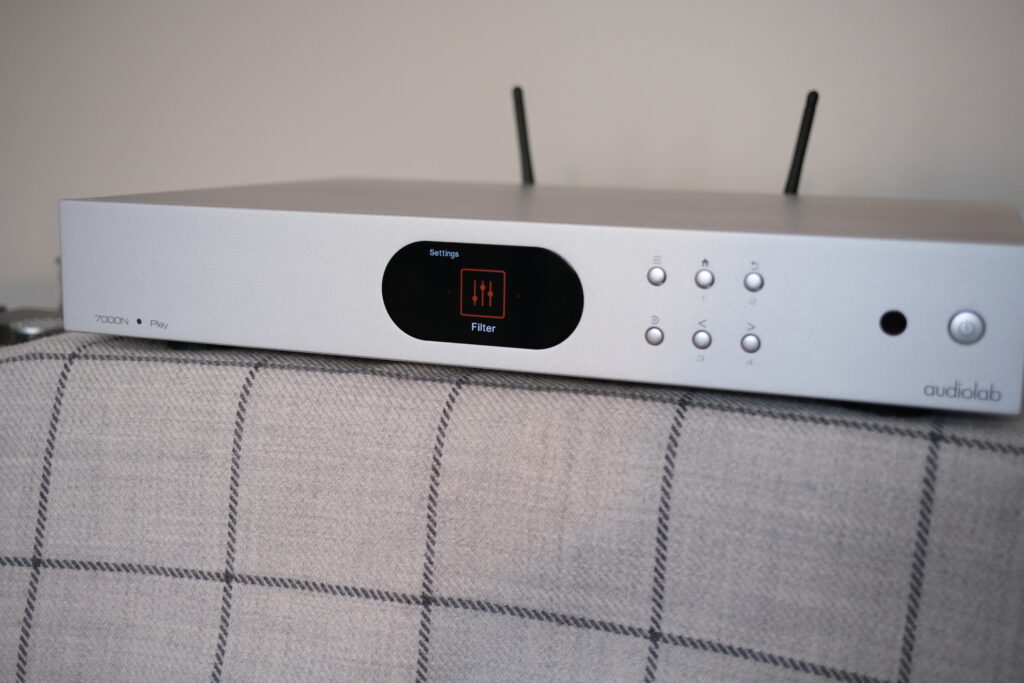
- A 2.8-inch full-color IPS display shows streaming service, format, and track data, and can switch over to a real-time VU meter for either channel, a nice touch in a category where most rivals settle for a two-line text readout or nothing at all.
- Five selectable digital filter modes let you tune the character of playback without needing outboard equalization.
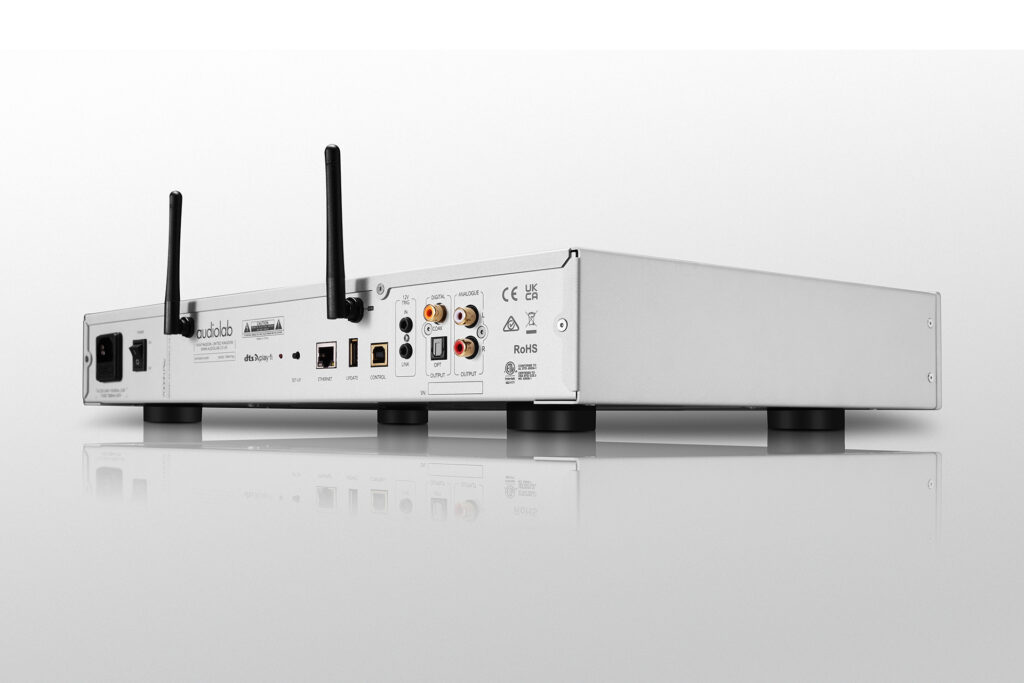
- A rear USB Control link ties the Audiolab 7000N Play directly to the matching 7000A integrated amplifier, so one remote and one volume control run both components together, with the 7000A’s analog volume circuit, not a digital one, doing the actual attenuation.
- Fixed or variable line-output modes mean the streamer can feed a preamp’s own volume control or drive a power amplifier directly.
- The chassis follows the same low, minimalist aluminum design language as the rest of the 7000 Series, offered in black or silver.
- Build quality is one area where I have no reservations whatsoever on this component. The chassis felt properly finished, rather than merely adequate, with a five-kilogram weight that reflects the dedicated, isolated power supply inside. It ran cool and completely silent for the entire review period, with no electrical hum, and no dropped connections. For a $999 component, it simply doesn’t feel like one when you have it in your hands. The display stayed easy to read, even during the day when my room was well-lit.
Audiolab 7000N Play Network Streamer Specifications
| Type | Network streamer with DAC |
| DAC | ESS Sabre ES9038Q2M |
| Max resolution | 24-bit/192 kHz |
| Streaming | DTS Play-Fi, AirPlay 2, Spotify Connect, Tidal, Qobuz |
| Digital inputs | Coaxial, optical |
| Outputs | RCA analog (fixed or variable), coaxial, optical |
| Display | 2.8-inch color screen |
| Dimensions (W x D x H) | 17.5 x 13.4 x 3.1 inches |
| Weight | 11 pounds |
| Price | $999 at review |
Why You Should Care About the Audiolab 7000N Play?
Who is the Audiolab 7000N Play actually for? Anyone building a modern digital front end who doesn’t want to spend flagship DAC money to get near flagship DAC performance. If you already own an Audiolab 7000A, adding the 7000N Play is close to a no-brainer, since the USB Control link and matched fixed output mode turn the pair into something that behaves like a single component with two volume knobs, only one of which actually does anything. If you’re assembling a system around a separate preamp or integrated amplifier from another brand, the Audiolab 7000N Play still competes well purely as a streaming DAC, though it’s worth reading the competition section below before assuming it’s the automatic choice at this price.
It’s also worth thinking about who this streamer is not for. If you live entirely inside Apple’s ecosystem and never plan to touch a dedicated streaming app, AirPlay 2 has you covered, so you may never need to open Play-Fi at all. But if multi-room audio across mixed-brand speakers matters to you, Play-Fi’s cross-brand compatibility is a real advantage over more closed platforms, and having used both wireless and wired network connections, it’s worth using a wired Ethernet connection where possible, as it connects quickly and is more reliable. This is not a statement of the Audiolab 7000N, but more about the realities of home Wi-Fi.
I kept looking over at the Audiolab 7000N Play and the matching Audiolab components. I find the series modern and clean, with a Scandinavian feel. The silver finish on my review sample is elegant and looks the part. I really like the aesthetics and how Audiolab has balanced a modern look with practical controls that should easily make sense in most environments and stand the test of time.
Some Things You Might Not Like About the Audiolab 7000N Play
- There’s no Bluetooth and no native DSD file support, which other reviewers have flagged as a surprising omission at this price point. Considering the on-purpose design of the 7000N Play, it’s worth highlighting, yet it might not be a big issue. DSD share represents less than one percent of digital music listened to, compared to MP3, PCM/FLAC, AAC, etc. Add to this that there isn’t a DSD streaming service, and this omission can make sense. If DSD support is a must-have for you, take a peek at the Audiolab 9000 Series, which does support it.
- The remote is a lower-quality plastic unit than I would like to see on a $999 component. It did everything I needed it to do without complaint, but it doesn’t match the quality of the chassis it’s controlling.
- The music app DTS Play-Fi has had a mixed reputation among reviewers over the years, with some finding the app clunky or prone to unexpectedly dropping a selected service. I never had a single issue with it during my review time, though results may vary based on the actual network setup.
- There’s no built-in phonostage or headphone output, so anyone hoping to consolidate more functionality into one box will need to look elsewhere in the 7000 Series or beyond it.
- Digital inputs are limited to what you can feed it over a network or by USB for firmware updates. There’s no coaxial or optical digital input for pairing it with an outboard transport, so it works strictly as a source, not as a standalone DAC for other gear you may already own.
Listening to the Audiolab 7000N Play Network Streamer
Across both my system setups, the Audiolab 7000N Play’s overall character tracked closely with what I already know from the 7000A: a neutral, unforced tonal balance rather than anything voiced to impress on first listen. Through the Pass Labs XA30.8 (read the review) and Allnic L-7000 (read the review), the background was genuinely black and quiet, which let instruments sit against a clean canvas rather than a hazy one. Feeding the 7000A directly, the sound leaned a shade warmer and, while not as cohesive and expansive, it sounded well above its weight class. Using Audiolab’s 7000CDT CD player as a source proved to be a great match for the 7000N Play. Everything worked seamlessly, and what was interesting is that the underlying character – the bass control, the way vocals were placed, the general sense of ease – was highlighted using both. The exclamation point came when using all three 7000 components together, clearly showing a design intent around the 7000 series products.
Tight bass was the unexpected standout quality for me. It wasn’t the biggest or most exaggerated bottom end I’ve heard, but it was tight, well-defined, and had real weight and pitch definition rather than just generic low-frequency thump. Leading-edge attack on transient bass notes was quick and clean, without the smeared or one-note quality that cheaper digital front ends sometimes provide. The midrange had good body and warmth without turning thick or syrupy, and vocals sounded natural, with the kind of tonal density that made voices feel like they were coming from a real chest and throat, rather than a speaker. Where the Audiolab 7000N Play showed its price point most honestly was at the very top: the treble was clean, smooth, and free of grain or harshness, but it rolled off just slightly earlier than what I hear from far pricier DACs. It appears Audiolab chose to trade a bit of top-end extension for a top end that never turns fatiguing, a defensible choice I largely agreed with over long listening sessions. This is one very musical digital front end.
Soundstage width was consistently good, wider than I expected for the price, with instruments placed distinctly left to right, rather than smearing toward the center. Depth was a little more modest, not as deep and vibrant as my reference system, yet well-played for the price point. The 7000N Play organizes a full band or a small ensemble convincingly but, on denser orchestral or big-ensemble material, it didn’t quite have the layering or three-dimensionality to fully separate a back row of players from a front row the way the best source components I’ve used can. Dynamics followed the same pattern: no trouble with the sudden swings in volume and energy that make a song feel alive, but the very largest dynamic swings didn’t slam quite as hard as they do through my full reference chain, exactly what I’d expect given the price gap. While I listened to a lot of music, I used four tracks that as I know well for exactly this kind of review, each stressing the system in a different way.
On Royal Blood’s “Figure It Out” (buy at Amazon – Qobuz 16-Bit/44.1 kHz) from the band’s self-titled album, the bass guitar and drums are doing all of the work, and the Audiolab 7000N Play kept them properly separated, instead of letting the heavily-affected bass line blur into the kick drum. That’s a tougher trick than it sounds for a $999 streaming DAC, and the 7000N Play handled it with the same solid, well-controlled low end I have heard from their 7000A Integrated amp. The bass had real weight and pitch definition without turning bloated, the attack on each note was quick, and the kick drum kept its own distinct thump underneath the bass line rather than folding into it. I also admired the midrange body and smoothness, which wasn’t edgy or bright, yet still with ample detail.
On Gregory Porter’s “Liquid Spirit” (Compact Disc – buy at Amazon) from the Grammy-winning album of the same name, Porter’s rich baritone sits over driving piano and gospel-inflected backing vocals, and this is where the Audiolab 7000N Play’s midrange came through best. Porter’s voice sounded full-bodied and grounded, with real chest resonance and none of the papery thinness that lesser components impose upon a voice this low. The horns stayed resolved, instead of congesting into a blur, as the arrangement built toward the chorus, and the backing vocal stack behind Porter remained a distinct layer, rather than folding into the lead. This is the kind of track that can expose a lean-sounding component quickly, and the 7000N Play never fell into that trap.
Moving to something with a lot more going on, Kamasi Washington’s “Truth” (Qobuz 24/96) from The Epic (buy at Amazon) is a big, ensemble piece with double drummers, strings, and choir – an excellent way to find out whether a component can keep a crowded mix organized. The Audiolab 7000N Play’s soundstage imaging was good, especially considering the price point, with real width and enough depth that the choir sat believably behind the horns and rhythm sections, rather than smearing onto one plane. The choir and strings toward the back of that soundstage didn’t have quite the same three-dimensional separation from the front line of drums and horns that I hear through my reference setup, yet that is expected. Things never collapsed into a wall of sound, though, which is the more common failure at this price. The treble remained composed and smooth through the entire song and, in fact, the album.
Finally, The Weeknd’s “Blinding Lights” (Qobuz 44.1/24) from After Hours (buy at Amazon) leans on bright synth arpeggios and a driving bassline, and it’s where I noticed the 7000N Play’s slightly relaxed top end most clearly. The synths were clean and never turned edgy or harsh, but they also weren’t the last word in sparkle or extension. For a track that can get fatiguing on a more aggressive system, I actually preferred the Audiolab 7000N Play’s more forgiving presentation,and the bass line underneath stayed tight, well-defined, and easy to follow throughout.
Will the Audiolab 7000N Play Network Streamer Hold Its Value?
Reasonably well for the category, though streaming components as a class simply don’t hold value the way amplifiers, speakers, or turntables do, since DACs and streaming platforms age out faster than pure analog components. Audiolab has a real advantage here: it’s a U.K. brand with more than four decades of history now under the ownership of IAG, a strong reputation for reliability, and real liquidity in the used market, with specific focus on U.K. brands. Outside of Audiolab, IAG’s portfolio includes Wharfedale, QUAD, Castle, Mission, and Leak. Current listings show open-box and refurbished Audiolab 7000N Play units running around $600 against a retail price of $999, a normal amount of depreciation, not a red flag. The biggest long-term risk isn’t the hardware, which should age gracefully, but the DTS Play-Fi platform itself. If it loses ongoing software support down the road, that would hurt resale faster than it would for a fixed-function amplifier. That risk isn’t unique to Audiolab, though – every networked streamer on the market today, including every competitor listed below, carries the same exposure to whatever platform it depends on.
What is the Competition for the Audiolab 7000N Play?
The Audiolab 7000N Play sits in one of the most competitive corners of the Hi-Fi market, and shoppers should look in both directions on price before committing. Four rivals bracket its $999 price point, two below and one just above, along with the streamer most frequently mentioned in the same breath. None of these are obscure, Internet-only brands, either.
- The WiiM Ultra (read our review) ($329 buy at Crutchfield) undercuts the Audiolab 7000N Play by two-thirds and uses a DAC chip from the same ESS Sabre family, though it lacks AirPlay 2 and its preamp and phonostage functions are considered a weak point. It’s a remarkable value, but it doesn’t match the 7000N Play’s bass authority, high-end smoothness, and overall polish.
- The Cambridge Audio MXN10 ($499 buy at Crutchfield) is the toughest value argument in this entire field, at essentially half the price of the Audiolab 7000N Play, with a Roon-Ready platform that reviewers consistently praise as more polished than Play-Fi. It is a simple unit yet, if you are looking to spend less, a viable option.
- The Bluesound Node 2024 (buy at Crutchfield) is the Audiolab 7000N Play’s most frequently cited rival, pairing a newer ESS Sabre DAC with the BluOS platform, which includes Roon compatibility and a more refined app experience than Play-Fi by most accounts. It undercuts the 7000N Play by $450.
- The Bluesound Node Icon (buy at Crutchfield) for a bit more money adds a dual-mono DAC, balanced outputs, Dirac Live room correction, and a built-in headphone amplifier for about $150 more than the Audiolab 7000N Play. It’s a legitimate upgrade option in flexibility and refinement, but it also drops any digital inputs, so it can’t double as an outboard DAC for a separate transport.
None of these four beat the Audiolab 7000N Play outright across the board, and that’s really the point. It doesn’t win every category against every rival at every price, but it doesn’t lose badly in any of them, either, and pairing it with the matching 7000A is still the single easiest way to build a cohesive, excellent-sounding digital front end without shopping a bunch of different brands.
Final Thoughts on the Audiolab 7000N Play Network Streamer …
The Audiolab 7000N Play network streamer is a $999 that does exactly what I want a component at this price to do: it doesn’t call attention to itself, it doesn’t cause problems, and it gets the fundamentals of good sound right. Across two different systems and two different amplification approaches – the Pass Labs and Allnic combination on one side and Audiolab’s own 7000A and 7000CDT on the other – I got solid bass, a believable soundstage, and a tonal balance that never asked me to make excuses for the price. It isn’t the last word in resolution or treble sparkle, and the remote could be nicer, but I never ran into a real problem during my time with it, and it paired especially well with the 7000A, exactly as the company intended.
What ultimately impressed me most wasn’t any single measurement or any one track. It was the total absence of drama. Nothing dropped out, nothing sounded thin or fatiguing, and nothing about the build or the interface made me second-guess the price. Audiolab has clearly figured out how to do it consistently across the entire 7000 Series. If you’re building a system around the 7000A or simply want a well-built, fully-featured streaming DAC that won’t embarrass itself against pricier rivals, the Audiolab 7000N Play is a solid choice.
“…it doesn’t call attention to itself, it doesn’t cause problems, and it gets the fundamentals of good sound right.”




This is an excellent and informative review of the Audiolab 7000N Network Streamer. Something Ive come to expect from Future Audiophile and Frank. I enjoyed reading it, thank you!