
 By
By I recently reviewed the PS Audio PMG Signature preamp (read my review) and was highly impressed. I remember it sounding extremely open, highly detailed and blazingly fast, but never edgy or harsh. When I had the opportunity to review another PS Audio Signature product, I was eager to get my hands on it. Enter the PMG Signature 512 DAC.
The marketing literature of the PS Audio Signature 512 DAC mentions many new technologies aimed at improving timing, resolution and musicality. This component is designed to be the jack of all trades in the PMG Signature product portfolio. As you would expect, it is a high-performance DAC, and is also a streamer. In my experience, integrating streamer and DAC functionality into a single box has massive upsides, such as improved timing, reduced noise and fewer cables to buy. The PMG Signature 512 DAC can also serve as your system’s preamplifier in simpler configurations.
When asked for system advice from new audiophiles entering the hobby, I almost always recommend starting with something like this DAC as the cornerstone of their system. It gets them up and running at a very high level by integrating a streamer, a DAC and a preamp in a single box without breaking the bank too badly. Let’s dig in and see if the PS Audio Signature 512 DAC impresses like its preamplifier sibling did.
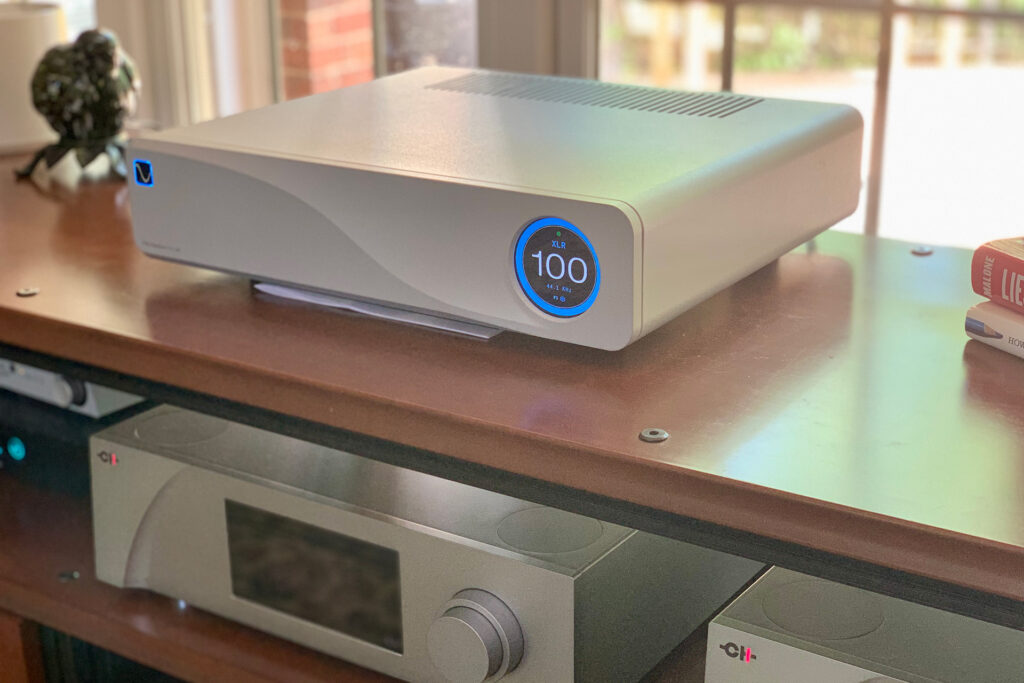
What Makes the PS Audio PMG Signature 512 DAC So Special?
- The PS Audio PMG Signature 512 DAC up-samples every digital signal to an 8X DSD stream with the PureStream DSD 512 engine. This eliminates decimation, which is a reduction in sample rate where bits are lost, typically after passing through a filter.
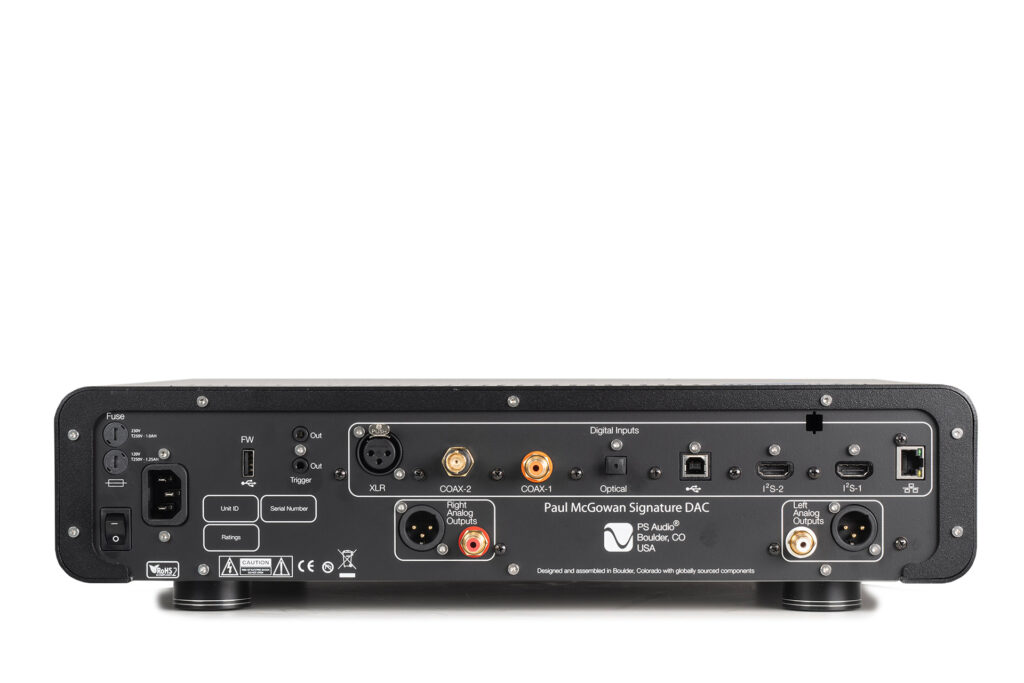
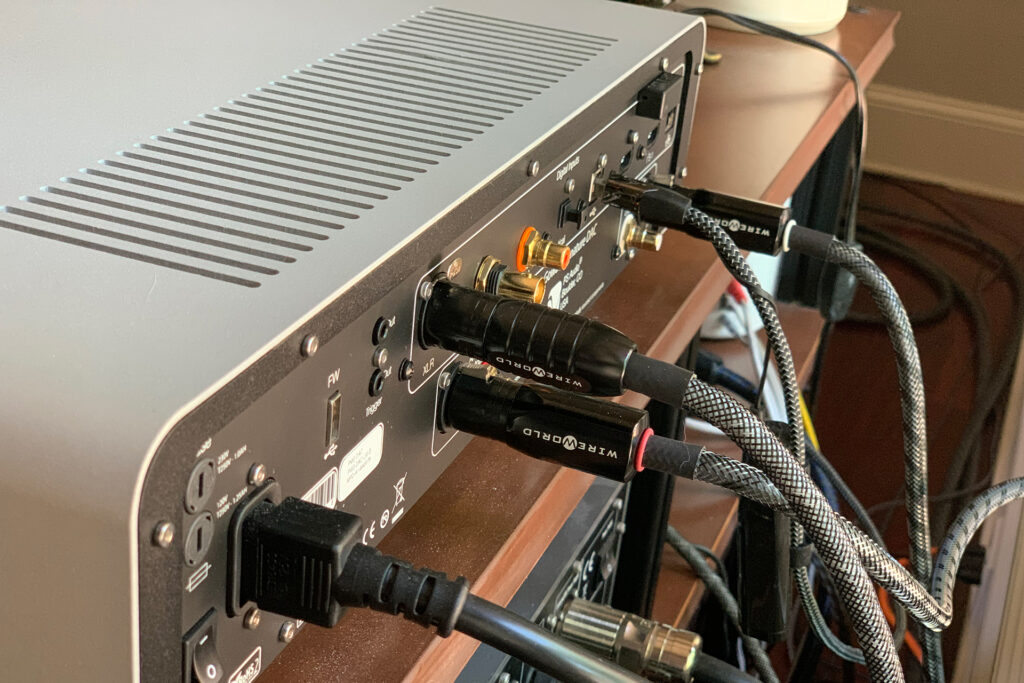
- The PS Audio PMG Signature 512 DAC has every digital input you can possibly need. It offers an ethernet port, two I2S inputs, Asynchronous USB, XLR, two coax and an optical. If you run out of inputs, you just have too many sources.
- The PS Audio PMG Signature 512 DAC is completely comfortable processing high-resolution data streams. Max data rates are 768 KHz/32-bit and DSD 512. Realistically, this is above what most audiophiles use on a day-to-day basis, but it is great to know that you’ve got this many format/connection options available to you.
- The PS Audio PMG Signature 512 DAC keeps the Digital Lens technology, which PS Audio is known for in the digital domain. The Digital Lens uses a buffer to store incoming digital data, then uses a high-performance internal clock to manage the release of the data from the buffer. This eliminates the inconsistency of data that comes through a streaming service across a noisy LAN network, and also greatly reduces jitter. Less jitter means more focused imaging and better timing.
- The PS Audio PMG Signature 512 DAC has a SpectraWave 64-Tap sequencer. This is the digital filter that uses Finite Impulse Response (FIR) techniques, which means that each data bit has a finite response. What does that mean? Well, typically, when a filter is applied, it affects the phase of the signal. Change the phase, and you change timing. FIR allows you to apply a filter without affecting the phase. This eliminates things like pre-ringing, and preserves timing. Clearly, PS Audio is serious about keeping timing in check, as our ears are very sensitive to it. Get it right and you lift veils from your music, and everything becomes more precise.
- The PS Audio PMG Signature 512 DAC has an output stage that is fully balanced and direct-coupled. The result is a more direct connection to the music/recording.
- The PS Audio PMG Signature 512 DAC has preamplifier capability to drive an amplifier directly. Many DACs offer this ability and, while the Signature 512 sounded great driving my amplifier, it sounded better when my preamplifier was in the signal chain.
- The PS Audio PMG Signature 512 DAC has an integrated streamer. What better way to optimize the transfer of data from the streamer to the DAC than to have them designed by the same people, in the same chassis, using the same clock? This is a big improvement in performance for all but ultra-high-end gear, plus it saves your dollars for better speakers or room treatments. Win-win. You can connect the streamer to your LAN using either an ethernet cable or Wi-Fi.
PS Audio PMG Signature 512 DAC Specifications
| Digital inputs | Two I2S (HDMI), two coaxial, two AES/EBU (XLR), one optical, one USB; Ethernet and Wi-Fi streaming |
| Analog outputs | Balanced XLR (up to 4 volts) and single-ended RCA (up to 2 volts) |
| PCM resolution | Up to 32-bit/768 kHz |
| DSD | Up to DSD512 |
| THD+N | Below 0.001 percent at 1 kHz |
| Frequency response | 20 Hz to 20 kHz (±0.25 dB) |
| Dimensions (W x D x H) | 375 x 445 x 112 mm, including feet |
| Weight | 13.6 kg (about 30 pounds) |
| Power consumption | 30 watts |
Why Should You Care About the PS Audio PMG Signature 512 DAC?
The Signature line of products from PS Audio represents the pinnacle of performance from PS Audio, a company with products that punch above their price tags. If you prefer an open, fast presentation over warm and romantic, then the PMG Signature 512 DAC is something you should consider. If you want a single component to build a system around at a very high level, this is an excellent option. PS Audio spends its dollars wisely, stopping short of the law of diminishing returns, which puts products out of reach of most audiophiles. For example, they don’t use costly billet enclosures, instead opting for high-quality and affordable shaped heavy-gauge metal enclosures. PS Audio is perfect for those consumers who don’t want to work with dealers and all that goes along with that. They offer an industry-standard 30-day in-home trial. If you don’t love the product, you can return it for a refund. There is no better way to audition a component than in your home, with your equipment.
Some Things You Might Not Like About the PS Audio PMG Signature 512 DAC
- The remote control for the PMG Signature 512 DAC feels cheap. I think a product at this price point, especially with the “Signature” moniker, deserves better than a universal remote you can buy on Amazon for 10 bucks. With that said, it does everything you need it to do, and it is backlit, which I appreciate.
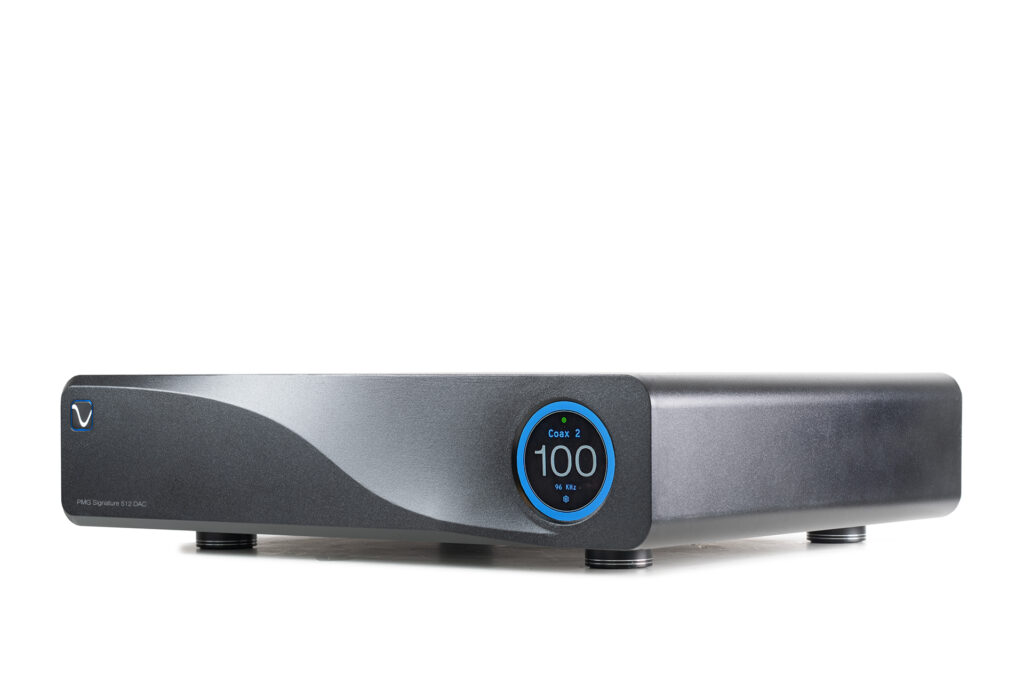
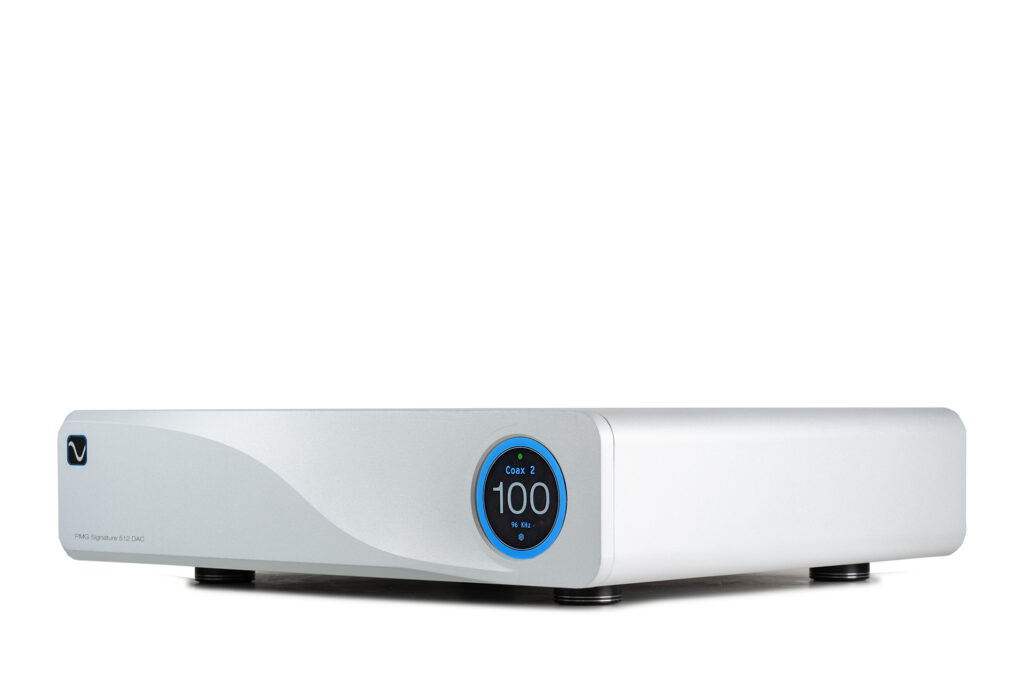
- The PS Audio PMG Signature 512 DAC is missing the bling of some of its competitors. The styling is understated and somewhat plain, but still handsome. If you want to impress with fancy dials and billet machining, this is not the DAC for you.
Listening to the PS Audio PMG Signature 512 DAC
My reference system includes the CH Precision L1/X1 Preamp preamplifier, CH Precision M1.1power amplifier, Wattson Madison streamer/DAC and Rockport Avior II loudspeakers. The PS Audio PMG Signature 512 DAC was connected to the preamp with Platinum Eclipse 10 XLRcables from WireWorld.
The rest of the system is fully wired with 10 Series WireWorld cables.
I used the PMG Signature 512 DAC in two ways, first with its dedicated streamer and second as a standalone DAC, fed from my Lumin U1 Mini streamer using Wireworld’s top-of-the-line Platinum Starlight 10 balanced cable. What I noticed was that I clearly preferred the internal streamer over the external Lumin. There was an improved sense of focus and precision, which I have grown to expect. The Lumin seemed to put a slight haze across everything, making music sound slower and less lively. The streamer supports nearly every service imaginable, such as Roon-Ready, Qobuz Connect (which is what I used), Tidal via Roon, Spotify Premium, and more.
I experimented with some different connections from my Lumin but always came back to S/PDIF over XLR as sounding best to me. To my ear, it had more weight than the I2S, which sounded a touch faster but wasn’t quite as authoritative. The USB input was slightly behind the I2S performance, sounding slightly less analog. If this were my DAC, I would not use an external streamer.
I typically have jazz playing in the background while I work and, while walking through the living room to my kitchen, I happened to hear “The Man I Love” by the Fred Hersch Trio. I had to stop and listen rather than my usual pass-through. This track highlighted many key aspects of the sonic signature of the PS Audio 512 Signature DAC. First, the piano was very convincingly reproduced. Lots of DACs, even very pricey ones, struggle to make a piano sound like an actual piano. They tend to emphasize the initial strike of the hammer, but struggle with the strings’ vibrations after the strike. These should fill your listening space and slowly trail off. The PS Audio 512 Signature DAC is one of the few to pass through my system that gets it right. I would attribute this to all the effort PS Audio made to timing accuracy. The track also features a long bass solo which, like the piano, let each note spread out and hang around. The bass had speed and clarity that let you listen deeper into each note. I found that the PS Audio 512 DAC brought each instrument to life in a way that I typically experience in a live musical performance.
“One in a Million” by Guns N’ Roses was another sonic winner in my queue on this PS Audio DAC. It’s another song I’ve listened to countless times, although not recently. What I first noticed when listening through the PS Audio 512 Signature DAC was a much deeper soundstage than I was expecting. I don’t think anyone would consider G&R Lies an audiophile recording, but it sounded much better than I remember. Most of the hard rock/metal albums from the 80’s were highly compressed and typically have a flat soundstage, this one included. Slash’s stage right acoustic guitar intro sounded clear and lively, with each string clearly identifiable. The stage left electric guitar of Izzy Stradlin comes in shortly after with max distortion, as a stark contrast to the purity of the acoustic, maybe as a nod to Axl Rose’s vocal range which can also be crystalline or raspy. The 512 Signature DAC uncovered a new-to-me detail in the vocals from the master recording. I could clearly hear his voice reverbing off the walls of wherever the track was recorded. The beauty of a great piece of equipment is to reveal new surprises in music you know, without taking away from the feelings you get when listening to it. This song takes me back to lots of great times with friends, doing things we had no business doing.
Will the PS Audio PMG Signature 512 DAC Hold Its Value?
DACs have an interesting hierarchy on the used market in my observations. I see three tiers that they seem to settle into. First are the Chi-Fi DACs, which are flooding the market at lower and lower price points. In my mind, these are almost disposable products. Due to how low the cost of entry is for a new one, why would anyone bother with a secondhand one? Next are the uber-high-end DACs, which seem to rarely show up and, when they do, seem to sit for a long time and likely go unsold. This is because the seller has unrealistic expectations on the value of their used high-ticket item. The sweet spot seems to be for the DACs, which sold new around the $10,000 mark. They move quickly and seem to hold their value well. All this to say I think the PS Audio Signature 512 DAC will do very well on the used market. It’s an excellent-sounding audiophile component, with tons of features from a reputable brand.
What is the Competition for the PS Audio PMG Signature 512 DAC?
The DAC market is one of the, if not the most, hotly contested areas of the audiophile world. It’s a component that can make a dramatic change in a system without requiring a second mortgage. In my opinion, the $5,000-to-$10,000 range of the market is the heart of the biggest bang for the buck.
The recently reviewed $5,000 Wattson Madison Streamer DAC (read my review) is priced under the PS Audio Signature 512 by a couple of grand. It also has integrated streaming and preamplifier capability. However, the inputs are limited in comparison. The Wattson offers only two external inputs, coax and TosLink. It is clearly designed to be an all-in-one solution of streamer and DAC. It is not a full-sized unit like the PS Audio, which is a negative for many, including myself. On the positive side of the equation, it has much of the trickle-down technology of the ultra-high-end CH Precision C1.2 DAC, and is made in the same factory.
The $10,500 Meitner MA3 DAC (read the review) is another DAC I would audition in this price range, although it is a bit higher-priced. It is also a streamer like the PS Audio 512 Signature DAC, but only accepts up to 192 KHz/24-bit inputs, versus 768/32-bit for the PS Audio. The MA3 does support MQA unfolding via USB and Network, while the PS Audio does not. The Meitner DAC can also serve preamplifier functions, which is always a perk in simpler system configurations.
Final Thoughts on the PS Audio PMG Signature 512 DAC
PS Audio’s Signature line of products is set apart from all the other PS Audio products by proudly wearing the initials of company founder Paul McGowan. Signature products should represent something special and, in my experience with the preamplifier and now the 512 DAC, they are.
The PS Audio PMG Signature 512 DAC has a presentation that is most recognizable by outstanding clarity. Layer upon layer of detail is revealed by the Signature 512 in a way that is natural, not forced. Clearly, the attention given to reducing noise and timing errors is to thank. Music flows from the speakers across a rich soundstage, which sounds wide and deep, as compared to other digital components. Like the Signature preamplifier, the 512 DAC is fast and light on its feet. There is an immediacy to every note that is highly addictive. The PMG Signature 512 DAC is my kind of DAC.
Read more about distortion and how it affects an audiophile system from FutureAudiophile.com editor, Paul Wilson




So what is a timing error that this thing reduces?
Let me point Jim Swantko to this.
Stay tuned
It’s the digital lens which uses a buffer to store digital data that comes from your network. A standard LAN is very inconsistent when it comes to data timing, which isn’t a problem when it comes to things like excel spreadsheets or word documents. Audio however is a very different thing as missing audio information cannot be corrected for and the ear/brain is highly sensitive to. The Digital lens allows for data to fill up the buffer and be ready to send the next chunk of data to the DAC so that the data instability of the LAN is essentially eliminated. Hope that makes sense.
No, it doesn’t make sense….data from the LAN arrives in packets. These packets get assembled in the correct order in the DAC network module. No data packets go missing, and each packet gets assembled in the correct order. Timing for this process does not matter. The LAN has many hundreds of times of throughput capacity than is required by the DAC to make lossless music. Timing only matters when that data is processed and becomes PCM and gets sent as a stream (i.e. not packets). So you are saying the digital lens is buffering data packets, or buffering a PCM stream? Buffering of the stream might be understandable, but buffering of LAN data packets I do not understand.
I can assure you lots of data packets get lost across an IP network. This is exactly what error correction is. If a packet is lost the network has it resent. If there is a buffer to shield the DAC from this missing data then the listener will not be aware of it.
You are right. Network router or switch has a chips that can request the lost packets and correct the data transmission. Next thing every dac has buffer that receives data but can’t correct the lost packets but digital lens looks into data for missing packets and requests back to correct it. That’s why they call it digital lens.
Would you compare the sound of the Wattson Madison to this PS?
Hey Ernie,
The PS Audio DAC had a wider soundstage and was a touch faster sounding. The Madison leans a little bit to the warmer side but not by much. Both are excellent DACs that I could live happily ever after with. As always it’s going to depend on your preferences as to which is the better fit.
You would recommend a NINE THOUSAND DOLLAR DAC to “new audiophiles entering the hobby”? With all due respect, are you insane?
A DAC with integrated preamp controls is what I was referring to. I don’t think I’m insane… but what else would a crazy person say? 😁
Explain by breaking it down like this. It’s a premium dac plus premium streamer and premium preamplifier.3500+3500+3500. It’s worth more than 10 grant.
This is nonsense. It’s not a “premium streamer”, it has bare bones support for a few streaming platforms, and no UI into them at all. It’s not a “premium preamp” because it has ZERO analog inputs, much less a phono stage. You can do much better for less money on both fronts.
There are quite a few PMG Signature 512 DAC owners on the PS Audio forums reporting various operational issues and bugs with their units, and some appear to be quite frustrated at the slow progress in getting these fixed. Did you find any of the operational difficulties that these owners are reporting?
I had no issues with my review sample.