
 By
My recent trip around the sun has put me far closer to 50 human years of life than to when I began. As the typical existential crises set in that are normal around this time, I find myself longing for the “good ol’ days.” The earmark of these times for Gen X isn’t simplicity – hell, we grew up with technology from its infancy – it is quality that makes sense. Here is where many audio companies get their integrated amplifiers wrong, often cramming way too many features in without a sensible way of using it all. For the end user, this often feels like simply slapping handfuls of features in, like kids packing their sandcastles at the beach with more mud just to make it bigger than the next kid’s. When Quad’s flagship Platina Integrated Amplifier darkened my doorstep for evaluation, I was prepared to dig into another complex world of many tedious features. Then I read the manual.
When you work in the audio realm for nearly three decades, it is easy to make assumptions based upon the trends one sees and historic experiences. Sometimes those assumptions are wrong. As I thumbed through the Quad Platina’s manual, I started to see the picture forming of a thoughtful, usable flagship integrated amplifier that has everything a technically-forward audiophile would love, including the power to drive large loudspeakers, all backed by the 90 years of quality Quad brings to the table. Sounds cool, right? Let’s see if the Quad Platina integrated amplifier backs up my on-paper impressions with real-world use and listening performance.
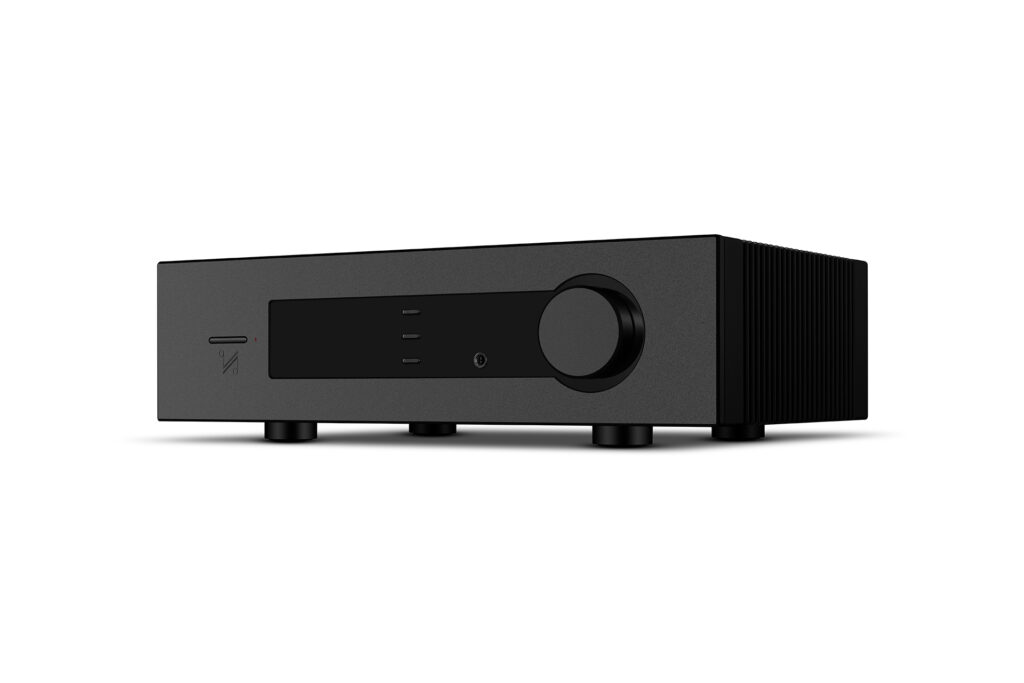
What Makes the Quad Platina Integrated Amplifier So Special?
- The Quad Platina integrated amplifier comes with a great amplifier section. All amplifiers are far more than their watts. If watts are all you want, go buy a 4,000-watt Pyle Pro from Amazon and be wholly disappointed when it does not have nearly the drive of the Quad Platina, and is grossly unlistenable to boot. Instead, look at what is behind the watts. The Quad Platina has an advanced power supply with large reserves, short signal paths utilizing the same SMD (Surface-Mount Device) technology one would find in a cutting-edge data center server, 0.0008-percent THD (Total Harmonic Distortion), and a respectable >112 dB S/N (Signal to Noise) ratio. When you look beyond the watts, it is clear to see the Quad Platina’s 200 watts into eight ohms, and 310 watts into four ohms, have all the quality and hard-hitting drive most will ever need.
- The Quad Platina integrated amplifier has both an excellent DAC and phono section built in. I do not normally lump analog and digital together, because no one likes a peanut butter and mayonnaise sandwich. Yet I have to do that here, because the Quad Platina integrated amplifier has other great features that deserve bullet points, too. I found the powerful digital section backed by an ESS 9038Pro chipset, and a flexible analog section that accommodates both moving magnet and moving coil cartridges with selectable gain, to be high performers. I ended up using both the analog and digital sections in the Quad Platina for all my listening tests. They sounded fantastic and had enough flexibility to carefully tune in my listening experience. This was impressive, since most times I end up putting my Bricasti Design M1 Series II DAC (read here)and SPL Phono Preamplifier back in for listening. The total experience with the Quad Platina’s drive, its digital and its analog section was simply fantastic.
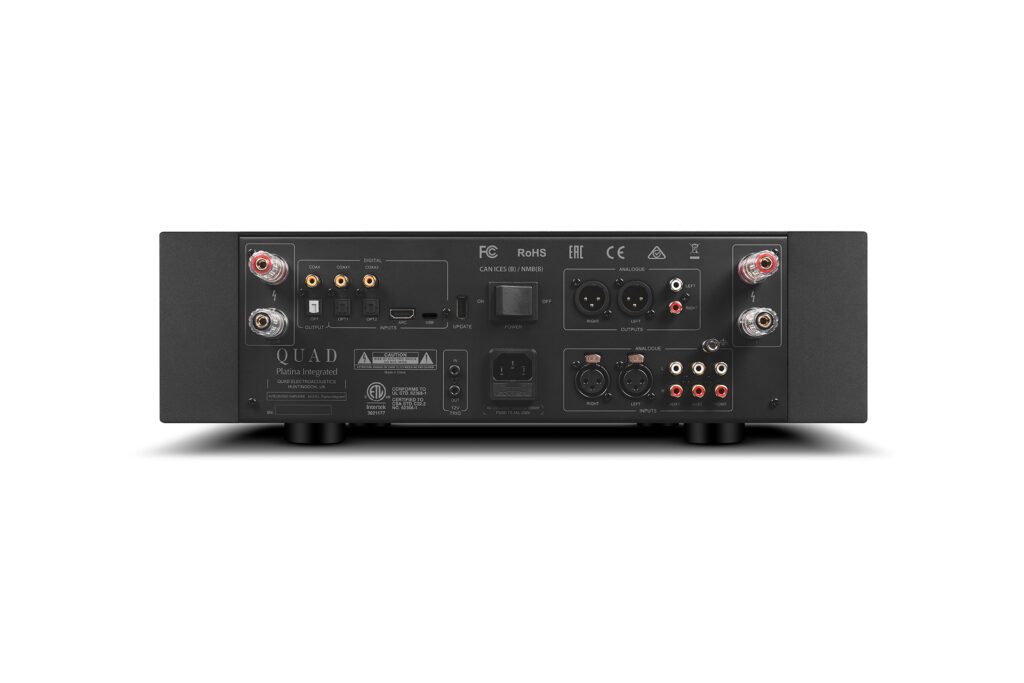
- The set-up options, driven by a thoughtful GUI (Graphic User Interface), allow for a level of fine-tuning in the Quad Platina that is usually only found in advanced separate components. This is one of the highlighted points that I wanted to save room for. Once I started getting deep into the intuitive menu of the Quad Platina, I found I could set a copious amount of the DAC to my choosing. In the Quad Platina’s DAC, the user can adjust the DAC’s filters, up-sampling and phase lock with the digital signals. On the phono side, the user can select the MC/MM options and appropriate gain control for their individual phono cartridge. For the preamplifier, the user can adjust each input’s sensitivity. There are other useful settings, too, that allow the user to use just the preamplifier section, configure the 12-volt triggering, and adjust the display.
- The Quad Platina has both an ARC (HDMI) and USBc input. For those who are looking for it, the Quad Platina allows for seamless PC integration and system control.
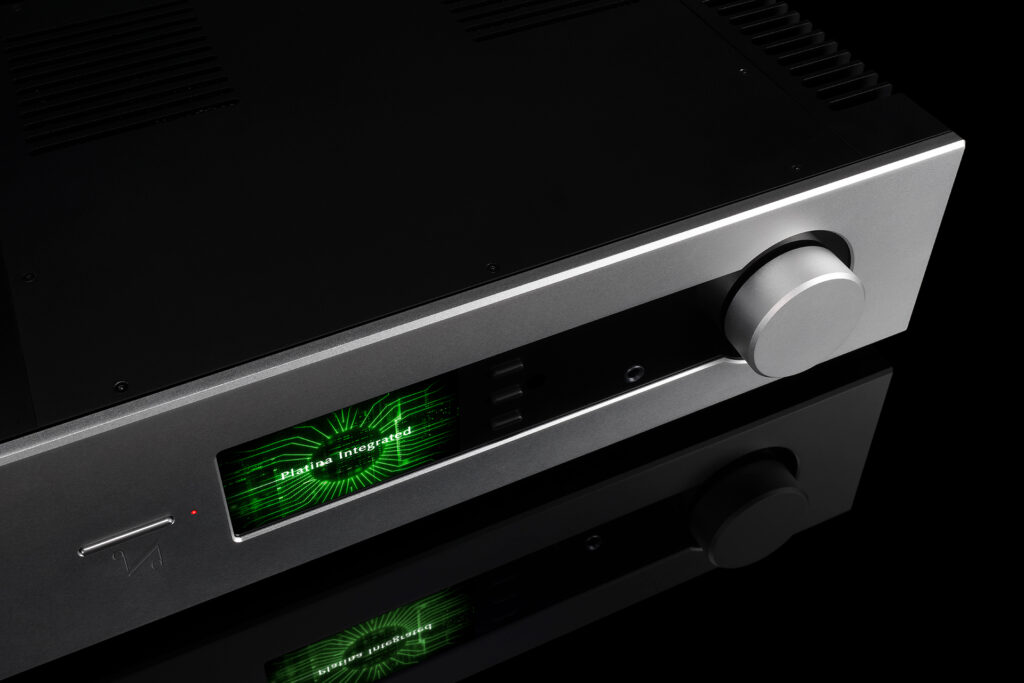
- The Quad Platina feels and looks rich and luxurious. This modern take on a classic high-power chassis, hefty remote, and overbuilt feel make the Quad Platina something to proudly display.
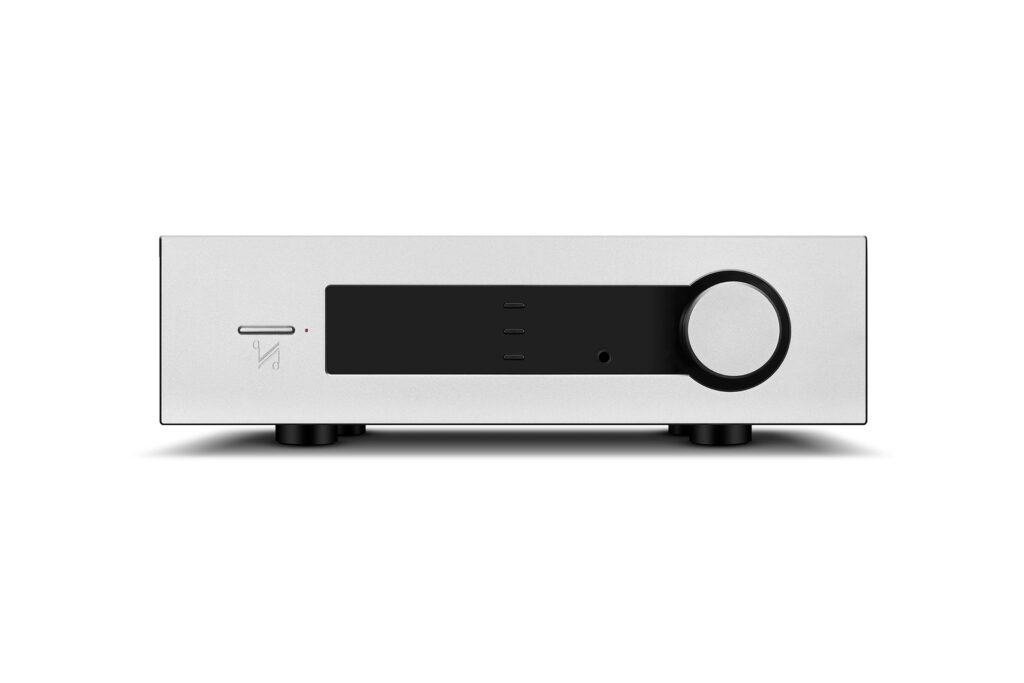
Why Should You Care About the Quad Platina Integrated Amplifier?
There are many great audio companies offering their versions of integrated amplifiers that include as much future-readiness as possible. Most of the time, these integrated amplifier offerings do well, but never quite get to the level of execution of separate components, or what I discovered in the Quad Platina integrated amplifier. From hard-hitting power delivered with grace and poise, to full-featured, onboard DAC and preamplification sections, every aspect of the Quad Platina was seamlessly integrated. The Quad Platina was also made future-ready/upgradeable as Quad sees fit through its programming port, Quad worked directly with Roon to be fully Roon-tested, and it is easy to navigate. So what that the Quad Platina is not cheap at $5,450? It is a well-executed, buy-once piece that can keep its owner happy for a very long time from every aspect of its design and function. That is quite the feat of engineering, Quad. Well done.
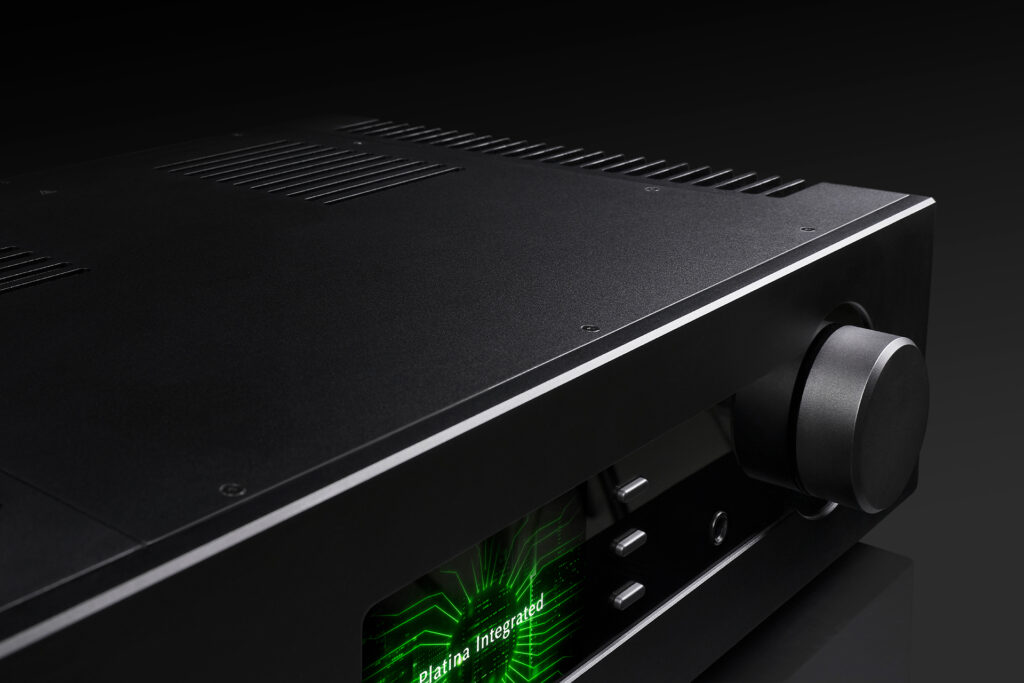
Some Things You Might Not Like About the Quad Platina Integrated Amplifier
- The TFT display isn’t as cool as Quad thinks it is. Most quality units now come with high-resolution, full-color displays. I actually found the one on the Platina to be small and somewhat hard to read from any usable distance in a medium-to-large listening space. The clunky analog meter setting that functions more like a 1980s digital representation of analog meters was distracting. I thought it would be fun but ultimately switched this feature off.
- A second set of balanced outputs and inputs would have rounded off the Quad Platina nicely. A second set of preamplifier outputs would be nice for those of us who may end up using the Quad Platina as a balanced preamplifier, while also needing balanced preamplifier subwoofer outs. This is the configuration I like to use with my PSB Speakers BP12 Subwoofer (read here). It is almost a niche way of running things, but flexibility is always commended, as anyone’s system can grow and change over time. On the input side of things, one balanced input at this level is just outright limiting. I will leave it there.
- The Quad Platina integrated amplifier is not sonically forward-leaning. I think it’s an unspoken dirty thing in the audiophile world to enjoy aggressive-sounding equipment. In the right situation, I enjoy a little extra musical enthusiasm, just not in my listening room. It seems the only acceptable sonic preferences in the audiophile world come down to “true to the music,” which can be simplified as meaning neutral, or warm-sounding. The Quad Platina is a couple of clicks toward the warm side, which makes it a fairly laid-back musical experience. Sometimes a piece that’s laid-back can be perceived as lacking drive. However, the Quad Platina certainly has an abundance of drive, as you will find during the listening session.
Listening to the Quad Platina Integrated Amplifier …
Out of the loudspeakers I tested with the Quad Platina integrated amplifier, I found the Sonus faber Lumina V (read here) to be its soulmate. This amplifier/loudspeaker combination that sat on the edge of a warm sonic signature was just forgiving enough for less than ideal recordings, but blossomed in the room with great ones. If I have not made a certain type’s blood boil yet, I want to note that, because the Quad Platina was part of a highly-resolving, low-distortion system, there was a clear drop in audible background noise when I added my Isotek V5 Elektra (read here) into the mix. At this point, I was excited to get to some serious evaluation, since I has such great system synergy going.
In 2013, my son was welcomed into this world along with the track “Me” by The 1975. This ambient song with random instruments spread through a thick, clouded atmosphere, engulfed my listening space with musical beauty, thanks to the Quad Platina integrated amplifier. While the song airs on the melancholy side, the hazy beauty of self-reflection as Matty Healy’s voice broke through the clouds was perfectly captured on the Platina. What impressed me most with this track on the Quad Platina was the separation of all the complex harmonic ambience, while gently anchoring Healy’s voice in the soundstage. The bottom end of the harmonics remained full, rich, and grounded, whether a piano was gently meandering through the fog, or a saxophone was darting about the soundstage. These sonic qualities exemplified excellent control, tonality, and resolution by the Quad Platina with this track. This was truly a chilling listen.
I do try, really try, to stay out of the clichés when it comes to demo music, but I am an audiophile and cannot help myself at times. Perhaps I was in a certain mood when listening to the Quad Platina integrated amplifier, but the next sad song combo to talk about, and there is a lot to talk about with these two, is Pink Floyd’s “Southampton Dock” that leads into “The Final Cut” off the album The Final Cut. Without delving into the masterful engineering behind Pink Floyd’s music, this 1983 album was way ahead of its time. From the moment the ambient sounds of being near the shore of a ship launch and the first strum of the guitar occurs, the Quad Platina demanded attention. The guitar was harmonically rich, dynamic, and anchored in the soundstage. Roger Waters’ haunting baritone vocals were full and rich, fronting the soundstage without sounding detached or overly aggressive. As “Southampton Dock” led into “The Final Cut,” the beauty of the soft piano, then silence, caused my breath to hitch. As the song developed, the drums were weighty, bass was fortified, and the highs were extended and airy with a smooth, textured midrange. When the song reached its peak of intensity, the laid-back nature of the Quad Platina did have a little more politeness than suits my taste. The Platina’s polite nature was did not detract fully from the music, but it was simply not as dynamic as my tastes enjoy when listing to large-scale tracks. Even so, the sudden emotional halt at the end of this musical journey left me very impressed with the Quad Platina integrated amplifier, and the experience reminded me of a more expensive system made from separate high-performance components.
A slightly more fun coming-of-age song from an album that won the Quboz Album of the Week Award in 2023, the track “Letter To My 13 Year Old Self” from Laufey’s Bewitched is a jazz piano/guitar-backed vocal beauty, anchored with a subtle cello, that shows jazz vocal music is not an outdated concept. In fact, this track came to me via my 18-year-old daughter. Laufey’s voice is honey-smooth throughout this track, and the Quad Platina never missed a beat with any subtle inflection or dynamic change. All the while, the jazz guitar danced with Laufey’s voice, and the piano rounded out the depth in the soundstage. Each instrument was distinct, and never intruded into Laufey’s voice in this midrange-heavy track. “Letters To My 13 Year Old Self” was a truly beautiful musical experience on the Quad Platina and made me feel it would be difficult to recommend separate components that could outperform the Quad Platina at its price point.
Will the Quad Platina Integrated Amplifier Hold Its Value?
The Quad Platina may never go viral as an Internet meme, but I believe this component has the right qualities to go viral (per se) in the audiophile used market. Like many legendary and sought-after used electronics, the Quad Platina is high-quality, does everything well, and carries strong brand-name recognition. There is a solid audience of Quad fans out there, which is a good start. The feature set will help attract more audiophiles to this integrated amp for years to come, so I think resale will be pretty safe for those looking to invest now but with an eye on future upgrades.
What is the Competition for the Quad Platina Integrated Amplifier?
For $5,499, Musical Fidelity offers the extra-beefy M6si500 integrated amplifier (buy at Crutchfield). This monster swings in with 500 quality watts per channel – AT EIGHT OHMS. However, there is no DAC, no phonostage, and no intelligence, just raw power and a low-distortion preamplifier section. This seems to be for those who already have a top-end DAC/streamer and phono stage, and want the power of a separate amplifier/preamplifier in one unit.
A while back, I evaluated the Peachtree Audio GaN1 (read my review) and, if I was picking up what my colleague Mike Prager was putting down, the Lyngdorf TDAI-2210 Streaming Integrated Amplifier (read the review here) for $4,800 uses a similar amplifier topography that keeps all signals in the digital domain until the output stage. It’s digital, but not really Class-D and, from my experience with the Peachtree, it sounds fantastic. While the Quad Platina is more of a traditional integrated amplifier with cutting-edge tech to integrate full custom controls and state-of-the-art digital, the TDAI-2210 IS digital, and provides the benefits of Digital Signal Processing (DSP), such as room correction. This is a different option with added advantages for some, but it will not likely deliver the purity or raw drive of the Quad Platina.
Final Thoughts on the Quad Platina Integrated Amplifier …
I think the trick with integrated amplifiers in today’s audiophile world is to offer the value of the best separate components in a single chassis. This is a difficult feat because, when assembling a top-tier system of separate components, you have the ability to get exactly what you want. So how are manufacturers supposed to hit every audiophile’s individual tastes with power, simplicity, elegance, and future-readiness?
It is clear to me that the Quad Platina integrated amplifier is the correct answer, blazing a path forward with the perfect mix of fidelity and features that builds a hard-to-beat value at $5,450. I began this journey reflecting upon my recent trip around the sun, and thoughts about how the ideal integrated amplifier would seamlessly deliver quality made sense. The Quad Platina is clearly a bang-on integrated amplifier that is high-quality, with a feature set that just makes sense, so much so that I need to thank the patience of the good folks at MoFi Distribution, as I held on to it a little longer than necessary, trying to rationalize a way to get it into my system.



