
 By
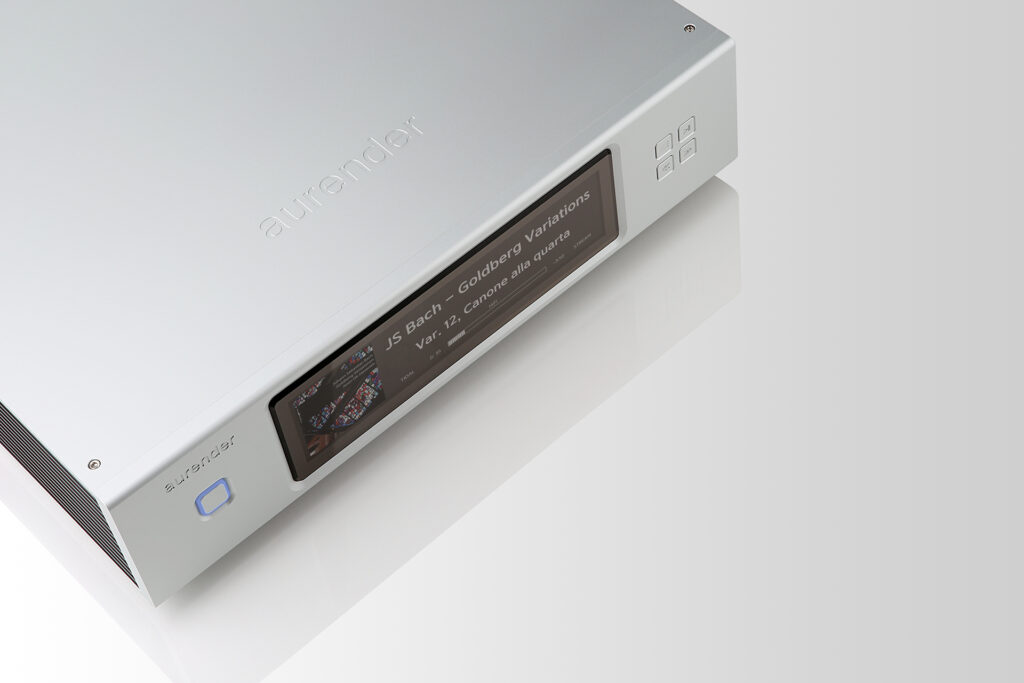
The Aurender N20 is a $16,000 network transport and music server from Aurender, a Korean company that has spent more than 15 years refining one idea: a digital source’s only job is to move a signal from storage or a streaming service to a DAC. while adding as little noise and jitter as possible. The Aurender N20 has no built-in DAC, preamp section, or analog outputs. It is a source component in the purest sense, built to pair with an external DAC, sitting in the middle of Aurender’s lineup, just below the two-chassis NS30SA and their current flagship N50.
I ran the Aurender N20 into my reference system, feeding my Denafrips Terminator Plus 15 DAC (read my review), Gaia 15 DDC, Allnic L-7000 (read my review) preamp and Pass Labs XA30.8(read the review) power amp, with my Marten Parker Trio (read my review) loudspeakers doing the work throughout. Throughout the review timeframe, I ran the Aurender directly into the DAC, bypassing the DDC. I also took my LHY SW-10 switch out of the Ethernet path. In all configurations, the Aurender N20 showed its strengths and filled in many of the gaps the DDC and switch are intended to handle.
What Makes the Aurender N20 Network Transport Special
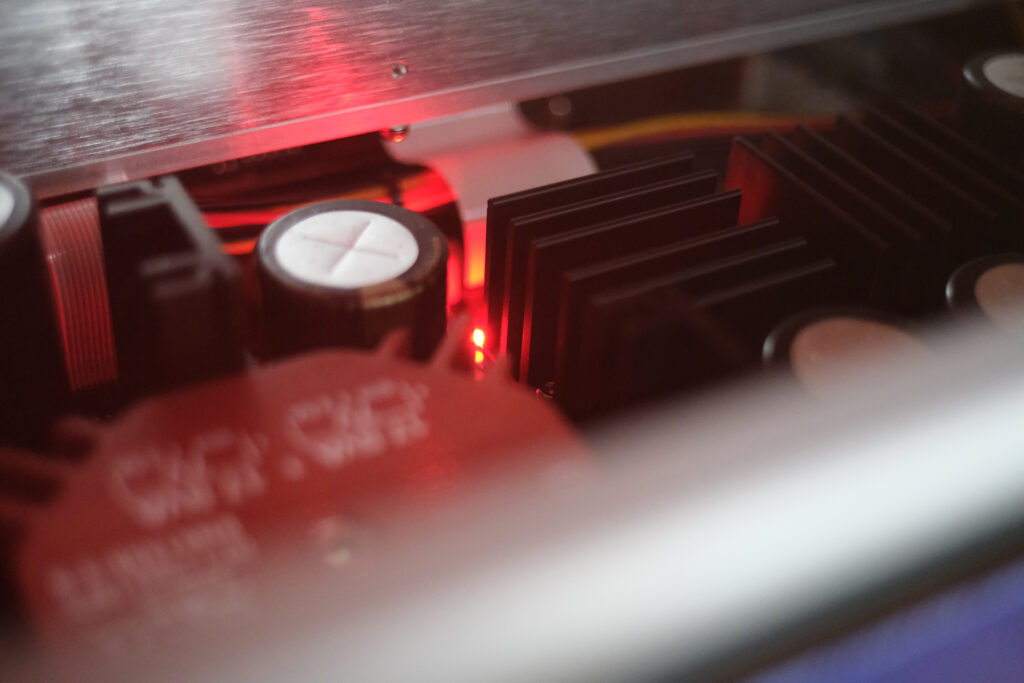
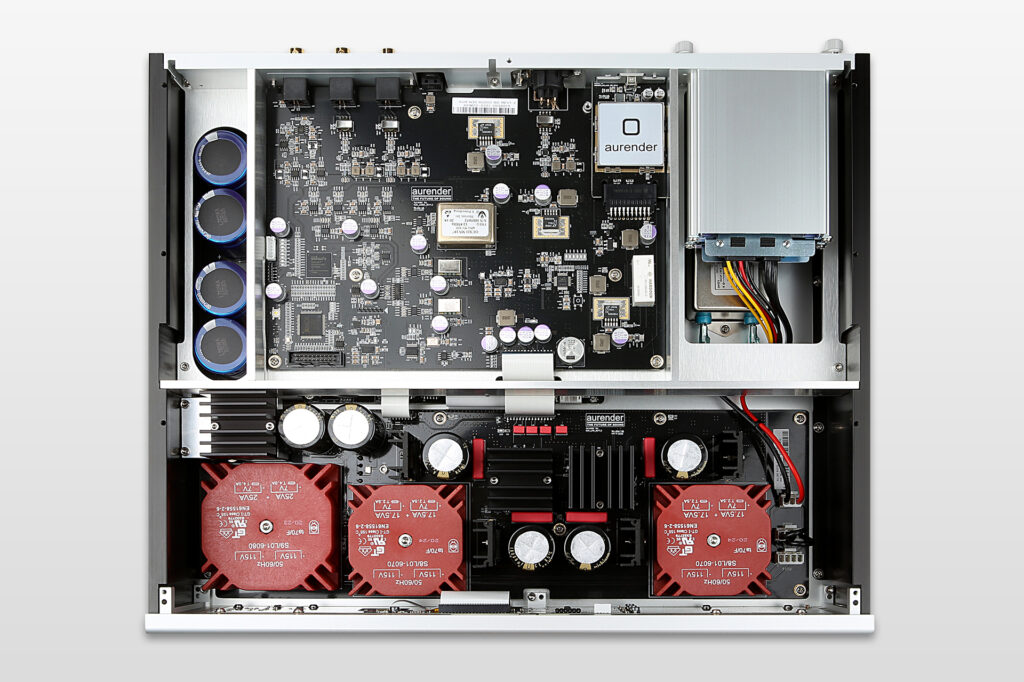
As a dedicated network transport, Aurender’s engineering philosophy for the N20 centers on one word: noise. Better said, it centers on a fanatical engineering approach to eliminate as much noise as possible, the rationale being that noise in an analog signal is something totally different than noise in the digital domain. The impact of noise in a digital signal on sound quality, clarity, and apparent musical timing is real and affects what an audiophile is striving to get closer to: musicality. Aurender gets this. A linear power supply keeps a dedicated pure DC rail for the digital audio output board completely separate from the power feeding the CPU, display, and storage. The SPDIF and AES/EBU outputs are governed by an oven-controlled crystal oscillator, far more stable over time and temperature than the ordinary crystal oscillators in most computers. Every one of those outputs runs through transformer-isolated grounding to keep the noise floor low. Even the Ethernet port is double-isolated, stripping out noise from the router or network before it reaches the audio circuitry. The Aurender is a digital engineer’s dream.
Aurender even chose a lower-power CPU over a faster one for the same reason: more power means more electrical noise, and the company wasn’t willing to trade a quieter signal for a faster chip. It’s a deliberate, almost conservative approach, and it shows up in what you hear.
- A hybrid linear power supply with a dedicated, isolated rail for the digital audio output board, kept separate from the power feeding the CPU, display, and storage.
- An oven-controlled crystal oscillator, governing every SPDIF and AES/EBU output, engineered specifically for low jitter and long-term stability rather than a generic clock borrowed from off-the-shelf computing parts.
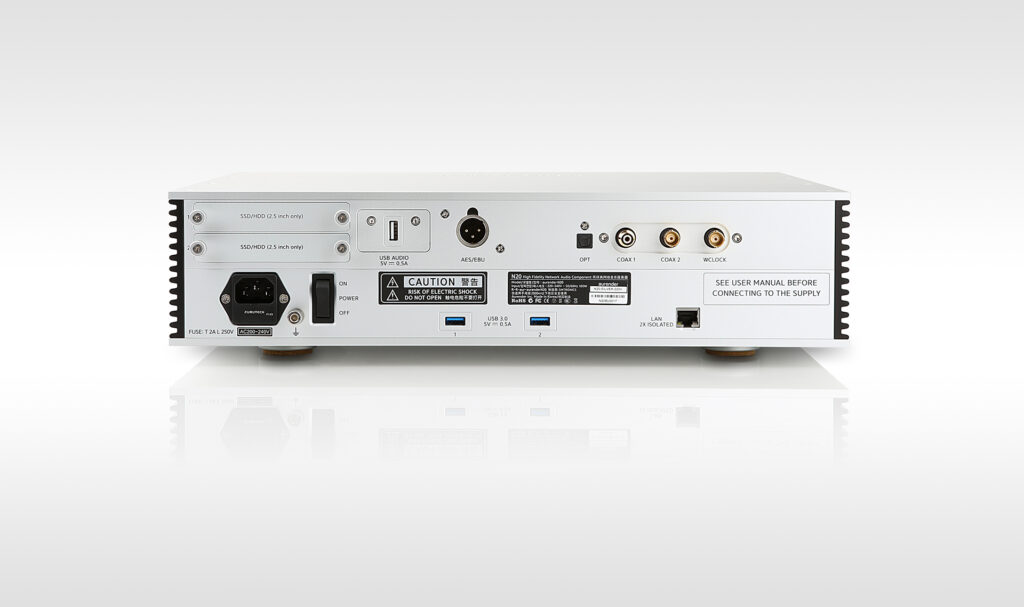
- Aurender uses double-isolated Gigabit Ethernet, employing two layers of transformer isolation to keep router and network noise out of the audio signal path.
- Two user-installable 2.5-inch drive bays supporting up to 16 terabytes of onboard storage, so the N20 can grow with a library, rather than being replaced by one.
- A word clock input that accepts an external master clock, for owners who want to push SPDIF and AES/EBU performance even further down the road.
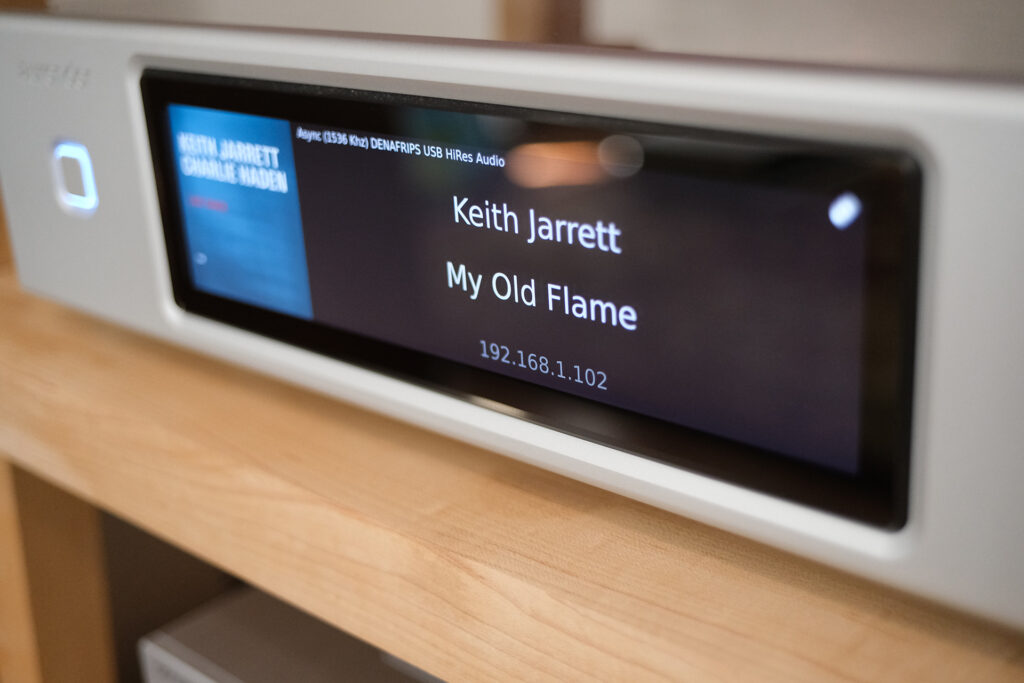
- An 8.8-inch full-color IPS display that is genuinely beautiful to look at, with the option to change brightness levels, including turning the display completely off to eliminate any noise from the display being introduced into the digital signal path.
- An internal supercapacitor-based UPS that safely shuts the unit down during a power interruption, protecting the file system, rather than leaving it vulnerable to corruption.
- A machined aluminum chassis that is internally segmented to keep circuit boards from interfering with one another. This is a flagship product, and it is built like a tank, with the same care and precision under the cover that you can see on the outside. It wears the high price well. Taking the cover off reveals an almost artistic presence of precision, no compromise, and beauty.
Why You Should Care About the Aurender N20 Network Transport
Who is the Aurender N20 actually for? Anyone building a serious audiophile system around an external DAC, preamp and power/integrated amp, who wants a source component that gets out of the way, rather than adding its own signature. Because the Aurender N20 has no volume control or analog output, it needs a DAC and a preamp/volume. That’s not a limitation so much as a statement of what a purpose-built transport is all about. It’s also worth being honest about who this isn’t for. If you want a single-box solution, like the Cary Audio DMS-800PV (read my review), this isn’t your streamer. But for anyone with a resolving DAC, or willing to invest in one, the N20 is built to reward that investment rather than become the weak link in the chain.
Some Things You Might Not Like About the Aurender N20 Network Transport
- Set-up is not the plug-and-play experience you get from more modern, turn-key platforms like my Matrix unit. Some of that gap is simply the price of the N20 offering far more configuration options, yet be prepared to spend time getting things personalized. Some things the Matrix discovers on its own required me to find the set-up option to manually change the setting. Big deal? Not really as, once set, the streamer is stable, intuitive, and trouble-free.
- There is no hardware remote in the box. Volume and playback control run entirely through the Conductor app, or through your DAC’s own remote if it has one. The app allows for volume control but not the physical hardware.
- The Aurender N20 is physically large, tall, wide, and deep. I had to find a dedicated spot on my rack and then left it alone.
- The Aurender N20 is heavy and not easy to move around to access the rear of the unit. While reviewing the Aurender, this was impacting me, as I was constantly behind the unit plugging and unplugging cables yet, in normal use, this won’t be an issue.
Listening to the Aurender N20 Network Transport
This is where the N20 separates itself from everything else that has passed through my listening room. It is very quiet, with a genuinely low noise floor. What this quiet allows is musicality, body, and bass energy that is far better than I expected without ever tipping into exaggeration. Imaging is precise, and both soundstaging and image depth are excellent. More than any single attribute, the improvement I heard over anything I have had in my listening room came down to musicality, body, and analog-like rendering of the music. I could not get enough of it. The high end was smooth yet detailed, with a rare see-through clarity that let me hear deeper into recordings without the sound ever turning etched or hard. I found myself getting wrapped up in the music itself, in the musicians, in the messaging of the songs, and in the emotion of the recordings, rather than sitting back and analyzing the streamer.
I leveraged several sources for music comparisons, including my external USB-attached eight-terabyte hard drive filled, with a lot of higher-def PCM and DSD music files, Qobuz for streaming, and an external Audiolab CD player, all with outstanding results. I would say that the USB-attached local music provided the most jaw-dropping sessions, pointing to a well-engineered and low noise USB circuit.
On Silk Sonic’s “Leave the Door Open,” from the group’s An Evening with Silk Sonic (buy at Amazon), a warm, live-band retro-soul production, the N20’s quiet noise floor let that vintage warmth come through undiluted rather than smeared with digital haze. I listened to this both on CD and Qobuz, and both provided excellence. On a separate note, something that showed up in the majority of my listening sessions was how good high-def streaming is through the Aurender, demonstrating the power of both modern streaming platforms like Qobuz and quality players like the Aurender.
The bass and kick locked together with real weight but stayed controlled, never bloated, and the falsetto vocal harmonies separated cleanly from the horn stabs instead of collapsing into a single wash. The N20 pulled the whole performance closer, putting me right up next to the band rather than in front of a speaker playing a recording.
Laufey’s “From the Start,” from her Bewitched (buy at Amazon) album, is an intimate, largely acoustic arrangement built around her voice, upright bass, and strings, and it is where the N20’s imaging precision and see-through top end really showed off.
Her vocals had real body and breath rather than sounding thin, with the string section resolved as distinct instruments sitting behind her, rather than one soft-focus blur or a flat plane of music. The N20 closed the distance between us until it felt less like streaming a track and more like she was singing just for me.
Jacob Collier’s arrangements stack vocal harmonies and layered instrumentation aggressively, and “He Won’t Hold You,” featuring Rapsody, from Djesse Vol. 3 (buy at Amazon), is a genuine stress test for separation and detail retrieval. For this song, I was able to compare Qobuz, the CD, and the local PCM version. Again, all three were amazing, with the slight nod going to the local 192/24 version, followed by the Qobuz stream.
The N20’s low noise floor kept each harmony line distinct, even as the arrangement thickened and got busier, with Rapsody’s verse entering cleanly against the mix, rather than muddying it. The N20 made a dense arrangement feel inviting instead of exhausting, drawing me further into the song rather than holding me at arm’s length.
boygenius’s “Cool About It,” from the eponymous record (buy at Amazon), pairs interlocking acoustic guitars with three-part harmony vocals recorded close and dry, and it turned into a showcase for midrange delicacy.
Each guitar occupied its own space in the image, and the three voices were distinguishable as individual singers, rather than a single blended chorus, which is exactly the kind of texture the N20’s quiet background is supposed to reveal. The N20 put me in the room with the three of them, close enough to hear the breath before each vocal line. I forgot about the gear and enjoyed the music.
Gregory Alan Isakov’s orchestral reimagining of “The Stable Song” with the Colorado Symphony, from the Gregory Alan Isakov with the Colorado Symphony (buy at Amazon) album, moves from a spare acoustic-guitar-and-voice opening into a full symphonic swell, and it is a good dynamic range and depth-of-field test.
The N20 kept Isakov’s voice and guitar forward and intimate early on, then opened up believably as the orchestra layered in behind him, with real front-to-back depth, rather than having everything arrive from the same distance. The N20 made that swell from a single guitar and voice into a full orchestra feel like something happening to me, not just something I was hearing on a recording. I have not experienced this song like this before.
Robert Glasper Trio’s “In Case You Forgot,” recorded live at Capitol Studios for the album Covered (buy at Amazon), has wide dynamic swings and detailed brushwork and percussion.
The N20 placed piano, bass, and drums precisely across the stage, with the piano’s decay trailing off naturally into the room sound of the studio, rather than being cut short, a good indicator of low-jitter clocking translating into natural note decay. The N20 put me in that room at Capitol Studios, close enough to feel the trio listening to one another as they played.
Melody Gardot’s “Baby I’m a Fool,” from My One and Only Thrill (buy at Amazon), is a well-known reference recording for a reason: an intimate jazz vocal set against strings, demanding real vocal body and tonal density.
Gardot’s voice had genuine weight and breath support, rather than sounding papery, against a black, quiet background that let the string arrangement’s decay trail off naturally. The N20 made it feel like Gardot was singing directly to me, rather than through a wall of production, and that closeness is what made the song land.
Ambrose Akinmusire’s “Rollcall for Those Absent,” from The Imagined Savior Is Far Easier to Paint (buy at Amazon), closes out my listening notes on modern jazz trumpet with wide dynamic swings and a spare, spacious arrangement, carrying real emotional weight.
The N20 captured the trumpet’s tonal bloom and breath noise without ever turning hard or brittle at the top, with the wide dynamic range, from near-silence to full cry, rendered without compression, which is exactly where a lesser source usually gives itself away. The N20 made the silences between phrases as gripping as the notes themselves, and that is what pulled me deepest into the emotion of the piece.
Will the Aurender N20 Network Transport Hold Its Value?
I went into this review wondering whether the long life of a computer-based streaming platform is a strength or a concern, and the honest answer is a little of both. On the strength side, Aurender has stayed at the top of this category for more than 10 years without losing ground to newer entrants, and it keeps shipping software updates that reach even discontinued models years after they leave the price list. It feels to me like a philosophy of getting the hardware perfect and evolving the software to enhance the feature set and performance, more evolutionary than revolutionary. The N10, released in 2015 at $8,000 and discontinued in 2021, is still actively bought and sold used today, holding a meaningful fraction of its original price a decade on. Current used N20 units fetch a strong percentage of retail as well, unusual for anything built around a CPU and a solid-state drive. Aurender’s engineering choices reinforce this: a deliberately low-power CPU, linear power supplies instead of switching ones, and user-swappable storage rather than soldered proprietary parts. All of this points toward a component built to be lived with for years, not treated as disposable technology.
The Aurender N20 has better long-term prospects than almost anything else in the streaming category, but it isn’t immune to the category’s inherent risks, and buyers should go in with that realistic picture. The digital music platform category is evolving quickly and unlike, say, and amplifier or turntable that can stay the course for years, the digital space has a shorter life. This can impact resale values.
What is the Competition for the Aurender N20 Network Transport?
Dedicated network transports at the top of the market are a small category, so the most useful comparisons bracket the N20’s $16,000 price against Aurender’s own flagship and a handful of genuine external rivals.
Aurender’s own N30SA, at $32,000, is the natural upgrade path within the family. It separates the power supply and digital clock into its own chassis rather than sharing one with the digital side, and Aurender describes the improvement as the final 10 to 20 percent of resolution and background silence – a serious step up in cost and performance, not a value alternative. It also includes eight terabytes of internal SDD which, at current rates of about $1,500, is a nice touch.
The Grimm Audio MU1, at around $14,800, is a Dutch-built rival that doubles as a Roon Core and endpoint in one chassis. It’s built around Grimm’s own ultra-low-jitter clock and has a devoted following for its natural, holographic imaging.
The Innuos Statement, starting around $13,750, depending on storage configuration, is priced a step below the N20 and takes a similar two-chassis approach to isolating the power supply from the audio circuitry. It has a strong reputation for realism and soundstage scale, though Aurender’s Conductor app and ecosystem are generally considered more polished and easier to live with day to day.
The Antipodes K50, at $17,500, is the closest direct price match to the N20, and a step-up alternative from the Australian-based Antipodes, known for a full-bodied, richly saturated house sound and a modular approach that lets owners add reclocking and other upgrades over time. It asks more of the owner in terms of configuration, but it is a legitimate consideration for anyone chasing the last increment of resolution.
The Matrix Audio NT-1, at $3,999, roughly a quarter of the N20’s price, highlights the latest tech and approach against a proven impeccably engineered product. Side by side, the NT-1 is an extraordinary value: dead quiet, dynamic, its operating system essentially flawless, with no edge or hardness anywhere in its presentation. It shines in nearly every category I could name and captures a real slice of what draws people to Aurender’s sound in the first place. But the N20 does something sneaky good with the rest of that price gap. Where it pulls ahead isn’t in the categories most streamers get judged on, it’s in what audiophiles actually chase: the bass foundation the music stands on, the holistic sense of musicians occupying real space, and impact that feels physically real rather than reproduced. And then there’s the thing I can’t fully measure or explain, call it soul, and the N20 has it in spades. That’s what the remaining $12,000 buys and, after living with both, it will be for many worth every penny.
Final Thoughts on the Aurender N20 Network Transport …
The Aurender N20 is a $16,000 network transport that does exactly what I want a component at this price to do: it gets out of the way, doesn’t call attention to itself, and lets everything downstream sound like a better version of itself. In my system, it added dimension, body, depth, and musicality. After working through the set-up, I found the Conductor app basic yet solid. The N20 delivered the quietest, most musical, analog-like digital playback I’ve had in my listening room, with real body, well-controlled bass energy, imaging and soundstaging that consistently impressed me across a lot of different genres of music.
What ultimately impressed me most was how completely I stopped thinking about the equipment and started thinking about the music, the musicians, and the emotion in the recordings themselves. That is the highest compliment I can give a digital source and really any piece of gear. If you already have, or are willing to invest in, a DAC and preamp capable of showing what the N20 can do, it is an easy recommendation and a component built to be lived with for a long time to come. I know this because the check has been written and I plan to live with the Aurender N20, which is no small feat but one hell of an endorsement.



