
 By Frank Picarello
 I have gone all-in on digital music as my preferred audiophile source these days. This includes both streaming from Qobuz and access to over five terabytes of local USB-attached high-definition music. I listen to music files that are both PCM and DSD. In the last five years, the increase in digital music products, high-definition music, and significant improvements in the quality of the gear has kept a smile on my face. I remain convinced that the improvements in sound quality and access to more quality digital music will put digital music front and center in more serious audiophile systems.
I’m amazed at the quality of the digital music streamers that entry-level budgets can buy in the modern era. This is a very exciting time, driven by an increased level of research and development around digital technology, as well as more music sources adding lossless and generally higher-definition music to their streaming services.
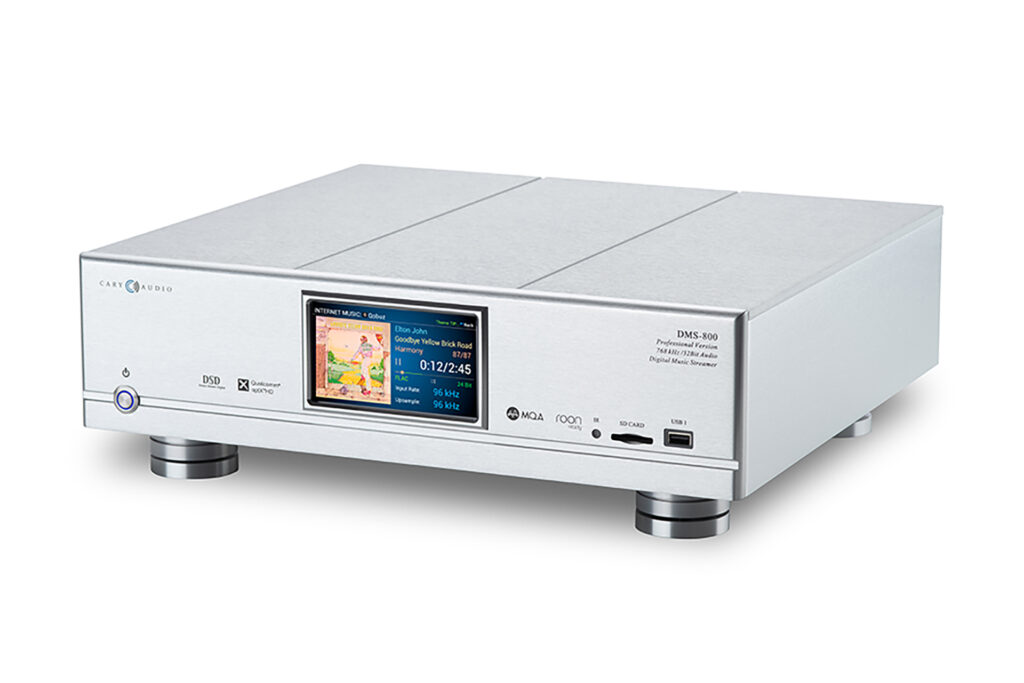
This review is of Cary Audio’s DMS-800PV all-in-one digital music player/streamer/DAC. Cary Audio is a U.S.-based high-end audio manufacturer originally known for vacuum tube amps/pre-amps, and now also digital music systems. Cary Audio has a reputation for producing musical gear with classic tube warmth and musicality with modern engineering and high-quality manufacturing. Founded in 1989 in North Carolina by Dennis Had, one of the designer legends in the industry (but not the designer on this digital audio component), Cary Audio has recently doubled down on digital music products. Specifically, they have a family of products referred to as DMS – Digital Music Servers – that have evolved over the years, becoming a complete audiophile digital music platform.
The DMS line from Cary Audio represents the company’s evolution into modern digital streaming, improving across clear product family generations since the mid-2010s, moving from early network players to a full tiered ecosystem of high-end streaming DACs. The current products utilize AKM DAC chips. AKM or AsahiKASEI Microdevices is an Asian manufacturer of specialty sensors and chips. The AKM DACs are delta-sigma chips that are known for a very musical and analog type of sound. AKM refers to this as Velvet Sound, designed to provide a rich, detailed, and analog-like listening experience. It emphasizes silky smooth sound with a very low noise floor. As with most audio engineering, the devil is in the details, and it’s the execution of the power supply and connected analog circuits that define the quality of the product. Cary Audio has expertise in both areas and leverages their experience exceptionally well in the DMS product family. The DMS platform combines a DAC, streamer, and a volume control, defining a digital music source that can plug into a power amplifier and speakers as a complete system.
What Makes the Cary Audio DMS-800PV Network Streamer DAC Special?
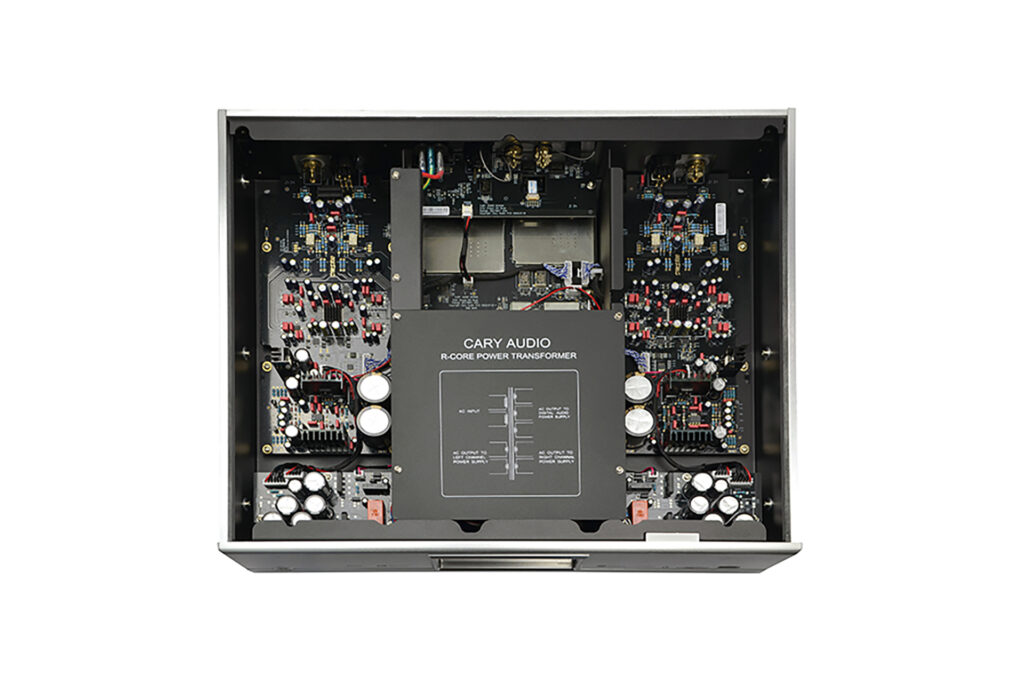
- The Cary Audio DMS-800PV is a fully-balanced dual-mono design with completely independent left and right channels. This level of channel separation is rare even at this price point and contributes directly to the expansive, stable soundstage that becomes immediately apparent during critical listening. Having previously owned the Cary Audio DMS-700, the improvement to the DMS-800PV is clearly sonically noticeable. While the wonderfully musical Cary vibe remains, the improvement in focus, staging, and body is front and center. While the Cary Audio DMS-700 is a strong performer and a solid player for the price, the DMS-800PV is an audiophile-level product with refinement in sound that’s worthy of the price point.
- Eight DAC channels driven by dual AKM 4499 chips provide exceptional resolution while maintaining a natural, unforced presentation. While getting a little long in the tooth, The AKM 4499 remains among the most highly regarded DAC chips in the industry, known for its combination of low noise and musical naturalness. Cary’s implementation favors musicality over clinical precision, which is very much to the liking of this reviewer and makes a meaningful difference in long listening sessions.
- 14 independent regulated power supplies isolate digital and analog circuits, reducing noise and improving overall coherence. That level of power supply engineering is typically reserved for components costing significantly more and reflects Cary’s belief that the power supply matters.
- Full support for DSD512 and DXD ensures compatibility with the higher-resolution digital formats currently available.
- Integrated network streaming eliminates the need for an external streamer, simplifying system design while improving synergy.
- Roon Ready certification allows seamless integration into modern streaming ecosystems.
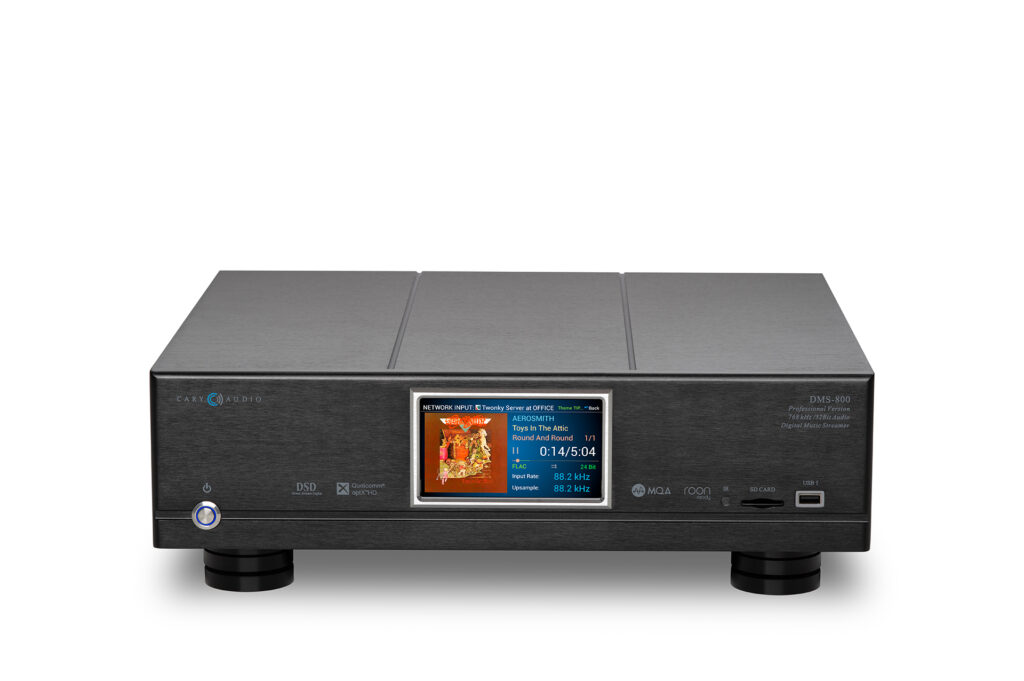
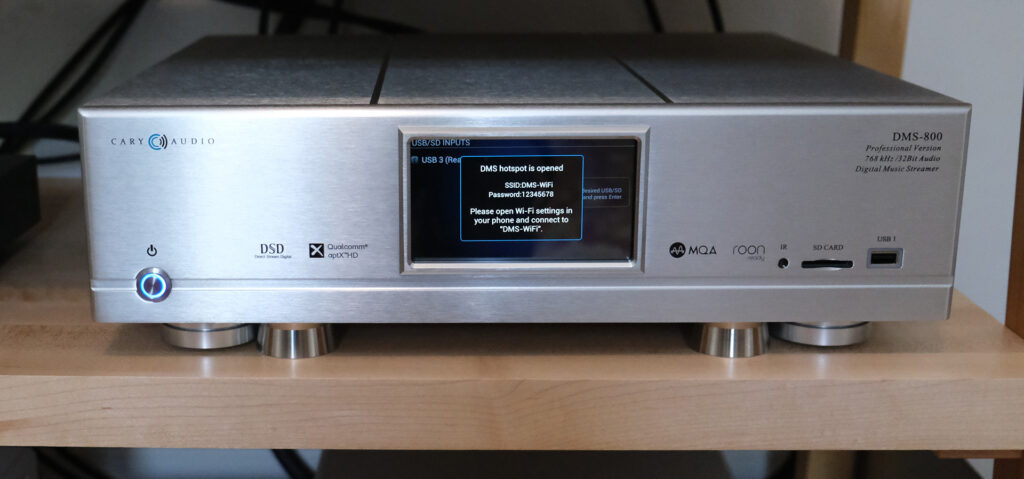
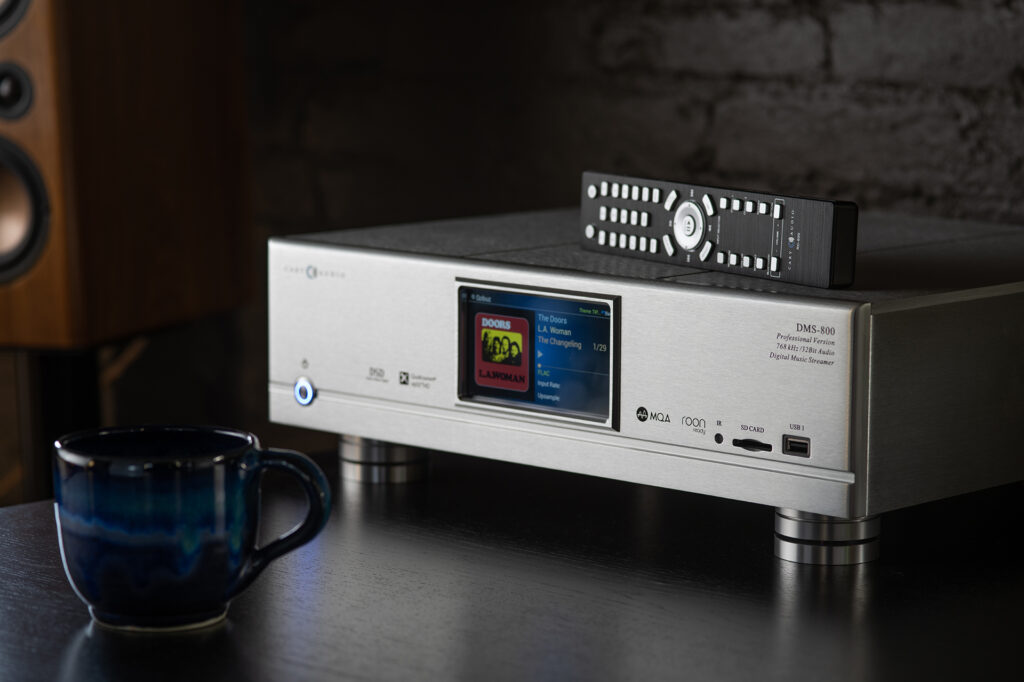
- Build quality is substantial and purposeful, with a chassis that reflects its flagship status. Fit and finish convey confidence without crossing into ostentation. At first, it looks almost too plain, yet you quickly realize this is a purpose-built design. The screen is front and center and clear, the remote works perfectly, and all the input and output connections are where they need to be. The fit and finish is high quality.
Cary Audio DMS-800PV Network Streamer DAC Specifications
| DAC Chips | Two AKM AK4499EQ (fully balanced) |
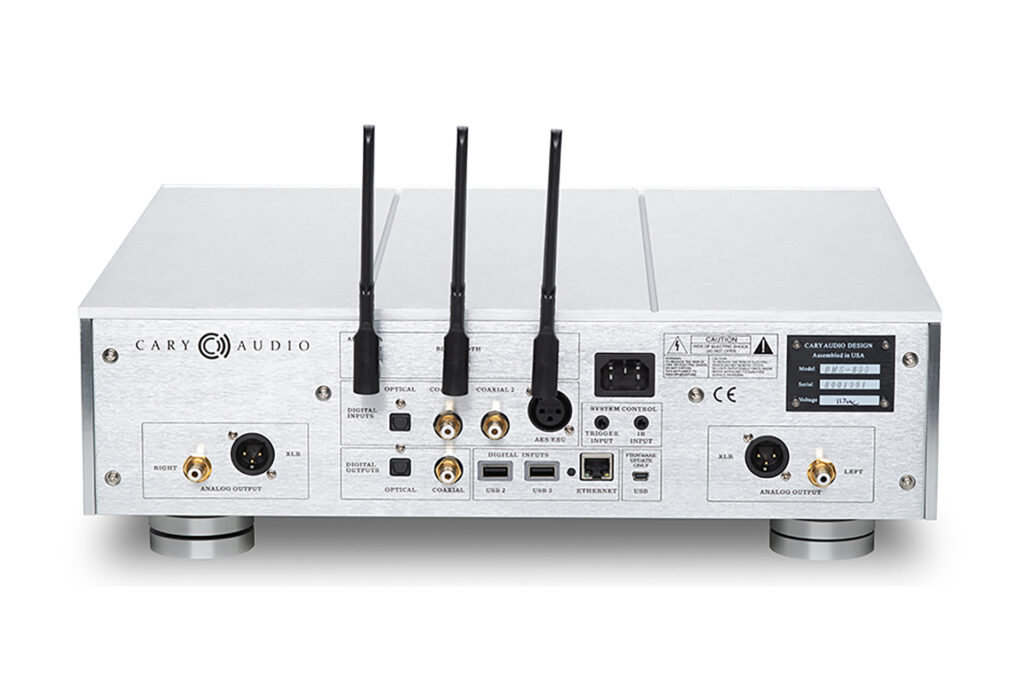
| Digital Inputs | Three USB, AES/EBU, two coaxial, optical, SD card, Bluetooth (aptX HD) |
| Analog Outputs | Balanced XLR and RCA |
| Digital Outputs | Coaxial and optical |
| Sample Rates | 44.1 kHz to 768 kHz PCM; DSD64 to DSD512 |
| Streaming | Spotify Connect, Tidal Connect, Qobuz Connect, AirPlay, vTuner; Roon Ready |
| Output Level | 2 to 3 volts RMS (RCA) |
| Dimensions (W x H x D) | 17.3 x 4.3 x 16.3 inches |
| Weight | 39.5 pounds |
Why Should You Care About the Cary Audio DMS-800PV Network Streamer DAC?
The Cary Audio DMS-800PV is built for serious listeners who already have high-quality amplification and speakers, and need a digital source that can match that level of performance. It is designed for users who want to get the most out of digital music, yet don’t want to compromise on the desire to retain analog-like musicality.
Anyone who still believes digital music is not analog-like or has a hard time listening to digital music should listen to the DMS-800PV. Cary Audio has done a fantastic job in making this player have body and soul, yet not compromising the digital-domain primary attributes of details, dynamics, and clarity.
The Cary Audio DMS-800PV delivers the convenience of modern streaming without the compromises that have historically defined digital audio. For those looking to simplify their system without sacrificing performance, this single-box solution makes a compelling case and removes one of the most frustrating variables in digital system-building: the interface between streamer and DAC. With fewer boxes, fewer cables, and a fully optimized signal path, the case for an integrated solution has never been stronger than it is at this price point.
While the price might seem high and arguably is in contrast to other good but far less expensive options, when you consider that, if you are only using this digital source as the streamer and DAC, the Cary DMS platform potentially eliminates the need to purchase a stereo preamp. Just because an audiophile product is expensive doesn’t mean that it isn’t also, in many ways, a value.
Some Things You Might Not Like About the Cary Audio DMS-800PV Network Streamer DAC
- The chassis is large and deep, which may present challenges for rack placement and cable management. Measure your rack carefully before ordering as a simple precaution.
- The Cary Audio DMS-800PV Network Streamer is heavy. The use of a complex and complete power supply configuration in the DMS-800PV, along with a very solid housing, shows up. The Cary Audio DMS-800PV tips the scale at 40 pounds, making it feel more like a power amp.
- There is no internal SSD storage option, requiring external USB and local network solutions for local music libraries. More manufacturers are providing options for internal SSD (solid state drive) storage, which is not only quieter; it eliminates the need for an external cable and should also sound better. With that said, adding SSD drives is a very low-cost option at this stage. It does, however, add complexity to the system, which is a bummer. A one-terabyte internal drive would be a nice addition that would make the component more useful without running the cost up too much.
- While functional, the control app could benefit from additional refinement and expanded features. Roon users will not feel this limitation, but those relying solely on the native app may find it a step behind some competitors. It’s simple and works, yet if you have a lot of music, it’s not as efficient as the newer applications.
- The DMS-800PV allows for both wireless and wired access to streaming services. In my case, I used the Cary wired, yet for some, the option for wireless is a plus.
Listening to the Cary Audio DMS-800PV Network Streamer DAC
I evaluated the DMS-800PV in a dedicated listening room driven by either a pair of Psvane T-845 reference-grade tube monoblocks with matching two chassis T-417 tube preamp or a Pass Labs XA 30.8 amp (read the review) and an Allnic L-7000 preamp. Both setups drove a pair of Marten Parker Trio loudspeakers (read the review). The source material was either streamed using Qobuz or a local USB-attached hard drive with both PCM and DSD music. I ran the Cary Audio DMS-800PV fully balanced with the Pass Labs/Allnic set-up or using RCA cables with the Psvane amplification.
For all the songs listed below, I switched back and forth from Qobuz for streaming and a local copy of the exact music that I had on my hard drive. I also switched between my two configurations of the Psvane amp/preamp and the Pass Labs and Allnic setup. This allowed me to compare a single-ended tube front end with a balanced solid-state amp/tube preamp setup. Additionally, I switched between using the Cary in fully balanced and non-balanced modes. In all cases, the local USB sourced music sounded better, and using the Cary balanced with the Pass Labs solid state Class-A amp worked the best, providing more detail and dynamics without any loss in musicality.
I began listening with “Father and Son” from Cat Stevens’ Tea for the Tillerman (buy at Amazon). The opening finger-picked acoustic guitar immediately revealed the strengths of the DMS-800PV. Each string had distinct texture and body, with the natural resonance of the guitar’s wooden body coming through with a physicality that most digital sources simply thin out. Midrange clarity and vocal presence were immediate and unmistakable – Stevens’ voice occupied a specific stable position in the room, neither pushed forward artificially nor recessed behind the mix. The guitar carried not just detail, but body and harmonic weight – something many digital sources struggle to reproduce convincingly. The ability of the DMS-800PV to layer the sound, convey the warmth and body of the instruments, and render a proper soundstage was exceptional.
Moving to Joni Mitchell’s Blue (buy at Amazon), the presentation became even more compelling. On “A Case of You,” Mitchell’s voice conveyed a subtle attack and decay rendered with a precision and clarity that balanced detail and human warmth as good as I’ve heard. The instruments sounded like real instruments. Mitchell’s vocal pitch shifts and breath control were preserved with a level of intimacy that is genuinely rare in digital playback. Was I listening to the original LP pressing on a really nice turntable? All the subtle inflections and micro-dynamic shifts – the slight catch in her throat, the way her vibrato develops mid-phrase – were present and accounted for. The DMS-800PV excels at resolving fine detail without drawing attention to itself, allowing the listener to remain focused on the music rather than the underlying technology. Mitchell’s Blue is one of those albums that exposes every weakness in a playback chain, and the Cary passed that test with confidence. On the song “River,” the piano’s sustained sound was rendered with exceptional length and natural decay, and the space around Mitchell’s voice felt like a real acoustic environment. Nothing about the playback felt constructed or processed. This is not an exceptionally-recorded album, yet I found myself listening to the music and not the limitations.
I then turned to “A Long December” from the album Recovering the Satellites by Counting Crows (buy at Amazon) on the album. The production on this track layers piano, guitars, strings, and Adam Duritz’s densely stacked vocals into a rich, borderline orchestral texture. The Cary Audio DMS-800PV handled the layered production with ease, maintaining separation and composure even when I cranked up the volume. Each instrument retained its own identity within the mix – the piano’s countermelody sat distinctly behind Duritz’s lead vocal, the strings were there, yet not overly exaggerated or blurring the midrange, and the low-end foundation of the kick drum remained controlled and tuneful. This is another less-than-perfect recording, with somewhat compressed dynamics, yet the Cary gets the most out of it and leads with highlighting the emotion and musicality of the track.
“Peg” from Steely Dan’s audiophile classic Aja (buy at Amazon), is a great song and a good recording. Aja was recorded at the Village Recorder Studio in Los Angeles (learn more here) and is still widely considered one of the best-sounding albums in pop history. Through the Cary Audio DMS-800PV, the horn section had proper weight and bite without becoming harsh, Michael McDonald’s backing vocals were layered with convincing depth, and the bass guitar locked in with the kick drum in a way that communicated groove rather than just frequency. The Cary streamer brought a rhythmic coherence to this song that allowed me to engage with the music and forget the gear. Finally, a shift away from the technology and a step closer to the music. One of the most telling strengths of the Cary Audio DMS-800PV is how complete the sound remains when played quietly. Detail, dynamics, and engagement are preserved without the need to increase volume. While not discussed much, this attribute matters and, as as I am learning, a hallmark of exceptional gear.
Will the Cary Audio DMS-800PV Network Streamer DAC Hold Its Value?
Cary Audio has been a fixture in the high-end audio world for decades, and that institutional reputation contributes directly to resale value. Cary Audio stands behind their products, provides superb post-sales support, and builds long-lasting products. I met the team at Cary Audio and, to a person, they are smart, care, and audiophiles at heart. Cary Audio has a strong track record of supporting its products long after purchase, which the used market rewards.
Products that combine performance, brand recognition, and long-term support tend to perform best on the secondary market, and the Cary Audio DMS-800PV fits that profile. While no audio component is immune to depreciation, this is likely to remain a desirable product for years to come. As streaming hardware is improving faster than other categories, it will in general depreciate faster than amplifiers or speakers, so keep that in mind.
What is the Competition for the Cary Audio DMS-800PV Network Streamer DAC?
The Cary Audio DMS-800PV operates in a highly competitive market segment, facing strong alternatives. One way to look at this is competition from similar all-in-one platforms with DAC, streamer, preamp and also separates providing the same functionally in discrete products. Additionally, underlying DAC differences in chip vs R2R are alternatives for comparison. The different approaches are meaningful. As an example, while the benefits of a single chassis product have their pre-engineered benefits, the option to just upgrade the DAC or streamer goes away. I have found that R2R DACs have a specific sound and, as quality R2R DACs are showing up at lower price points, that option from a competitive position to the Cary DMS-800PV should be considered.
The Holo Audio May and Denafrips Venus 15th DACs, combined with the Matric Audio NT-1 $8,000 to $10,000, depending on the DAC, are viable alternatives to the Cary in terms of sound quality, flexibility, and user interface. Other manufacturer options taking this approach exist from companies including Schiit Audio, Topping, Matrix Audio, Topping, Gustard, Audio-GD, LAIV, etc.
The Aurender A15 integrates a music server alongside its DAC and streaming capabilities using dual mono AKM AK4490 chips. The Aurender also offers balanced and unbalanced outputs, USB output for an external DAC, large display and high-quality volume control. Retail price is $9,250. Unlike the Cary, the Aurender has internal storage bays for two 2.5 inches of storage.
A much lower-cost option is the Lumin T3 that, at $4,990 retail, offers a complete platform alternative to the Cary Audio streamer. The Lumin uses two ESS Sabre ES9028PRO DAC chips, is Roon Ready, has a solid CNC machined chassis, and uses the proven Lumin music management application.
Final Thoughts on the Cary Audio DMS-800PV Network Streamer DAC
The Cary Audio DMS-800PV represents a significant achievement in digital audio design in the audiophile world. It combines reference-level performance with real-world usability, delivering a listening experience that is both technically impressive and emotionally engaging. The asking price is serious, but so is the component level, build quality, attention to low noise, and musicality.
What sets the Cary Audio DMS-800PV apart is not just its lineage and build quality, but also its ability to connect the listener to the music. It avoids the sterile, analytical tendencies that can plague high-end digital components, instead presenting recordings with a sense of realism and coherence that invites long-term listening. Song after song, the urge to stop analyzing and simply enjoy what was playing was the most consistent experience the Cary Audio DMS-800PV delivered – and for a component at this price, that is exactly the right result.




Nice review Frank!
I enjoyed reading it!
Paul
I enjoyed reading the review of the Cary DMS 800PV. I think Mr Picarello does an outstanding job highlighting the attributes of this product. As an owner of a Cary DMS 800PV, I would perhaps add more superlatives, as I love this dac/streamer.
Mr Picarello is an outstanding reviewer and an asset not just to Future Audiophile, but to the audiophile community at large.
Thank you for a great review of a fantastic product!
Thanks for your kind words!!!
Steven, thank you so much for your thoughtful comments. Totally agree. Cary has done a fantastic job at creating a well designed and built wonderfully sounding digital front end.
Seems like this would be an investment piece for someone who wants good results and doesn’t want to fiddle with equipment for a few years. Nice to see Cary is still in business too.
Hi Michael, It is great to see Cary not only in business yet staying true to their genetics of building very musical products. That is highlighted with their flagship Music Streamer the DMS-800PV. It is plug and play and built not only on a single chassis yet functionally well integrated. No fiddling. Thanks!
Great review Frank. I own this product and love it. Agree with what you wrote and for the price the sound is amazing. I suspect you’d have to go way up the ladder like to EMM Labs, Playback Designs, T + A HV series, MSB, Wadax to notice a significant improvement over this great piece of gear. Billy at Cary is awesome with customer service and I love that I’m supporting an American company. Another great thing about this unit is you can control everything from the remote if you don’t want to mess around with a third party app. I really like that I can just have a 2 TB USB flash drive plugged into the front of the unit and dial up my files very easily with the remote. Baffles me why very few companies allow for this functionality and make people set up WiFi connections with apps on an iPad/iPhone, etc. Simplicity always rules.