
 By
iFi Audio is a British company founded in 2012 as a sister brand to high-end manufacturer Abbingdon Music Research (AMR), created to bring serious audio engineering to a broader, more value-conscious audience. Like much of the industry, iFi’s products are manufactured in China, though design and engineering remain rooted in the U.K.
The iFi NEO Stream 3 (buy at Amazon), with an MSRP of $999, is a network player (streamer) and digital-to-analog converter (DAC) combined into one convenient product. It is iFi’s latest entry into an already crowded, overachieving network streaming DAC space, but with a unique implementation of an older legacy DAC. Let’s unpack what sets the NEO Stream 3 apart and determine if it earns your consideration.
What Makes the iFi NEO Stream 3 Streaming DAC So Special?
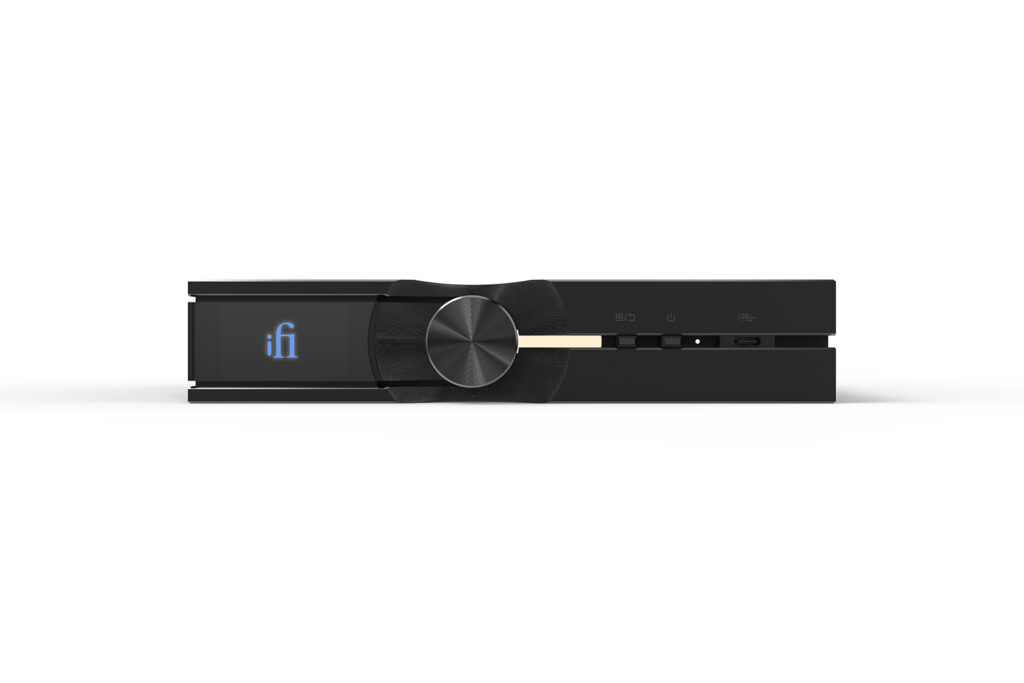
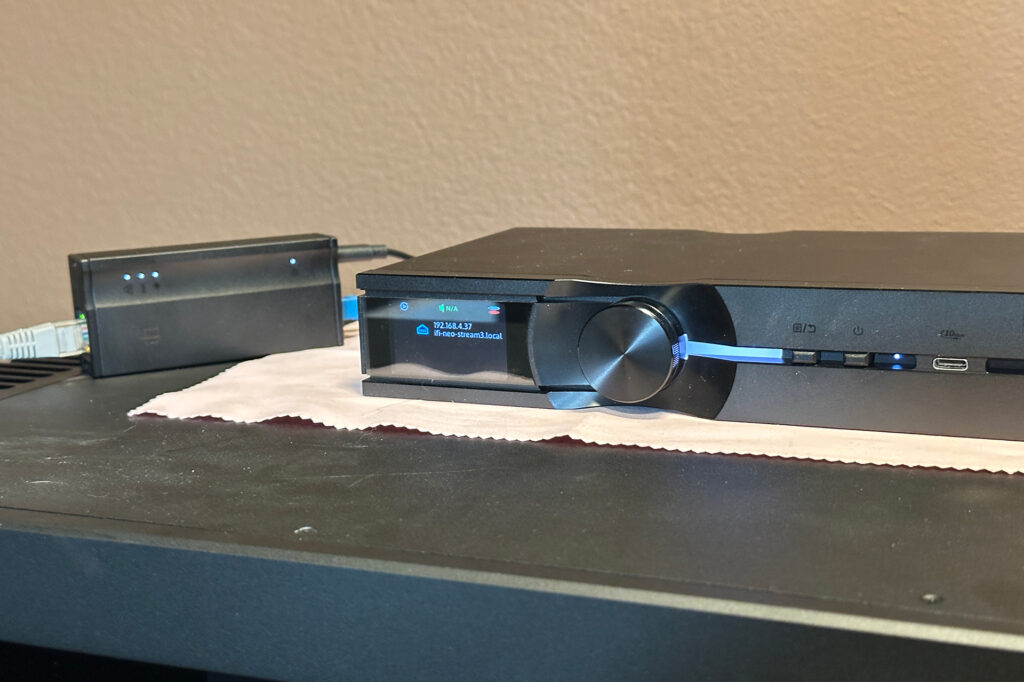
- The iFi NEO STREAM 3 case build, design, fit, and finish are near the top in a small select group of manufacturers at this price point for a streamer DAC. The overall metal enclosure is quite compact, with a thick faceplate that exudes physical quality. The off-center multi-function dial selects control settings and volume, with a quality notched yet fluid feel. A small yet super-cool TFT display shows cover art and file type information. Also included is a metal stand that allows the iFi NEO Stream 3 to stand on end for a desktop location.
- The iFi Nexis app, available on the App Store and Google Play, allows NEO Stream 3 component setup and control. There are no music streaming service integrations within the app itself; however, Spotify Connect, Tidal Connect, and Qobuz Connect are all supported, allowing native streaming APP control. Roon is supported, which is my preferred method and how I primarily auditioned the NEO Stream 3 for review. AirPlay, DLNA, and UPnP are all supported.
- The iFi NEO Stream 3 streaming engine is powered by a 64-bit Quad-Core ARM Cortex processor. One gigabyte of RAM runs alongside low-latency flash memory, running on a custom-tailored lightweight platform for maximum audio purity.
- The iFi NEO Stream 3 integrates a legacy four-channel Burr-Brown DSD/PCM1793 DAC chipset (a brand operated by Texas Instruments since its 2000 acquisition). The single chip is integrated as a fully-balanced differential, with two channels for each right and left layout. The PCM sample rate is published at 768 kHz with no corresponding bit depth indicated. While the unit’s input stage accepts up to 32-bit/768 kHz, the DSD/PCM1793 itself is a 24-bit/192 kHz native converter. The use of the older Burr-Brown chip choice is intentional. The 1793 is one of relatively few modern DACs that processes DSD natively through a dedicated signal path, rather than first converting it to PCM (DoP) or DSD over PCM, and it accomplishes this by routing PCM and DSD through two parallel internal pathways that converge only at the analog output stage. This is the technical basis for iFi’s “True Native” marketing claim and is the linchpin selling point for this component. Additionally, all popular and relevant codecs are supported.
- The iFi NEO Stream 3 uses ELNA Silmic II capacitors, a specific and well-regarded line from ELNA of Japan. They are used in the audio signal path and are said to shape the NEO Stream 3’s tonal character directly. Additionally, quality polymer capacitors used in the power supply filtering stage are said to help smooth ripple and noise, a common source of interference in power supplies.
- The internal Network Transport (streamer) and DAC are internally connected using an I2S pathway. The audio signal is routed through iFi’s proprietary Global Master Timing (GMT) Femto precision clock directly at the DAC interface to eliminate digital jitter before conversion.
- The iFi NEO Stream 3 offers four user-selectable digital reconstruction filters.Reconstruction filtering is a fundamental part of digital-to-analog conversion. Because there’s no single mathematically “correct” filter shape, some manufacturers expose the choice so the listener can match the filter to the recording or to personal taste. The four options are: Standard: modest filtering with modest pre- and post-ringing. Bit-Perfect: bypasses iFi’s selectable reconstruction filtering and routes the data through the chip’s minimal processing path. GTO (Gibbs Transient Optimized): iFi’s proprietary minimum-phase filter that upsamples PCM to 352.8/384 kHz and applies very light filtering with zero pre-ringing and minimal post-ringing. Minimum Phase: short minimum-phase filter with slow roll-off and minimal pre- and post-ringing.
The audible differences between these filters are subtle, but real and worth experimenting with over time. The NEO Stream 3 lets you switch on the fly but only directly on the unit. It’s worth experimenting across a few familiar tracks to develop your own preference.
- The iFi NEO Stream 3 offers two selectable modes of JVC-Kenwood’s K2 processing. It promises to restore harmonic content lost during digitization or compression while preserving the file’s native resolution, and K2HD, which does the same harmonic restoration and additionally upsamples PCM files below 192 kHz up to 24-bit/192 kHz. Both are aimed at recordings that lost detail somewhere in the digital chain, whether older masters cut down for CD, lossy streaming content, or original analog recordings digitized after the fact.
- The iFi NEO Stream 3 offers an unusually deep set of network connectivity options for a unit at this price. On the wired side, three ports are provided:
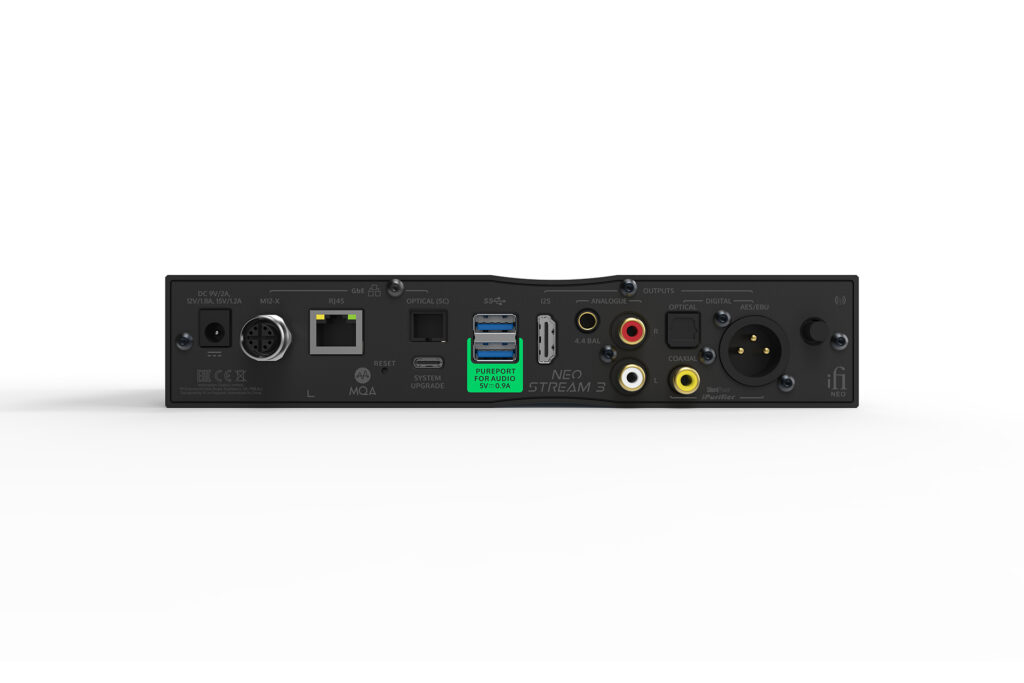
First, a standard RJ45 Gigabit Ethernet port for typical home network connections. Second, an M12-X industrial Ethernet port – a rugged, screw-locking connector borrowed from industrial and automotive applications – included for installations where vibration resistance and a positive mechanical lock matter. Finally, an SC Optical Ethernet input – the most interesting of the three. The included OptiBox accessory plugs into your router or switch via standard copper Ethernet and converts that electrical signal into a fiber-optic output, which then connects to the NEO Stream 3’s SC optical input via the included fiber cable. Because light cannot transmit electrical noise, the fiber link provides true galvanic isolation, physically breaking any conductive path between your home network and the NEO 3’s analog stage. This eliminates ground loops and the high-frequency electrical noise that routers, switches, PoE devices, and powerline networking can inject onto copper Ethernet. This meaningful upgrade typically requires aftermarket modules like the Sonore optical module on competing streamers.
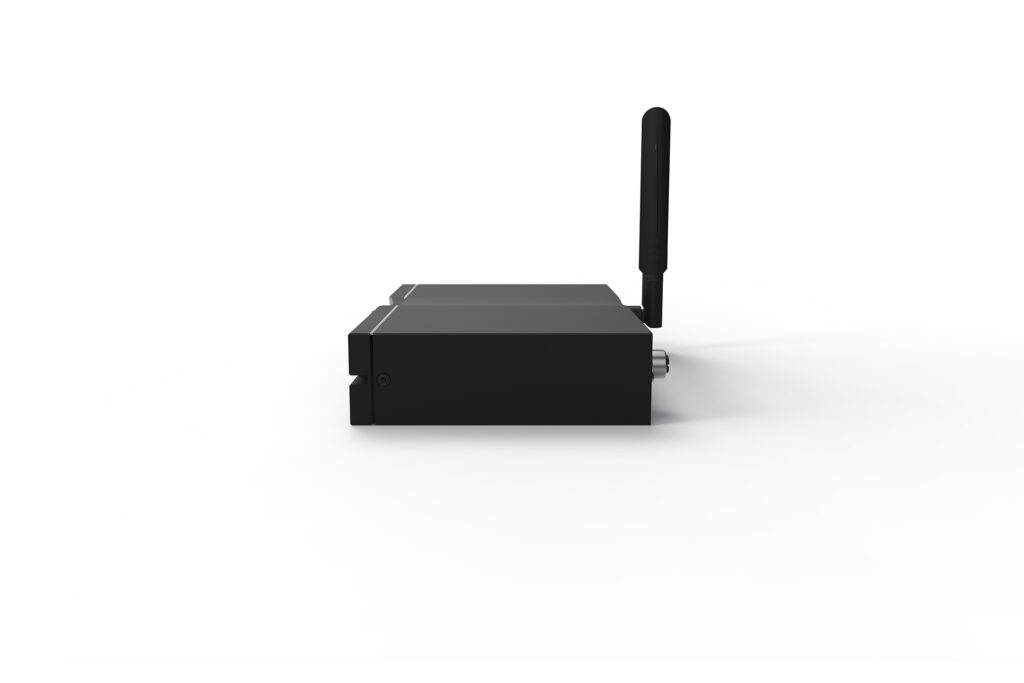
- For wireless operation, the iFi NEO Stream 3 has dual-band Wi-Fi. Pairing is handled two ways: through the iFi Nexis app, using Bluetooth-assisted setup (the app hands Wi-Fi credentials to the streamer over Bluetooth), or via WPS button-press pairing if your router supports it.
- The NEO Stream 3 has Dual USB-A ports that support both USB 2.0 and USB 3.2 protocols: the first port (output A) is for output to a USB DAC, providing data and power; the second port (output B) is for input from hard disc drives and USB drives. Both ports provide iFi proprietary active noise cancellation, referred to as PurePort.
- The iFi NEO Stream 3 provides a front-panel USB-C dual-purpose input and output for connection to a USB DAC, HDD, or USB drive.
- The iFi NEO Stream 3 offers additional digital outputs, allowing its streaming engine to bypass the internal DAC for connection to an external DAC: Optical Toslink up to 192 kHz/24-bit, S/PDIF coaxial up to 192 kHz/24-bit, AES/EBU for PCM files up to 192 kHz/24-bit and, finally, an I2S via HDMI, which can support PCM and DSD files natively. That is a lot of digital outputs for a small-stature streaming DAC.
- The iFi NEO Stream 3 provides two analog output options: stereo single-ended RCA and a balanced output via a single 4.4-mm Pentaconn connector – the compact balanced standard now common on portable players and high-end headphone gear, but uncommon on traditional home components, which almost universally use XLR. Connecting the balanced output to a power amplifier or preamp therefore requires a 4.4-mm-to-XLR adapter cable. Output voltage follows the standard reference levels: four-volt RMS balanced and two-volt RMS single-ended.
- The iFi NEO Stream 3 provides variable output via software-based volume control when using its internal DAC. Connect the NEO Stream 3 to an external USB DAC, and a “hardware” volume option becomes selectable, handing volume control off to the DAC.
Why Should You Care About the iFi NEO Stream 3 Streaming DAC?
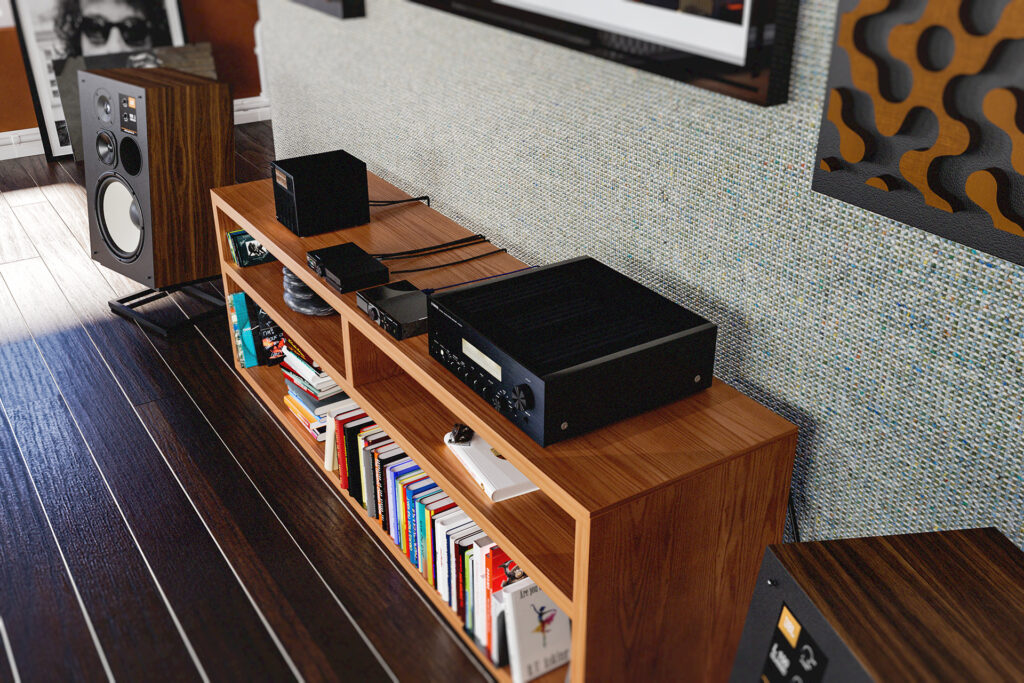
The NEO Stream 3 challenges an industry assumption: that the newest DAC chip from the most popular manufacturers is required for top performance. Instead, iFi tweaked the formula with a well-implemented legacy DAC chip for a different user – one who prioritizes DSD playback. Additionally, a fiber-optic network interface option is an extravagant feature at this price point that no enthusiast will reject. These aren’t mainstream priorities, but they carve out a real niche. Whether enough buyers appreciate these nuances remains to be seen but, for dedicated DSD lovers, the NEO Stream 3 could be exactly the right fit at this price.
Some Things You Might Not Like About the iFi NEO Stream 3 Streaming DAC…
- The iFi NEO Stream 3 balanced output is available, but only via 4.4-mm Pentaconn as previously mentioned, rather than XLR. At this price point, XLR is the more useful standard for longer cable runs and lower noise.
- Digital audio inputs on the iFi NEO Stream 3 are through USB only – XLR/AES-EBU or SPDIF/coax digital inputs are nonexistent. Additionally, there are no analog inputs. These omissions limit its ability to serve as the main control hub of a full sound system if you have other sources, digital or analog.
- The iFi NEO Stream 3 lacks a subwoofer output, which adds another limiting factor in using the streamer DAC as a preamplifier.
- The iFi NEO Stream 3 skips a headphone output entirely. That may not matter to some, but if headphone listening matters to you, it’s worth noting.
Listening to the iFi NEO Stream 3 Streaming DAC
My current reference system is a Pass Labs XP-22 preamplifier, paired with Pass Labs XA60.8high-current monoblock amplifiers, which operate in full Class-A up to 60 watts at eight ohms, doubling into four ohms and again into two ohms. The system runs on Wireworld Eclipse 8 speaker cables, Eclipse 10 XLR interconnects, and Electra 7 power cables for the amplifiers.
PS Audio Aspen FR10 floorstanding speakers, still in place from their recent review, rounded out the setup.
The iFi NEO Stream 3, set to fixed volume output, connected to my system via a Pentaconn-to-XLR cable into the Pass Labs XP-22’s XLR input. Roon served as my primary control interface for the NEO Stream 3, which connected seamlessly.
I ran many songs through the NEO Stream 3, but a few are worth discussing here.
Led Zeppelin’s “Whole Lotta Love,” the remastered version via Qobuz (24-bit/96kHz FLAC), was impressive. The instantly recognizable guitar riff imaged beautifully, forming behind and around the front speakers and creating a wonderful center image, while the texture of the guitar chords and rhythm left nothing to criticize. Depth was equally impressive, placing the crisp background cymbals right where you’d expect them, especially around the one-minute-twenty mark, when the song slows down. I was genuinely impressed with the sound quality: not forward, not laid-back, just thoroughly enjoyable.
The Beatles’ “Come Together,” also the remastered version via Qobuz (24-bit/96kHz FLAC), carries that instantly recognizable, endlessly lovable bass line. The NEO Stream 3 treated it with respect, showing finesse and control – the bass line retained detail and depth, while painting a panoramic image from left to right. Vocals kept their realism and were easily placed on an imaginary stage directly in front of me, while percussion at the back showed beautiful depth and dynamic range. The overall presentation was satisfying, with no sense that anything was missing. Once again, not forward or laid-back – the NEO Stream 3’s presentation was spot-on.
For the last track, I chose Rush’s “Tom Sawyer” – the original album version via Qobuz (24-bit/192kHz FLAC), since no remaster exists – to hear how an older recording would fare. It sounded great, but the dynamic range and three-dimensionality weren’t as robust as on the other two tracks, even though this file’s resolution was higher than either of the prior songs. A reminder that higher resolution can’t overcome the limitations of the original studio recording. I suspected this would be the outcome, since I’ve had the same experience with this track on other streamer/DACs. My guess is it comes down to the chosen recording techniques of that album’s era. I also used this track to experiment with the NEO Stream 3’s various filter options and JVC K2 processing modes; toggling through them, I heard subtle changes, nothing earth-shattering. Perhaps I needed more time with them. DAC filter options and alternative processing, in my experience, tend to be track- or song-dependent and require many days of experimentation to discern benefits. Still, in standard modes, “Tom Sawyer” had an expansive image that extended behind and around the speakers, anchored by a solid center image.
I spent some time toggling between the iFi NEO Stream 3 and a 10k streaming and DAC stack, made up of the glorious HiFi Rose RS130 network transport and the HiFi Rose RD160 DAC, on these same three songs. Of course, there was a difference, as we would expect at 10 TIMES the price. The HiFi Rose stack had a consistently more sophisticated, overall relaxed presentation on these tracks, and it was also smoother on the top end. Upper frequencies had an advantage, with a cleaner presentation showing as a crisp rendition on cymbals that hung in the air a tad longer. Vocals were delivered with a transparency that sounded more realistic to my ears. However, I must admit the difference was not as dramatic as one would think. Small differences in various areas can add up, but what I experienced was an overall though not jaw-dropping improvement, proving that an impressive system can be had at an approachable price. It further exposes the viability of an older DAC chip and that thoughtful implementation is potentially more important.
Moving off of Roon, both Tidal and Qobuz Connect were tested on all three tracks, playing through their native apps, but with the NEO Stream 3 still in fixed output – leaving volume control to my preamplifier, where functionality performed flawlessly. Sound quality was still very good, but I believe Roon still maintains an advantage in bass control, midrange weight, and upper-frequency hang. Once again, not dramatic, but still worth mentioning.
To test the NEO Stream 3 as the control center of an audio system, I switched volume to “software” within the Nexis app, reconnected it directly to my amplifiers, and used Roon as the interface. Playing all three tracks again, I consistently noticed bloated bass and less coherence throughout the songs. Not dramatic, but noticeably inferior to the NEO Stream 3 set to fixed output with my preamplifier taking over. In this same variable-output configuration, Tidal and Qobuz Connect produced the same less impressive bass control, clarity, and detailed resolution, with overall volume output reduced as well. Acting as a digital preamplifier and front end isn’t the NEO Stream 3’s strongest feature. If your goal is a streaming DAC to serve as your digital front end and master control, I think there are better options at this price point, but do your own listening and see if your experience is the same.
Will the iFi NEO Stream 3 Streaming DAC Keep Its Value?
The iFi NEO Stream 3 is a strong brand, with trickle-down design from its mother brand AMR.Additionally, iFi is widely distributed, not only by brick-and-mortar stores, but also directly to consumers through its website and online through Amazon and other online stores. The NEO Stream 3 has a few unique features and, for the right consumer, it will hold its value well. My thought process is that this component is very specialized with its DSD processing capabilities, and most consumers drawn to DSD native processing will tend to keep their unit, limiting the secondary market supply and, in turn, improving value retention.
What is the Competition for the iFi NEO Stream 3 Streaming DAC?
The Eversolo DMP-A6 Gen 2 ($859 – buy at Amazon) and DMP-A6 Master Edition Gen 2 ($1,399 – buy at Amazon) remain the latest models in the Eversolo A6 lineup. Both units offer excellent connectivity, with fully-balanced XLR analog outputs front to back, as well as single-ended RCA outputs; headphone and subwoofer outputs are also included. Dual ES9038Q2M DAC chips handle digital-to-analog conversion, and the resulting performance is impressive – though you lose the native DSD signal path that the iFi NEO Stream 3 offers. A larger six-inch touchscreen and a long list of additional features round out a compelling package. The original DMP-A6 is the streamer/DAC that set this component category on fire when it launched in 2023 – its handsome aluminum casework, build quality, and overall aesthetic, combined with an astonishing feature set, were extremely well-received by everyday consumers and dedicated enthusiasts alike. Not long after that launch, a Master Edition arrived with several upgraded components. A full Gen 2 refresh followed a couple of years later, updating a few functionality quirks – bringing both a standard Gen 2 and a new Master Edition Gen 2 A6 to market – extending Eversolo’s hold on this price point while putting all competition on notice. While I never officially reviewed these Gen 2 models, I’ve had some time with them, and they’re impressive. Depending on your needs, either model may serve you well.
The Orchard Audio PecanPi+ Premium ($1,499 – read the review here), which I reviewed about a year ago, is priced higher than the iFi NEO Stream 3. Still, it may be worth the difference if you appreciate American design and build quality. The Orchard Audio PecanPi+ Premium is Roon Ready and offers Tidal and Qobuz Connect functionality. Orchard Audio focuses on internal part quality, building a proprietary jitter-reduction circuit around the well-regarded AKM Velvet Sound Verita two-chip DAC solution, and a headphone output is included as well. Performance punches above the PecanPi’s weight class. That said, the AKM chipset doesn’t maintain separate PCM and DSD signal paths the way the iFi NEO Stream 3’s Burr-Brown chipset does – worth knowing if a fully isolated native-DSD path matters to you.
The Bluesound Node Icon ($1,299, buy at Crutchfield) is another streaming DAC I reviewed and I remember being very impressed, particularly with its audio performance. The Bluesound Node Icon (read the review) is relatively close in price to the iFi NEO Stream 3. It offers the advantage of an optional Dirac Live room-correction upgrade, for an additional cost, if that’s important to you. If streaming from a wide variety of music services is a priority, Bluesound’s BluOS app and platform are among the most comprehensive in the industry, with multi-room functionality across the broader lineup of Bluesound, NAD, and PSB products. Additionally, XLR analog outputs, a well-implemented digital volume control, and a subwoofer output position it well to act as the conductor of your entire system from your mobile device. A headphone output is included. On the other hand, native DSD isn’t supported, so the NEO Stream 3 retains its signature advantage.
Final Thoughts on the iFi NEO Stream 3 Streaming DAC…
First and foremost, the iFi NEO Stream 3 (buy at Amazon) is a great-sounding streaming DAC when connected directly to a preamplifier with fixed analog output selected. But these days, sounding great alone isn’t enough to win the hearts of consumers and enthusiasts – there are plenty of products in this category that sound just as impressive. It really comes down to priorities. What matters most to you? Do you primarily stream from a service, working in PCM, or do you purchase and download DSD files, particularly in the classical and jazz genres where the format still has real depth?
Personally, I stream from music services (Tidal or Qobuz). But one day, I may dip my toe into downloaded high-resolution files, DSD included. That path comes at a real cost, though, and I find myself wondering whether that money would be better spent elsewhere in my system. Unpacking that question fully is beyond the scope of this review, so I’ll leave it there. What I will say is this: the NEO Stream 3’s native DSD signal path is a genuine feature, and it’s rare at this price point – the alternatives covered above, as good as they sound, don’t offer it. If you intend to connect the streaming DAC directly to a preamplifier, and DSD is a format you’re genuinely invested in, the NEO Stream 3 is a streaming DAC you should consider on your shortlist for that reason alone.



