
 By Frank Picarello
 Allnic Audio is a high-end audio equipment manufacturer specializing in vacuum-tube electronics and analog audio components for audiophiles. Allnic has a broad product family, consisting of preamplifiers, power amplifiers, integrated amplifiers, analog components (phonostages, step up transformers, and moving coil cartridges), one DAC, headphone amps, and cables. Their stereo preamps start at $7,500 for their entry-level model and go up to $45,000 for their top-of-the-line option. The Allnic preamp lineup consists of the entry-level L-6500, L-7000, L-8000, L-8500, L-9000, and L-10000. This review is for their L-7000 line-level preamp, which has a list price of $16,200, which would make it a pretty advanced product in the overall scope of the hobby.
Allnic Audio is known for its engineering-heavy designs, hand-built transformers, and emphasis on analog sound quality. Allnic was founded in 1997 and is located in South Korea. The name Allnic derives from all-nickel-core, referencing the company’s use of nickel-alloy transformer cores in its electronics. These materials are valued for their magnetic and signal-transfer properties in audio circuits.
In my system, the Allnic L-7000 was reviewed using a single input for digital sources. While my configuration allows the digital feed to directly drive my Pass Labs XA30.8 power amp (read the review), which allows both attenuation and overall improved sound versus a truly direct connection, how does a tube preamp of this magnitude compete in this fiercely competitive space? That’s what we are here to discuss.
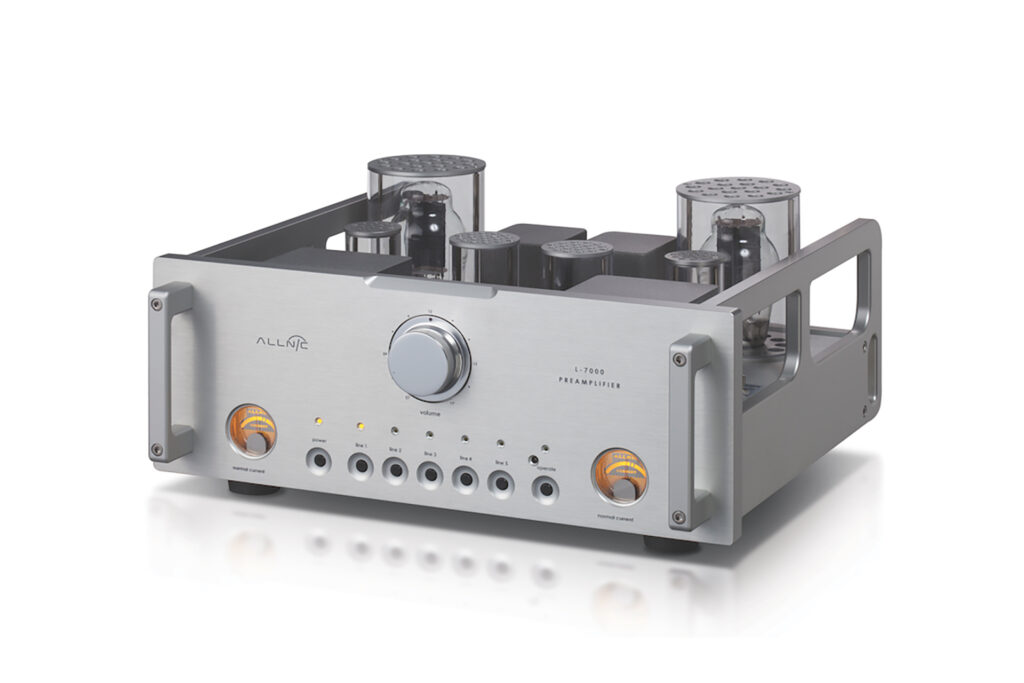
Allnic L-7000 Stereo Preamplifier Specifications
| Type | Line-level tube preamplifier, dual mono |
| Tubes | Two E810F (gain), two 300B (regulators), two 5654 |
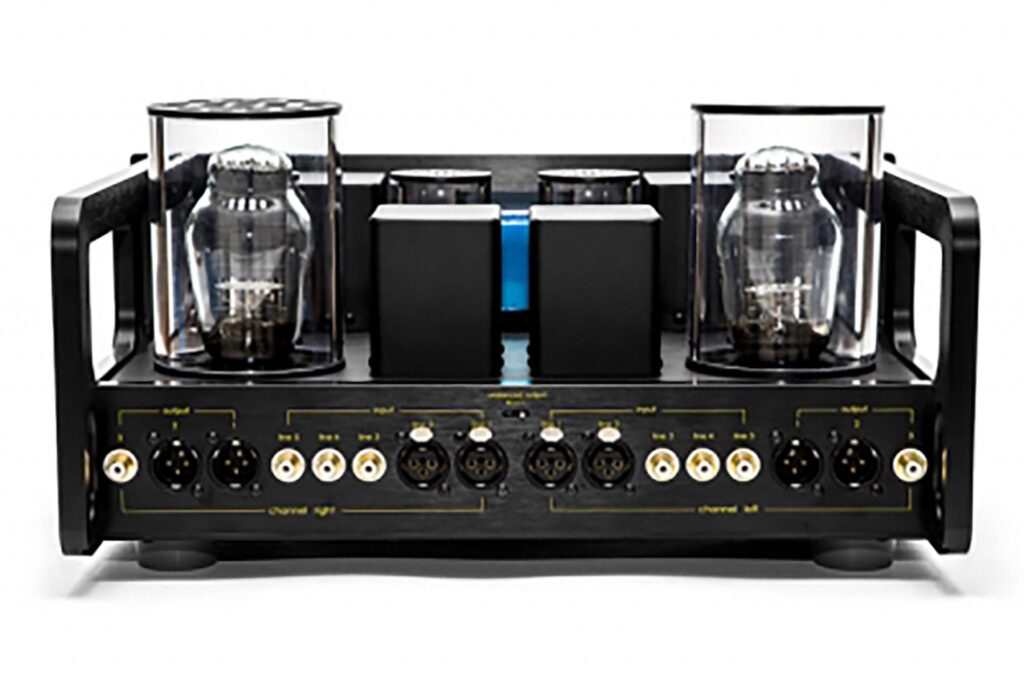
| Gain | 20 dB |
| Frequency response | 16 Hz to 50 kHz (-3 dB) |
| THD | 0.06 percent at 0.3 volts out |
| Inputs | Three RCA, two XLR |
| Outputs | One RCA, two XLR |
| Volume control | 61-step motorized constant-impedance attenuator |
| Dimensions (W x D x H) | 430 x 410 x 173 mm (about 17 x 16 x 7 inches) |
| Weight | 18 kg (about 40 pounds) |
| Price | $16,200 at review |
Why Should You Care About the Allnic Audio L-7000 Stereo Preamp?
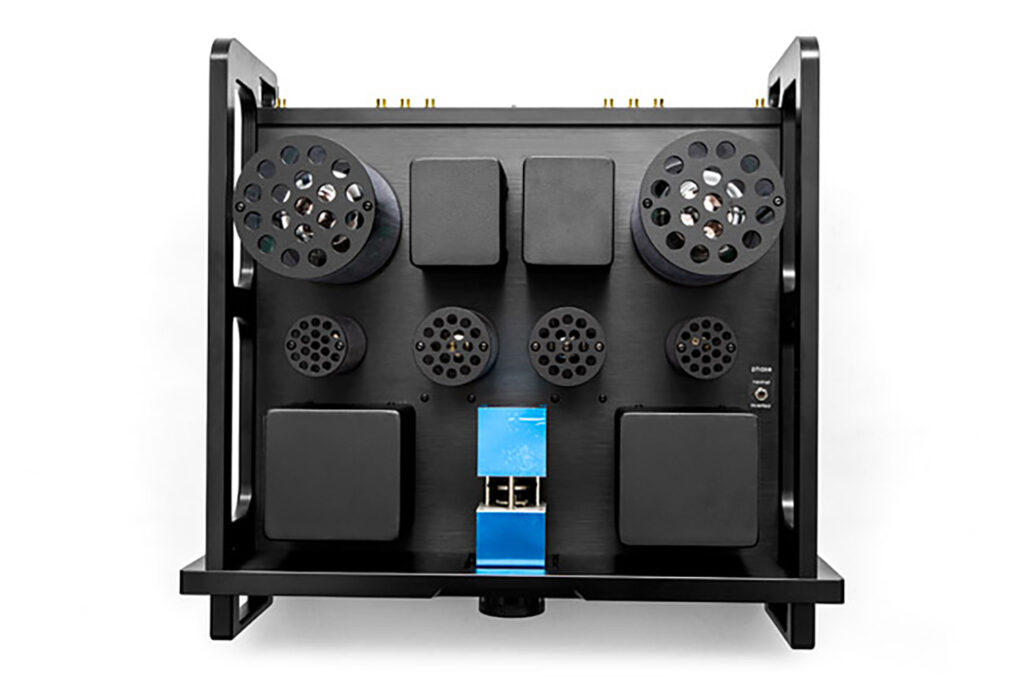
- The Allnic Audio L‑7000 preamplifier uses several unusual design choices that improve transparency, dynamics, and tonal realism. The Allnic L-7000 uses the legendary 300B tube, but not in the audio path, which is quite unique. Most tube gear uses the 300B as an output in power or integrated amplifiers. The Allnic L-7000 does something unusual: it uses 300B tubes as voltage regulators in the power supply, rather than as amplification tubes. Why does this unique and expensive approach matter? The 300B can pass high current with very low voltage drop. This creates a very stable, low-noise power supply, which many designers believe directly improves clarity and dynamics.
- Audiophiles can still “tube roll” the 300B to subtly change the sound, if that is desired. Tube rolling implies that there are different types of the same configuration of tubes. Like many gourmet ice cream companies that all make great vanilla, there are a number of modern and legacy companies that make 300B tubes. Some audiophiles like to swap out any tubes in their gear for a subtle audiophile effect. All I am saying is that it is an option, more than an endorsement of the concept.
- The signal path on the Allnic 7000 uses only one amplification stage per channel. Why? Fewer components in the signal path delivering less distortion and phase shift, which creates a noticeably direct, transparent sound. The Allnic suggests that they can deliver a purer, more detailed and dynamic reproduction than many multi-stage designs.
- The build quality of the Allnic L-7000 preamp is simply amazing. The quality of the metal, fit and finish, robust design of the transformers, connectors, and attention to detail is as good as I have seen at any price.
- Instead of capacitor coupling, the L-7000 uses transformers. These are custom transformers built in-house, which makes this L-7000 unique. Permalloy cores (nickel-iron alloy) are employed for low distortion and wide bandwidth, resulting in a frequency response roughly 16 Hz-50 kHz (-3 dB). Transformer coupling is more expensive, takes up more space and adds weight, yet it can transfer more actual energy to the load and maintain dynamics and tone better than capacitor coupling.
- Each channel is essentially its own preamp, thanks to the Allnic L-7000’s dual-mono architecture. Separate circuits for left and right are shared only by the chassis and AC input.
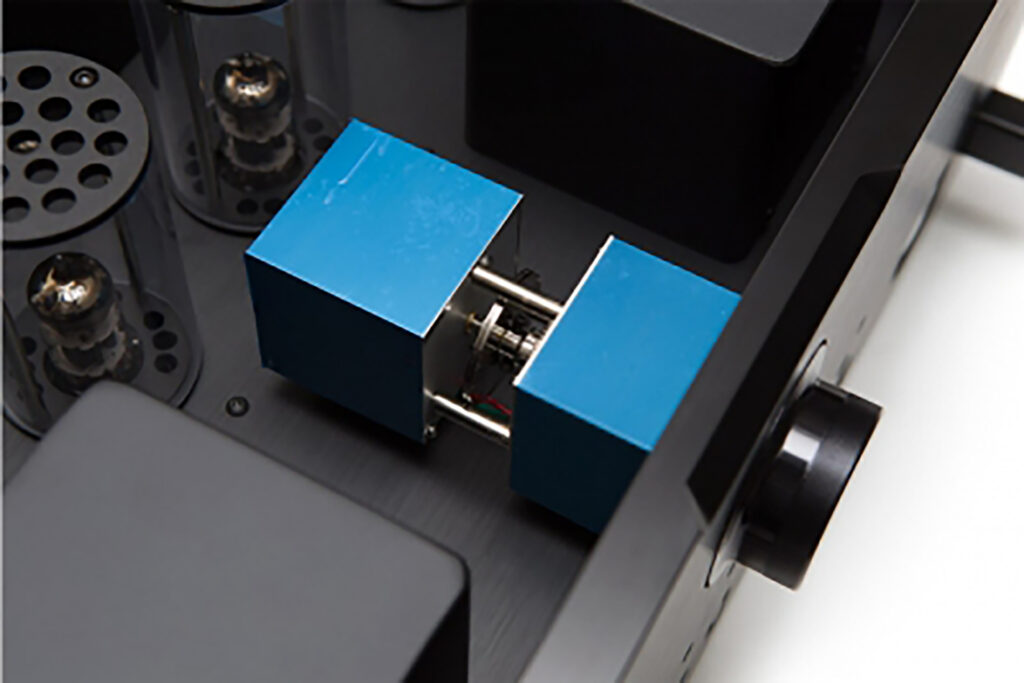
- Instead of a typical potentiometer, the Allnic uses a multi-step constant-impedance attenuator (volume control). Why does this matter? It makes for better channel-matching and consistent impedance across volume levels, delivering lower distortion and noise.
- The circuit operates in Class-A with no negative feedback, which helps deliver the Allnic’s natural tone and dynamics.
- Allnic uses a very high-precision volume attenuator, which is to be expected in a preamp at this level. Most preamps use a potentiometer, which is a moving wiper contact with continuously variable resistance. The problem with this design can be channel imbalance, noise as the wiper moves, and changing impedance, depending on volume position. Allnic avoids this by using a stepped attenuator made from discrete components instead of a sliding contact, which delivers a consistent impedance at every volume setting.
- The tube sockets on the Allnic L-7000 stereo preamp, unlike traditional ceramic sockets, have a design focused heavily on mechanical vibration control and microphonics reduction. This is a gel-damped tube socket mounting system that adds one more level of polish to the performance of the Allnic L-7000.
- The two meters on the front of the Allnic L-7000 are tube current monitors showing the health and operating current of the tubes. Each meter corresponds to the left and right channel, showing the current supplied to the gain stage tube. In other words, they are bias/current indicators for the tube circuit, leaving the user with a clear understanding of the health of the tubes. At first, I thought this was gimmick, yet after a better understanding of how the indicators work, the Allnic shows a precise health indication of the important tubes in the circuit. Knowing when you need new tubes is a key part of owning audiophile components like this, even if you just like looking at the meters for the coolness factor.
- Allnic’s design goal is to minimize circuitry in the signal path while maximizing power supply stability and transformer quality. These are two things Allnic believes most strongly affect sound and, based on the purity and musicality of sound, mission accomplished.
Some Things You Might Not Like About the Allnic L-7000 Preamp
- For vinyl lovers, there’s no option for an internal phonostage requiring the need for an external device. This isn’t uncommon at this advanced level of an enthusiast product. An audiophile spending $16,200 on a stereo preamp likely will want to have his or her own phonostage, too.
- While the remote is high-quality and a lovely chunk of aluminum, there is no power on and off switch. I don’t mind turning the unit off but this is yet another audiophile product with a big asking price and a poor remote control.
- Many stereo preamps today also include a pretty fantastic internal digital-to-analog converter, but not the Allnic L-7000. Like the omission of a phonostage, this speaks to an actual strength, which is overall design simplicity. Any audiophile willing to buck up for a $16,200 preamp also knows which DAC they like, and that is almost assuredly a standalone component.
- Other preamps at this price range outside of the tube world need literally no maintenance.OK, fine, but with an enthusiast audiophile component like the Allnic L-7000, part of the fun is being elbow deep in its operation and maintenance. If you are looking for less work, there are at least a dozen designs that have comparable sound and no maintenance. This isn’t an SUV that you drive in the snow as much as it is a Lamborghini that you lovingly care for a drive-the-hell-out-of on a Sunday afternoon. Passion.
- The AC power jack is on the side of the preamp towards the front, which is super-odd. I am assuming there is a technical or physical configuration reason for this, yet this can be both a little cumbersome and an eyesore. Most aftermarket cables require space for the connection, making the space required on the left-hand side of the preamp significant.
Listening to the Allnic Audio L-7000 Stereo Preamp
The Allnic L-7000 preamp is a music lover’s component. Simplicity is its design philosophy, executed with precision, with focus on critical aspects of the signal path make this a perfectionist tool. I have listened to a lot of music with this preamp and continue to be amazed with the ability of the Allnic L-7000 to make music sound like music.
I love Norah Jones’ voice, as it is both romantic and emotional. Jones has the music genes of her father, Ravi Shankar, and her talented sister, Anoushka Shankar. On the song “Don’t Know Why” (Analogue Products Hybrid SACD), Jones’ voice sounded focused, full, and round with the Allnic L-7000 in my system. The guitar sounded warm, yet with attack and positioned perfectly in the soundstage. When the background piano showed up, this attack felt like a bass note hitting you. The leading edge of the notes were powerful and more of what you’d expect from a quality solid-state preamp. The piano solo was excellent, warm, clear, and with body. The soundstage was just perfect, left to right and bottom to top with believable depth.
The song “Bending Hectic” from The Smile 2023 album Wall of Eyes, Qobuz, is a wonderful and moody song. The guitar floated and had body sitting at the right side in the soundstage and focused. The soundstage is wide and Thom Yorke’s voice was centered nicely and weighted perfectly. You could feel what he’s singing and the Allnic was in its element, delineating details, remaining seemingly true to the music and providing that colorless or black background and low noise foundation required for an emotional song like this. I was reminded of how this preamp is purpose-built for music, sounding natural and right.
My sister turned me on to Susan Tedeschi and Derek Trucks years ago, and I remain a fan.Future Soul is brand-new and was released on Qobuz 96/24 last week. What a great album with a lot of wonderful music. On the song “Who Am I,” Tedeschi’s voice was front and center – smooth and earthy. The essence of the song was not only heard, it was felt. Trucks’ guitar was just right, almost vintage-sounding. Trucks is one of the finest guitar players alive, and you have to pay attention to his style, skill, and melodic approach to really appreciate what he can do. The Allnic did a fine job in appropriately emphasizing both Tedeschi’s voice and Trucks’ guitar. There was a lot of detail, yet the Allnic made this album easy to listen to over and over again. The Allnic L-7000 got the musical balances right for my tastes. Body, clarity, attack, dimension, and tonal rightness is how I would describe things.
Khruangbin is a trio from Houston, Texas, known for blending global music influences, including Thai rock and Iranian pop with American soul, rock, and psychedelia. On the album Mordechai, released in 2020, Qobuz 24/96, the song “Is There No Question,” during the opening, the bass line was strong yet not exaggerated, plus you could feel the skin of the drum. The Allnic L-7000 was a magician in making the bass sound like a very good solid-state preamp. When the music opened up, the Allnic pulled another trick in sounding emotional, smooth, and with the right weight. The song slowly built by adding vocals and they were perfectly placed in the soundstage and clearly in the background. The tempo of the songs is melodic and engaging, and the Allnic let this shine through. As happened throughout my listening sessions, I easily forgot to pay attention to the preamp and instead just totally enjoyed the music. The emotion and vibe of the song came through really well.
Will the Allnic L-7000 Stereo Preamp Hold its Value?
The Allnic L-7000 should hold its value well over time. The L-7000 is widely considered a reference-level preamp, with a solid (somewhat cult-y) brand following. The build quality, over-engineering, and musical performance will stand the test of time, making buying one used a safe bet. Allnic is a small manufacturer, which means fewer units in circulation and potentially less price pressure than mass-market brands. Allnic is respected but as it’s more niche, it may take longer to find a buyer.
What is the Competition for the Allnic L-7000 Preamp?
As the Allnic is a premium-priced and quality preamp, the competition is strong. Many competitors offer internal phono and DAC/streaming options so, depending on what you need and desire in terms of flexibility and ability to upgrade, there are many options. The Allnic L-7000 preamp takes a path of simplicity in design, with an emphasis on execution. Execution contains excellent parts, and the unit is over-engineered and puts an emphasis on extremely low noise, gain management, and the use of tubes in a way that does not limit the dynamics, while still delivering the emotional balance that great products seem to get right. The Allnic helped make my system sound better.
The Audio Research Reference 6SE at $22,500 is one of the most widely-known reference tube preamps that use multiple 6H30 tubes and sophisticated power supply regulation. This preamp is known for neutral, highly transparent sound and very strong resale and dealer support.
VTL TL‑7.5 Series III Reference preamplifier at $12,500 is a flagship two-chassis design with a huge power supply. It is designed to deliver extreme dynamics and drive capability.
The VAC Renaissance Mk V preamplifier at $12,990 is a high-end tube preamp with optional phonostage, known for lush midrange and dimensional soundstage. These are less expensive but quite worthy comparables.
Pass Labs XP‑22 Preamplifier at $9,999 (read the review) is a staff favorite and a true reference solid-state alternative with a dual-chassis design, extremely low noise floor and very high transparency. It is not tubes but it is musical as can be. It adds no sonic color. It just delivers resolution and that close-to-the-master-tape sound.
Final Thoughts on the Allnic Audio L-7000 Stereo Preamp
The Allnic L-7000 is a tour de force audiophile, tube-based stereo preamp. Simple in its configuration, it still has a level of precision in the engineering and deployment of some very notable technological decisions, which include the 300B tubes in the power supply, a precision volume control, transformer stage coupling, no feedback, and the crown jewel of the transformer material and design. A lot of thought went into the design choices and execution. This is an endgame preamp that remains respectful of the music and is utterly quiet, dynamic, musical, and engaging. While not an audiophile household brand name, the Allnic L-7000 is worth investigating.
Read more about distortion and how it affects an audiophile system from FutureAudiophile.com editor, Paul Wilson




Once again an excellent review by a seasoned audiophile. Well written and very informative as usual. Looking forward to the next one!
Thanks Joe. Happy you found the review worth the read. Appreciate it.
Another great review by Mr Picarello. It is full of useful info, well written and a pleasure to read. I also enjoy the music choices made in the review. Khruangbin is a recent find of mine, and its nice to read them mentioned in the review. Frank is an outstanding reviewer, and I look forward to reading more of his inciteful reviews!
Frank , I agree 1000% , fantastic review . Thanks !!!!!!