
 By
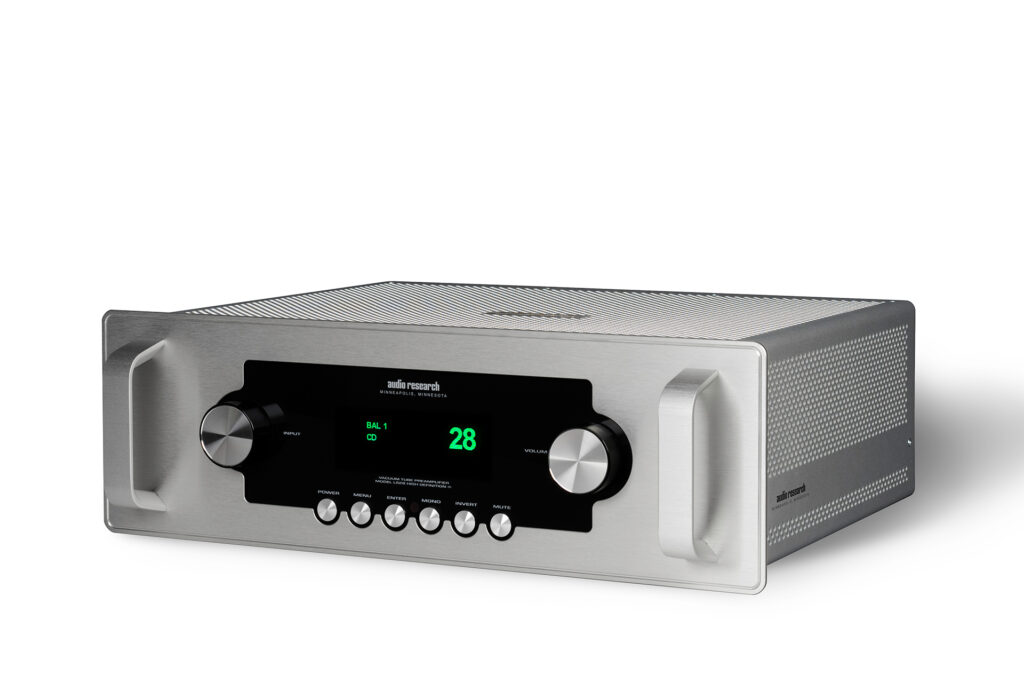
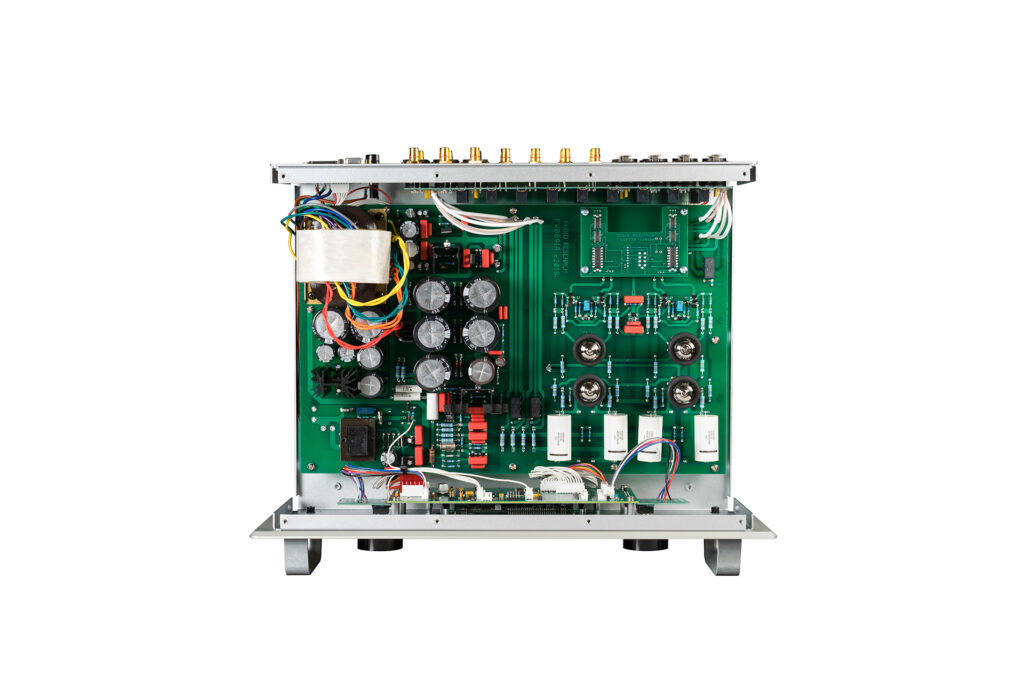
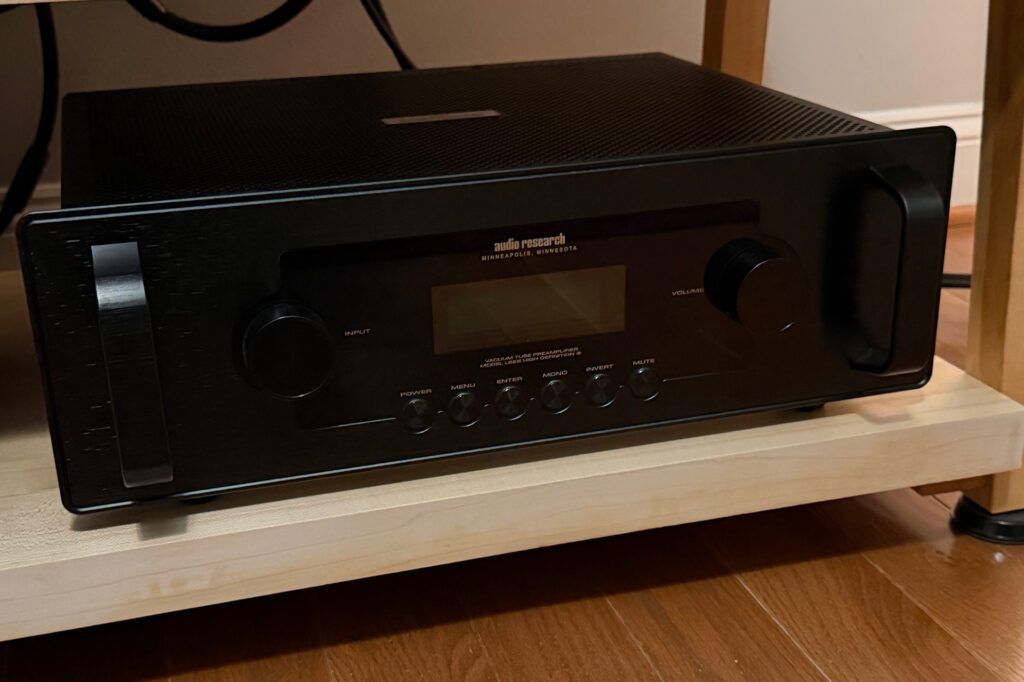
Vacuum tubes were on the path of extinction in 1970, the year Bill Johnson bet against the industry’s move to solid state and founded Audio Research on the idea that audiophile valves still had more to offer. The Audio Research LS28SE is a $12,000 tube line-stage preamplifier just below ARC’s Reference line. It is a pure Class-A, single-gain stage with zero feedback and a differentially balanced design built around four 6H30 dual-triode tubes. The SE revision adds the same proprietary gold coupling capacitors and internal wiring found in ARC’s flagship REF6SE. It has no phonostage, no internal audiophile DAC, and no digital inputs, just a line stage built to be the heart of a serious stereo system.
I ran the LS28SE in place of my reference Allnic L-7000 (read my review) preamp, feeding my Pass Labs XA30.8 (read the review) power amp and my Marten Parker Trio (read my review) loudspeakers, with a Denafrips Terminator Plus 15 (read my review) DAC, with the Gaia 15 DDC as the source throughout the review. Music was sourced through local music files and streaming was through Qobuz. Every listening note below reflects the LS28SE doing what a line-stage preamplifier is asked to do: manage gain and pass a clean signal without adding or subtracting anything along the way, providing the user flexibility and control over the rest of the system.
What Makes the Audio Research LS28SE Line-Stage Preamplifier Special?
Audio Research’s engineering philosophy for the LS28SE was never about hitting a price point by cutting corners; it was about bringing their Reference-level circuit topology and build quality down to a level more buyers could reach. The LS28SE traces a direct line through the numbered LS-series, the SP-10 and SP-11, back to the 1972 SP-3 that established ARC’s reputation. Each generation absorbs engineering developed for the Reference line, and the LS28SE is no exception. This is a serious product, pointing to solid engineering, discerning ears, and a lineage with decades to fine-tune the formula.
Because the LS28SE and standard LS28 share an identical circuit topology, the SE designation refers entirely to componentry along the signal path. Audio Research offers it as a $3,500 factory retrofit so existing owners can upgrade in place rather than buy a new preamp. That says a lot about how Audio Research treats the products it sells and the customers they faithfully serve.
- As a dedicated line-stage preamplifier, the LS28SE carries no DAC, phonostage, or headphone amp, just a single item executed as purely as Audio Research knows how. That focus is deliberate, not missing features; ARC’s philosophy is that one circuit doing one job well beats one chassis trying to do everything adequately.
- A pure Class-A, single-gain stage with zero feedback, differentially-balanced circuit runs through four six 6H30 dual-triode tubes in the analog signal path. There is no OP-amp buffering and no added gain stage between input and output, bringing the sound closer to neutral than to classic tube warmth.
- The SE upgrade carries over the same proprietary gold coupling capacitors and specialized internal wiring developed for the flagship REF6SE. Audio Research and independent reviewers both credit this componentry change with higher resolution, a more grain-free top end, and a noticeably more expansive soundstage, compared to the standard LS28.
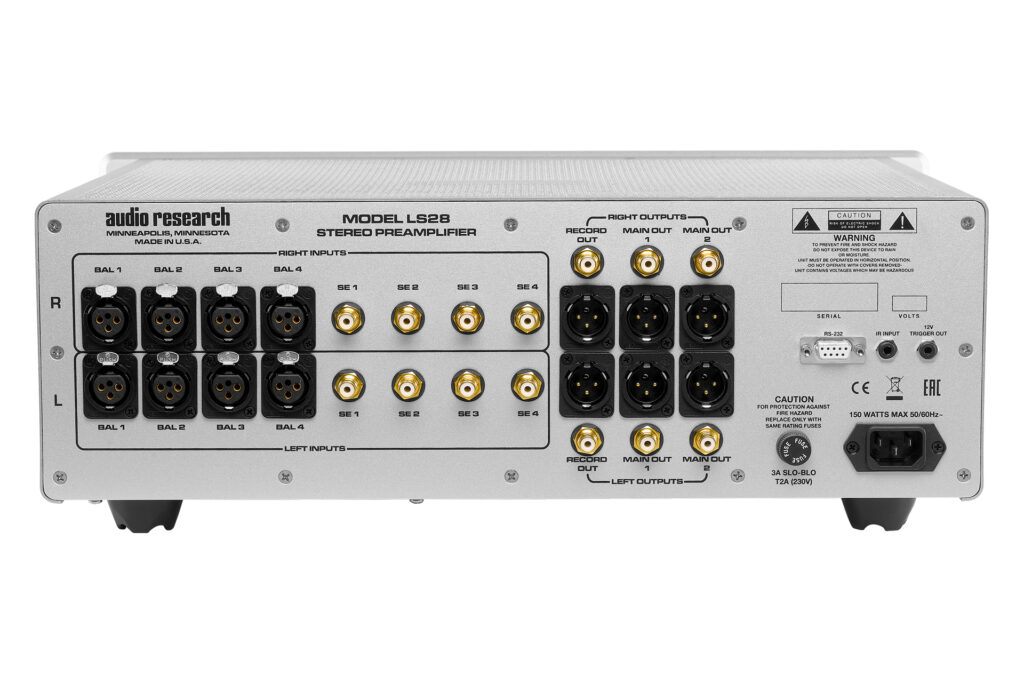
- Eight total inputs, four balanced XLR and four single-ended RCA, are matched by three output pairs, two main and one record, each available in both balanced and single-ended form. That is an unusually generous amount of input and output flexibility for a line stage in this category, and it is the kind of thing that keeps a preamplifier relevant, even as the rest of a system changes around it.
- A fluorescent green front-panel display handles input naming, a tube-hours counter, adjustable auto-shutdown, per-input volume memory, mono and absolute-phase-invert switching, and a home-theater bypass mode. The unit also powers up muted by default, a small safeguard against a volume spike on startup.
- The LS28SE ships with tubes that are pre-matched, burned-in, and tested at the factory in Maple Grove, Minnesota, and installation takes only a few minutes with the full-size screwdriver Audio Research includes in the box. A signed quality-assurance certificate documenting each stage of factory testing comes with every unit, which is the kind of detail that tells you how ARC thinks about the people buying its products.
- Existing LS28 owners can upgrade to full LS28SE specification for $3,500 as a factory retrofit. It is a small line item, but it says plenty about a company built around the idea that it will service, repair, or restore nearly anything it has ever made.
- The chassis is a comparatively thin-gauge, lightweight aluminum design, weighing 16 pounds. ARC’s cosmetic attention goes toward the display and the panel layout instead.
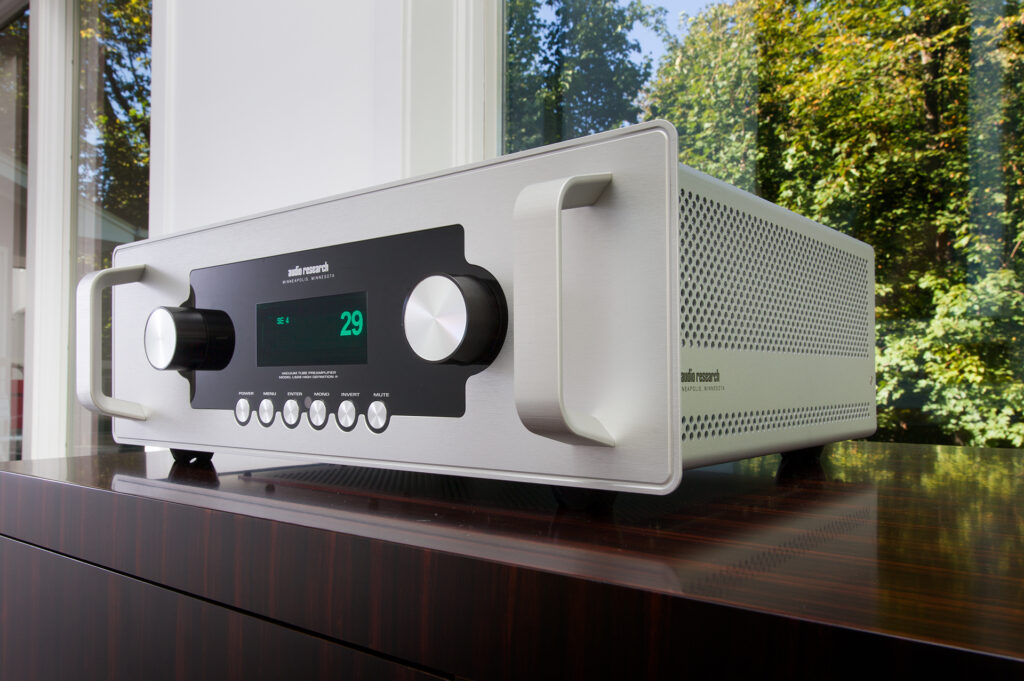
- The overall panel design is genuinely ageless; it looks as much at home in a system today as it likely would have 20 years ago, and the fluorescent display and understated fascia have aged better than plenty of flashier designs from the same era. Audio Research has never chased trends with its industrial design, preferring to put the attention inside, where it counts most.
- The volume control itself is a standout: it moves quietly, tracks accurately, and never introduces the channel imbalance some stepped attenuators show at the extremes. It is paired with a substantial, nicely weighted remote that is sized and finished appropriately, a small detail that matches the rest of the LS28SE’s quality.
- Inside the chassis, the layout is logical and the componentry is exactly what I would expect at this price. Nothing about the internal execution feels like a shortcut.
Why You Should Care About the Audio Research LS28SE Line-Stage Preamplifier
Who is the LS28SE actually for? That’s anyone assembling a serious system who wants a line stage that leans neutral and transparent rather than one that adds overdone warmth and body and who values a manufacturer with a track record spanning more than 50 years of standing behind what it sells. It rewards a system built around resolving sources and a capable power amplifier.
It is also worth being honest about who this is not for. If you want one chassis to handle preamplification, phono, and digital conversion, the LS28SE isn’t for you. For anyone with, or willing to invest in, a DAC and phonostage that can show what a genuinely transparent line stage can do, the LS28SE is built to reward that investment.
Some Things You Might Not Like About the Audio Research LS28SE Line-Stage Preamplifier
- The Audio Research LS28SE has no built-in DAC or phonostage, so both digital and vinyl sources require separate outboard components. That is true of any dedicated line stage but, at $12,000, some buyers are looking for more functionality.
- Compared with the milled-billet construction of some rivals, the LS28SE’s thinner aluminum chassis feels a little less substantial for a $12,000 component.
- The bass, while well-controlled, is not quite as weighty as what I hear from my reference Allnic L-7000. I suspect this is more a matter of a slightly different presentation, as the bass is detailed and fast.
- This is a smooth preamp and borderline rounded in certain passages. Detail retrieval never actually suffers, but listeners chasing the very last word in transient snap and slam should audition it against the competition that is above this price point.
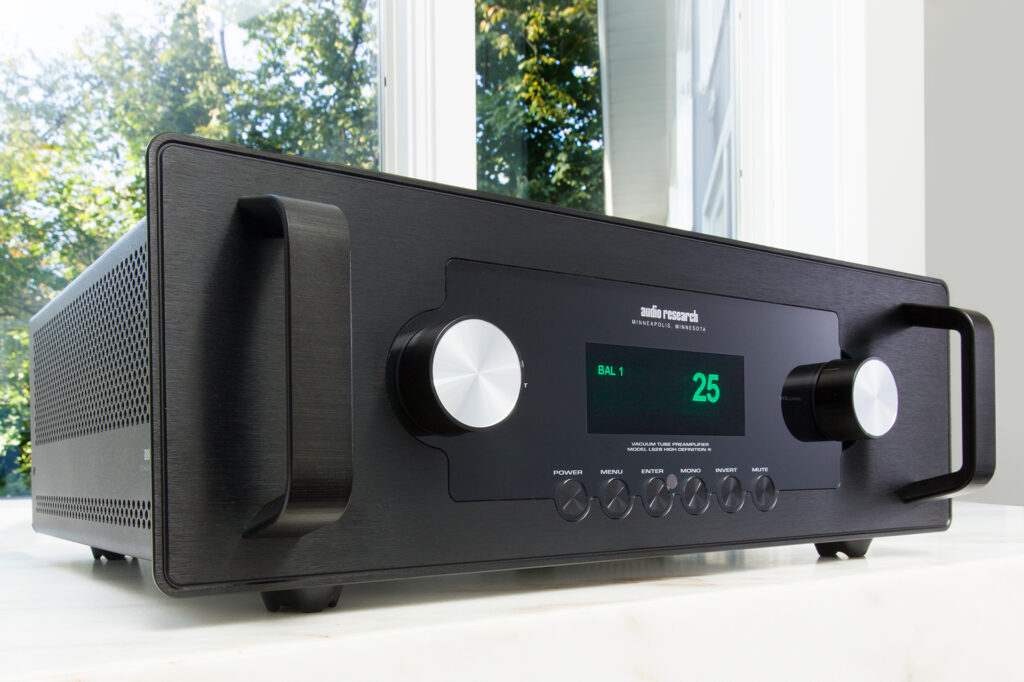
- My review sample was finished in black and, in a dimly-lit room, the dark fascia swallowed some of the front-panel display’s detail and maturity. I would expect the silver finish to be easier to read in a darkened listening room, which is worth considering.
Listening to the Audio Research LS28SE Line-Stage Preamplifier
The Audio Research LS28SE is quiet, simple, and remarkably easy to live with. It carries an old-school sensibility in the way that matters most: it reaches its optimal operating range quickly and, unlike other preamplifiers I have spent real time with, it sounded fully settled within a few minutes of power-up. It is neutral without turning cold, smooth without glossing over detail, and background noise stays low even at higher volumes, with a noise floor closer to a good solid-state preamplifier than a tube design, right down to bass, with zero fatness or boldness. I knew I was listening to a preamp with 50-plus years of evolution. Sonically, it bridges solid-state and tube attributes exceptionally well, combining tube body, tonal density, and warmth with solid-state speed, accuracy, and clarity. It keeps complex arrangements tidy without ever sounding frenzied, a genuinely wonderful trait at any price. Soundstage width, height, and depth are good, if not quite as wide or deep as some pricier alternatives, and very good for the price; none of it changes with volume, and I did plenty of satisfying low-volume late-night listening, where bass, midrange clarity, and treble transparency all stayed intact. I would imagine a lot of audiophile musicians would enjoy this preamp. It makes you a part of the music.
Peter Gabriel’s “Playing for Time,” from his i/o (buy at Amazon) album, begins with just Gabriel and piano before gradually building into something much larger, which makes it a useful test of a preamplifier across both ends of the dynamic range.
The LS28SE let the piano’s hammer strike, body, and decay unfold as three distinct events rather than blurring them together, and Gabriel’s unique yet aging grainy voice came through with real texture rather than being smoothed over. As the arrangement widened into a fuller orchestral backdrop, the LS28SE scaled up believably, the added instruments gaining size and weight without ever crowding Gabriel’s voice out of the picture.
Víkingur Ólafsson’s recording of the “Aria” from J.S. Bach’s Goldberg Variations (buy at Amazon), is about as close to a bare test of a component’s honesty as recorded music gets, with almost nowhere for a weak link in the chain to hide.
Through the LS28SE, individual notes carried their full life cycle: the hammer’s initial attack, the fundamental developing underneath it, and harmonics blooming and fading into a genuinely quiet background. Tonal balance stayed even from top to bottom, without the extra upper-midrange edge that can make solo piano sound hard and glassy through a lesser line stage. The LS28SE balanced weight and speed in a way that few preamps at this price point can. The LS28SE’s fine-grain smoothness paid dividends here.
Samara Joy’s “Autumn Nocturne,” from her Grammy-winning Portrait (buy at Amazon) album, pairs a rich, full-bodied jazz vocal with a small acoustic ensemble, and it is an excellent test of midrange honesty and finesse.
Joy’s voice had real chest resonance and body through the LS28SE, and the small dynamic inflections within individual phrases came through as continuous and natural rather than clipped off. She was in the room, and I could feel her energy and emotion. The acoustic bass retained its pluck and resonant body without the upper-bass warmth that can obscure pitch, and cymbals carried real metallic complexity, instead of collapsing into a wash of treble energy.
Khruangbin’s “A Love International,” from the trio’s A LA SALA (buy at Amazon) album, strips down to the fundamentals of bass, guitar, and drums across a lot of open space, which makes it an unusually revealing test of pace, timing, and bass control.
The bass was tight, fast, and highly articulate, allowing Laura Lee’s bass line to stay easy to follow note to note, and Mark Speer’s guitar held its reverberant cloud while keeping the initial pick attack clearly defined, with the three musicians locking together with a genuine sense of being connected. The drums kept the part creating the pace for the music with body, clarity, and impact.
Arooj Aftab’s “Raat Ki Rani,” from her Night Reign (buy at Amazon) album, leaves enough open space around her voice that the small musical events carry real weight, and it is a strong test of low-level resolution and a genuinely black background. Using the LS28SE, you can hear deep into the recording sensing the space left to right and front to back. I kept writing down in my notes how musical and easy to listen to this preamp is.
The LS28SE’s quiet noise floor let Aftab’s phrasing come through with all its small changes in breath pressure and volume moderation, conveying real emotional information rather than sitting flat. Her voice retained both its physical weight and the delicate breath surrounding it, and the silence around her defined the dimensions of the recording rather than sounding merely empty.
Will the Audio Research LS28SE Line-Stage Preamplifier Hold Its Value?
Audio Research components are broadly known for holding value better than most high-end audio brands, and that extends to the LS28SE. No successor has been announced, so it remains in current production; the existing $3,500 factory upgrade path historically supported used LS28 pricing and should do the same here; and ARC’s ability to service or restore nearly anything it has made (like, ever) keeps units usable long after a less-supported brand’s gear would be obsolete.
Read this resource on the future relevance of tubes in the audiophile experience written by FutureAudiophile.com editor, Paul Wilson.
What Audio Research’s New Ownership Means for the LS28SE Line-Stage Preamplifier
Audio Research, as a company, has changed hands several times since Bill Johnson founded it in 1970. Johnson sold the company to the Italian investment group Quadrivio in 2008, forming the Fine Sounds Group alongside Sonus faber; that group later grew to include McIntosh and was restructured and renamed McIntosh Group in 2016. In August 2020, timed to ARC’s 50th anniversary, longtime North American sales head Trent Suggs bought the company back from McIntosh Group through his own TWS Enterprises, with no outside debt or partners, returning ARC to independent ownership. In 2023, ownership changed again: ARC’s assets were acquired out of an assignment-for-benefit-of-creditors process by AR Tube Audio Corporation, a new, privately-held company with an ownership group that included Valerio Cora, founder of Toronto-based Acora Acoustics, who then ran ARC as its executive leader for the next several years.
The most recent chapter arrived in mid-2026. Roger Hwang, a Toronto-based manufacturing executive who had been ARC’s major financial backer since the 2023 transaction, formally stepped into the CEO role in July, while Cora was relieved of his responsibilities at both Audio Research and his namesake, Acora Acoustics. Audio Research and Acora Acoustics operate as separate businesses, and ARC’s statement was clear that its operations, product development, dealer support, service, and warranty support continue independently. Day-to-day leadership stayed in place throughout: Evan Skucius and Les Robinson remain co-general managers running daily operations, Allan Haggar remains VP of Global Sales, and David Schultz remains Director of International Sales.
The detail I find most telling and promising in all of this is David Gordon’s return. Gordon joined Audio Research in 1989, is as close as anyone alive to representing the brand’s institutional memory and lineage back to founder Johnson and briefly left the company in March 2026 over a disagreement about market direction. He came back as ARC’s Brand Ambassador in June, right as the ownership situation resolved and, by his own account, does not see Hwang as a threat to stability. Hwang, Gordon said, “is not a private equity guy who flips companies. His background is manufacturing … it’s a big commitment.” A figure with Gordon’s history and credibility choosing to come back, rather than stay away, says as much about where this company is headed as any press release could. My broader view is that leadership change, more often than people realize, moves a company to a better place: sharper focus, renewed investment, and a clearer sense of direction, rather than a threat to what made it worth buying in the first place. Awareness matters for a purchase at this level, and prospective buyers should know this history. But between Hwang’s manufacturing background and long-term capital commitment, continuity in day-to-day operations, and Gordon’s return to a company he has represented for more than three decades, Audio Research looks positioned to carry its legacy, lineage, and focus on audio excellence forward, and come out of this transition stronger.
What is the Competition for the Audio Research LS28SE Line-Stage Preamplifier?
At $12,000, the LS28SE competes against a mix of tube and solid-state line stages from other established high-end manufacturers and, as a very crowded space, it’s worth bracketing its price in both directions.
The Allnic L-7000 (read the review), at $16,200, is the most direct comparison I can offer, since it has been my reference preamplifier and on hand through this review. The Allnic takes an entirely different approach: a single gain stage per channel in a dual-mono chassis, signal-path coupling through custom in-house permalloy-core transformers instead of capacitors, and 300B tubes used as power-supply voltage regulators rather than amplification devices, a choice Allnic credits with a stable, low-noise foundation.
The LS28SE has a faster albeit lighter neutral balance and a top end that’s arguably as extended and grain-free as the Allnic’s, fitting Audio Research’s goal of transparency over added color. The Allnic has a musical palpability that is amazing. Neither is objectively “correct”; they’re two legitimate philosophies for how a tube line stage should sound and, at $4,200 less, the LS28SE makes a strong case for buyers who want most of what the Allnic does without reaching into flagship territory.
The Rogue Audio RP-9 v2, at $7,995, is the value play among American-made tube preamps here: a fully-balanced four-tube (six H30P) mu-follower design with MOSFET output buffering, an OLED display, and an optional plug-in headphone and phono module. It undercuts the LS28SE by more than $4,000. It has exceptional build quality, musicality and customer support.
The McIntosh C2800 (read the review), at around $10,500, is arguably the most recognizable name here. It brings McIntosh’s house sound, plus bass and treble tone controls and DSD512 support the LS28SE lack. It has feature-rich options for sure.
The Mark Levinson N°5206 (read the review), at $11,000, takes the opposite design philosophy entirely: a built-in 32-bit DAC, an MM/MC phonostage, a headphone amp, and Bluetooth all live inside the same chassis as its Pure Path Class-A line stage. It is the all-in-one answer for buyers who want one box to do everything the LS28SE deliberately leaves out, though that convenience comes at the cost of the tube-driven warmth and single-purpose focus that defines the Audio Research path.
The Pass Labs XP-32 (read the review), at $17,500, is a solid-state step up, built around a three-chassis design that isolates the control circuitry and power supply from the signal path. It’s a legitimate reach for anyone chasing the last increment of resolution, see-through sound, and dead-quiet backgrounds but, at roughly 50 percent more in price, it’s not a value alternative.
The VTL TL6.5 Series II Signature, at $18,000, is a genuine step up in price, using a hybrid tube-and-FET topology, rather than the LS28SE’s pure tube gain stage. It has a devoted following for a more overtly tube-like presentation, appealing to listeners who want more classic warmth.
The conrad-johnson ET7-S2, at $15,500, is another tube-based alternative built around conrad-johnson’s flagship-derived circuit: a single 6922 triode gain stage feeding a high-current MOSFET output buffer, a design lineage borrowed directly from the company’s GAT Series 2. It’s simpler and more single-minded than the LS28SE’s fully-balanced, dual-mono topology, but conrad-johnson loyalists prize it for the same warm, liquid midrange the brand has built its reputation on for four decades.
The Balanced Audio Technology VK-85, at $12,500, is priced within a few hundred dollars of the LS28SE but takes a completely different technical route: a solid-state, single-gain-stage Unistage design with transformer-coupled outputs, high-current N-channel MOSFETs, and no global feedback, aiming for tube-like warmth without tubes. It’s the pick for listeners who want the LS28SE’s transparency and pace without the maintenance, heat, or periodic tube replacement of a vacuum-tube line stage.
The Backert Labs Rhythm 1.4, at $12,900, is the boutique tube alternative at essentially the same price: a minimalist two-tube (12AU7) design hand-built in Pennsylvania around Bob Backert’s patented GreenForce power supply, trading the LS28SE’s broader input count and remote-control convenience for a purist, single-purpose approach to pace and rhythm. It has earned a devoted following among listeners who prize a hand-assembled, small-batch feel over a full-featured flagship.
Within Audio Research’s own current lineup, the LS28SE sits directly below the Reference 7, at around $28,000, giving buyers already sold on the ARC house sound a clear in-house upgrade path once the budget allows.
Final Thoughts on the Audio Research LS28SE Line-Stage Preamplifier …
The Audio Research LS28SE is a $12,000 line-stage preamplifier that does exactly what I want a component at this price to do: it disappears into the system, lets the character of everything downstream come through honestly, and does it with a genuine tube-and-solid-state hybrid character I haven’t quite heard duplicated elsewhere in my listening room. It intelligently and in a refined way makes music sound better. Across five very different genres of music, it kept complex arrangements organized without ever sounding clinical, and its generous input and output complement should keep it relevant as the rest of a system evolves.
What stayed with me longest was how quickly the LS28SE got out of my way and let me just listen. I stopped thinking about the equipment and started thinking about the music, the recording venues, and what was behind the songs. This is the highest compliment I know how to give a piece of electronics. Add in more than 50 years of continuous American manufacturing, a factory that will service nearly anything it has ever built, and a company entering its next chapter with its engineering priorities intact, and the LS28SE is a genuinely easy recommendation for anyone building a serious system around it.



