
 By Frank Picarello
 I have not had a dedicated Compact Disc player in my system for years. About five years ago, I moved all my CD, SACD, and downloaded PCM and DSD music to a single, local, USB-attached hard drive to work seamlessly with my streamed music, and I forgot what it was like to play physical CDs. Having enjoyed all three Audiolab 7000 Series products in my home for several months, it was the 7000CDT that I enjoyed the most.
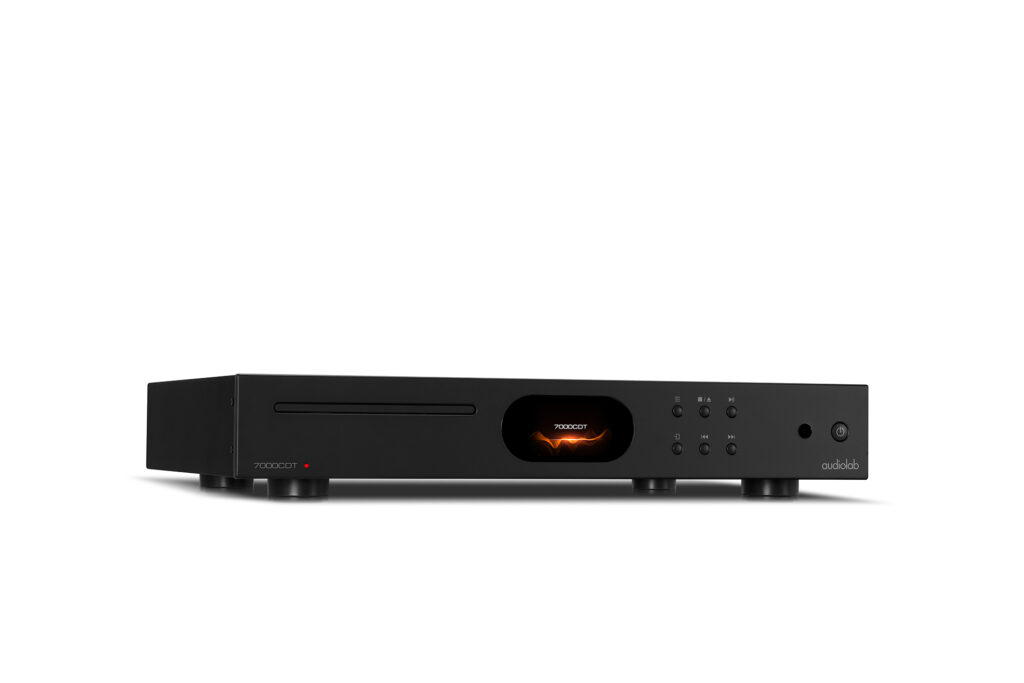
Audiolab 7000CDT (buy at Crutchfield) is a $999 CD transport, built around a low-jitter, temperature-compensated master clock, a shielded and isolated tray mechanism, and a design philosophy that keeps disc-reading duties completely separate from digital to analog conversion. It has no built-in DAC by design, which is the whole point: Audiolab’s 7000A integrated amplifier (read my review) and Audiolab 7000N Play (read my review) round out the matched three-piece 7000 Series, with the heritage of being U.K.-engineered, built under the International Audio Group (IAG) since the early 1980s. My assumption is it is the best of two worlds; Audiolab U.K. approach to engineering, user experience, design and sound, and IAG’s prowess in quality manufacturing. As with all the Audiolab products I reviewed, the packaging was high-quality and it was easy to unpack and set up.
I ran the Audiolab 7000CDT feeding an Audiolab 7000A directly, and also as a source into my Allnic L-7000 (read my review) preamp and Pass Labs XA30.8 (read the review) power amp, over a six-week review period, with my Marten Parker Trio (read my review) loudspeakers doing the work throughout. My review sample was silver, and it felt equally at home with my reference setup and in my rack with Audiolab’s 7000A and 7000N Play, sharing the family’s low, minimalist quality aluminum design. Having listened to all the Audiolab 7000 family products individually and as a system, it’s nice to see a dedicated, well-engineered transport for a physical CD collection is still a reality at this price.
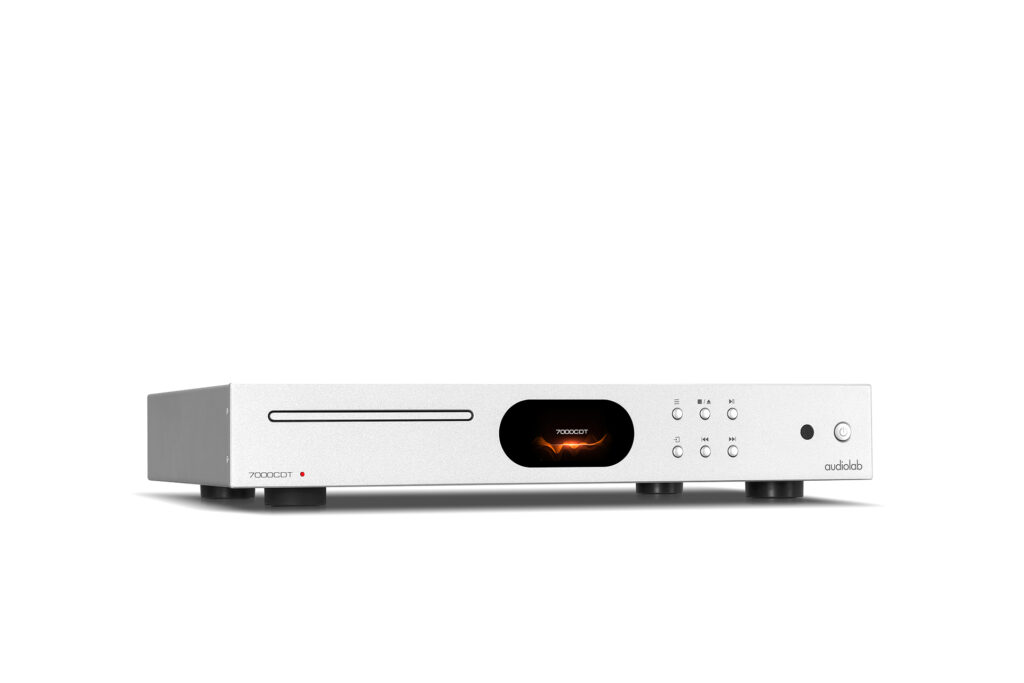
What Makes the Audiolab 7000CDT CD Transport So Special?
- As a dedicated CD transport, it isolates the CD mechanism’s vibration from the DAC and amplification stage, rather than combining everything in one chassis – a deliberate audiophile-oriented choice, not a cost-cutting one. This is the same separates logic that makes a dedicated preamp, phonostage, or outboard DAC worthwhile: one job, done well, in its own enclosure.
- The tray loading mechanism is markedly quiet, fast to read a disc’s table of contents and start playing. I must have opened and closed the loader 100 times and never had an issue with the mechanical movement, and every CD played right away, demonstrating a tight tolerance in positioning the CD.
- A high-precision optical pickup with a digital read-ahead buffer reduces reading errors, even on scratched or otherwise damaged discs. I purposely tried a few older CDs with scratches and did not have issues. For anyone with an older CD collection that might have a few less than pristine discs, consider the Audiolab.
- A temperature-compensated crystal oscillator and differential line driver on the coaxial output are engineered for vanishingly low jitter on both digital outputs. This is one of the fundamental design objectives of a quality dedicated transport, and Audiolab has clearly prioritized it.
- The transport mechanism sits in its own electromagnetically-shielded enclosure, powered by a dedicated custom Noratel toroidal transformer, rather than a shared supply. Nothing about the digital or mechanical side of this component feels like an afterthought.
- A rear USB Type-A input allows playback from storage devices in MP3, WMA, AAC, and WAV formats. It is not lossless or hi-res file support, but it is a useful bonus on a transport that could have skipped it entirely.
- A 2.8-inch full-color IPS display, shared remote and power-sync with the 7000A integrated amplifier via USB Control and a 12-volt trigger tie the whole system together. Standby on one component puts the whole stack to sleep, which is a small touch that can matter to the daily and possibly lazy listener.
- Build quality is the one area where I have no reservations whatsoever. The chassis felt properly finished rather than merely adequate, and it ran cool and completely silent for the entire review period, with no electrical hum and no dropped connections. For a $999 component, it simply doesn’t feel like one when you have it in your hands. The display stayed easy to read, even during the day when my room was well-lit. I put the 7000 CDT through its paces changing CDs often, interrupting songs, and fiddling around with the settings far more than most likely will. Solid and no issues.
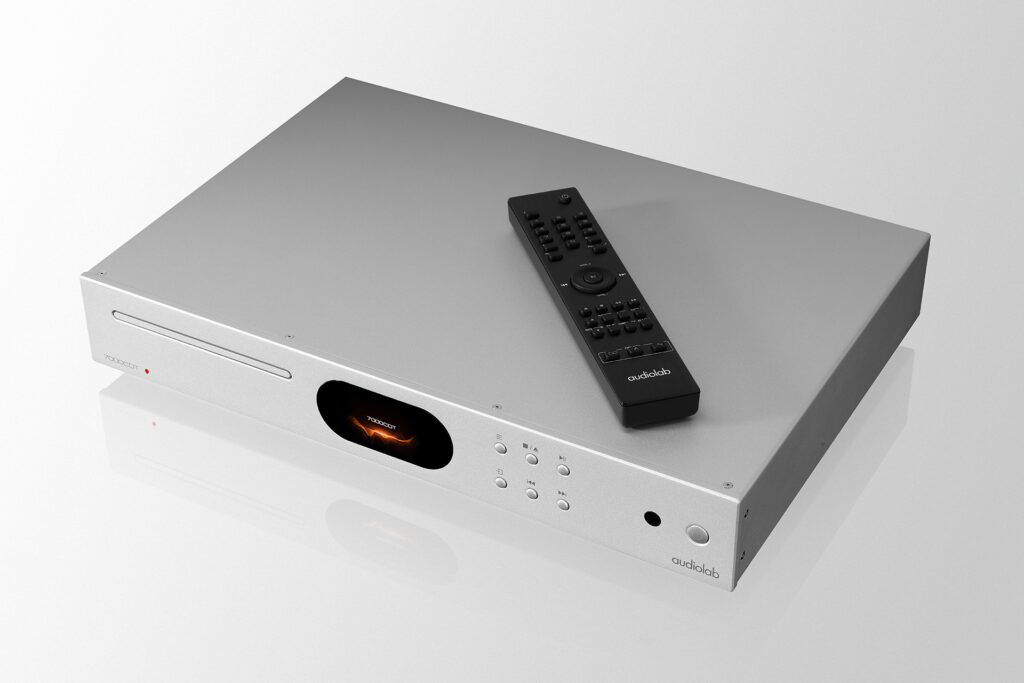
Why You Should Care About the Audiolab 7000CDT CD Transport?
Who is the Audiolab 7000CDT actually for? Anyone with an existing CD collection who wants a modern, well-engineered way to keep using it – especially owners of the Audiolab 7000A, or another capable outboard preamp or integrated amplifier, who want the best possible transport feeding it. It’s also a natural fit for separates enthusiasts who’d rather isolate a noisy mechanical transport from their DAC and amplification stage than buy an all-in-one CD player.
It’s also worth thinking about who this transport is not for. If you’ve fully moved to streaming and no longer spin physical discs, or if you want a single-box solution, the 7000CDT has no DAC of its own, so it only makes sense paired with one. This is not a limitation of the Audiolab 7000CDT so much as a statement of what a dedicated transport is.
I kept looking over at the Audiolab 7000CDT sitting beneath the matching 7000A. I find the series modern and clean, with a Scandinavian feel. The silver finish on my review sample looked sharp stacked with the rest of the system, and there is something genuinely satisfying about physically loading a disc into a component built this well, rather than tapping an app. I really like the aesthetics and how Audiolab has balanced a modern look with practical controls that should easily make sense in most environments and stand the test of time.
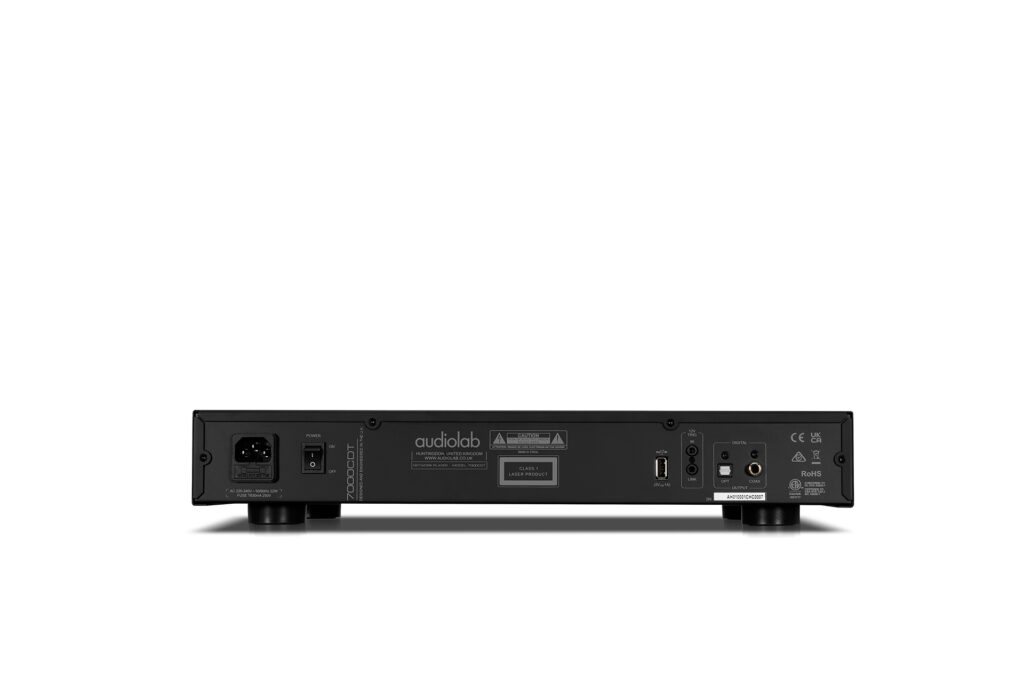
Some Things You Might Not Like About the Audiolab 7000CDT CD Transport
- The CD tray itself, while fluid in motion, feels a bit flimsy and lightweight relative to the rest of the chassis. It’s the one physical weak point I flagged, though it never affected performance.
- The Audiolab 7000 CTD only plays Compact Discs, thus has no SACD capability, which for some might be a miss. Not sure what it takes to also allow for SACD playback and, in all honesty, what the market is for SACDs, yet it would be nice and would allow the 7000 CDT to compete on features with additional and higher-priced units.
- The remote is shared with the 7000A and requires manually toggling between “amp” and “CD” modes. Some commands don’t map across automatically, which is a minor annoyance, but I was reminded of this often. For Audiolab to get so many things right for the 7000 CDT and its thoughtful-on-purpose complement with the other 7000 series products, this seems like a simple fix.
- The transport’s display has comparatively little to show – track and time information, an optional progress bar – and I found myself turning it off more often than not. It is a small thing on an otherwise excellent component.
- USB playback is limited to MP3, WMA, AAC, and WAV, with no lossless or hi-res file support from a USB drive. It’s a nice bonus feature, not a core one, so this is easy to overlook.
- There’s no onboard DAC by design, which is the whole point of a transport, but worth flagging plainly: this is a source-only purchase that needs a compatible DAC or amp to be useful at all.
Listening to the Audiolab 7000CDT CD Transport
Across both my system setups, the Audiolab 7000CDT’s job is a narrow one – read a disc cleanly and hand off a jitter-free digital signal – and it did that job without ever calling attention to itself. Feeding my Allnic L-7000 and Pass Labs XA30.8, the background was genuinely black and quiet, which let instruments sit against a clean canvas, rather than a hazy one. Feeding the 7000A directly, the sound leaned a shade warmer and, while not as cohesive and expansive as my full reference stack, it was sounding well above its weight class. Using the Audiolab 7000CDT as a source alongside the 7000N Play proved to be a great match, and the exclamation point came when running all three 7000 components together, which clearly shows a design intent around the 7000 Series products.
Bass was the standout quality for me. It wasn’t the biggest or most exaggerated bottom end I’ve heard, but it was tight, well-defined, and had real weight and pitch definition, rather than just generic low-frequency thump. Leading-edge attack on transient bass notes was quick and clean, without the smeared or one-note quality that is sometimes found with lesser transports. The midrange had good body and warmth without turning thick or syrupy, and vocals sounded natural, with the kind of tonal density that made voices feel like they were coming from a real chest and throat rather than a speaker.
Soundstage width was consistently good, wider than I expected for the price, with instruments placed distinctly left to right rather than smearing toward the center. Depth was a little more modest, not as deep and vibrant as with my reference system, yet for the price point, well-played. The Audiolab 7000CDT organizes a full band or a small ensemble convincingly but, on denser orchestral or big-ensemble material, it didn’t quite have the layering or three-dimensionality to fully separate a back row of players from a front row the way the best source components I’ve used can. I listened to a lot of CDs over the review period and thoroughly enjoyed my time with this purpose-built CD Player.
On Royal Blood’s “Figure It Out” (CD) from the band’s self-titled debut album (buy at Amazon), the bass guitar and drums are doing all of the work, and the Audiolab 7000CDT kept them properly separated, instead of letting the heavily-effected bass line blur into the kick drum. That’s a tougher trick than it sounds for a $999 transport, and the 7000CDT handled it with the same solid, well-controlled low end I have heard from the 7000A integrated amp. The bass had real weight and pitch definition without turning bloated, the attack on each note was quick, and the kick drum kept its own distinct thump underneath the bass line, rather than folding into it.
On Gregory Porter’s “Liquid Spirit” (CD) from the Grammy-winning album of the same name(buy at Amazon), Porter’s rich baritone sits over driving piano and gospel-inflected backing vocals, and this is where the Audiolab 7000CDT’s transparency to the downstream DAC came through best. Porter’s voice sounded full-bodied and grounded, rather than thin, with real chest resonance and none of the papery thinness that lesser components impose on a voice this low. The horns stayed resolved instead of congesting into a blur as the arrangement built toward the chorus, and the backing vocal stack behind Porter remained a distinct layer rather than folding into the lead.
The Weeknd’s “Blinding Lights” (CD) from After Hours (buy at Amazon) leans on bright synth arpeggios and a driving bassline, and it’s where I noticed the 7000CDT’s contribution most clearly by its absence – nothing added, nothing smeared. The synths were clean and never turned edgy or harsh, and the bassline underneath stayed tight, well-defined, and easy to follow throughout. For a track that can get fatiguing on a more aggressive system, the presentation stayed composed and controlled from the first bar to the last.
On Leon Bridges’ “Motorbike” (CD) from Gold-Diggers Sound (buy at Amazon), the track opens on a muffled, close-mic’ed guitar line before soft bass and drums slide in underneath, and the 7000CDT let that slow build unfold without rushing it or smoothing over the room tone baked into the recording. This is a warm, analog-leaning production, and the transport’s low-jitter clocking kept the low end from turning soft or one-note as the arrangement filled in.
On Adele’s “Easy on Me” (CD) from 30 (buy at Amazon), it’s just piano and voice for most of the track, which leaves nowhere for a weak transport to hide. The Audiolab 7000CDT handed off a genuinely quiet background, letting the piano’s decay trail off naturally instead of getting swallowed by noise, and Adele’s voice had real body and headroom rather than sounding compressed or flat.
On SZA’s “Snooze” (CD) from SOS (buy at Amazon), the sub-bass sits deep and controlled beneath layered, close-mic’ed vocal takes, and this is exactly the kind of modern, bass-forward mix that can turn muddy on a lesser front end. The Audiolab 7000CDT kept real separation between the low end and the vocal stack, never letting one bleed into the other, which speaks well of how cleanly it’s handing the disc off to the DAC.
On Immanuel Wilkins’ “Emanation” (CD), the opening movement from The 7th Hand (buy at Amazon), the quartet plus guest flute and percussion are captured with real spot-on imaging, and the 7000CDT preserved that placement cleanly, with the piano coming through full-bodied and harmonically detailed down into the bass notes. It’s a genuinely acoustic, minimally processed jazz recording, and the transport didn’t get in the way of any of the fine dynamic shading between the players.
On Julian Lage’s “Auditorium” (CD) from View With a Room (buy at Amazon), Lage and Bill Frisell’s two guitars intertwine throughout, and the 7000CDT kept enough separation and air between them that I could track each player distinctly even as the lines wove together. That’s a genuine test of a transport’s resolution, and it passed comfortably.
On Cécile McLorin Salvant’s “Wuthering Heights” (CD) from Ghost Song (buy at Amazon), Salvant opens completely unaccompanied with a reverberant, church-recorded vocal, before ominous wind effects and the band enter. The Audiolab 7000CDT let that reverb tail decay naturally and gave her voice real scale and air, which is exactly what a track built around a single unaccompanied voice demands from a source component.
Will the Audiolab 7000CDT CD Transport Hold Its Value?
The Audiolab 7000CDT will likely retain a good portion of its value better than most digital source components, and for a specific reason: unlike a network streamer, the 7000CDT isn’t tied to a software platform that can lose support down the road. It is a mechanical transport with a fixed job, so it should age more like an amplifier than like a streaming DAC.
Audiolab’s broader advantages apply here too: a U.K. brand with more than four decades of history under IAG, a strong reputation for reliability, and real liquidity in the used market. The CD transport category itself is a niche one in a streaming-first market, which could be read as a long-term risk – fewer buyers means it may take longer to sell used than a mainstream component. But physical media has shown real resilience among the exact audience likely to buy a $999 dedicated transport in the first place, and Audiolab’s execution here has been well-reviewed enough that resale demand should track the brand’s overall strength rather than the format’s broader decline.
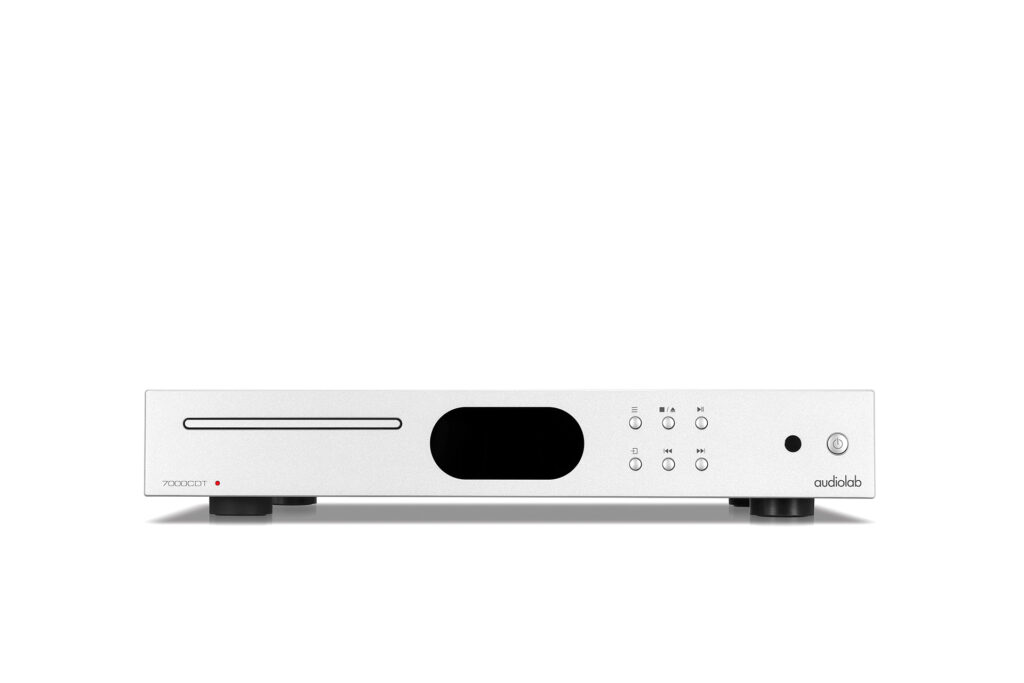
What is the Competition for the Audiolab 7000CDT CD Transport?
Dedicated CD transports with no onboard DAC are a small category, so the most useful comparisons bracket the 7000CDT’s $999 price, both against true third-party rivals and against Audiolab’s own siblings. None of these are obscure, Internet-only brands, either.
The Cambridge Audio CXC v2 (buy at Crutchfield) is the most direct third-party rival – a dedicated, DAC-less transport at a similar price. It’s a well-regarded, no-frills option, though it lacks the 7000CDT’s USB playback and shared-ecosystem integration with a matching amp.
The Audiolab 6000CDT (buy at Crutchfield at $549) is the entry point into Audiolab’s own transport lineup. It uses an older slot-loading “inhaler” mechanism that reviewers consistently rate as less pleasant and less refined than the 7000CDT’s tray design, making the step up feel worthwhile for anyone shopping within the brand.
The Audiolab 9000CDT (buy at Crutchfield for $1,499) is the flagship transport, built on similar principles with further refinement. It’s about 50 percent more than the 7000CDT’s price, and reviewers treat it as the ceiling of what Audiolab’s transport engineering can do, rather than as a value alternative.
The Roksan Attessa CD Transport at $699 is the closest direct price match to the 7000CDT, with its own MaestroUnite app for firmware and setup and real synergy when paired with Roksan’s own Attessa amplifier. It’s coaxial-only, though, with no optical or USB output, and it doesn’t carry Audiolab’s dealer and support footprint.
The TEAC PD-507T at roughly $1,699 brings a broadcast-derived transport mechanism, independent power supplies for its clock and output stages, and a 10MHz external clock input for future upgrades. It’s a genuine step up in engineering ambition, but at nearly double the 7000CDT’s price, with no USB input.
None of these fully replace the case for the 7000CDT if you already own or plan to buy the matching 7000A: the shared remote, synced power, and cohesive design make the in-family pairing the path of least resistance.
Final Thoughts on the Audiolab 7000CDT CD Transport …
The Audiolab 7000CDT (buy at Crutchfield) is a $999 CD transport that does exactly what I want a component at this price to do: it doesn’t call attention to itself, it doesn’t cause problems, and it gets the fundamentals of good disc playback right. Across two different systems and two different amplification approaches – the Pass Labs and Allnic combination on one side and Audiolab’s own 7000A and 7000N Play on the other – I got solid bass, a believable soundstage, and a tonal balance that never asked me to make excuses for the price. It isn’t reinventing what a CD transport can do, but I never ran into a real problem during my time with it, and it paired especially well with the rest of the 7000 Series, exactly as the company intended.
What ultimately impressed me most wasn’t any single measurement or any one disc. It was the total absence of audiophile drama. Nothing dropped out, nothing sounded thin or fatiguing, and nothing about the build or the interface made me second guess the price. Audiolab has clearly figured out how to do it consistently across the entire 7000 Series. If you’re building a system around the 7000A, or simply have a CD collection you’re not ready to give up on, the Audiolab 7000CDT is a solid choice.
Compare it with our reviews of the Music Hall CD25.3, Rotel CD11 Tribute and Panasonic DP-UB820. Comparing options? See our audiophile CD player reviews from FutureAudiophile.com.




Nice review. I often recommended the Audiolab or Cambridge to folks wanting a decent CD transport. But as a backup to my tried and true Electrocompaniet EMC-1 UP i bought a surpisingly nice SMSL semi-portable player that’ has a terrific transport and fine build quality for well under $1k. I don’t question that any of these affordable players can rival my 20+ yr old 20kg Electro, but I’ve heard good things about the new Shanling….
As someone who has a few thousand CD’s I am always happy to see a disc player review. I enjoyed reading it as well as listening to Frank’s music selections. I wish the Audiolab also did SACD’s as I also have a ton of those. Thank you for another excellent review!
CD Transports read binary numbers, not music. Ask a prospective lover for their telephone number. If he/she gives you a number at all, it is either right or it is wrong – there is no “a little bit wrong”. Numbers to be translated into an amplitude staircase at the rate of 44.1 kHz are the same. Once we achieve that the correct numbers are sent to the DAC at the right frequency, a higher quality at the transport stage simply does not exist. Many cheapskate CD transports already achieve exactly that, with no need for buffering, until the laser pickup conks out.
So I’ll put your remarks about perceived variance in sound quality from transports down to romanticism. It’s not that I won’t buy one now, just that I’ll buy it for different reasons and I’ll still buy the first round of beers when we sit down to punch it out. Maybe it WILL play through peanut butter traces from my saamie and have half a dozen chances of getting the right binary number into the buffer even when the laser is tired. I hope the flimsy looking tray is alloy, not plastic (you could have told us that). It is understated smart, it has track programming which is essential for my listening habits, they claim it can play mp3 files in the thousands (65,535!!? the book says), it has a USB port (on the wrong side) but most of all I am searching for info on reliability and in particular life of their lasers. The 3 to 4 years (far less than 2000 hours) typical life I get from mid-range CD players lasers is just not good enough (yet my 25 year old PIONEER dvd players lasers go forever). Have Audiolab stuck something better than the common Philips/Sanyo in?
Cheers