
 By
For a long time, I considered the streamer primarily as a functional piece of gear in a digital front end where differences were primarily tied to features and ease of use. The attention went to the DAC in shaping the music. How much the Matrix NT-1 streamer transport shapes noise floor, timing, and the overall sense of ease in a system surprised me, and that realization is what made the time I spent with the Matrix Audio NT-1 so worthwhile. While there are plenty of good all-in-one components with preamp, DAC, and a streamer in a single chassis, there is a level of musicality that shows up with network equipment separates and, in particular, with the Matrix NT-1 streamer. The Matrix NT-1 brings a level of maturity to the sound that a single-chassis solution rarely matches, and for listeners who can afford to go that route, it is worth every bit of the extra investment.
The Matrix NT-1 is a $3,999 network transport from Matrix Audio, a China-based manufacturer that has spent nearly two decades refining digital source components. The Matrix NT-1 does one job: it retrieves digital music from a streaming service, a network share, or its own onboard or USB-attached storage, and hands that signal off to an external DAC in the cleanest state it can manage. There is no digital-to-analog conversion on board and no volume control, only five simultaneous digital outputs, a dual-mode femtosecond clock, a full internal linear power supply, and a wired-only network design built around Gigabit Ethernet and an SFP fiber cage. $3,999 puts it firmly in the middle of a crowded transport category, and it is one of the more complete arguments out there.
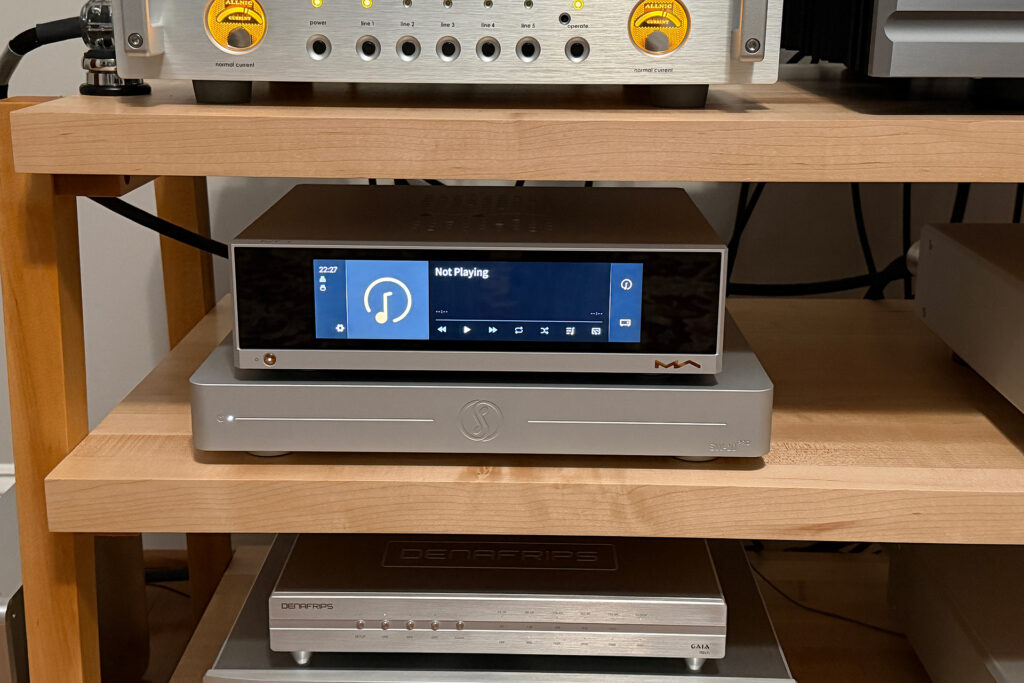
I ran the NT-1 into my reference system, feeding my Denafrips Terminator Plus 15 (read my review) DAC, Allnic L-7000 (read my review) preamp, and Pass Labs XA30.8 (read the review)power amp, with my Marten Parker Trio (read my review) loudspeakers doing the work throughout.
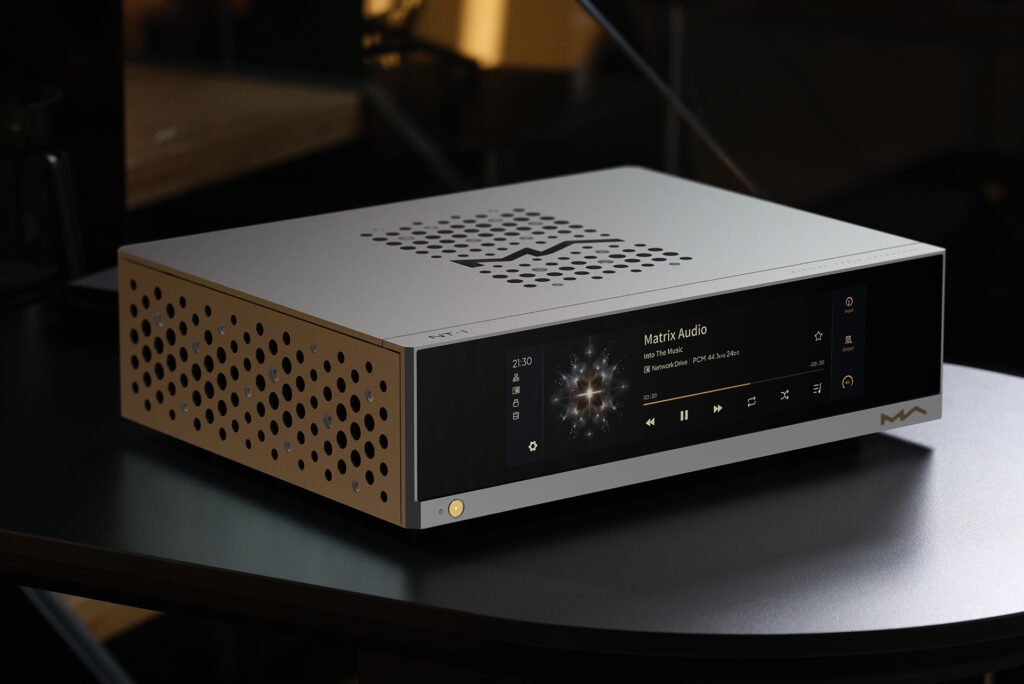
What Makes the Matrix Audio NT-1 Network Transport Special
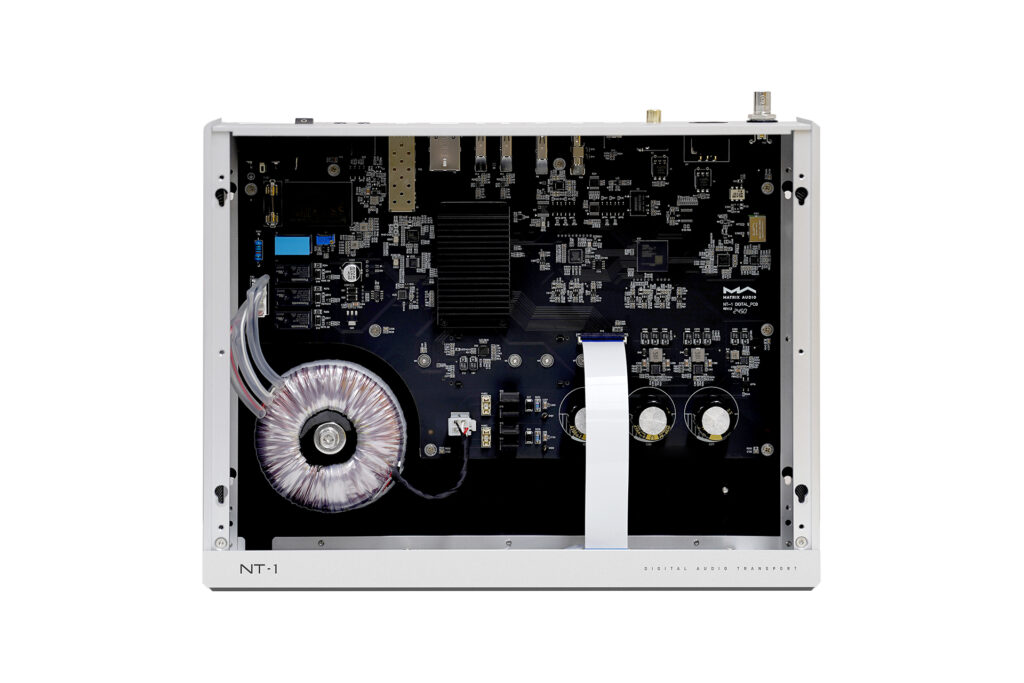
Matrix Audio’s engineering philosophy for the NT-1 centers on one idea: simplicity done exceptionally well. Strip away the DAC, the volume control, and everything else a transport doesn’t strictly need, and put every bit of engineering effort into keeping the digital signal as clean and low-noise as possible before it ever reaches an outboard DAC. It shows up everywhere you look inside the chassis.
- A full internal linear power supply built around a 60-watt toroidal transformer, with independent windings and low-dropout regulators that keep the digital processing core electrically separate from the USB DAC output stage.
- A dual-mode femtosecond clock system inherited from Matrix Audio’s flagship M Series,running its own RF synthesizer for low-phase noise standalone use, or accepting an external 10 MHz reference for owners who want to chase jitter performance further down the road.
- An isolated, audio-specific USB DAC output with galvanic isolation between the USB port’s ground and the chassis ground, engineered specifically to keep computer-borne noise out of the signal reaching the DAC.
- SFP fiber networking alongside standard Gigabit Ethernet, giving owners a genuinely isolated optical path into the transport rather than a single copper connection.
- An onboard M.2 NVMe SSD bay on its own dedicated, ultra-low-noise power rail, turns the NT-1 into a real network transport and local music server rather than just a network bridge, with the option to share that storage back over the network, and to rip CDs directly to it through an external USB drive. I did not specifically put the onboard NVMe storage itself through its paces, though I have no reason to expect issues.
- USB external drive with auto discovery allowed me to easily use my full five-terabyte music library mounted and indexed quickly, rather than triggering a long rescan.
- An 8.8-inch color touchscreen with album art, sample rate, and clock source allowed me large and easy access to key user data in my time with the unit.
- Setup was about as close to plug-and-play as a network transport gets, and the software feels mature: the Matrix Player app is simple, purposeful, and intuitive, and the two firmware updates installed cleanly.
- Automation trigger inputs and outputs for power sequencing with a paired DAC or amplifier, a small touch that speaks to how thoroughly Matrix Audio thought through the NT-1’s role.
- A CNC-machined, sandblasted aluminum chassis with a perforated top and side panel doing double duty as heat dissipation and RF shielding. In hand, it feels like a component built to a higher price than $3,999.
- A solid list of streaming services and integrations: Qobuz, TIDAL, Spotify (lossless), Apple Music, and HIGHRESAUDIO, plus Internet radio, Roon Ready endpoint, and AirPlay 2 integration.
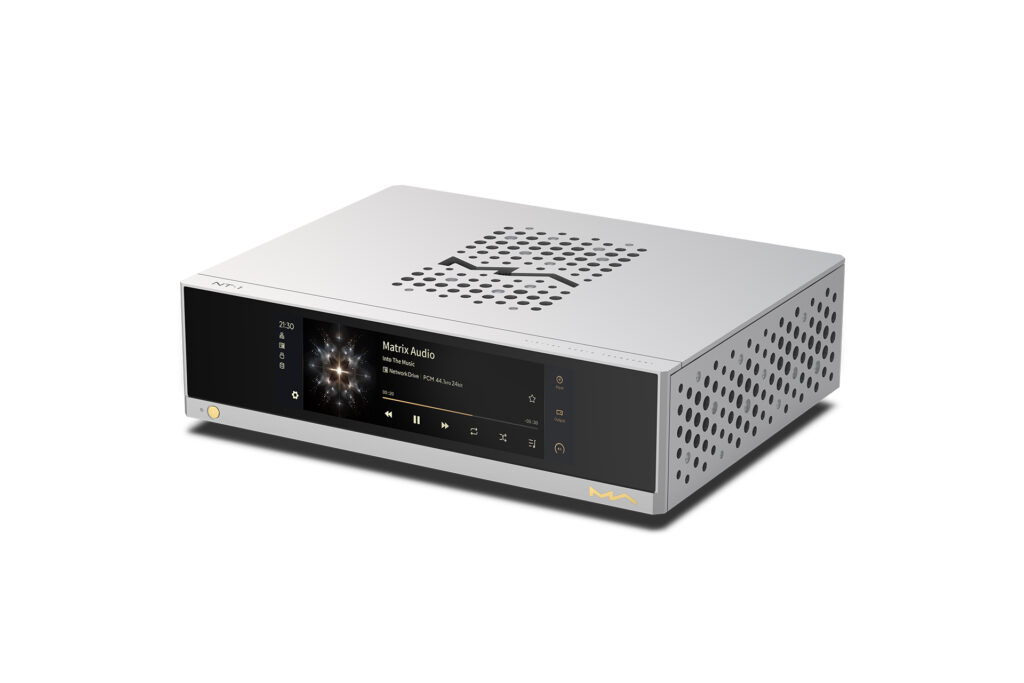
Why You Should Care About the Matrix Audio NT-1 Network Transport
Who is the NT-1 actually for? Anyone assembling a serious digital front end around a resolving DAC who wants a transport that disappears into the system rather than adding its own signature, and who does not want to spend five figures to get there. Because the NT-1 has no volume control and no analog output of its own, it requires a DAC, a preamp or an integrated amplifier with a built-in DAC, capable of doing that job. It’s a good fit for anyone who wants the option to run local storage and streaming from the same box.
It’s also worth being honest about who this isn’t for. If you want an all-in-one streamer, DAC, and preamp in a single box, or if a bundled remote control and WIFI flexibility matter more to you than a genuinely musical streamer, the NT-1 is not for you.
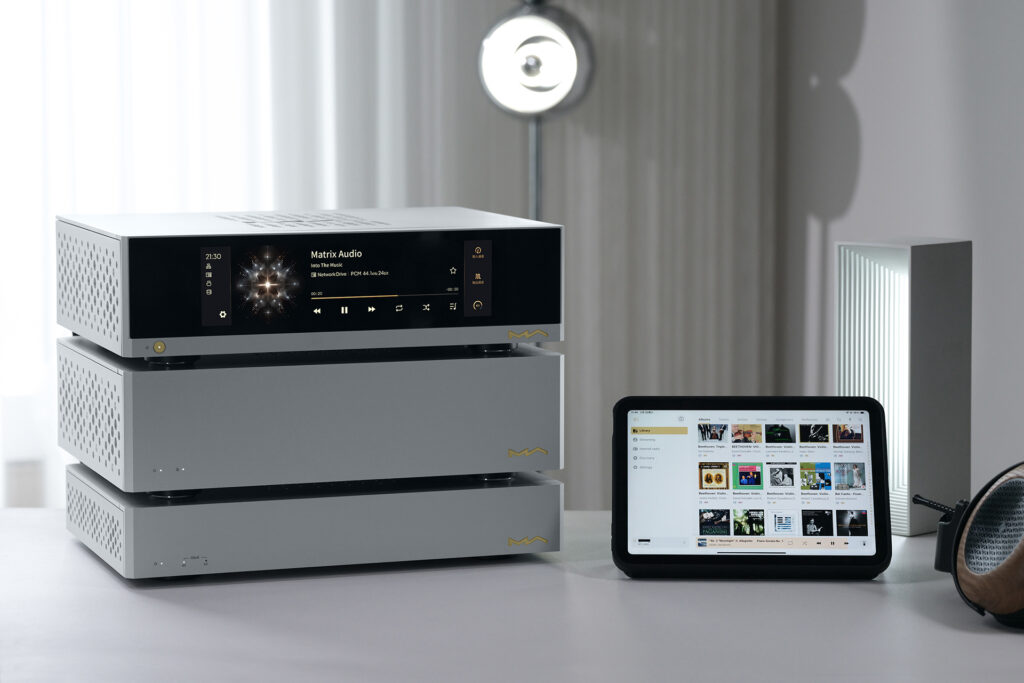
Some Things You Might Not Like About the Matrix Audio NT-1 Network Transport
- There is no remote control, which for some can be a minus. Between the large and clear screen and the Matrix app, I didn’t miss a remote, but that’s me.
- The outboard clock once was only set to 24 hours but that has been modified by a software update which is a small but thoughtful little upgrade.
- There is no WIFI connectivity, so anyone without an existing Ethernet run to the listening room will need to add one, or run a point-to-point wireless bridge before the NT-1 can even join the network.
- Browsing local files by folder, rather than through the library view, can be less polished than the streaming-service side of the app, which is a minor daily friction point for anyone who keeps music organized in nested folders.
- Bass is tight and well-controlled, but is a touch lean rather than full, and the soundstage, while appropriately wide and tall, does not open up to quite the scale a costlier transport can throw in the same system.
- While requiring the less than audiophile workaround using Apple’s AirPlay2, among the streaming services not included are Amazon Music, Pandora, Deezer, and YouTube Music.
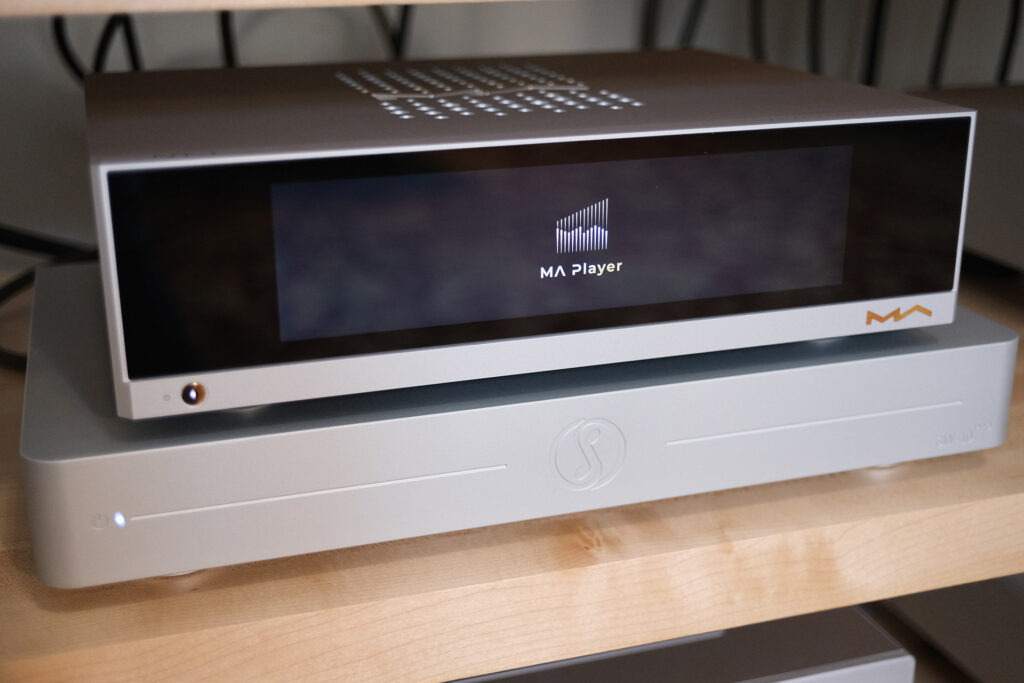
Listening to the Matrix Audio NT-1 Network Transport
The NT-1’s sonic character is clean and unusually free of grain, especially for a $3,999 component. What struck me first was how genuinely quiet the background is: music simply emerges from black, and that noise floor is exceptionally low, on par with units costing a lot more. That quiet is what lets fine detail through without ever tipping into an etched or clinical presentation, and more than once it let me forget I was listening to a piece of equipment at all. Dynamics are very good, imaging is accurate, and the top end stays smooth and extended without turning hard. I ran most of my listening off my own USB-attached music library on an external USB drive rather than the onboard storage and Qobuz as my dedicated streaming service. Where I had both the local file on my hard drive and the Qobuz version, I compared the two. As expected, the local version sounded better, yet the streamed version was, in most cases, close. This is a tribute to the Matrix’s streaming quality of low noise, signal integrity, and musicality.
Steven Wilson’s “What Life Brings” from The Harmony Codex (buy at Amazon) is a densely layered modern production, and it is a good first test of whether a transport can keep a complex mix organized, rather than merely detailed. The NT-1 placed Wilson’s voice with real stability and let the guitar and keyboard layers separate cleanly as the arrangement thickened, without ever pushing brightness or edge to make the point. Bass stayed defined, even as more instruments piled into the mix, and the sense of depth behind the vocal was convincing, rather than flat. More than once, I caught myself following the arrangement instead of picking it apart, which is exactly what a transport this transparent should let you do.
David Gilmour’s “In Any Tongue” from Rattle That Lock (buy at Amazon) opens on a restrained, largely atmospheric passage before building into a full guitar climax, and it is exactly the kind of large dynamic swing that exposes a transport’s composure. The NT-1 kept the opening’s very quiet information intact, with real weight and texture in Gilmour’s voice and genuine depth behind it. When the guitar solo arrived, it expanded without ever turning hard or congested. Discipline under a big dynamic rise is not a given, especially at this price, and the NT-1 handled it without strain. By the time the solo faded out, I had stopped listening like a reviewer and just listened.
Rhiannon Giddens’ “At the Purchaser’s Option” from Freedom Highway (buy at Amazon) surrounds her voice with acoustic instruments recorded with real intimacy, and it is a fair test of whether a digital front end preserves natural instrumental color. The NT-1 let banjo and bowed strings stay distinct from one another, rather than blurring into a single acoustic wash, and Giddens’ voice had real body and breadth, rather than sounding thin or papery. There was air around individual instruments that gave the whole recording a sense of a real room, rather than a processed studio take. It was intimate enough that I felt like I had been let into the room, rather than handed a recording of it.
Sarah Jarosz’s “Orange and Blue” from World on the Ground (buy at Amazon) is a beautifully controlled acoustic recording, and its uncluttered arrangement made small changes in noise floor and image focus easy to hear. The NT-1 kept Jarosz’s vocal image stable and sized correctly, with the difference between a string’s initial attack and the body of the instrument clearly resolved, and quiet reverberation trailing off after phrases rather than getting swallowed by the mix. It is a strong track for talking about low-level resolution without leaning on anything flashy, and the NT-1 made its case quietly and convincingly. I found myself leaning in, rather than reaching for the next track.
Samara Joy’s “Can’t Get Out of This Mood” from Linger Awhile (buy at Amazon) is a contemporary jazz recording built on classic ensemble values. It asks a transport to keep voice, piano, bass, and drums spatially distinct, while still sounding like musicians playing together rather than isolated tracks, a solid test for any music source. The NT-1 handled that balance well, with the walking bass staying tuneful and precisely pitched, cymbal decay trailing off naturally, and Joy’s voice sounding open and unforced against the group. The swing of the whole performance came through intact, which is the real test this track sets. I ended up nodding along more than analyzing, which is usually the best sign a system is doing its job.
Dire Straits’ “Private Investigations” from Love Over Gold (buy at Amazon) is a familiar audiophile reference for good reason: near-silence, resonant guitar, and very large dynamic swings all in one track. The song should start out soft and warm and, through the Matrix, it does. The NT-1’s quiet background paid off immediately here, with sharply localized percussion and effects against a genuinely black opening, and the sudden dynamic jumps later in the track arrived cleanly rather than compressing into a smear. This is exactly the kind of track that separates a transport with a real noise-floor advantage from one that only sounds quiet on paper, and the NT-1 earned its keep. I turned the volume up instead of down, which tells you plenty about how comfortable that quiet made me.
Pink Floyd’s iconic “Money” from The Dark Side of the Moon (buy at Amazon) is familiar enough that any weakness in a source component has nowhere to hide, and it remains one of the better tests of transient precision and channel placement around. I hadn’t listened to this song in years, so I wasn’t sure what to expect. The NT-1 kept the opening sound effects sharply located and rhythmically locked, the bass line had real pitch and propulsion, rather than turning into an undifferentiated rumble, and the saxophone carried both bite and body without ever sounding hard. Louder passages stayed open, rather than congested, which is not always the case with a familiar track played at real volume. I played it louder than I probably should have, and the NT-1 never once suggested I back off. This song represents to me the norm in listening where most recordings are good, not great. and provides a real-world front-end test, whether analog or digital. The Matrix impressed.
The Bill Evans Trio’s “Waltz for Debby (Take 2),” recorded live at the Village Vanguard, from Waltz for Debby (buy at Amazon) closed out my listening notes, and it may be the single best track here for judging low-level resolution. The NT-1 let the club’s ambience stay present behind and around the trio, rather than collapsing into silence between phrases, with Scott LaFaro’s bass agile and clearly pitched and the piano’s harmonic decay trailing off in a way that felt continuous, rather than cut short. That kind of believable, unforced decay is a strong indicator of low-jitter clocking, and it is where the NT-1’s engineering choices paid off most clearly. It is recordings like this that help many analog source fans win the argument yet, in this case, the Matrix showed its musicality and maturity. For a few minutes near the end, I forgot I was reviewing anything at all.
Will the Matrix Audio NT-1 Network Transport Hold Its Value?
Going into this section, I wondered whether resale value on a computer-based transport is a strength or a genuine question mark. With the NT-1, the honest answer, much like the category as a whole, is a mixed picture. On the strength side, Matrix Audio has spent a decade building a reputation specifically around network audio, and continues to push firmware updates that add real functionality. Spotify Connect Lossless and Apple Music support have both arrived on the platform well after launch, and the NT-1’s core engineering, a linear power supply, isolated USB, and external clock support are the kinds of things that age well, rather than looking dated in a few years. Wide distribution among specialist audio dealers and a name that shows up consistently in comparison threads and published reviews both help here, too, and a company actively marketing itself around a decade of focus in this category tends to keep supporting what it has already sold.
What is the Competition for the Matrix Audio NT-1 Network Transport?
The NT-1’s $3,999 price and DAC-less architecture put it in a specific, well-populated segment of the market, so I have bracketed the comparisons both below and above its price. None of the products below are obscure, Internet-only brands, and every one of them is worth cross-shopping before writing a check.
The Lumin U2 Mini at $2,400 has genuine transport architecture with no DAC to work around, Roon Ready certification, and MQA support the NT-1 does not offer. It is the right call for a buyer chasing Lumin’s house sound at a lower entry cost, but it cannot match the NT-1’s linear power supply, external clock input, SFP fiber networking, or onboard NVMe storage, and listeners who have heard both consistently describe the NT-1 as the more resolving, lower-noise component of the two.
The Eversolo DMP-A8 (buy at Amazon) at $1,980 is a good comparison: on paper, they are close, yet as both are pure transports feeding an outboard DAC, the NT-1 is the more refined performer. The Eversolo leans towards a more useful and flexible device where the Matrix stays true to its single purpose of doing one thing exceptionally well.
The dCS Network Bridge at $4,250 trades on dCS’s engineering pedigree, dual AES/EBU and word-clock inputs and outputs. It is an older design at this point, and it does not offer SFP fiber, I2S output, or onboard storage, but it remains a credible alternative for a buyer specifically drawn to the dCS house sound or planning to eventually add a dCS DAC. It has no display, which might be a factor for some.
The Aurender N20 (read my review), at $16,000, is my new reference transport, and I was able to spend real time comparing the two directly in the same system. On paper, the two share a surprising amount of philosophy: both are pure digital-output transports with isolated power supplies and precision clocking, and both offer an isolated USB output alongside conventional S/PDIF and AES outputs. Where they diverge is character. The N20 leans warmer, denser, and more overtly analog-like, with a larger scale than the NT-1 throws in the same room; the NT-1 is the more modern and analytical of the two, cleaner and every bit as dynamic, without adding warmth for its own sake. That the NT-1 invites this comparison at all, at roughly a third of the N20’s price, says most of what needs to be said about where it stands.
Final Thoughts on the Matrix Audio NT-1 Network Transport …
The Matrix Audio NT-1 is a $3,999 network transport that does exactly what a component at this level should do: it manages music, retrieves a digital signal cleanly, hands it to a DAC without adding its own signature, and gets out of the way. As with just about any piece of audio equipment, compromises get made, and the better companies know exactly where to make them. Here, the trade-off is simplicity: a streamer with no audiophile-level DAC or preamp, built around an exceptional power supply that keeps noise low, clarity without an edge, solid soundstaging, and a smooth overall signature. It is only once you start considering meaningfully costlier streamers that real differences in musical body, dimensionality, and soundstage depth start to show up. Matrix Audio made the right compromises here, and the result is a $3,999 streamer that is audiophile-grade, well-built, correctly-featured, and one I would expect to serve its owner for years.
What stayed with me longest was how little I thought about the equipment once it was set up and running. The NT-1 disappeared into my system the way a genuinely good source component should, leaving a clean, quiet, modern presentation with excellent dynamics and nothing added for its own sake. For anyone assembling a serious digital front end around an external DAC and looking to spend well under five figures to get there, the NT-1 is an easy recommendation and one of the strongest values I have heard in this category in some time. It is a small box with a big job, and it does that job about as well as anything I know of at the price.



