
 By
By There isn’t an audiophile out there who doesn’t have a story about how they have abused their hearing at one level or another. Car stereo systems are a likely historical venue for past auditory abuse. Workplace noise is another common one. For me, it was seeing Metallica on the … And Justice for All Tour at the Philadelphia Spectrum circa 1989. The funny part was that Metallica wasn’t as loud as the opening act, The Cult. Years later, for my 25th birthday, I ended up meeting the band members from The Cult (and John Bonham’s widow and family) at a club in Hollywood and I told them just how loud they played. They couldn’t have been happier to hear the report all those years later. Realistically, it is a miracle that I have the hearing left that I do. Now that I am a father of two boys, I only hope to protect their hearing better than I did when I was their age. When I took my older son and his 13-year-old buddy to see the Grammy-winning surf-punk-metal act Turnstile at USC in 2025, I had them wear earplugs. When I took my four-year-old son to Maui, he needed a cool travel rig like his Dad. Listening to headphones too loudly (especially over long periods of time) is really bad for hearing. This is why I got him a pair of Puro headphones for the trip.
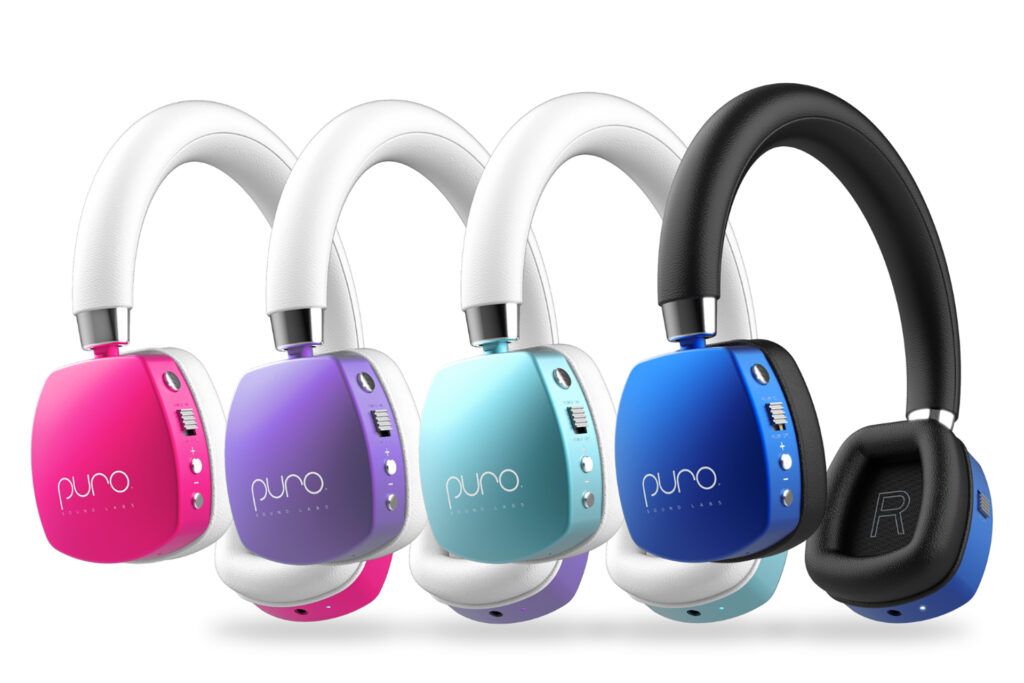
The PuroQuiet Plus ($119 – buy at Amazon) from Puro Sound Labs is a pair of on-ear, Bluetooth, active noise-canceling headphones made specifically for kids. Adults know better than to blow their hearing out, but kids would be well-served being more protected, and that is the stated goal of Puro with these headphones. How do they work? How do they sound? Are they worth it? That’s what we are here to explore.
What Makes the PuroQuiet Plus Kids’ Headphones So Special?
- The PuroQuiet Plus headphones limit output volume to 85 dB. Puro does this with DSP (digital signal processing) rather than a resistor in a cable, and the idea is that the kid never really “hits a wall” on the volume knob. 85 dB is the number you will see referenced in hearing-safety guidelines for long listening sessions, and that is the whole point of these headphones. Your kid can’t override it, and neither can their friend who knows how to get into the settings on the iPad or other kid-hackable devices.
- The active noise cancellation reduces up to 22 dB of outside noise. This is a design concept that makes the volume limit actually work in the real world. Without ANC, a kid on an airplane or a school bus might realistically push the volume up to compete with the background noise. With a little ANC, the need is less. Is it Sony- or Bose-level ANC? No, and Puro doesn’t claim that this is what they deliver, but it really helps without creating too much of an ANC bubble for the kids.
- The battery life on the PuroQuiet Plus is rated at 35 hours with ANC off and 23 hours with ANC on. By today’s standards, that isn’t the longest battery life but it is realistically quite a long time. Also, if a pair of Puros were to be left to drain to no battery – you can recharge them via USB-C very quickly. A 10-to-15-minute charge gives you lots and lots of additional listening time.
- There is a wired connection option with a volume-limiting cable included. If the battery does run out, or you are on an airplane with a seatback screen, the included 3.5mm cable still keeps the volume limit in place. This option is nice to have, but personally not one that I want from a wireless pair of headphones.
- Puro includes a daisy-chain cable, which is really thoughtful. This allows two sets of headphones to share one audio source. Anybody who has had two kids fighting over one iPad in the back of a car on a road trip understands the value of this little cable.
- The PuroQuiet Plus comes with a pretty nicely appointed hard-shell carrying case. I abuse the hell out of my wireless headphones, because I refuse to use such a case (all my headphones have them), yet for some reason, we always use the case for the Puros, which are still in near mint condition thanks to the case and careful attention.
- The PuroQuiet Plus uses a 40mm dynamic driver and is reported at 20 Hz to 20 kHz with less than one percent THD. That’s a pretty big driver for a small ear cup and some pretty good frequency range performance.
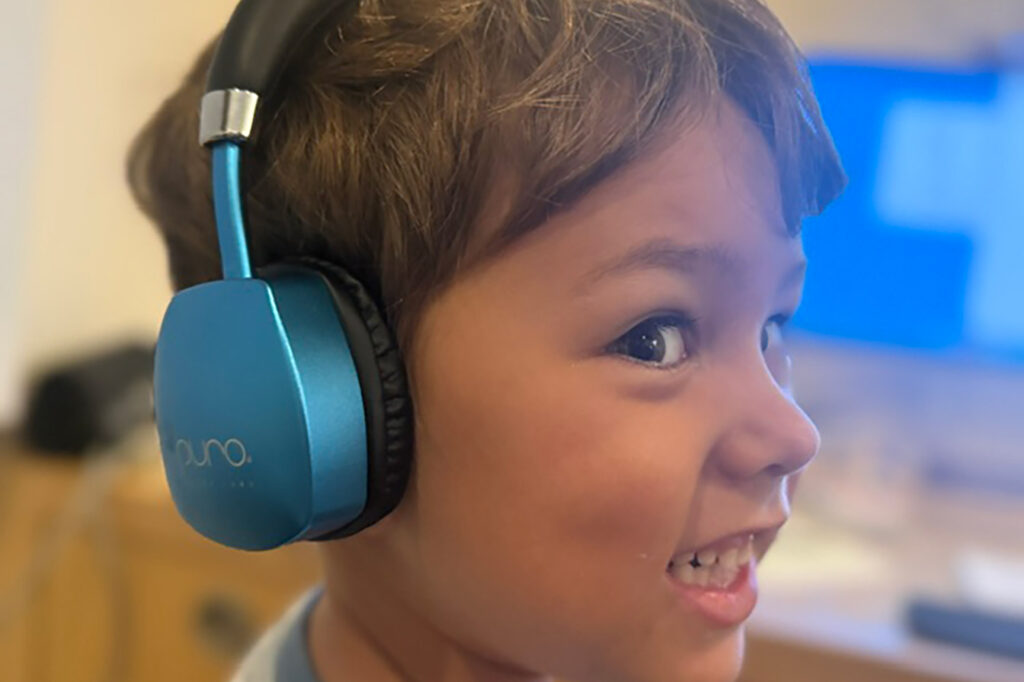
- There is a built-in microphone for online school, video calls and gaming. My older son uses ROG (Republic of Gaming) headphones with a robust microphone for collaborating while playing Roblox, Fortnite and other video games. My little guy doesn’t have those needs, but the microphone functionality is a nice plus.
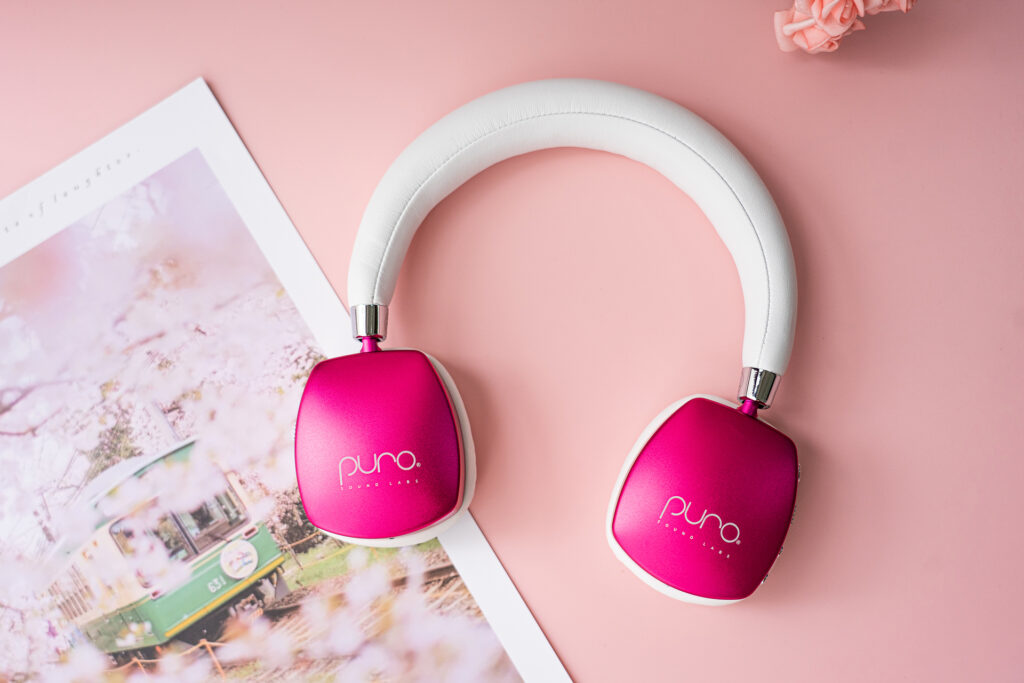
- The vibrant colors offered are perfect for kids. Teal, dark blue, light pink and purple are on Puro’s site right now. My son’s pair is in the teal finish.
Why Should You Care About the PuroQuiet Plus Kids’ Headphones?
At FutureAudiophile.com, we talk a lot about how to grow the hobby with the next generation of music lovers. If you are basically hard of hearing by the time you are in high school, then you don’t really need a pair of $20,000 monoblock power amps years down the road.
As a parent, protecting my kids’ hearing is just me doing my job. As an audiophile and publisher, introducing the hobby to younger people is my stated goal in the mission statement of this publication. Protecting their hearing from an early age seems really reasonable to me and likely for the young people that you know in your world, thus why I am so fond of their design philosophy of hearing protection for kids.

Some Things You Might Not Like About the PuroQuiet Plus Kids’ Headphones
- The PuroQuiet Plus is an on-ear design, not over-the-ear. On-ear headphones are lighter and better-sized for smaller heads, but they don’t seal out sound as well as over-the-ear cups, and some kids will find the clamping force a bit much on long sessions, but allowing a little external sound to leak in has a safety upside that I also like. I often mention in my over-the-ear, ANC headphone reviews that you want to be careful when walking down the street with the ANC on, as you could get run over in the crosswalk if you are not careful. Kids are even more susceptible.
- The ANC is pretty good, but it is not flagship-level. If you are comparing these to your own Sony or Bose headphones (at a much higher price), you can hear the difference, but there is a reason for this, which we’ve already explained.
- The 85 dB limit is fixed. It would be cool to adjust the volume limits, but that is by no means a deal-breaker.
- There is no Puro app for these headphones. No EQ and no firmware updates from your phone, as well as no parental dashboard. Your kids might expect an app but, at these prices, I think I can live without one and not be too bummed out.
Listening to the PuroQuiet Plus Kids’ Headphones
“Superstition” from Stevie Wonder’s Talking Book album is a 1972 R&B classic, as well as a fantastically catchy audiophile demo track. The Bob Margouleff-produced song is layered with horns and other tasty instrumentation, and that came across very nicely when listening to the PuroQuiet Plus headphones. The bass wasn’t hitting subsonic depths (it never does on headphones like this), but it sounded groovy and fun. The horns sounded warm, rich and layered. I was impressed.
In looking for a fun, kid-friendly jam, I cued up the Bruno Mars/Mark Ronson song “Uptown Funk,” which my younger son thinks is just great. I liked the PuroQuiet Plus headphones’ ability to present depth on the syncopated call-and-response background vocals. The horns were even more poppy and vibrant on this track than on “Superstition,” which is likely the result of the modern recording. The bass guitar felt lit. It hit deep notes, but the articulated bass chops were tasty-sounding, too. If you can’t groove to this song, then something might be wrong with you.
My favorite demo in the modern era is Beyoncé’s cover of “Blackbird,” which brings the songwriting of Lennon and McCartney to the female voice of our generation with a modern, reinvented production. It is pure audiophile gold for any system. On the PuroQuiet Plus headphones, Beyoncé’s voice sounded warm and engaging. Again, the layering and depth was well-presented (even with the headphones jammed on my head, which is a me problem, not a Puro problem), well beyond my expectations for headphones at this price point, let alone ones with all of the other thoughtful features.
Will the PuroQuiet Plus Kids’ Headphones Hold Their Value?

What is the Competition for the PuroQuiet Plus Kids’ Headphones?
The BuddyPhones Cosmos+ ($99.99) is the most direct competitor. They are over-the-ear rather than on-ear, have ANC, and offer three selectable volume limits of 75, 85 and 94 dB, with roughly 24 hours of rated battery life. The adjustable limit is a plus for little kids. The 94 dB setting is a minus perhaps, as that is a little loud for hearing protection – especially over long listening sessions.
Puro also makes the BT2200-Plus ($99), which is the same 85 dB volume-limiting idea without ANC, as well as the step-up PuroPro Hybrid ANC headphones ($149 list). If your kid mostly listens at home in a quiet room, the BT2200-Plus saves you $20. If they travel, I’d spend the extra money on the PuroQuiet Plus for the ANC.
When your kid graduates to adult headphones, you are into a whole different category. Something like the Sony WH-1000XM6 (read my review) offers world-class ANC, but understand that there is no hard volume limit on adult headphones, so the conversation about safe listening levels becomes a parenting issue and not a hardware one.
Final Thoughts on the PuroQuiet Plus Kids’ Noise-Cancelling Headphones
The PuroQuiet Plus headphones not only open up the audiophile world to kids, but protect their hearing at the same time. That is the definition of an audiophile win-win value proposition. These headphones are affordable, well-considered in terms of design and pretty durable. They have the visual appeal that kids will love and sonic appeal that will keep them engaged from here to Maui (a proven fact). My little one wears them down to the pool at my condo, as he is a total fan. That might be the biggest compliment that I can give to these smart, sexy and attainable headphones that have their heart (and your kid’s ears) in the right place.



