
 By
By PS Audio spent nearly five decades building a reputation in audiophile electronics before entering the loudspeaker arena in 2020 with its flagship Aspen FR30, a speaker designed to meet CEO Paul McGowan’s uncompromising standard for resolution and truly full-range performance. The “FR” designation is no marketing flourish; it signals a speaker engineered to deliver both revealing detail and authoritative, accurate bass.
The PS Audio Aspen line quickly expanded into a four-model lineup, scaling down in size and price to suit a wider range of rooms. Third from the top sits the FR10, priced at $9,995 and reviewed here. Designed by Chris Brunhaver, the Aspen series shares a consistent engineering philosophy: heavily-braced, ported MDF cabinets, dedicated planar magnetic tweeter and midrange drivers, and dynamic woofers augmented by passive radiators. Every driver is a custom design, built to spec when off-the-shelf solutions prove insufficient.
The PS Audio FR10’s mission is straightforward but ambitious – to capture as much of the flagship performance as possible in a more compact, room-friendly form at a more attainable price. That’s a big ask, and we are here to see how well they did.
What Makes the PS Audio Aspen FR10 Floorstanding Loudspeakers So Special?
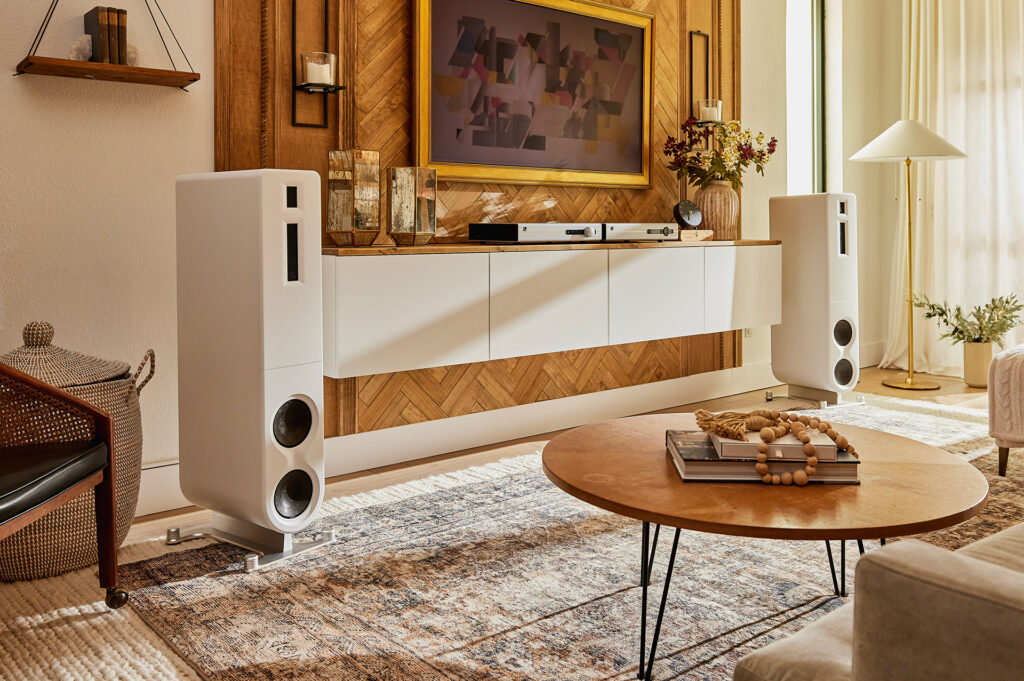
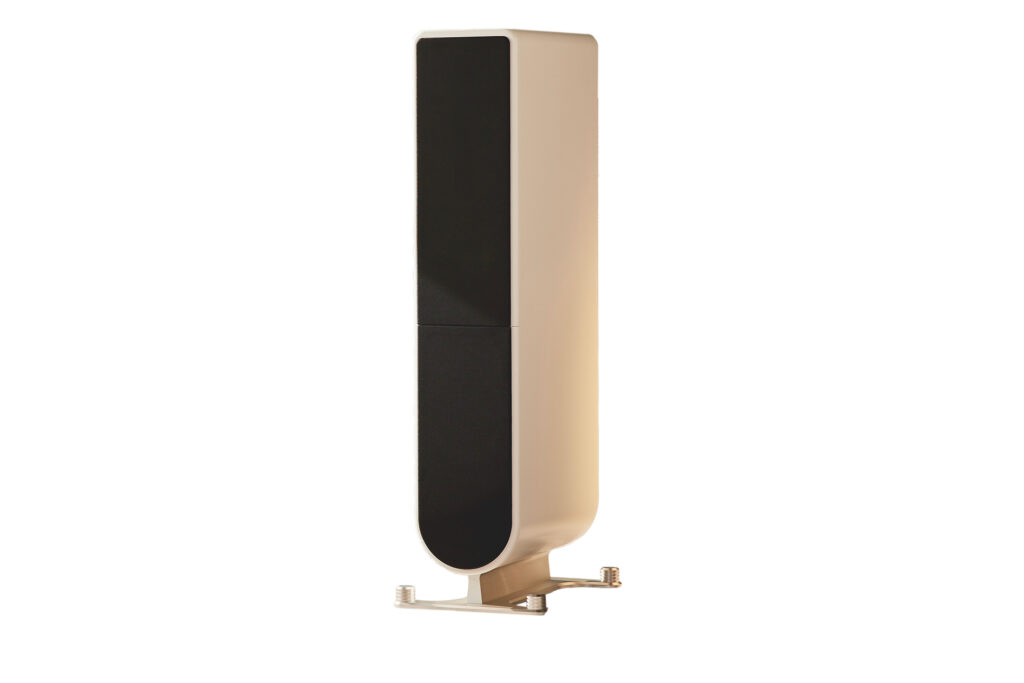
- The PS Audio Aspen FR10 features a heavily-braced MDF enclosure, paired with a thermoset fiberglass resin baffle that’s precisely molded to integrate the high-frequency waveguides. Its proportions signal serious intent: a narrow eight-inch-wide profile contrasted by a relatively deep 16.25-inch cabinet. The curved base flows into a brushed aluminum outrigger with adjustable feet, adding both stability and visual refinement. At 41.5 inches tall, the PS Audio FR10 maintains an unexpectedly unobtrusive presence in the room – something I can confidently confirm, as my wife was quick to point out. At 75 pounds each, the FR10s are substantial but still manageable.
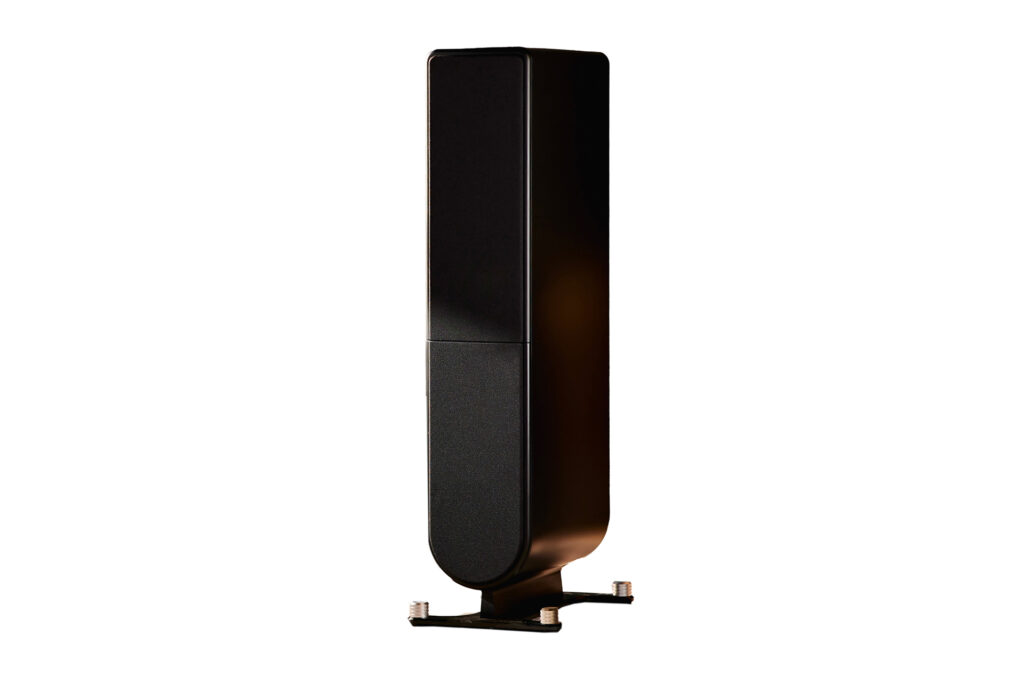
- The fit and finish are exemplary, conveying a quiet, understated elegance. The PS Audio FR10 is offered in black or white satin, each requiring a painstaking multi-coat lacquer process to achieve its refined surface. My black review pair blended seamlessly into the room, neither calling attention to themselves nor feeling visually imposing. While nudging the speakers back and forth to dial in placement, I came to appreciate the swirl-free satin finish, which avoids the fingerprints and micro-abrasions that so often plague high-gloss designs. Magnetic grilles add a final sophisticated touch.
- The PS Audio FR10 features a 2.5-inch tweeter and an eight-inch midrange, both planar magnetic designs by Chris Brunhaver. Notably, the tweeter is shared with the more expensive FR20 and flagship FR30, evidence of meaningful trickle-down engineering from the top of the line. The midrange driver is unique to the FR10, purpose-built to complement its more compact cabinet while preserving the series’ signature clarity and speed.
- For the lower midrange and bass, the PS Audio FR10s employ two 6.5-inch high-excursion woofers, also of PS Audio’s own design. These drivers use carbon fiber cones, sandwiching a Rohacell foam core for the combination of low mass, high rigidity, and low distortion. Bass is further augmented by three six-by-nine-inch passive radiators that occupy the majority of the rear panel.
- PS Audio didn’t skimp on the crossover network. The FR10s use custom film capacitors and premium air-core inductors in a three-way configuration with crossover points at 550 Hz and 1,750 Hz, implemented as Linkwitz-Riley filters with a steep fourth-order acoustic slope.
- The PS Audio Aspen FR10s can be bi-wired or bi-amped. Two sets of binding posts separate the tweeter and midrange from the bass drivers. Red and black jumper cables are included to combine the two pairs when running a single set of speaker cables.
- PS Audio includes Paul McGowan’s in-depth book, The Audiophile’s Guide: Aspen Speaker Setup, along with a companion CD. The two work hand in hand: the book explains speaker placement, and the CD demonstrates the concepts across 19 tracks. Some of those tracks are basic system checks – confirming proper connection, channel orientation, and phase – while the rest are paired with McGowan’s guidance on what to listen for and how to improve what you’re hearing. More on this topic in the listening section.
- PS Audio offers a 30-day in-home trial, so customers can evaluate the FR10s in their own room rather than a showroom. It’s a smart, customer-friendly policy and signals that PS Audio is willing to put real money behind its product.
- One feature that doesn’t get enough attention is PS Audio’s trade-up program. The details are on their website, but the short version: consumer-owned components from a wide range of brands can be traded in at their original retail price and credited toward the purchase of a PS Audio product. Limitations apply, but for anyone holding onto a piece of gear they wish they hadn’t bought, this is a meaningful way to recover that value.
Why Should You Care About the PS Audio Aspen FR10 Floorstanding Loudspeakers?
The PS Audio Aspen FR10 hits a sweet spot in size and performance that integrates easily into a room – and that listeners will love. The $10,000 floorstanding speaker market is crowded, but few competitors combine thoughtful cabinet design, in-house driver technology, and a consumer-direct model backed by a 30-day home audition. That mix alone puts the FR10 on the radar.
Manufacturers face a long list of decisions – driver technology, cost allocation, go-to-market strategy – and every one of those choices shows up in the final product. PS Audio committed to its path with conviction, and the result is something special. That’s worth caring about.
Some Things You Might Not Like About the PS Audio Aspen FR10 Floorstanding Loudspeakers
- While the fit and finish are excellent, the solid satin color combined with the rectangular cabinet shape could read as plain. For many, that understatement is exactly the appeal; for others, it may feel underwhelming next to more sculpted or visually striking designs at this price. It’s a matter of personal taste, but worth noting.
Listening to the PS Audio Aspen FR10 Floorstanding Speakers
The PS Audio Aspen FR10 Floorstanding Speakers were evaluated in my reference system: a Roon Nucleus One server streaming to a HiFi Rose RS130 network transport and RD160 DAC. From there, a Pass Labs XP-22 stereo preamplifier feeds a Lyngdorf MXA-8400 multichannel Class-D amplifier (two channels in use) built around Purifi Eigentakt modules. WireWorld Generation 10 interconnects and speaker cables tie the system together. All told, it’s a highly resolving and revealing setup.
For this review, my reference Estelon Aura floorstanding speakers were swapped out for the incoming PS Audio Aspen FR10s.
I started with the new FR10s speakers in my usual spots – about 24 inches off the front wall, toed in slightly – and made a few placement tweaks while cycling through familiar tracks. Results were promising. On “Hey Now” by London Grammar (Qobuz FLAC 44.1 kHz/24-bit), the speakers threw a solid center image with good bass impact. Midrange and treble were smooth and silky, with nothing harsh. My immediate impression: the FR10s are easy to integrate into a room.
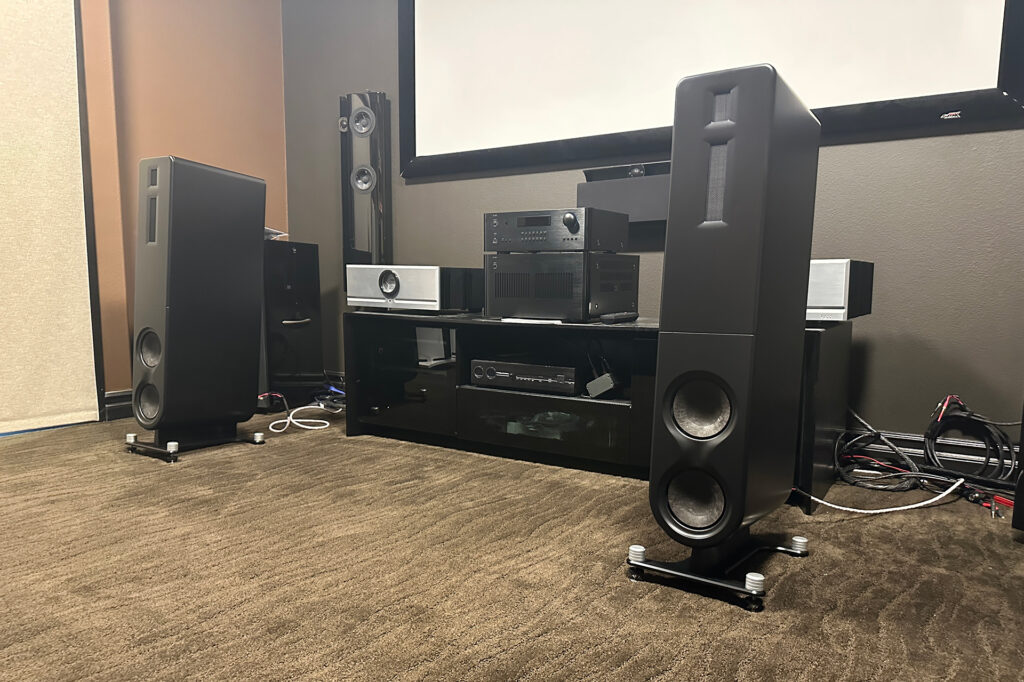
I then put Paul McGowan’s book The Audiophile’s Guide: Aspen Loudspeakers Setup and its companion CD to work. This pushed the PS Audio FR10s out to 45 inches from the front wall (the book recommends 48, but 45 was the best I could manage), significantly further into the room than my usual setup. The guide’s recommendations on speaker-to-speaker distance and seating – an equilateral triangle between the listener and the two speakers – were already familiar to me from years in this hobby. But the guide goes well beyond that, covering room shape, side-wall spacing, acoustics, furnishings, and equipment placement. It reminded me that my room has less than desirable configurations: small and nearly square at 13.5 by 14.5 feet. Given those dimensions, I was operating at or near the minimum recommended distances – speakers eight feet apart with the same listening distance, at least two feet from the side walls, and ideally four feet from the front wall (where 45 inches was my ceiling). The room itself is neutral, without echo but not overly dead. Carpet on the floor, plus a small French door and a small window each covered with a heavy roller shade, soften the hard surfaces. A weakness is the low audio cabinet between the speakers; happily, the FR10s now sit in front of it, though removing it entirely would likely improve things further. For this review, it stays. The guide’s consistent message is to work with what you have – chase the easy wins, and remember that while perfection is the goal, a strong result comes from implementing as many of the rules as you can.
Working in my favor is an A-frame ceiling that pitches from nine feet up to 11. The angle runs laterally, front to back, so no pitched surface faces the listening position directly. Compared to a flat ceiling, this geometry reduces vertical standing waves and flutter echo while diffusing reflections more evenly throughout the room. The extra height at the apex also increases room volume. Following another of McGowan’s suggestions, I positioned my equipment and listening seat off-center, to the extent the room allowed. Various tracks on the Audiophile Guide CD walked me through what I should be hearing as described in the book.
Replaying “Hey Now” after the reconfiguration was astonishing. There had always been a phantom center image, but now there was that and much more. The audio emanated more distinctly from behind and around the FR10s, anchored by a locked-in center. The presentation was spectacular. High frequencies were clear and smooth, without any harshness. In my experience, planar magnetic tweeters can deliver a hyper-real quality in the upper registers – not unpleasant, but attention-grabbing and arguably unrealistic. The PS Audio Aspen FR10s were different: airy, with a natural-sounding decay that never drew unwanted attention. The midrange was robust and detailed, with weight in the lower midrange that gave vocals real texture. Bass was taut, present, and deep. As the song progressed and the low-end synthesizers kicked in, the FR10s delivered a deep, dynamic presentation that held its composure and detail. I could feel the bass, but it never overwhelmed – it was just right. All of this came at a moderate 70 dB listening level. There’s something satisfying about not having to crank the volume to get speakers to open up, and that was clearly the case here. Worth noting: the FR10s are rated at 86.5 dB sensitivity at one meter – below average, but not a strike against them. It simply means they want a bit more power than something more efficient. In my experience, speakers that ask for more power tend to sound more accurate and organic than speakers that play loud on a whisper of amplification. The sensitivity here is likely a function of the planar magnetic tweeter and midrange. Regardless, the PS Audio Aspen FR10s sounded effortless and posed no obvious challenge for the amplifier.
On “Second Hand News” by Fleetwood Mac (2004 remaster, FLAC 44.1 kHz/16-bit), the newfound imaging held. Small details revealed layered vocals, and instruments were easy to place on the stage. Cymbals decayed authentically, the midrange was prominent and focused, and the bass continued to play deep but controlled. Mick Fleetwood’s percussion came through with momentum and a sense of urgency.
After the Fleetwood Mac track, Roon randomly served up “Let It Be” by The Beatles (Qobuz FLAC 96kHz 24bit), which caught my attention enough that I let it play out. Vocals occupied center stage with some height, replicating an intimate venue. Instruments filled the soundstage left and right. I’ve heard this track many times, but the standout here was a low-level cymbal pattern behind the rest of the mix that I’d never quite picked out before. My love of audio isn’t about hunting for hidden details like a lunatic, it’s about enjoying the musical presentation. But when something sounds genuinely special, my job as a reviewer is to figure out what’s making it better and put it into words. That was the case here.
I continued through many tracks, old and new, with consistent results: a natural, clear, and crisp treble, a focused and robust midrange, and defined, controlled bass. Whatever I played, the PS Audio Aspen FR10s reproduced it with excellent precision.
Will the PS Audio Aspen FR10 Hold Its Value?
All audio gear is subject to depreciation, and the PS Audio Aspen FR10 is no exception. The investment thesis for high-end audio has never really been about resale, it’s about the dividends paid in happiness, enjoyment, and pride of ownership, all of which the PS Audio Aspen FR10 delivers in abundance. Every time I fired up my system with the Aspens in the chain, a wave of anticipation hit me, followed by the kind of deep satisfaction that’s tough to quantify with a price tag.
That said, let’s talk numbers. Depreciation in the resale market should track right around the average for this category, which is what you’d expect from a speaker that remains in active production and is readily available new from PS Audio. During my research, I did not find a robust secondary market for the FR10. The few used pairs I came across were listed at a roughly 25 percent discount off retail which, in my view, isn’t a compelling enough savings to justify going pre-owned. For that delta, I’d rather pay full freight, get the factory warranty, the unboxing experience, and the peace of mind that comes with a new pair. But that’s just how I weigh it. Your math may differ.
What is the Competition for the PS Audio Aspen FR10 Floorstanding Loudspeakers?
Bowers & Wilkins 702 S3 Signature MSRP: $9,900
The 702 S3 Signature is the top-shelf version of B&W’s long-running 700 Series, dressed up with upgraded crossover components, premium internal wiring, and that gorgeous Datuk Gloss or Midnight Blue Metallic finish. You get the iconic decoupled tweeter-on-top, the Continuum cone midrange that B&W has refined over multiple generations, and Aerofoil bass drivers in a slim, three-way cabinet. The 702 S3 Signature is designed at B&W’s Worthing, U.K. headquarters and built at the company’s own manufacturing facility in China, with some key driver components like the Continuum cone still produced in the UK. It’s a speaker built around precision, imaging, and the kind of polished treble articulation that has defined the Bowers house sound for decades.
Compared to the PS Audio Aspen FR10, the Bowers 702 S3 Signature is most reminiscent of a reference-monitor presentation, excellent for vocals, strings, and intimate recordings. Where it gives ground to the PS Audio Aspen FR10 is in scale and openness. The PS Audio’s planar mid-tweeter array casts a more expansive, dimensional soundstage and breathes with a kind of effortless transparency that traditional dome-tweeter designs work hard to approach. The Bowers & Wilkins counters with a more forgiving load on amplifiers, broader dealer availability, and a finish that frankly belongs in a design magazine. If detail retrieval and a polished, classically-voiced presentation matter more to you than scale and air, the 702 S3 Signature earns its spot on the short list.
Paradigm Founder 120H MSRP: $9,900
The Paradigm Founder 120H is the most technologically ambitious speaker of this trio, and arguably of the bunch including the PS Audio Aspen FR10. The “H” stands for Hybrid, meaning Paradigm has built powered bass directly into the cabinet with onboard amplification and full ARC Genesis room correction. You get a beryllium tweeter, carbon-infused midrange, and an active bass section that can be tuned to your room with a microphone and software, basically a self-correcting low end in a passive-from-the-mids-up package. The Founder 120H is also the only speaker in this comparison built entirely in North America.
Against the PS Audio Aspen FR10, the 120H’s room correction is a genuine superpower, especially in untreated rooms where bass nodes can wreck an otherwise great speaker. What the FR10 brings to the fight is coherence and finesse. The PS Audio’s full-range passive design has a “whole cloth” quality that hybrid speakers, no matter how well-executed, can occasionally betray with a slight discontinuity between active and passive sections. The PS Audio Aspen FR10 also doesn’t ask you to find an outlet behind your speaker. If you have a difficult room or you’re a home-theater-meets-music listener, the Paradigm 120H makes a compelling case. If you’re chasing pure two-channel musicality in a treated or well-behaved space, the FR10 has the edge. Additionally, the 120H makes less sense if you have room correction elsewhere, perhaps in your electronics, and already have separate subwoofers.
Alta Audio Alec MSRP: $10,000
Alta Audio is the boutique entry on this list, with the Alec designed by company founder Michael Levy, and featuring Alta’s signature tuned transmission line bass loading, along with proprietary driver designs. Like the PS Audio Aspen FR10, the Alec is a bespoke design that’s manufactured overseas. I have had no personal experience with the Alta Audio Alec, but it obtained favorable recognition by Future Audiophile, which you can review here. If you like to stray off the beaten path, and take pride in being in the know, the Alta Audio Alec (read the review) is an insider secret for sure. The Future Audiophile review sparked my interest with its proprietary technology, and reminded me that there are many options at the $10,000 price point.
Final Thoughts on The PS Audio Aspen FR10 Floorstanding Loudspeakers
The PS Audio Aspen FR10 hits a sweet spot in its segment. It’s compact enough to integrate easily into a family room, living room, or dedicated listening space, yet plays well above its physical size. Follow the recommendations in The Audiophile’s Guide: Aspen Speaker Setup, and performance climbs dramatically from there. Combine that with the planar magnetic tweeter and midrange and a perfectly-sized bass array, and the FR10 is a true all-around performer – and an easy speaker to live with.
I suspect there’s still more to be had. I could have spent additional time tweaking, but going further would require removing the audio cabinet between the speakers, something I’d already been gearing up to do but wasn’t quite ready to execute. Once that’s gone, I expect another step up in performance, and I may even be able to bring the speakers a bit closer to the front wall. Or maybe not. Either way, that’s a conversation for another day.
It is worth noting: the techniques I drew from The Audiophile’s Guide apply to any speaker system. These are sound, universal principles, and a useful reminder that the room and proper setup make an enormous difference in what you ultimately hear.
With all that said, I am highly impressed with the PS Audio Aspen FR10 Loudspeakers. If you are shopping in this audiophile neighborhood for speakers, I would suggest they should be at the top of your audition list.




Sad there is no ink spilled on the one set of speakers that are you are familiar with in this system in your room. Although twice as expensive the comparison would be illuminating in my opinion.
Marc,
I am mot sure you understand the logistics and costs of the editorial request you are making of an online publication that produces more reviews (102 per year) with ZERO COST to you the reader.
Shipping a pair of speakers like these cost $500 to $1000 each way. Just shipping.
I am confused, I thought the Estelon Aura were his reference speakers that he personally moved out of the way to review the PS Audio Aspen speakers. If so there would be no shipping and ZERO COST to the publication. I do appreciate your publication’s mission and value to the reader.
The Estelon Aura speeakers.
Marc, sometimes I do compare considerably more expensive components just for comparison. But electronic components are a bit easier to swap in and compare side by side. Speaker swapping would have required far more effort and time. Given that the Auras are more than twice the price, I did not think the comparison was relevant but rather more of a curiosity. And given I have a stack of boxed subwoofers and electronics waiting in line to review, I had to draw the line somewhere. I will put the Aura’s back at some point. As of today, the PS Audio FR10s are still in place, as I will soon add their Foundry Sub for review. Thanks for reading the review.
Jerry, thank you for your review of this PS Audio FR10 speaker. I would love to listen to it in person but since they are sold direct I likely will not get the chance given that I already own a pair of floorstanders. I am curious as to why you use the Roon Nucleus One to stream to the Rose RS130 when the Rose RS130 is itself a network streamer.