
 By
By Five years ago, and most certainly 10 years ago, were someone to ask my opinion of integrated amplifiers, I would have probably likened them to day-old fish – not yet stinking but getting close. I have historically preferred separate audiophile components because of one simple reason: I thought they sounded distinctly better than their all-in-one counterparts. In the last year or so, my outlook on integrated components has somehow drastically changed.
Technology, not surprisingly, unerringly moves forward, and integrated amplifiers have risen past the point of unwarranted vilification. I have reviewed enough of them to know how remarkably exceptional they can sound. Likewise, the T+A PA 3100 HV (read review here) that I reviewed was amazingly close in sonic performance to my T+A HV separates – and, with the integrated at just under half the cost of the separates, a pretty good value as well. So, it seems rather obvious we have turned the corner on integrated amplification for an audiophile sound system. So where does the Devialet Astra fit into all of this? Let’s find out.
What Makes the Devialet Astra Special?
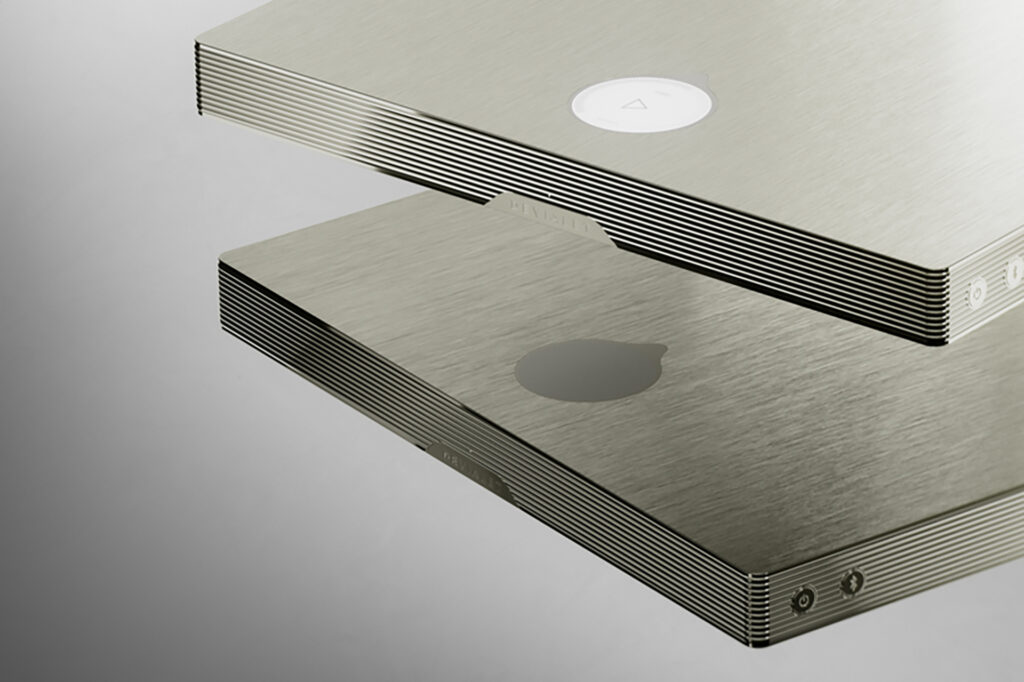
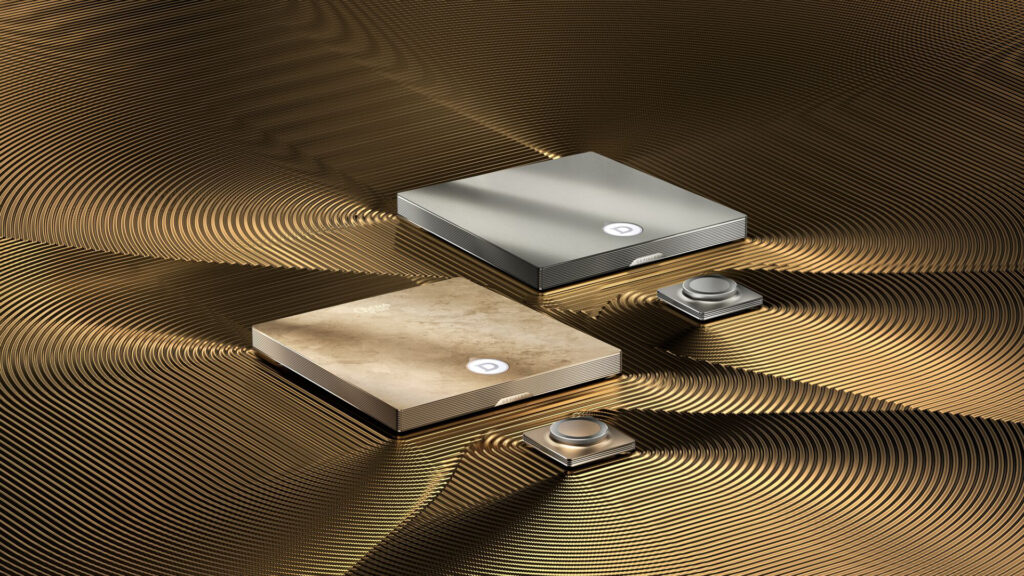
- We can easily start with the obvious: the Devialet Astra has a very sleek, almost minimalist design. It also has a very low profile and may easily be incorporated into a rack or cabinet, making it user-friendly from a physical-size standpoint.
- I have yet to see an audio component with the variety of variable configuration options that are possible with the Devialet Astra. However, these options require some initial setup. For instance, the user must first sign into the Devialet website, download the Devialet app, establish a user account, pair the app to the Astra, and set up the preferred user settings, which will then control the various options on the Astra. The remote is paired via Bluetooth. From there, the six RCA inputs, two TosLink optical inputs, one Ethernet and one USB connection may be configured in almost countless configurations. To say that the Devialet Astra is versatile is an understatement.
- Devialet uses what they call ADH technology, or Analog Digital Hybrid amplification. This technology combines the linearity of a Class-A analog amplifier with the power output capabilities of Class-D digital amplification. The result is said to be a very wide frequency range that is both impactful and precise.
- For speakers, Devialet includes their proprietary Speaker Active Matching or SAM technology. With SAM, a wide variety of speakers, including dynamic, planar, electrostatic, horn and many hybrids allows time alignment and driver correction filters to be selected for a specific speaker. The user simply chooses their particular speaker from a surprisingly comprehensive list of commercially available speakers, and the Astra applies the values automatically. As I suspected, my Teknik Audio Grand Notes (read review here) were not listed. However, if a speaker is listed, Devialet claims SAM will provide a sonic experience with improved low-frequency extension, corrected time alignment, and lower levels of distortion. A trim level is also included to alter the amount (or level) of SAM by plus or minus 15 dB. And what if the speaker being used is not one directly supported by SAM? The best option is to choose a SAM-supported speaker that matches the one in use as closely as possible. The trim level should then make up for any difference.
- The RAM, or Record Active Matching, technology allows optimization of the on-board phonostage for improved analog LP playback. In fact, the phonostage is also highly customizable through the app. It even has different RIAA curves to modify the sonics based on individual recordings. Specific, pre-loaded cartridges may be preselected and their operational values loaded automatically. Classifying the phonostage on the Devialet Astra as one of the most configurable available is not incorrect by any measure.
- The Devialet Astra is seemingly purpose-built for streaming. It is fully capable for AirPlay, Google Cast, Spotify Connect, Tidal Connect, and UPnP, and it is most conveniently Roon Ready. A full-featured DAC is included. All of these are standard and there are no options at an increased cost.
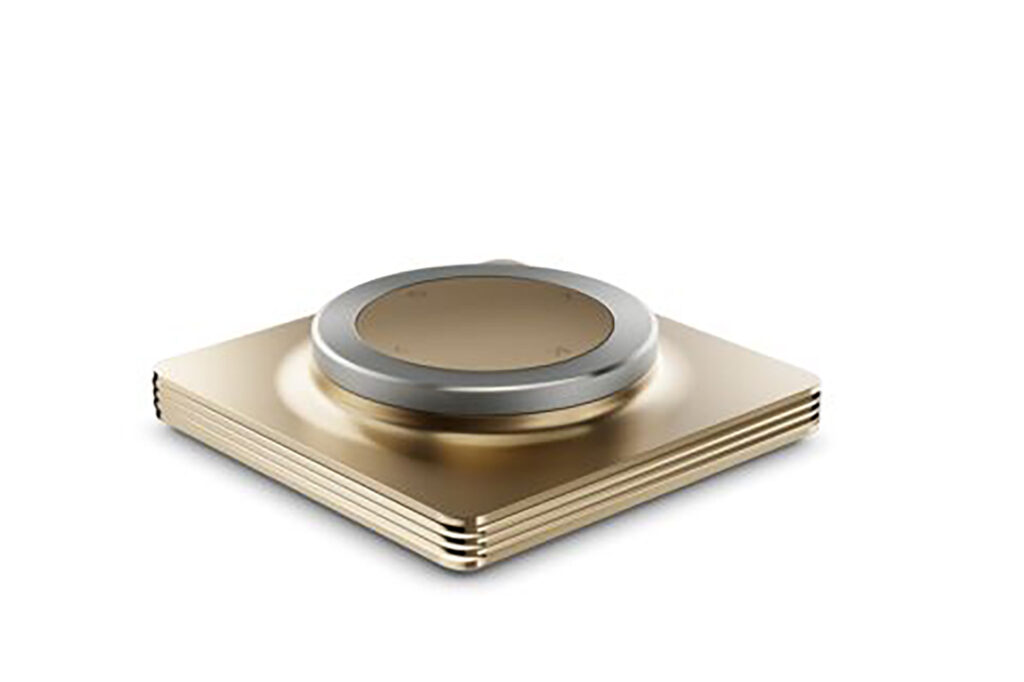
- A Bluetooth remote is included. Most conveniently, the round display on the remote eliminates the need to see the top panel on the main unit. The square base also gives a feeling of heft and quality construction.
- The Devialet Astra may be configured as a monoblock with the use of a second unit. This configuration doubles the output power.
- The Devialet Astra has 150 watts-per-channel into eight ohms, and 300 watts-per-channel into four ohms. The power button and Bluetooth connections buttons are on the right side. Digital inputs are compatible up to 192 kHz/24-bit and USB up to 384 kHz/24-bit. It weighs 15.87 pounds and is 15.19 inches by 15.19 inches, with a height of 1.85 inches.
Why Should You Care About the Devialet Astra Integrated Amp?
There is presumably a growing faction of audiophiles who place a certain value on a high-performance audio component with an agreeably small footprint, combined with excellent sonics. While many audiophiles will consider the $20,000 purchase price expensive, when all the technology and features are considered, the price begins to seem less problematic. When the price of high-performance, middle-of-the-road power amps, preamps, DACs, phonostages, cables and all the ancillary hardware is considered, a total for all components in the $30,000 to $50,000 price tag is not unreasonable. Then there are the issues of all those components taking up a lot of room. For many of today’s audiophiles, space matters. Add in the overall performance, and the Devialet Astra suddenly becomes effectively attractive and a component about which any audiophile should care.
Some Things You May Not Like About the Devialet Astra Integrated Amp
- The Devialet Astra integrated amp is not balanced or dual mono. In fact, there are not any XLR connections of any kind. An AES/EBU cable, which is what I use to connect my Teknik Audio Memory Player 64 (read review here) to my Bricasti M21 Platinum Edition DAC (read review here), cannot be used. All source connections on the Astra are RCA, TosLink and USB-only.
- The speaker terminals can be difficult to connect for certain speaker cables. The top plate extends over the rear-mounted connections by about one inch. This is actually done for aesthetic reasons. With the speaker binding posts spaced so closely together, and the top plate to some degree restricting access to the terminals, having sufficient room to tighten the cables may be difficult for some users.
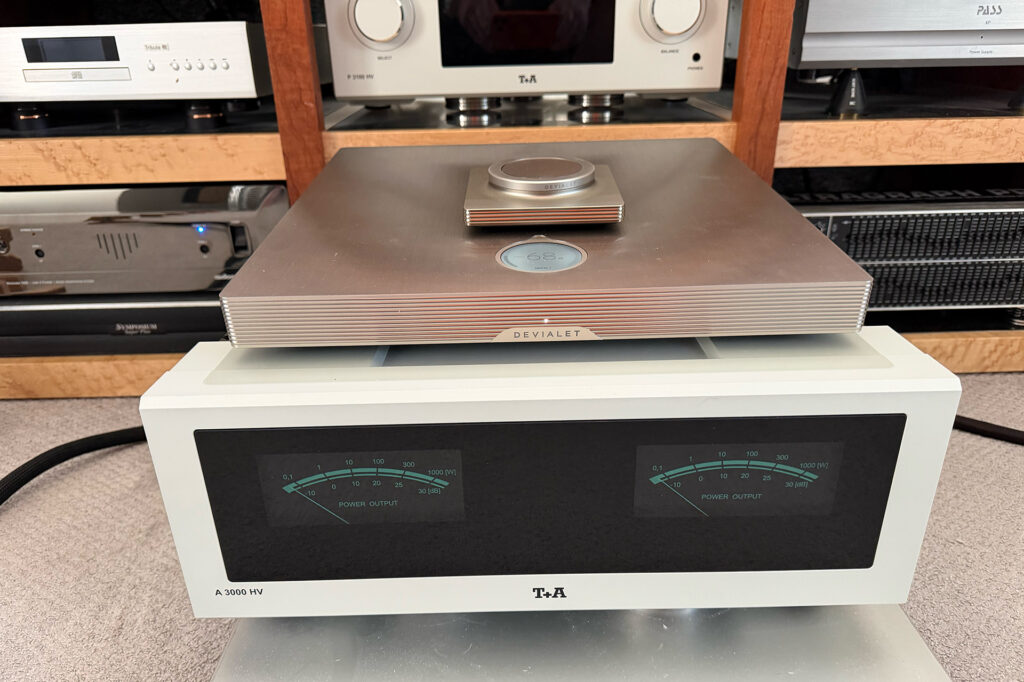
- Because of the overall low profile of the Devialet Astra, anyone who is using somewhat thick, rather unflexible speaker cables may have a clearance issue. I first set the Astra on my Symposium Super Plus platform, but did not have sufficient clearance for my speaker cables. In the end, I put my T+A amp back in place and, while still unplugged, put the Devialet Astra on top, with the back of the Astra hanging over the back of the T+A amp. In this way, I could have sufficient room to attach my speaker cables.
Listening With the Devialet Astra Integrate Amplifier
At first, I was curious if the Devialet Astra would even play sufficiently loudly enough to suit me. I must admit I fell victim to the incorrect perception that physical size equals performance. In actual practice, I never felt like the Astra struggled for one brief second to give me as much volume as I could take. It actually played very cleanly and with noticeable clarity at even my loudest volume levels. I never felt like I needed to reduce the volume because of compromised sonics or, more drastically, stop playback altogether. I was also immediately impressed by the bass performance, which was certainly helped along by the line array six-pack of REL S/550 subwoofers (read review here). The mids were also very lively, and instruments like guitars and mandolins had a very textured level of shimmer, almost as if the music was being performed live in my listening room. There was a noticeable absence of noise, which made the Devialet Astra one of the quieter integrated amplifiers I have reviewed. And this low noise floor and black background also helped the micro details be portrayed much more openly and noticeably. Music seemed to just flow along, which is not only the hallmark of a quality product but, let’s face it, also makes the listening process much more enjoyable.
Because the supergroup Chicago has always been one of my favorites, it seemed only natural to highlight one of their more notable hits as a music selection. Written by Robert Lamm and recorded in 1969, the track “25 or 6 to 4” from Chicago II is supposedly about writing a song in the middle of the night. There are also reports of the use of drugs, in which the band was involved at the time. Regardless, it was a monster hit for Chicago and the track remains a favorite. Guitarist Terry Kath, as he so often did, made use of a wah-wah pedal and, through the Devialet Astra, this unique guitar sound was easily recognizable. As with all Chicago songs, the horn section is a prominent feature, and the Astra’s capability with highs made the horns sound exceptional and blended very well with Kath’s guitar riffs. Like most Chicago songs, this track is a blend of jazz and rock and roll. This combination of genres was easily distinguishable with the Devialet Astra running the show.
On the (vinyl) MoFi One Step version of Yes’ “Roundabout” (now out of production) from the Fragile release, the unique opening gave the illusion of the music coming towards the listener. It is a combination of guitar and piano, and the band used various recording techniques to achieve the illusion. The Devialet Astra rendered this opening exactly as I have always heard it portrayed. The exceptional bass line came through not only with abundant clarity, which sounded imminently natural, but also with a pleasing level of power and dynamics. The accompanying guitar had exceptional clarity, and I could easily hear the strings being strummed during the initial opening. These sonic cues should be expected on digital yet, on this track, I was actually using the Devialet Astra’s onboard phonostage for vinyl playback. Because the One Step recording is very quiet and, at this point, is blissfully absent of pops and clicks, the sonics were overall also very quiet, making this track even more listenable. Because of the power capabilities of the Astra, I could crank up the volume and not feel like the amplifier was being taxed in any way.
Will the Devialet Astra Hold Its Value?
I see Devialet as a brand, as far as the U.S. market is concerned, residing in a bit of an odd place.Some of their equipment may easily be classified as a lifestyle product. The Astra, however, is more of a nod to a traditional high-performance audio part of an overall system. Is it unique? Absolutely. Does it have the raw power as did some of the previous integrateds I have reviewed? Not especially, but power output was not problematic in any way. Additionally, it did not lack any of the performance of any of the traditional integrated amplifiers I have reviewed. Factor in the customization, and the result is a very usable integrated amp, one I suspect that anyone who makes a purchase will see no reason to trade it in on something new for quite some time. For this reason, I feel the value proposition is very good to exceptional.
What Is the Competition for the Devialet Astra?
An integrated amp with very close features is the Hegel H600. It is a full-featured integrated with a DAC and also streaming capabilities. The Hegel H600 does not have a phonostage. However, at just under $15,000 in retail price, an allowance of $5,000 is therefore available for the purchase of a phonostage and still be price- and feature-competitive with the Devialet Astra. The H600 is rated at 303 watts-per-channel at eight ohms, 600 watts-per-channel at four ohms, and it will even drive a two-ohm load. It is fully Roon Ready and also has UPnP, Spotify Connect, Tidal Connect, AirPlay 2 and Chromecast. Unlike the Devialet Astra, the Hegel H600 has both XLR and RCA inputs and outputs.
Aurender has developed a reputation for very high quality in the 25 or so years they have been a market presence in the U.S. Initially, Aurender only offered music servers. Today, they have servers with streaming capabilities, and some models even come with a DAC. An amplifier section therefore only seems logical. The Aurender AP20 retails for $25,000 and has a Bruno Putzeys-designed Class-D amplifier capable of 200 watts-per-channel at eight ohms and 350 watts-per-channel at four ohms. It has multiple inputs and outputs in both XLR and RCA. Digital connections are varied and abundant. There is no phonostage, and adding one will certainly add to the already increased $5,000 price over the Devialet Astra. And, of course, probably no competitor I can even mention has the comprehensibly customizable features of the Astra. One feature I do like on the Aurender AP20 is a nice, large color front screen. This screen gives all the necessary information the listener should need, most notably about the artist and track.
Finding a competitor with directly equivalent features and performance specs to the Devialet Astra was surprisingly difficult. One would imagine there would be a plethora of full-featured components. Some, like the two previously mentioned competitors, come very close. Others, such as the Pass Labs INT-250 with a retail cost of $14,300, the Marantz Model 10 at $15,000, and the Boulder 866 at $16,000, are less than the $20,000 retail price of the Devialet Astra, but none are as full-featured out of the box. Given the cost differences, upgrades are possible while remaining faithful to the $20,000 cost of the Astra. Bottom line: it is a smart path to examine all the features, options and prices to determine the best component for a specific application.
Final Thoughts on the Devialet Astra Integrated Amplifier …
France has always occupied a unique place in the worlds of art, architecture, cuisine, and industrial design, where beauty and function coexist. Denmark is similar in such attributes, although it expresses them through a distinctly minimalist Scandinavian lens. The Devialet Astra is unmistakably French, yet it recalls the same design ethos long defined by Denmark’s Bang & Olufsen: the belief that technology should not exclusively perform brilliantly but should also enrich the living space it inhabits.
Customization is central to the Devialet Astra’s appeal. While not a budget component, the Astra offers a wide range of customization at a comparatively affordable price, while at the same time providing the minimum basic components of an audiophile system capable of both analog and digital playback. Moreover, how this playback occurs may be tailored to the individual user’s preferred needs.
Sonically, the Devialet Astra hits all the marks one would expect with an integrated amplifier at this price point. With the SAM technology, any of the many speakers in the Devialet database may be configured for optimal performance at little more than the touch of a button. This means speaker placement, while still important, is not the one-or-two-millimeter exercise in exactness normally associated with where a pair of speakers will sound their best. With the remote, and even more in-depth Devialet computer-based app, customization is possible from the comfort of the listening position. And, all the while, the compact nature of the physical size makes placement a simple exercise to orchestrate. After all, to many audiophiles, physical space matters.
I began this review somewhat suspicious of Devialet as a brand, especially when considering whether I would like to own it myself. While I remain devoted to my system of all separate components, the Devialet Astra could absolutely be the centerpiece of a two-channel audiophile system. It could also be used in the great room for music and movies. Such duality in function has its own merit and is certainly worthy of closer scrutiny. This is an exceptional device and has transformed my opinion of Devialet. Sonically, it is exceptional. It can easily be classified as full-featured, has outstanding customizable characteristics and obviously occupies a small footprint. Because of these attributes, I can easily recommend a trial by anyone who might be interested. Maybe a listening session with a nice bottle of French Burgundy might be in order?




Idiots, it’s D E V I A L E T.
Thanks for your kind words and soft approach.
This mistake made it through fact checking with the PR firm, me as an editor and more. It is fixed now.