
 By Frank Picarello
 The integrated amplifier segment has quietly become one of the most competitive, value-based, and rewarding categories of high-end audio. Modern buyers want great sound, streaming compatibility, phono support, television integration, and headroom for future upgrades, all without turning a living room into a component rack. Not long ago, hitting those marks meant stacking a separate preamp, power amp, DAC, and phono stage across three shelves, and hoping you had enough money to buy the endless cables required to connect it all. Today, a single well-engineered box can do it all and do it well. So, in a way, gone are the days of compromising within a price range, now replaced with even greater value in sound using an integrated platform. I admire the smart approach in this area and what companies like Audiolab are doing. In the category of big smiles, the Audiolab 7000A represents a legitimate gateway audiophile product, checking key boxes and making the right compromises.
Audiolab has been building high-value integrated amplifiers since 1983, when the British company introduced the original 8000A integrated amplifier and built a reputation on clean, accurate sound, rather than warmth for warmth’s sake. That founding philosophy, transparency over coloration, still shows up in every product the company makes. It has earned Audiolab a loyal following among engineers and music lovers who are suspicious of gear that tries too hard to sound impressive. The company’s current lineup spans the 6000, 7000, and 9000 Series. The 7000A sits right in the middle, more amplifier than the entry-level 6000A, more attainable than the flagship 9000A. Say it plainly: this is a $1,999 integrated amplifier built around a genuine 70-watts-per-channel Class-AB amp section, a flagship ESS Sabre DAC, a full moving-magnet phono stage, Bluetooth, and an HDMI ARC input that lets it double as the brain of a television system. There is a lot happening inside this chassis, and remarkably little of it feels like an afterthought, as its integration, where compromises are made, and the physical quality make the Audiolab 7000A a solid choice.
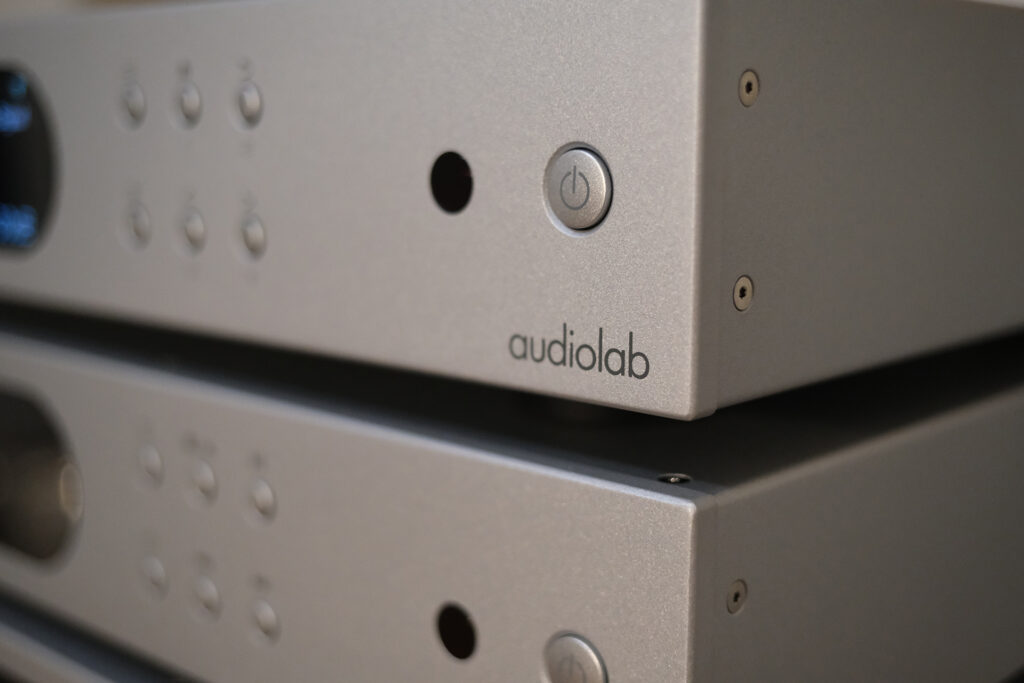
This review is of the Audiolab 7000A Integrated Amplifier (buy at Crutchfield), priced at $1,999 in either black or silver. Nestled between the 6000A and 9000A, the Audiolab 7000A borrows engineering lessons from the flagship model, including its ES9038Q2M DAC implementation and Class-A post-DAC filter stage, and packages them at a price meant to make affordable high-end a reality rather than a marketing slogan. This is squarely a one-box solution for listeners who want a serious two-channel system without the shelf space or the second mortgage.
I tested the Audiolab 7000A over six weeks, swapping it in and out of my system in place of separate stereo preamp and power amp combinations, and running it as the sole electronics component driving a full range of music sources. It handled that duty without complaint, and without ever feeling like compromise dressed up as convenience. The chassis feels dense and well-machined, rather than light and plasticky, which sets an expectation early that the Audiolab 7000A lived up to for the rest of the review period. Whenever I compare less expensive gear with my reference setup, I like to listen specifically to where the engineers made their compromises, highlighting both their sound preferences and engineering expertise. I also used the opportunity to listen to the Audiolab 7000A integrated amplifier with the Audiolab matching 7000CDT CD transport (buy at Crutchfield) and 7000N Network Streamer (buy at Crutchfield). More to come on these two in future reviews, yet – spoiler alert – as a system, the 7000 Series products from Audiolab sound amazing and seamless in sound quality.
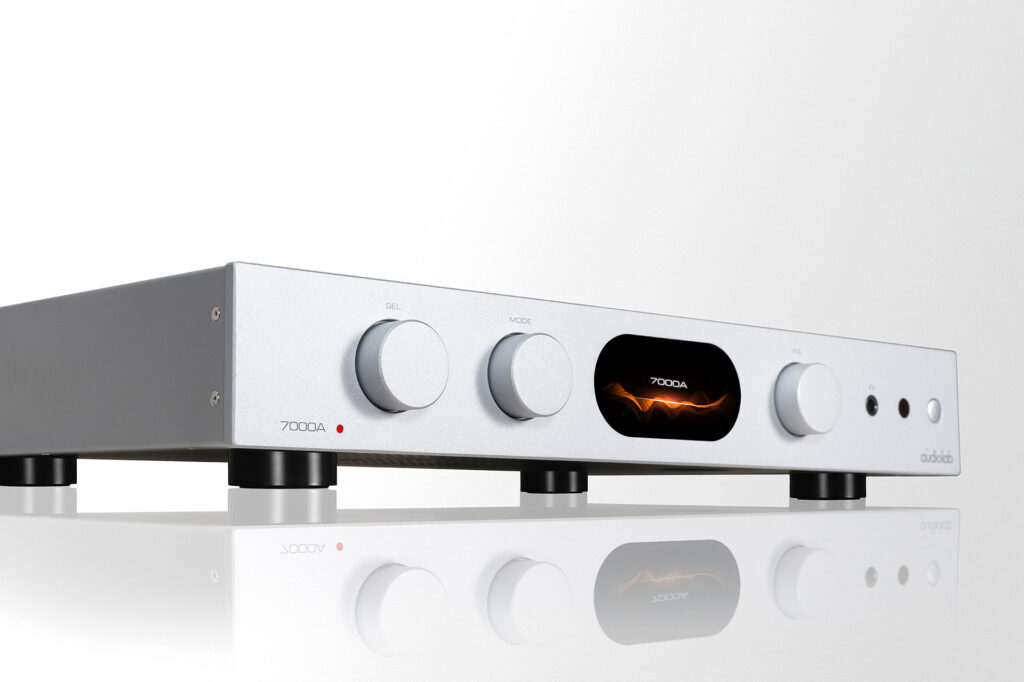
What Makes the Audiolab 7000a Integrated Amp So Special?
- The Audiolab 7000A delivers a rare balance between detail retrieval and musical enjoyment. It reveals what is happening in a recording without turning clinical or analytical about it, which is a harder trick than it sounds at this price, and it is the single trait that separates a merely competent amplifier from one you actually want to keep hearing.
- The ESS Sabre ES9038Q2M DAC implementation is genuinely excellent for an integrated amplifier, using 32-bit HyperStream architecture and a Time Domain jitter eliminator borrowed from the flagship 9000A. For a lot of buyers, this eliminates the need to shop for a separate outboard DAC entirely, and it frees up budget that would otherwise go toward a standalone converter, and instead can go toward speakers or a turntable upgrade. Again, Audiolab knows where to make audiophile-led compromises.
- A Class-AB power section, built around Complementary Feedback (CFB) topology, delivers a genuine 70 watts-per-channel into eight ohms, with up to nine amps of current on tap for difficult loads. Audiolab does not inflate its power ratings, and it shows in how composed the amp stays under real musical demands, holding its poise instead of compressing or hardening as speakers get harder to drive.
- HDMI ARC support lets the 7000A anchor both a two-channel music system and a television setup from a single remote, which matters more every year as living rooms consolidate gear, and buyers grow tired of juggling separate systems for movies and music. I thoroughly enjoyed integrating high-quality and seamless video into my musical experience, seeing and hearing the performance.
- The 7000A can be configured to run as a complete integrated amplifier, a preamplifier only, or a power amplifier only, giving owners a genuine upgrade path rather than a dead end. That flexibility means it can stay in a system even after a listener eventually adds a dedicated preamp or power amp down the road, providing more options.
- Bass performance stood out as one of the amplifier’s real strengths: tight, articulate, and controlled, rather than just loud, with a sense of pitch and texture that a lot of amplifiers at this price simply gloss over.
- The moving-magnet phono stage is a legitimately good phono preamp, not a checkbox feature bolted on to satisfy a spec sheet. Turntable owners can plug in and listen, rather than budget for an outboard phono stage, which is a real cost savings for anyone building a first serious vinyl setup.
- Full decoding of MQA happens internally, performing the complete three-fold process, rather than acting as a partial renderer, a detail that matters to anyone subscribed to Tidal’s HiFi Plus tier and looking to get the most out of Masters-tier streams. This experience was new to me and, honestly, I was skeptical of what I might hear. Well, this worked exceptionally well, making it a practical feature.
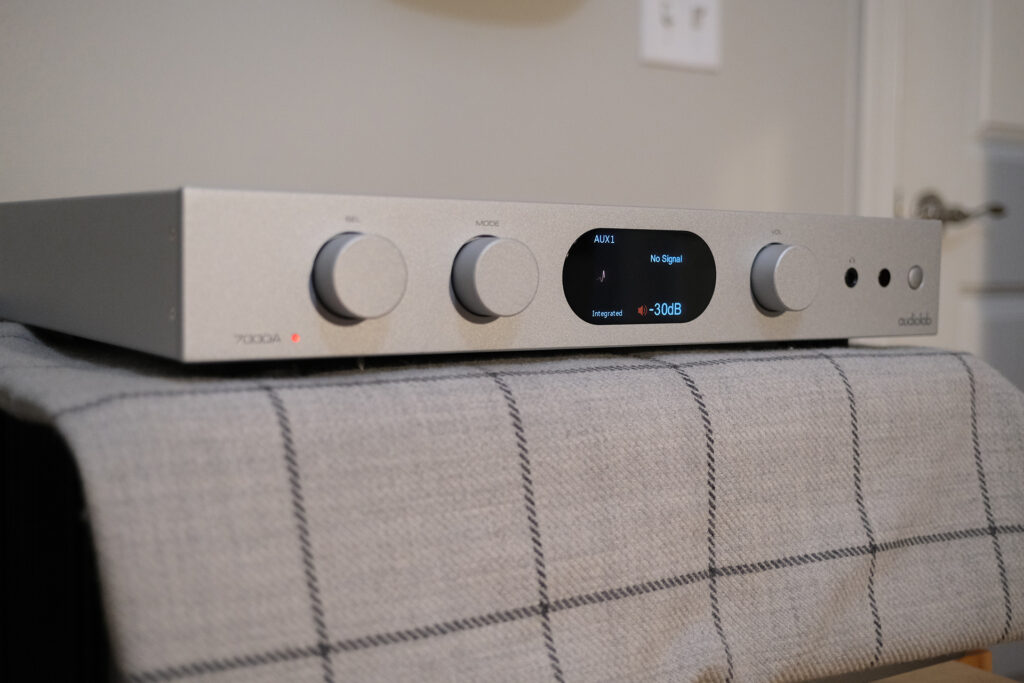
- The full-color IPS display is one of the more useful and good-looking implementations I have seen in this category, showing input, sample rate, MQA status, Bluetooth status, and operating mode at a glance, with a switchable VU meter. More than just a party trick, this is a genuinely handy way to confirm what is actually reaching the amplifier.
- Build quality punches above the price. At almost 19 pounds, with a substantial 250VA toroidal transformer inside, the 7000A feels considerably more substantial in hand than most competitors near its price, and the fit and finish on both the black and silver chassis options make it look and feel like a far more expensive component.
- The dedicated headphone amplifier, built around current-feedback circuitry, is strong enough to satisfy a lot of dedicated headphone listeners on its own. I listened with Sennheiser HD 660S headphones, and the quality of the sound, low noise, and strong gain made it a delight.
- The 7000A integrated amp lets audiophiles simplify without giving up performance. It has enough power for a wide range of loudspeakers, a genuinely capable onboard DAC, a real phono stage, and modern connectivity, all living in one chassis. This enables a turntable, streamer, CD transport, television, headphones, and computer to all connect without feeling like an afterthought.
- Listeners who value neutrality and transparency over a strong house sound will likely respond favorably to the 7000A. Rather than imposing its own character, it tends to get out of the way and let the source material speak, which rewards good recordings and, frankly, exposes mediocre ones.
- It has a very smooth balanced midrange. With midrange beauty, bloom, and the right level of warmth, the Audiolab delivered realistic voices. Female voices in particular had the body and sparkle that higher-priced gear delivers.
- The 7000A makes sense as a long-term anchor, rather than as a stepping stone. A listener could build a system around it for several years, then later add a dedicated power amp and run the 7000A purely as a preamplifier and DAC, all without replacing the piece that started the system in the first place. This makes it an easy amplifier to recommend to a friend just getting serious about two-channel sound, and shopping our integrated amplifier and preamp reviews for a starting point.
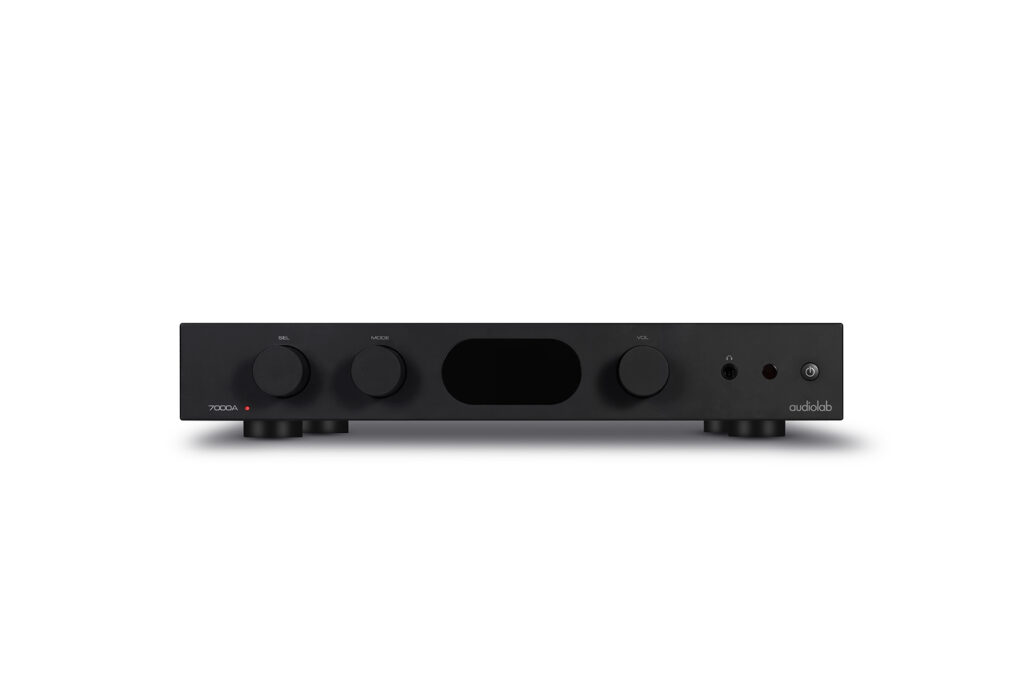
Audiolab 7000A Integrated Amplifier Specifications
| Type | Integrated amplifier with DAC, Class AB |
| Power | 70 watts per channel into eight ohms; 110 into four |
| DAC | ESS ES9038Q2M, up to 32-bit/192 kHz |
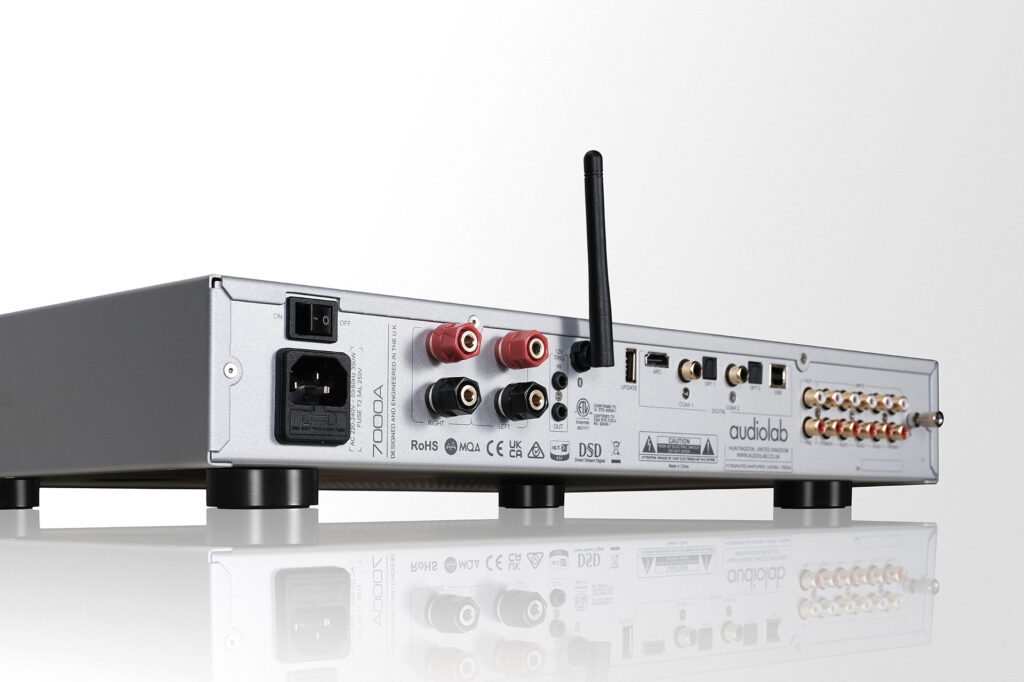
| Inputs | MM phono, two optical, two coaxial, USB-B, Bluetooth aptX |
| Outputs | Speaker terminals, preamp out, 1/4-inch headphone |
| Dimensions (W x H x D) | 17.5 x 3.1 x 13.4 inches |
| Weight | 18.5 pounds |
| Price | $1,999 at review |
Why Should You Care About the Audiolab 7000A Integrated Amplifier?
The Audiolab 7000A is an amplifier that will matter to many, because it delivers the kind of sound quality and flexibility that allows music lovers to build a genuinely serious hi-fi system without moving into luxury audio pricing. It strikes an impressive balance between musical performance, thoughtful engineering, and modern convenience, offering a refined and mature-sounding Class-AB amplifier, an excellent DAC, a quality phono stage, HDMI ARC, and enough connectivity to satisfy the music and home theater lover. The Audiolab doesn’t try to impress with artificial warmth or exaggerated detail. Instead, it presents music with honesty, control, and a natural sense of balance that encourages long listening sessions. For anyone looking to move beyond entry-level audio without spending a fortune, the 7000A represents one of those increasingly rare components that gets the fundamentals right and simply lets you enjoy your music.
Some Things You Might Not Like About the Audiolab 7000A Integrated Amplifier
- Listeners who prefer a darker, warmer, more harmonically saturated presentation may find the 7000A a bit reserved by comparison. This is not a tube integrated amplifier and doesn’t pretend to be.
- Set next to considerably more expensive amplifiers, ultimate dynamic authority is understandably limited. This is a $1,999 amplifier, not a $10,000 one and, again, as compromises are made, Audiolab makes the right ones.
- The included remote control is functional, but far from premium, and feels like the one area where cost-cutting is obvious. Considering how much it will be used, a nicer remote would have added to the experience.
- The menu structure and IPS display take a short learning period before the navigation becomes second nature. Not bad, yet it could be easier and more intuitive.
- Buyers craving more sonic drama or obvious coloration may be happier with something from Rega or Naim, both of which have a bolder “house sound,” but also can cost more money.
- The Audiolab 7000A does not include network streaming on board, so listeners who want a true all-in-one solution will still need to add a separate streamer or rely on Bluetooth for wireless playback. At this price point, this is an understandable compromise for the audiophile, yet not for someone looking for a fully-integrated listening experience.
Listening to the Audiolab 7000A Integrated Amplifier
I evaluated the Audiolab 7000A across a wide range of digital and analog sources, feeding it everything from Qobuz streams to analog listening through a Pro-Ject Debut EVO 2 through the built-in phono stage, paired with my reference Marten Parker Trio loudspeakers (read the review). What became clear almost immediately was the amplifier’s consistency. Genre after genre, the Audiolab stayed composed, balanced, and engaging, rather than picking favorites.
Billie Eilish’s “Bad Guy” (buy at Amazon) opens with a bass line that the 7000A kept exceptionally tight and controlled, revealing texture and pitch, rather than simply delivering weight. Eilish’s vocal floated in a stable center image while production effects emerged from a genuinely quiet background, and the amplifier’s low-end control and layer separation were obvious throughout. This is a deliberately sparse, bass-heavy production, and it is exactly the kind of modern mix that can turn muddy on a lesser amplifier. The Audiolab 7000A kept its composure, reminding me of a more expensive integrated unit. The front-to-back depth and soundstage width and height were very good, considering the price point, all putting a smile on my face.
On Frank Ocean’s “Pink + White” from Blonde (buy at Amazon), the Audiolab’s transparent midrange carried Ocean’s voice with a natural, intimate quality while strings and harmonies stayed distinct and easy to follow. The soundstage extended noticeably beyond the speakers, making for a spacious, immersive presentation that never felt processed. There are parts of the song where the vocals are portrayed with great width. I wasn’t expecting the Audiolab to get this as right and accurately as it did. The bass lines remained solid and warm, adding to the mood of this song. Very enjoyable and well done.
Masego and FKJ’s “Tadow” (buy at Amazon) is a superb musical test of timing and imaging, and the Audiolab let each musician occupy a clearly defined space, while keeping the live, improvised energy of the recording intact. Subtle dynamic shifts came through easily, which is what keeps a track like this feeling vibrant on repeat listening. What makes this song emotional is the voices and the smoothness of the female vocals. The Audiolab retained smoothness without giving up the details. Again, this amp balanced the musical compromises, perfectly retaining the right amount of warmth, tone, and body.
Yosi Horikawa’s “Bubbles” (buy at Amazon) remains one of the best tracks I know for evaluating imaging and soundstage depth. Through the 7000A, individual sounds appeared to move around the room with real precision, and the amplifier’s low noise floor helped create an almost holographic effect. Built entirely from field recordings of bouncing ping-pong balls, this track lives or dies on precise imaging, and the Audiolab did not lose track of a single bounce. There is a lot going on with this recording, subtle yet energetic at the same time. I remember smiling as I was hearing this with the Audiolab and, as I turned the volume up, the control remained with zero edge and sizzle added. While there was a hint of sonic compression, considering the very reasonable price point, it was acceptable.
Daft Punk’s “Get Lucky” from Random Access Memories (buy at Amazon) showed off the Audiolab’s ability to combine detail with musicality. Guitar lines stayed crisp, bass lines stayed taut, and the vocals remained clean and focused throughout. The ESS DAC and amplifier section worked together to surface fine details without ever turning harsh, and Nile Rodgers’ rhythm guitar retained its trademark snap without ever thinning out into brittleness. In the background is clapping that, while any decent amplifier will convey clearly, the better ones assure the impact, tome and energy of the sound is both real and balanced. The Audiolab 7000A pulls this off with class and ease.
Across five very different recordings, the Audiolab 7000A delivered a consistent personality: honest, balanced, and genuinely musical, rather than clinical. It never sounded sterile and it never called attention to itself, which are precisely the traits that make an amplifier easy to live with for years, rather than months. Whether the source was a moody, bass-heavy R&B cut or a bright, percussive pop single streaming over Bluetooth, the 7000A treated the material with the same care, and that consistency across very different modern productions is a harder engineering achievement than it is often considered to be.
Will the Audiolab 7000A Integrated Amplifier Hold its Value?
Audiolab has built a strong reputation for dependable, feature-rich products with broad appeal, and that reputation generally supports healthy resale value. The 7000A benefits from sitting in the middle of the company’s lineup: it carries many of the features buyers want from the flagship Audiolab 9000A, while remaining attainable, and products that combine strong brand recognition with wide functionality tend to outperform average on the secondary market. No audio component is immune to depreciation but, between Audiolab’s legacy, reputation, distribution, its multi-year warranty program, and the 7000A’s broad feature set, this amplifier looks likely to stay relevant and desirable for years to come.
What is the Competition for the Audiolab 7000A Integrated Amplifier?
At $1,999, the Audiolab 7000A competes in a crowded and well-regarded part of the market, and buyers here typically already know roughly what sound signature they prefer. The Cambridge Audio CXA81 ($1,199 buy at Crutchfield) is perhaps the most obvious competitor, offering a slightly warmer and more energetic presentation, while sharing the Audiolab’s focus on value and flexibility. It is worth an audition for anyone who wants a touch more excitement in the midrange.
The Rega Elex Mk4 appeals to listeners who prioritize rhythm, pacing, and midrange engagement, delivering a more characterful sound but without the Audiolab’s connectivity advantages. Rega loyalists tend to know exactly why they want that house sound, and the 7000A is not trying to be that amplifier.
The Naim Nait 5si at $2,295 remains a favorite among music-first listeners chasing pace and involvement, though it requires additional source components and lacks the 7000A’s built-in DAC and phono stage. Buyers drawn to Naim’s reputation should budget accordingly for the rest of the system.
Audiolab’s own 9000A provides greater authority, refinement, and dynamic capability for buyers willing to spend considerably more, but the 7000A remains the clear value leader within its own family, delivering a large percentage of the flagship’s performance for a fraction of the outlay.
Final Thoughts on the Audiolab 7000A Integrated Amplifier …
The Audiolab 7000A at $1,999 (buy at Crutchfield) succeeds because it understands exactly what a modern audiophile actually needs: excellent sound, extensive connectivity, thoughtful engineering, and genuine flexibility, all built into a single, well-finished chassis.
What impressed me most was not any single feature but the overall balance of the design. The amplifier avoids obvious weaknesse,s while consistently delivering a satisfying musical performance across genres, decades, and source types. It never sounds sterile, never becomes fatiguing, and never leaves the listener wishing a critical feature had been left out. It never gets old or edgy, and never did I feel I was missing out on sonic details. For the price, it’s a very musical amplifier, with solid features and decent build quality. The footprint is small enough to make it fit into a lot of environments, is a modern design yet not too edgy, and it’s clear that the designers made usability and user-interface a priority.
For music lovers who want a serious integrated amplifier capable of serving as the foundation of a complete system, the Audiolab 7000A deserves enthusiastic consideration. It delivers much of what makes high-end audio worthwhile, without demanding high-end audio money, and that combination of performance, versatility, and value makes it one of the safer recommendations in affordable audiophile electronics today.
“For the price, it’s a very musical amplifier, with solid features and decent build quality.”




Another great review! So much audio gear…so little money. Thank you Mr Picarello.