
 By
By A growing popular trend in high performance audio these days is component consolidation partnered with a smaller footprint system. Many modern audiophiles simply lack the necessary physical real estate to house mammoth racks with three or four shelves full of stereo components. At the same time, as audiophiles, we want performance, we want a reasonable cost, and we want our components to engage some measure of a modest visual statement. Basically, we want it all.
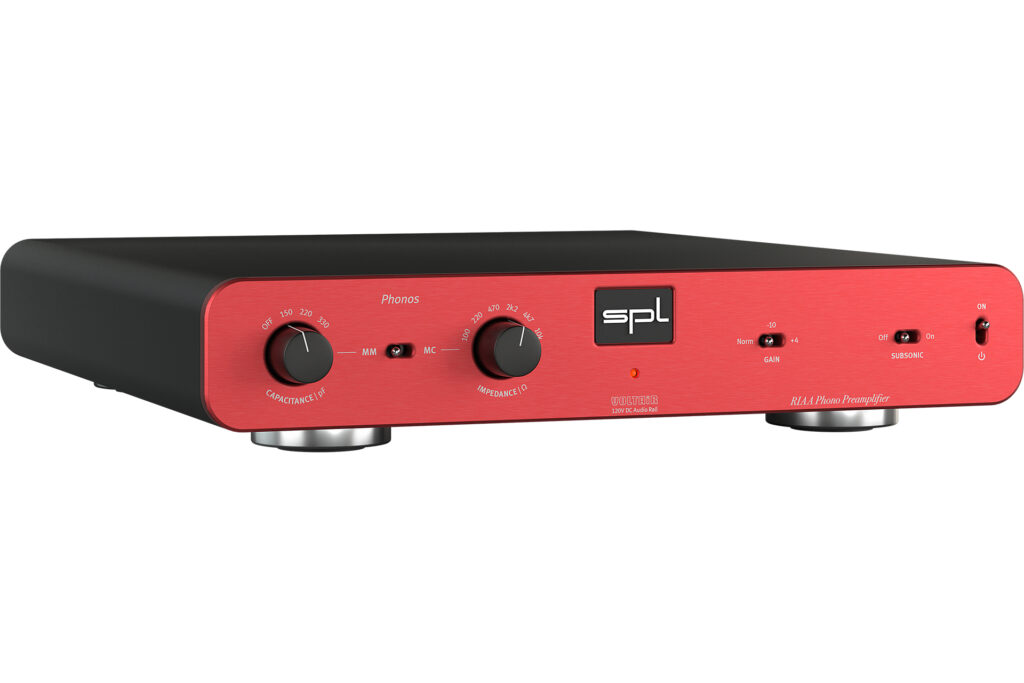
SPL Electronics GmbH, also known as Sound Performance Labs, is a German manufacturer of studio and mastering equipment for professional audio applications, and also surprisingly attractive home audio equipment. The home based selections include headphone amps, preamps and amplifiers,DACs, crossover units and phonostages. Located near Germany’s border with The Netherlands, SPL has been designing and manufacturing equipment for the music, film and broadcasting industries since 1983. Their line of products for home audio are, with the exception of a rather large power amp, mostly small, compact and visually interesting. My review sample phonostage was in their bright red color and there is no doubt it is pleasingly noticeable despite is smallish size. Of predominate interest is how it performs and what features it offers. In this review, we will seek to answer these questions.
What Makes the SPL Phonos Phonostage Special?
- SPL uses their proprietary VOLTAiR technology which increases the internal operating voltage by plus or minus 60V, or 120V total. This technology claims to provide greater dynamic range, lower distortion and an effortless sound signature. This is not too indifferent than the high voltage rail technology invented by T+A Audio Systems and used by several other manufacturers. The primary difference is SPL are using proprietary SUPRA op-amps which are specifically designed to operate at high voltages. Normal op-amps typically operate at plus or minus 15V. T+A, on the other hand, utilizes discrete gain stages whose plus or minus 160V rails approach vacuum tube design. Either way, the VOLTAiR technology is designed to vastly improve the sonic signature.
- SPL uses a custom designed RIAA equalization in the form of multiple small capacitors rather than one large capacitor. These multiple smaller capacitors will charge and discharge faster which results in better transient response.
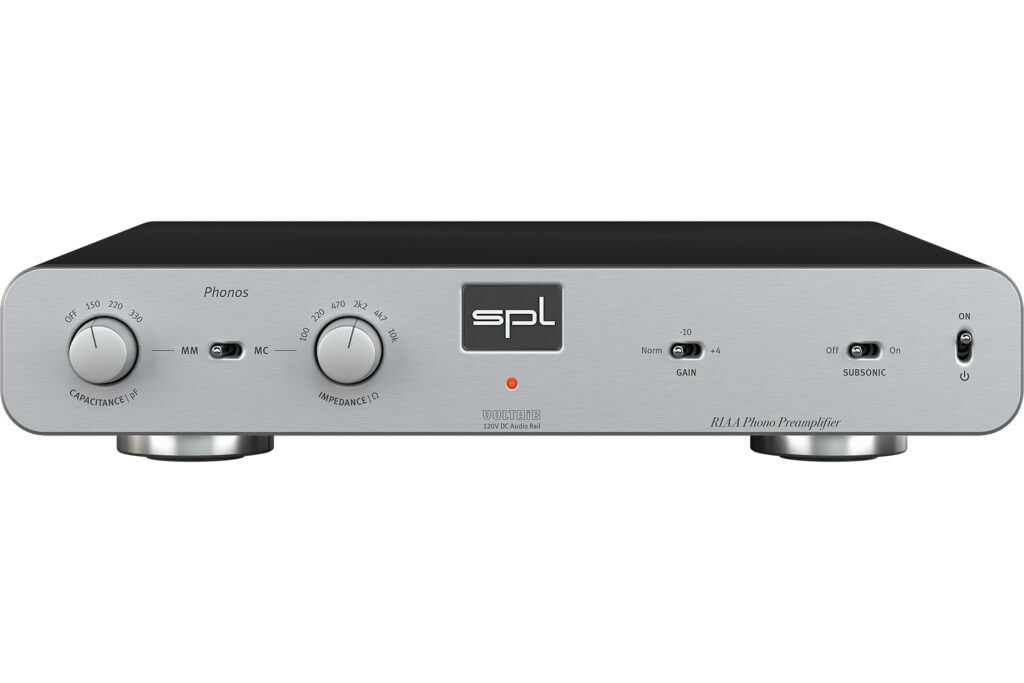
- Cartridge adjustment is independently possible for both a moving magnet (MM) and also moving coil (MC) cartridge. SPL recognizes the difference between both cartridge types and has capacitance settings of 150, 220 and 330 picofarads for a MM cartridge. The impedance settings for MC range from 100 Ohms to 10K Ohms. These settings give flexibility to establishing the optimal sonics based on the two most popular cartridge types.
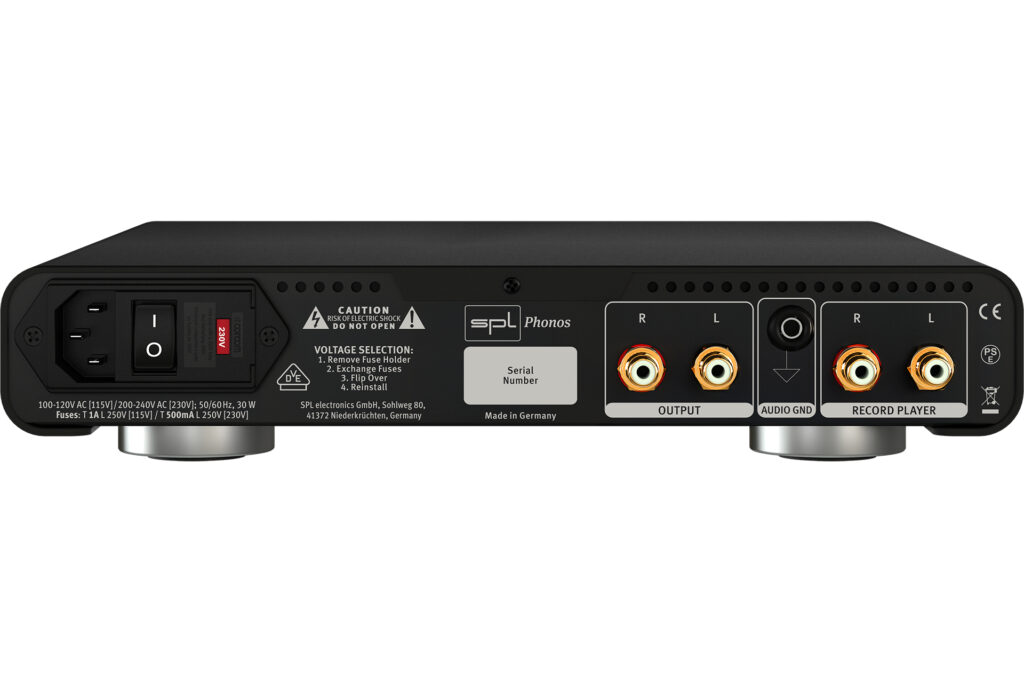
- The inputs and outputs are single ended, gold plated RCA only. There are no balanced XLR connections. Other rear mounted features include an IEC 15A main power connection, a master on/off button, a 120V/220V AC power selector switch, left and right RCA inputs and outputs and a chassis ground for the tonearm cable.
- Whereas many phonostages have individual gain settings, the SPL Phonos has three settings – Norm (Normal), which delivers plus 46dB for MM and plus 67dB for MC, a Minus 10 setting for plus 36dB for MM and plus 57dB for MC and lastly, Plus 4 for plus 50dB for MM and plus 71 for MC. These settings should effectively accommodate both normal and low output cartridges.
- A subsonic filter is also mounted on the front and is claimed to remove low frequency rumble of the drive mechanism due to RIAA equalization.
- The power on and off switch complete the front mounted selections.
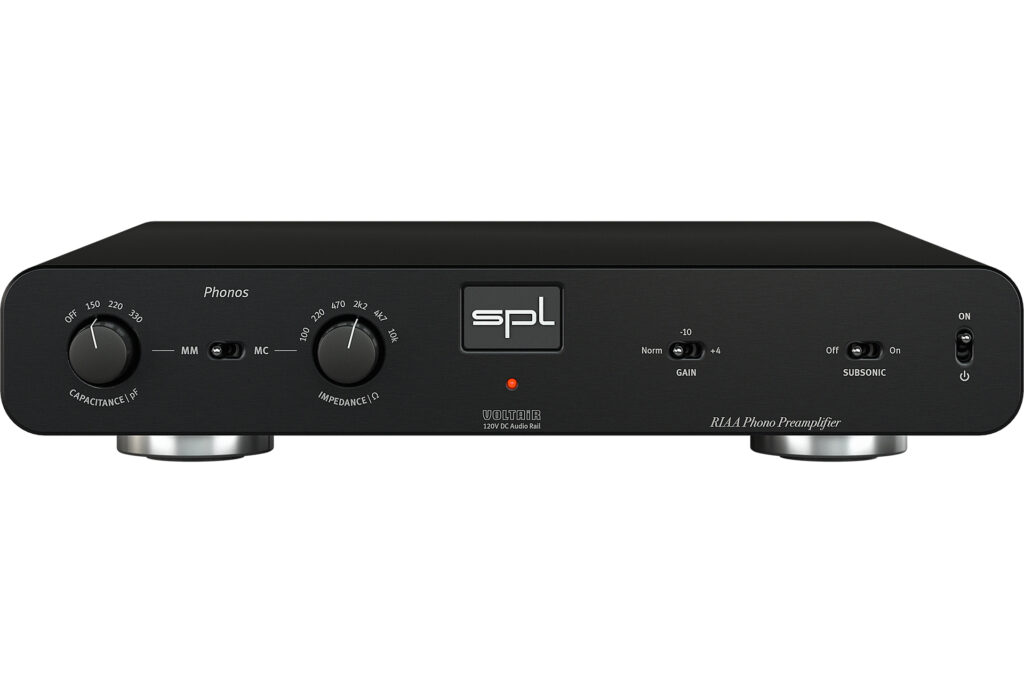
- The three standard colors are silver, black and red.
SPL Phonos Phono Preamplifier Specifications
| Cartridge Types | Moving magnet and moving coil |
| Gain | MM 36, 46 or 50 dB; MC 56, 67 or 71.5 dB |
| MM Input Impedance | 47k ohms |
| MC Input Impedance | 100, 220, 470, 2.2k, 4.7k or 10k ohms |
| MM Capacitance | Off, 150, 220 or 330 pF |
| Frequency Response | 10 Hz to 100 kHz (-3 dB) |
| Internal Rail Voltage | ±60 volts (120-volt technology) |
| Connections | Gold-plated RCA in and out; ground post |
| Dimensions (W x H x D) | 10.9 x 3.9 x 11.8 inches |
| Weight | 7.1 pounds |
Why Should You Care About the SPL Phonos Phonostage?
SPL has managed to find a way to pack a lot of technology into a small enclosure which will also appear very attractive in almost any audiophile system. Not only will this phonostage fit almost anywhere, it possesses some impressive features found on phonostages with much higher price points. It is very well built, surprisingly heavy relative to its size, and is not break the bank expensive. Performance wise, this is a superb sounding phonostage – one, in fact, many analog devotees can easily afford and will enjoy for many years without totally breaking the bank. It is hard to go wrong with the performance and value proposition.
Some Things You Might Not Like About the SPL Phonos Phonostage
- There are no XLR or balanced connections on the SPL Phonos Phonostage. And I realize a balanced design is very likely not realistically possible on a phonostage with a compact construction and at this price point. And the compact size also makes dual mono seem unlikely. But for those audiophiles who prefer balanced equipment, the SPL Phonos does not offer that feature.
- There is no mute button on the SPL Phonos. When a record change is due, many audiophiles find it easier to press the phonostage mute button to change an LP and lower the tonearm without adjusting the preamp volume. This makes it quite simple to lower the tonearm without a loud pop when the needle touches the record.
- I would like to see more choices in the capacitance settings. Having only three values, for some systems, may not be enough for some demanding audiophiles.
Listening to the SPL Phonos Phonostage
Lively. Energetic. Highly Dynamic. These are very valid descriptions of what I wrote in my review notes from the first LP I played. I felt the same all the way through to the last LP I played. This phonostage has ample amounts of headroom so it will not suffer unwanted compression. And surprisingly, it tends to kick the door down when it comes to a dynamic presence. There is also sufficient clarity and accuracy. The bass response was engaging but my Pass Labs XP27 (read review here) is superior as it should be given the cost difference. I also felt like the imaging on the SPL Phonos could have been better. In all fairness, this phonostage may appear to be designed for a more modest system, one with a lower overall cost. But in all actuality, the SPL truly enriches the sound of an LP, even on much more expensive systems. I enjoyed listening to LPs with the Phonos if for no other reason than the dynamic presence it portrayed. Who does not like lively and energetic in their music especially while reproducing our favorite music accurately to the master?
In the 1980’s, dance-pop with overtones of a driving pulse was the popular music medium of the day. On one of her most popular songs, “Gloria,” from her debut album Branigan, Laura Branigan set the tone for synthesized pop-infused music so popular in the 1980’s. Musically, there is a driving drum beat that hardly ever changes from the beginning of the track to the end. The ability of the SPL Phonos made this drum beat sound quite dynamic and was presented with a definite attack on the drum skin. The synthesizers almost seemed to sound as if they were alive and also were prominently rendered. For me, however, the real star of the track was Branigan’s voice. She had the ability to effortlessly move from a controlled presentation to a very highly powerful, full-throated, all-out assault on the lyrics. Here again, the ability of the SPL Phonos phonostage to make music sound lively and engaging was a testament to the magnificent power of the track. Sadly, Laura Branigan became a member of the gone too soon club of artists. She died of an unexpected cerebral aneurysm at the age of 52.
Released in July of 1976, AL Stewart’s timeless classic “Year of the Cat” from the album of the same name has long been revered for both its exceptional arrangements and from an audiophile perspective, a wide soundstage. Produced by Alan Parsons at Abbey Road Studios, this track is a blend of a number of genres such as soft rock, jazz and progressive pop. The track begins rather nonchalantly with a simple piano and soon thereafter a rather sharply attacked drum comes in. The drum and piano soon welcomes keyboard, bass and guitar. Most notably was the separation of instruments and the imaging set forth by the SPL Phonos. At about the 3:30 minute mark, an acoustic guitar gives way to an electric guitar which then turns into a really wonderful saxophone solo. Despite my LP being nearly 50 years old and having been played countless times, it still sounded, thanks in part to the SPL Phonos phonostage, surprisingly very listenable.
Will the SPL Phonos Phonostage Hold Its Value?
As a brand, SPL is not widely known in the United States but is gaining popularity with big awards like Product of the Year for their preamp from us as well as much better distribution from Walter Scofield and Walter Swanbon – two highly respected industry executives and friends of the publication. They do have a dedicated audience in Europe, however. But for those of us stateside, SPL as a brand may actually be penalized because they are not as well-known as other brands. And that may affect the value proposition. This would be a significant mistake. The entire SPL line is born from a pro audio background and their products are fantastically engineered and well made. There does not seem to be an abundance of SPL gear as a whole on the used US market. So actually holding value may be a somewhat difficult question to answer. Then again, with the performance compared to the retail price of the SPL Phonos phonostage, I am not completely convinced it even matters.
Who is the Competition for the SPL Phonos Phonostage?
A very valid choice is the PS Audio Stellar Phono Preamp (read review here). I once owned this phonostage and can attest to its very pleasing performance and its ability to make an LP quite engaging. At $2,999, it is slightly more expensive than the SPL Phonos, but not by very much. For the extra $500, the user gets both RCA and XLR connections and a balanced construction. It is also very neutral, very transparent and quite revealing. When it comes to dynamics, I would put the SPL Phonos slightly ahead because it absolutely offers a dynamic presentation.
Another highly valid competitor is the newly introduced MoFi Ultraphono Pro phonostage. Retailing for $2,495 and designed by Peter Madnik, the Ultraphono Pro uses some similar circuitry as the award winning MoFi Master Phono (read review here). The Ultraphono Pro has both RCA and XLR connections. It is built around fully discrete J-FET and MOSFET input and output stages. And like its big brother Master Phono, it is a very quiet, low noise phonostage. While it only has 65dB of gain when using an RCA connection protocol, the gain is actually increased to 71dB if the XLR connections are used. I was absolutely captivated by the MoFi Master Phono and if the Ultraphono Pro is even in the remotely same ballpark, it should be a standout phonostage. I would very much enjoy a head to head comparison of the MoFi Ultraphono to the SPL Phonos. I feel they are both very comparable in their overall performance.
I seem to have gone through quite a few phonostages as I also once owned the $3,350 Parasound JC3+ designed by the world renowned John Curl. In fact, this has been a very popular phonostage for Parasound and one Curl has continued to improve. It features dual mono, fully balanced construction. Connections are both XLR and gold plated RCA terminals. It can accommodate both moving magnet and moving coil cartridges. It has adjustments for both capacitive and resistive loading. For moving coil cartridges it only has 64dB of gain making it somewhat suspect with low output cartridges. Yet it is also very dynamic, revealing and an excellent performer for an affordable price.
Resource: check out Wireworld’s REA Plug Tonearm Cable here.
Final Thoughts on the SPL Phonos Phonostage …
Like all of high performance audio, no one component will satisfy everyone. But I must admit, the SPL Phonos is a product which is almost certain to satisfy a lot of analog fans. It has a small footprint which makes it a wise choice for today’s space challenged audiophile. It is superbly designed and built and when comparatively examining the price to performance metric, the SPL Phonos is a standout. Are there better phonostages? Absolutely. Are there more expensive phonostages? Well, of course there are. But when you consider the ease of installation and features of the SPL Phonos, and the impressively lively, upbeat, and dynamic presentation it renders, and it does all of this at a sub $3,000 price point, the Phonos is a very valid choice for analog enthusiasts. In fact, I suspect it could very easily find a home in many audio systems regardless of total system cost. The SPL Phonos is one of those good things comes in small packages product. I absolutely enjoyed my time with this phonostage. Anyone who is looking for a phonostage in the $2,500 price range, I can enthusiastically endorse the SPL Phonos to audiophiles at many levels of our hobby.



