
 By
By Denmark has long been known by audio aficionados as having produced a disproportionately high number of high-end manufacturers of drivers and speakers. Dali has been at the center of that story for over four decades. Founded in 1983 by the industry icon Peter Lyngdorf, Dali grew to be a well-respected speaker manufacturer with an international following. The company built its reputation on a simple premise: delivering real-world audiophile performance at nearly every price point. The bulk of Dali’s higher-end speakers, including the one in my system for this review, are still hand-assembled in the countryside town of Nørager.
Over the past few years, Dali has made some significant introductions in the higher-end audio world. First came the Kore, the company’s no-compromise, six-figure statement floorstanding loudspeaker, built to celebrate its 40th anniversary. That was followed by the more attainable Epikore 11. Now the technology developed for those two speakers has trickled down into the new Rubikore series, a five-model lineup that includes two floorstanders, a bookshelf speaker, an on-wall, and a dedicated home theater LCR. The Dali Rubikore 8 sits at the top of that range, and it is the model I have been reviewing over the last few months.
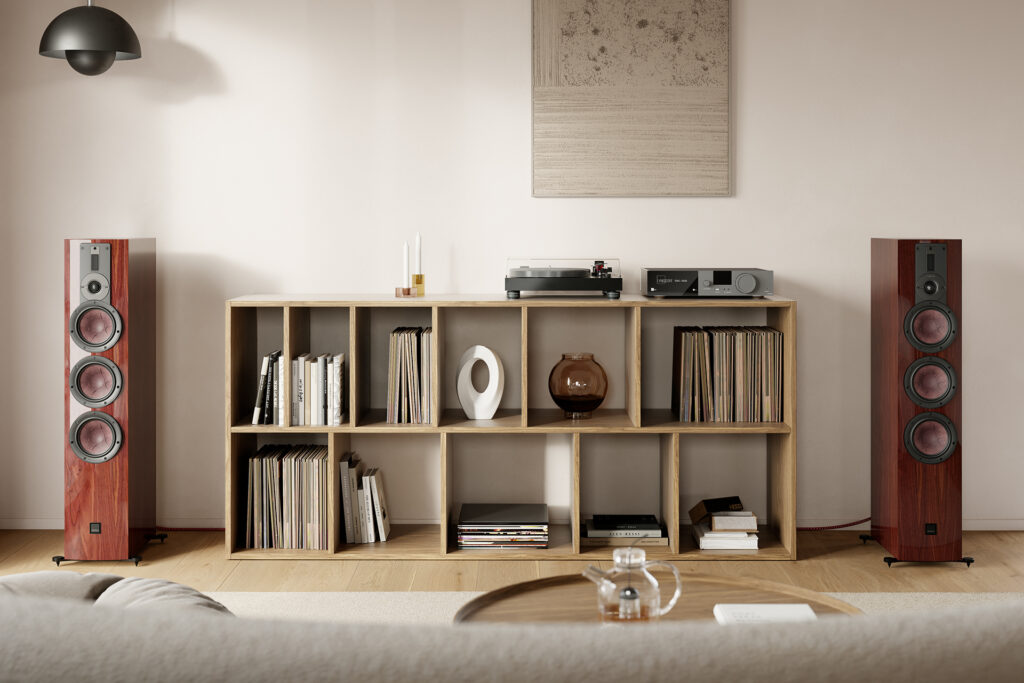
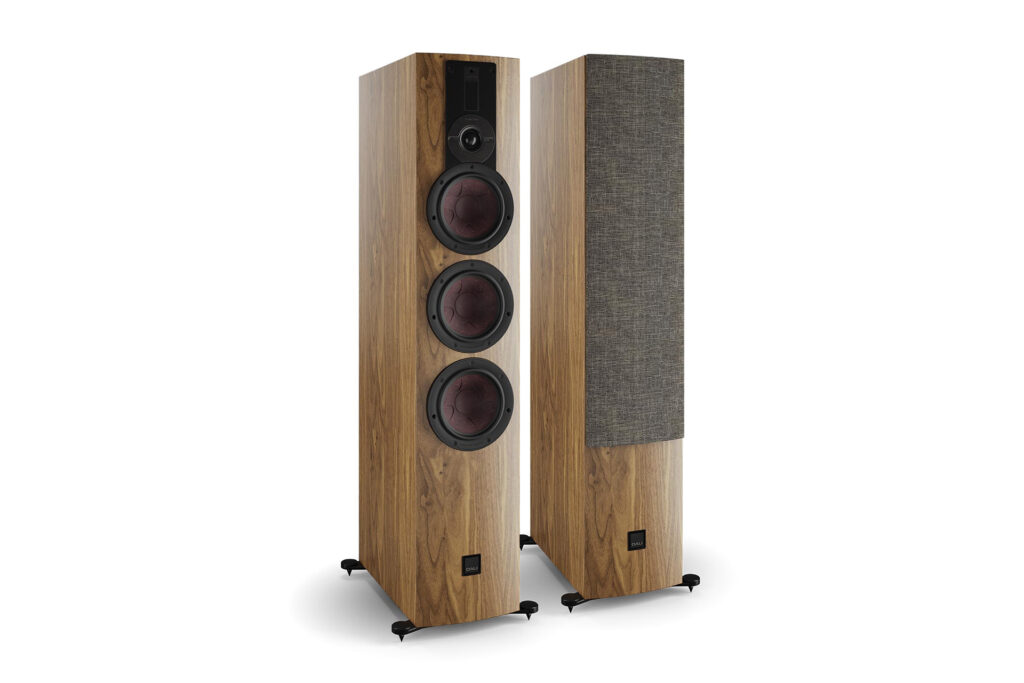
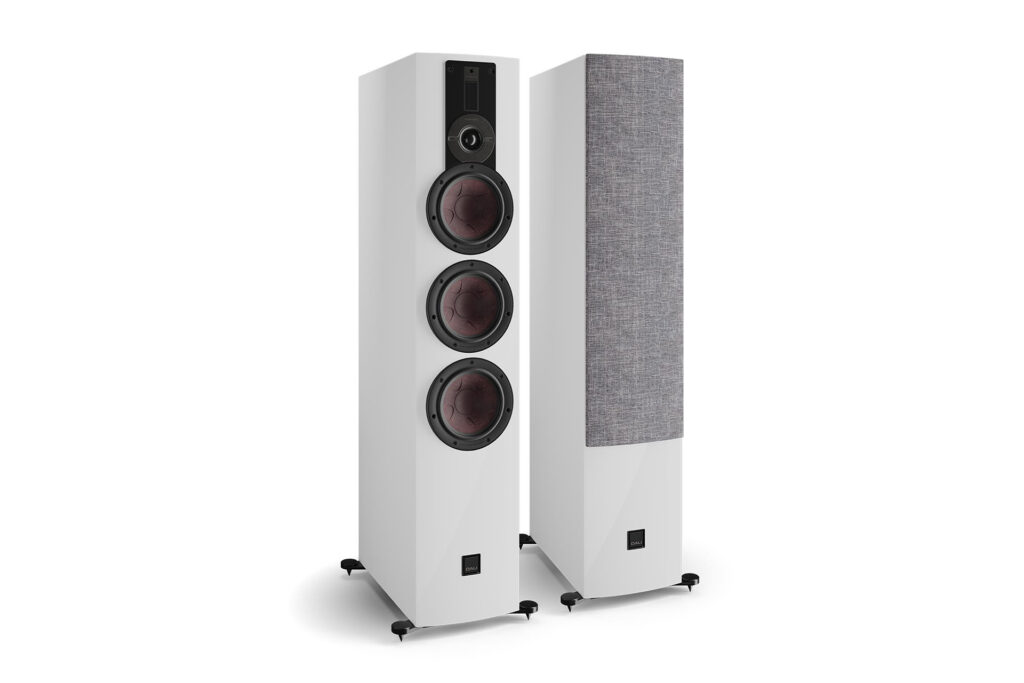
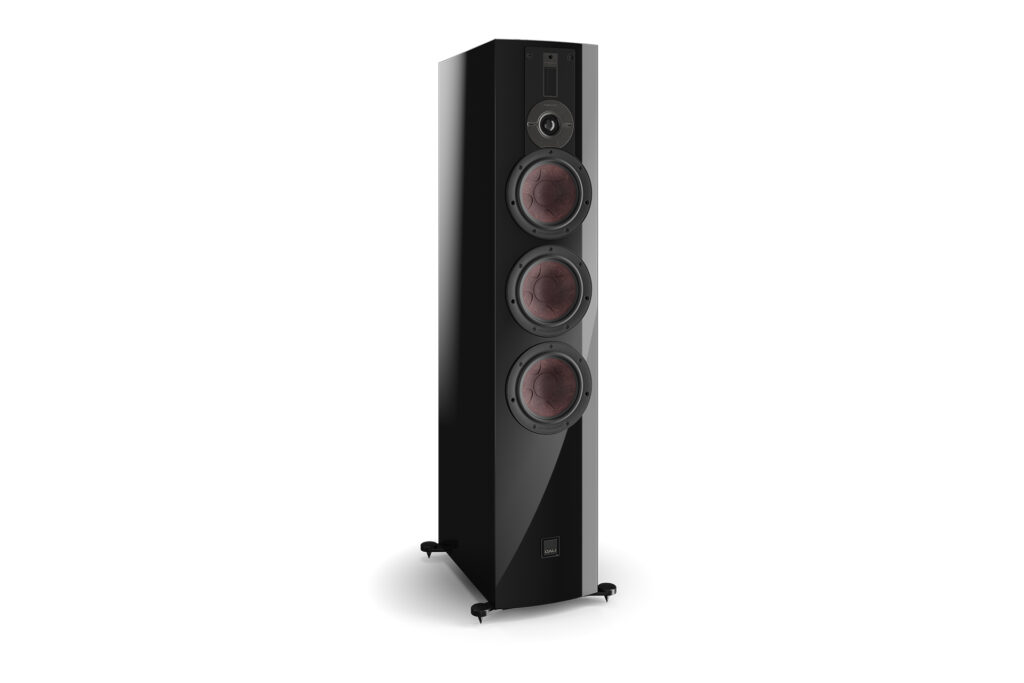
The Dali Rubikore 8 is a five-driver, quasi-three-way floorstanding speaker that stands 43.5 inches tall, 8.7 inches wide and 17.6 inches deep, a substantial but not overwhelming speaker for most rooms. It ships in a choice of High Gloss Black, High Gloss White, Natural Walnut, or High Gloss Maroon, and each speaker weighs in at roughly 66 pounds. Dali sent me a pair finished in High Gloss White with a light gray grille, and the fit and finish immediately signaled that this speaker, while a fraction of the price of the Kore, still carries a healthy dose of that flagship’s DNA.
|
What Makes the Dali Rubikore 8 Loudspeaker Special?
- The Rubikore 8 uses an unusual driver layout that Dali calls a 2.5 + 0.5 + 0.5-way design.Rather than the more common 2.5-way arrangement, where two identical woofers share bass duty and only one hands off to the tweeter, the Rubikore 8 gives each of its three 6.5-inch woofers its own filter point: 500 Hz, 800 Hz, and 2.4 kHz. The result is meant to combine the bass headroom of a 2.5-way design with the more focused point-source imaging of a true three-way and, in practice, the crossover network here is considerably more complex than that of a more typical 2.5- or three-way speaker.
- The woofers use Dali’s Clarity Cone technology, a paper and wood fiber, cone-shaped and embossed to resist breakup at higher frequencies. This lets the drivers cover a wider bandwidth without requiring steep crossover slopes, which in turn helps keep distortion in check. The cones are driven by Dali’s second-generation SMC-KORE (Soft Magnetic Compound) double-magnet motor system, which replaces solid iron in the magnet with insulated iron granules. This is said to reduce the hysteresis and eddy currents that would otherwise act as a brake on the voice coil, and it also gives the speaker a more linear impedance curve that is easier on amplifiers. While I do not have the engineering skill to evaluate the claims, I can say that none of the amplifiers I tried with these speakers struggled at all.
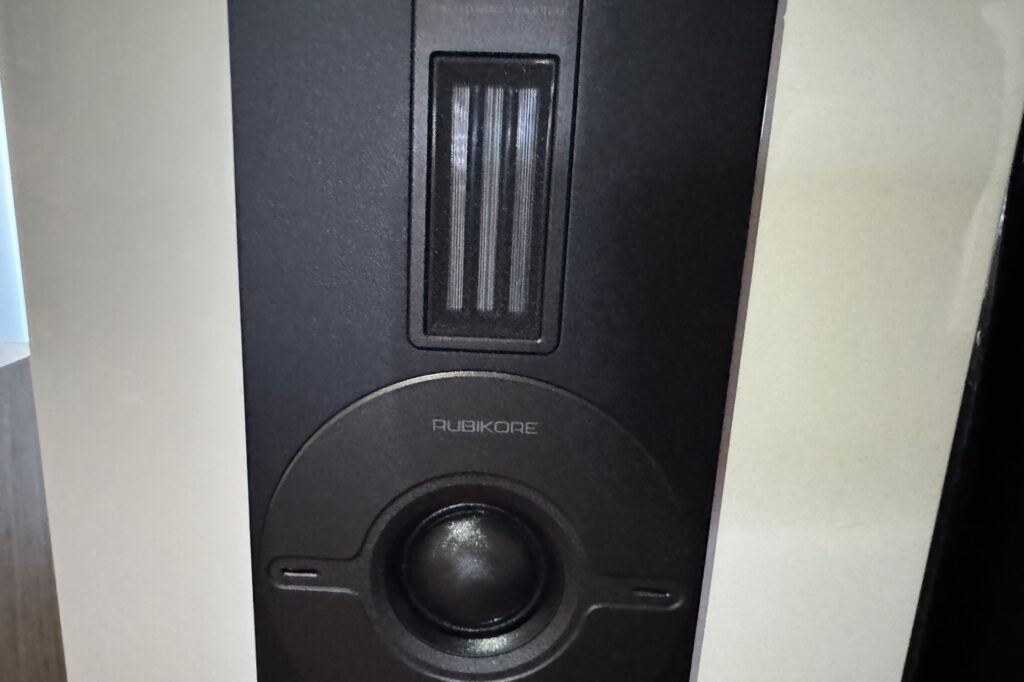
- High frequencies are handled by two separate tweeters rather than one. A newly-designed 29-mm low-loss soft dome tweeter, built without ferrofluid in the magnetic gap, covers the bulk of the treble. The tweeter is inspired by Dali’s flagship EVO-K dome tweeter from the KORE series. Dali claims that removing the ferrofluid reduces unwanted damping of the dome. A 17-by-45-mm planar magnetic tweeter takes over above roughly 14 kHz to extend response out to a reported 34 kHz. This allows each driver to operate in its optimum range.
- The crossover itself borrows directly from the flagship Kore. SMC-Kore inductors are used to minimize signal loss, and the capacitors are sourced from Mundorf, a well-regarded name among speaker designers who care about the parts bin. The result is a five-way binding post terminal that supports bi-wiring or bi-amping for owners who want to experiment further.
- Bass loading comes from a rear-firing Continuous Flare Reflex port. Dali’s engineers spent a lot of time on port design to maximize performance at low frequencies, and the continuously flared geometry is designed to reduce chuffing and turbulence at higher output levels. Combined with the three woofers, Dali rates the Rubikore 8 down to 38 Hz ± three dB, with useful in-room extension below that.
- Sensitivity and impedance make the Dali Rubikore 8 a relatively easy speaker to drive. At 90.5 dB sensitivity and a four-ohm nominal load, Dali suggests the Rubikore 8 can be driven with as little as 40 watts, though the company lists a recommended range up to 250 watts for those who want to open the throttle. While the impedance may be lower than that of some competing speakers, the crossover design is said to provide a smoother and easier load on the amplifier. Maximum SPL is rated at 112 dB.
- The cabinet itself is where a good chunk of the price goes. Each enclosure is extensively braced and hand-finished at Dali’s facility in Denmark, with the High Gloss White sample I received having a nicely-executed and simple, clean appearance. The otherwise traditional rectangular cabinet has a slightly curved front baffle, with the tweeters mounted to a metal plate and the mid-woofers mounted to metal rings that stand very slightly higher than the baffle. Dali includes a set of well-thought-out aluminum outrigger stabilizing bars with spikes that bolt to the base, adding stability without extending the footprint by much.
Dali Rubikore 8 Floorstanding Speakers Specifications
| Drivers | 17 x 45 mm planar magnetostatic tweeter, 29 mm soft-dome tweeter, three 6.5-inch paper/wood-fiber woofers |
| Design | 2½-way bass reflex (tuned to 33 Hz) |
| Frequency Range | 38 Hz to 34 kHz (±3 dB) |
| Sensitivity | 90.5 dB (2.83 volts at one meter) |
| Nominal Impedance | 4 ohms |
| Maximum SPL | 112 dB |
| Recommended Amplifier Power | 40 to 250 watts |
| Connections | Bi-wire and bi-amp capable |
| Dimensions (H x W x D) | 43.5 x 8.7 x 17.6 inches |
| Weight | 66.1 pounds each |
Why Should You Care About the Dali Rubikore 8 Loudspeakers?
The Dali Rubikore 8 occupies an interesting spot in Dali’s lineup. It carries meaningful trickle-down technology from a speaker that costs many multiples of its price, but it is still priced within reach of a serious enthusiast, rather than only the top of the market. For listeners who want a large-scale, full-range floorstander that can fill a big room without a subwoofer, and who value an easy amplifier-friendly load, the Rubikore 8 checks a lot of boxes at once.
It is a speaker that rewards good electronics without ever demanding them. Because it is genuinely easy to drive, a modest but well-sorted integrated amplifier can get you most of the way there. Step up in amplification, however, and the Rubikore 8 keeps revealing more, which makes it a speaker you can grow a system around, rather than one you simply pair and forget.
Some Things You Might Not Like About the Dali Rubikore 8 Loudspeakers
- The Dali Rubikore 8 is a tall, substantial floorstanding loudspeaker and, while its footprint is reasonably compact, the height and included outriggers mean it needs some genuine floor space and forethought about placement. This is not a speaker to be tucked into a bookshelf. Dali recommends placement at least eight inches from the front wall.
- Five drivers and a dual-tweeter array are a lot of moving parts, and the crossover network is correspondingly complex. Complexity is not inherently a flaw, and Dali’s execution here is clearly well-sorted, but listeners who prefer the simplicity of a two-way stand-mount will find the Rubikore 8’s engineering story a lot more elaborate than they may be seeking.
Listening to the Dali Rubikore 8 Audiophile Loudspeakers …
I did the bulk of my listening with a Marantz SACD 30n (read the review) as a source feeding a Krell Phantom III preamplifier, driving the power amplifier section of a Krell FBI and then a RBH Unrivaled stereo amplifier. Lastly, I listened through a TEAC preamplifier and amplifier combination that will be the subject of upcoming reviews. All connections were Wireworld Eclipse 8 series cables. The Rubikore 8s were placed roughly eight feet apart and about two feet from the front wall, with a slight toe-in aimed just behind my listening position, which is close to where Dali’s own literature suggests these speakers like to sit.
I began with Diana Krall’s “Dream a Little Dream of Me” from Jazz Love Songs on Tidal. Krall’s voice was rendered with real warmth and body, solidly positioned between and slightly behind the speaker plane. The piano accompanying her vocals had a natural woodiness to it that avoided the slightly metallic edge I have heard from lesser speakers. The dual tweeter array did exactly what Dali intends it to do; cymbal work was extended and airy without ever calling attention to itself as a separate driver handing off to another.
Moving to something more complex and with more low-end demand, I put on Fleetwood Mac’s Rumours and listened to “The Chain” run start to finish. The three-woofer array showed its advantage here; Mick Fleetwood’s drumbeat that carries through the track had genuine weight and speed, and the Dali Rubikore 8 never sounded like it was straining, even as I pushed the volume up. The staggered crossover points between the woofers seemed to be doing their job, because the midrange never lost focus, even as the bass was working hard. The vocals and guitars were cleanly layered above the drums. The bass guitar riff just over three minutes into the track was clearly rendered with substantial weight, while Lindsey Buckhingham’s guitar ripped away above it, layered with vocals and no congestion.
For a tougher test of the critical midrange, I returned to a reference I was introduced to at an audiophile event, Neil Young’s Live at Massey Hall 1971 and the track “Old Man.” Guitar transients were fast and well-defined, and Young’s voice had stable, in-the-room presence with a good sense of the space of the large hall where the track was recorded. Young’s distinctive voice was rendered naturally without any audible coloration, Rubikore’s did a great job capturing the micro-dynamics in his inflections alongside the more dynamic guitar notes.
On the orchestral side, I cued up Dvořák’s Symphony No. 9 from the New World, using a Gustavo Dudamel-led recording. This is exactly the kind of large-scale, dynamically demanding material that separates a genuinely wide-bandwidth speaker from one that is merely loud. The Dali Rubikore 8 opened up the soundstage well beyond the physical boundaries of the speakers themselves. The wind instruments were portrayed with a good balance of warmth, delicacy and detail. The underlying bass notes of the strings and drums gave up a touch of detail in comparison to the more expensive Revels, but provided more weight.
Finally, I wanted to hear how the Dali Rubikore 8 handled modern, bass-heavy production, so I played Billie Eilish’s “Therefore I Am.” The three woofers delivered real low-end impact without any hint of strain or chuffing from the rear port, and while a dedicated subwoofer would still add a further layer of extension and slam, I think I would save that for home theater duty. I found the Dali Rubikore 8 to have more low-frequency energy than the larger Revel F328Be (read my review) at lower to moderate volumes, but it evened out at higher volumes, where the Revel’s larger drivers seemed to provide more headroom. In short, I think the bass capabilities of the Dali Rubikore 8 should be more than satisfactory for most situations.
Across every genre, what stood out most was how effortlessly the Rubikore 8 scaled with volume. Micro dynamics stayed audible at low listening levels, and the speaker never lost its composure as I pushed things louder, which tracks with Dali’s claim that this speaker can be driven with anything from a modest 40-watt amplifier up through 250 watts without changing its character. I found all the amplifiers I tried to be more than capable of driving the Dali’s to moderately high levels for more than an hour without becoming excessively warm or with any audible cues of strain.
Learn how to position your audiophile speakers better with help from editor, Paul Wilson.
Will the Dali Rubikore 8 Loudspeakers Hold Their Value?
Dali has built a durable reputation over more than 40 years, and the Rubikore series carries real, well-demonstrated technology transfer from the company’s flagship Kore, which should help it age gracefully in the secondary market. Dali’s finishes are also fairly conservative and unlikely to look dated in a decade, which historically helps resale value on speakers as much as any spec sheet does. As with any large, heavy floorstander, shipping costs will eat into resale economics for buyers outside major metro areas, so factor that into any long-term ownership calculation. Lastly, with the recent departure from the United States market by Dynaudio, Dali stands as one the of the elite best options for audiophile speakers sold today in the U.S., thus more dealers, solid marketing and more consumer awareness. None of this hurts resale values.
What is the Competition for the Dali Rubikore 8 Loudspeakers?
At $13,000 per pair, the Rubikore 8 competes against a well-established group of flagship-adjacent floorstanding speakers from brands with their own long track records in high-end audio.
Focal Sopra No. 2 – $23,000 per pair
The Focal Sopra No. 2 (read publisher Jerry Del Colliano’s review of his former reference speakers) uses Focal’s Beryllium inverted dome tweeter and “W” composite sandwich cone woofers in a 2.5-way configuration. It is priced nearly twice as much as the Dali Rubikore 8 and leans toward a slightly more forward, detailed presentation. Listeners who want Focal’s house sound, with its emphasis on speed and top-end sparkle, may prefer the Focal Sopra; those who want a warmer, more relaxed rendition of the same level of detail may find the Dali more to their taste.
KEF Reference 3 Meta – $15,998 per pair
KEF’s Reference 3 Meta uses the company’s Uni-Q coincident driver array, along with Metamaterial Absorption Technology to tame internal reflections. It offers excellent point-source imaging thanks to the coaxial design, a different approach to coherence than Dali’s staggered, multi-driver crossover. The KEF is slightly less expensive and considerably lighter, which may appeal to buyers with placement or mobility constraints.
Revel F328Be – $17,600 per pair
Revel’s F328Be (buy at Crutchfield), a speaker I have spent considerable time within my own reference system, uses a Beryllium tweeter and a more neutral, studio monitor-derived voicing. The Revels are a bit more clinical and less overtly warm than the Dali Rubikore 8, and listeners who prioritize absolute neutrality over tonal richness may prefer the Revels’ more revealing presentation.
Bowers & Wilkins 702 S3 Signature – $9,900 per pair
I reviewed the Bowers & Wilkins 702 S3 Signature (buy at Crutchfield) for this publication and came away impressed with how much of the 800 Series’ trickle-down technology made it into a comparatively affordable package. It is a bit smaller and less expensive than the Rubikore 8, with Bowers & Wilkins’ characteristic tweeter-on-top design, a slightly more forward upper midrange and less bass output. Buyers who want a smaller footprint and Bowers’ house sound may lean toward the 702 S3 Signature; those chasing outright scale and bass authority will likely prefer the Dali.
Final Thoughts on the Dali Rubikore 8 Loudspeakers …
The Dali Rubikore 8 is exactly what its backstory promises: a speaker that takes real, meaningful engineering from a six-figure flagship and packages it into something a serious enthusiast is more likely to be able to afford. The unique dual-tweeter array integrates well with the staggered three-woofer arrangement that delivers bass with more headroom and weight than its cabinet size might suggest, and the whole package is genuinely easy to drive without sacrificing the ability to scale with better electronics.
The Dali Rubikore 8 is not a speaker that announces itself with an aggressive top end or an artificially warmed-over midrange. Instead, it does what the best Dali speakers have always done: gets out of the way of the music and lets a well-assembled system sound like itself, just bigger and more effortless. For listeners shopping in the $10,000-to-$15,000 floorstanding speaker range who want scale, ease of amplification, and a genuine connection to Dali’s flagship engineering, the Rubikore 8 is an easy speaker to make them fall in love.



