
 By
By Picture this: It’s a crisp New England fall day and you are shopping for new loudspeakers. Around 1996, Lechmere, Circuit City, Tweeter – several brick and mortar shops, and the occasional random white-van-in-a-parking lot were all available in a short drive’s distance to explore endless HiFi loudspeaker offerings. If your budget was $1,500 per pair (or less), it was the perfect position to be in to shop for loudspeakers. What a time to be alive! However, there was a downside to this cornucopia of loudspeaker availability. Any manufacturer’s loudspeaker offerings had to stand out among the crowded store shelves, poorly set-up sound rooms, and a sea of salesmen working on pure commission. To stand out, many loudspeakers were made with a sort of boom-and-sizzle represented sonically by hard-kicking but loose bass and emphasized by crispy treble. Man, did loudspeakers back then make a great five-minute demo with The Eagles’ track “Hotel California” off the live album Hell Freezes Over. Long-term listenability of budget loudspeakers back then, however, was a very different story. The Wharfedale Diamond 12.4i is a very different kind of $1,500 speaker.
Today in the audiophile world, things are different. With so much data available on loudspeakers, and the means to sell them through so many different channels, fidelity dominates all. This statement includes the lower-end price points of audiophile loudspeakers, too. Reputable companies like Wharfedale are putting forth loudspeakers such as the flagship of their Diamond line, the Diamond 12.4i. (buy at Crutchfield). For $1,500 per pair, Wharfedale has claimed to have honed in on the fidelity of the Diamond 12.4i through refinement of their previous generation’s technology, and are handling the bass response in a manner that aims to leverage the listening space more. All of this seems like true high-fidelity consideration for a $1,500-per-pair loudspeaker and a far cry from the boom-and-sizzle crowd of the late 1990s. Time to get these very tall Diamond 12.4is out of their boxes and into my listening space to see if my high-fidelity hunch proves true.
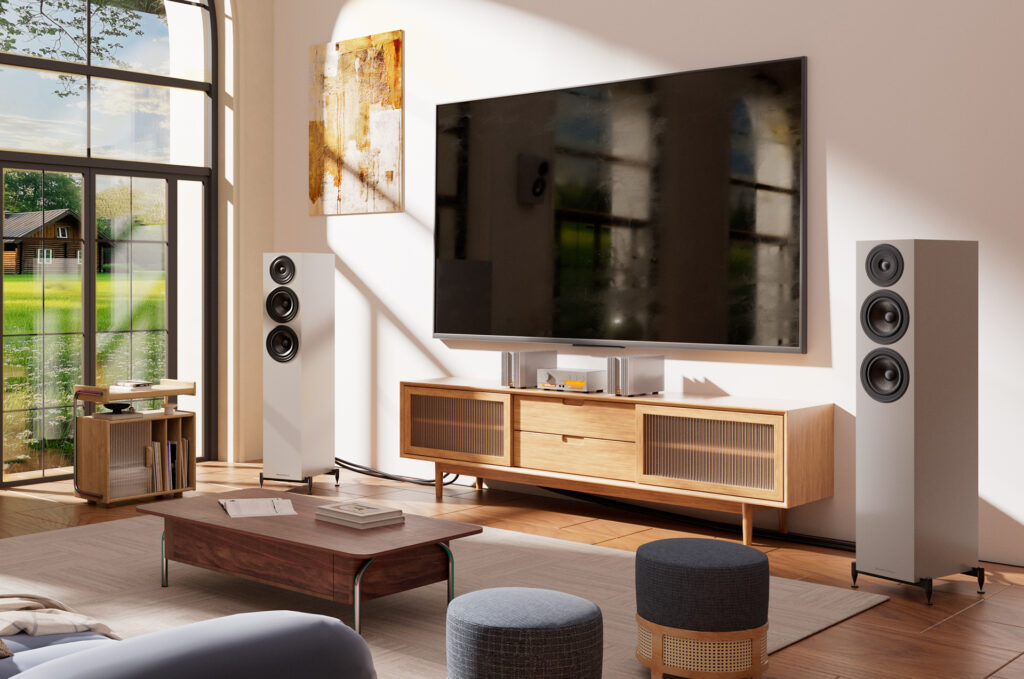
What Makes the Wharfedale Diamond 12.4i So Special?
- The Wharfedale Diamond 12.4i has been tuned for real listening environments. Too many loudspeakers rely on a simple measurement called frequency response. This shows how a speaker sounds to a single microphone in a single space at a single point in time. For some odd reason, the audiophile community has come to think this is the only measurement that matters. I am here to tell you it does matter. However, frequency response, when standing on its own, does little for our understanding of how we will finally perceive the lower midrange (below about 300 Hz) and bass of a loudspeaker like the Diamond 12.4i. There are several other, often unpublished and somewhat difficult-to-interpret, measurements that need to be used in conjunction with frequency response to deliver the whole picture of what the bass response will sound like in our listening spaces. Wharfedale has taken all the necessary measurements and added some common sense listening to them to produce the bass response in the Diamond 12.4i. Tuning and measurement at this level of complexity are rarely done at such a low price point, and this may be the most distinguishing factor of the Diamond 12.4i.
- The Wharfedale Diamond 12.4i loudspeaker is a 2.5-way loudspeaker, not a dual-woofer two-way loudspeaker. Two-way loudspeakers use two mid-bass drivers to do the same thing. 2.5-way loudspeakers still use two mid-bass drivers, but only one acts as a mid-bass; the other acts as a dedicated woofer. It’s a subtle difference, and far trickier to get right versus a two-way but, when gotten right, a 2.5-way loudspeaker benefits from deeper bass response, better efficiency, a cleaner midrange, and lower overall distortion.
- The Wharfedale Diamond 12.4i has structurally solid cabinets. I always expect to hear the distinct sonic signature of the cabinet in a loudspeaker that is sub-$2,000 per pair. It is rare to have audibly inert cabinets under $5,000 per pair. Wharfedale pulled off having inert cabinets nicely, which enhances the imaging and naturalness of the sound of the Diamond 12.4i.
- Wharfedale’s KlarityTM drivers in the Diamond 12.4i pack some serious technology. The mid-bass drivers in the Wharfedale Diamond 12.4i are made from a polypropylene/mica blend cone, mated to a carefully designed, low-distortion motor made to specifically drive this type of cone. According to Wharfedale, it helps the driver’s motor assembly stay light yet rigid to produce a more natural sound.
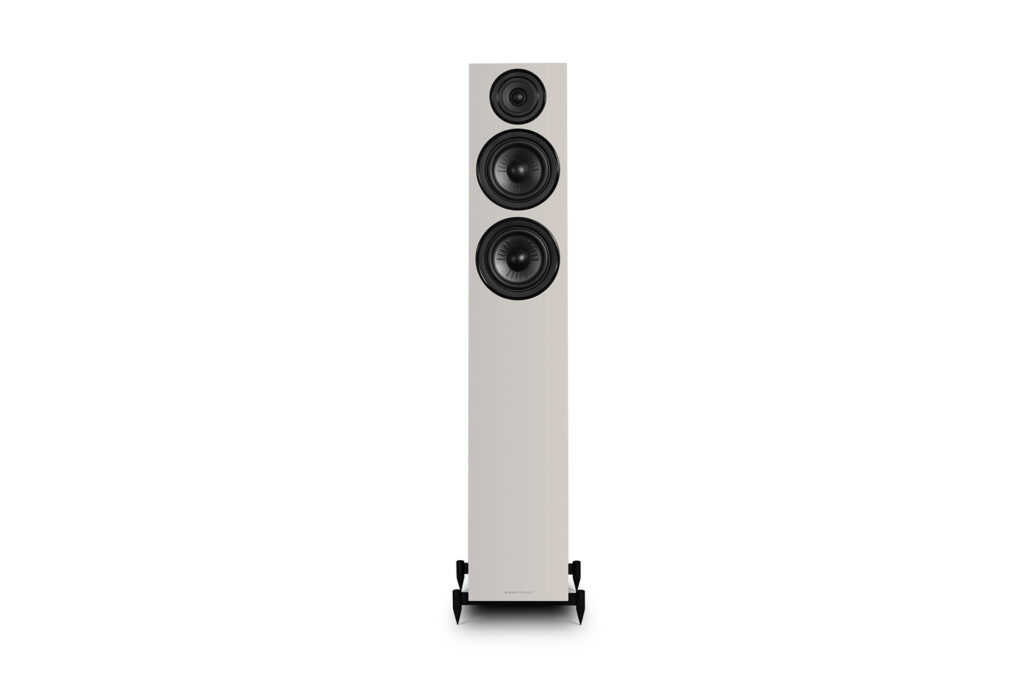
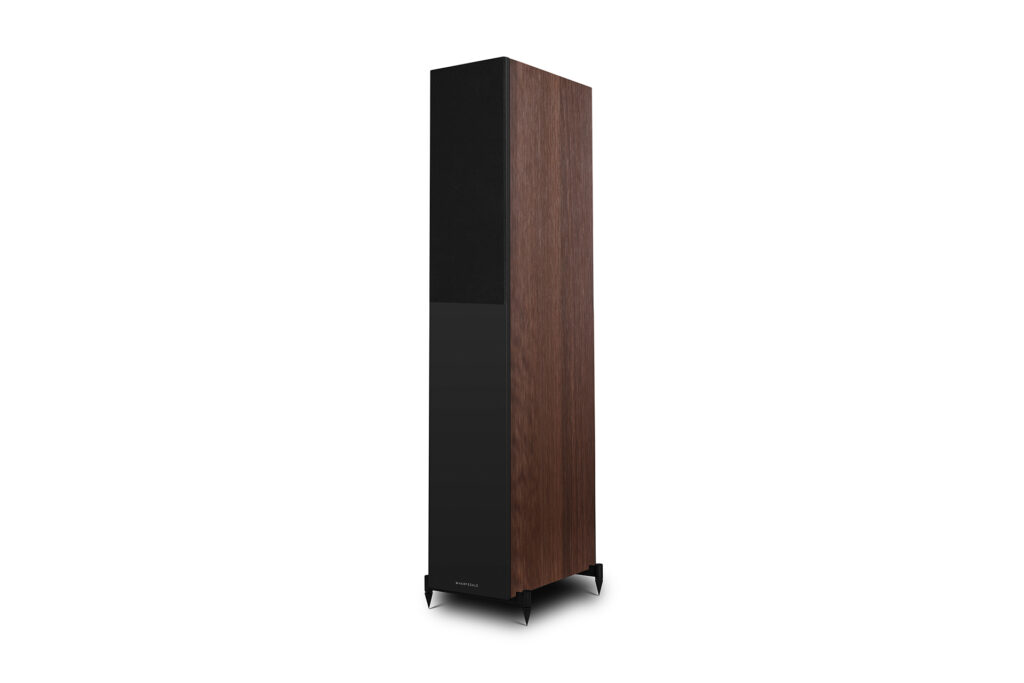
- The classic walnut finish on the Wharfedale Diamond 12.4i is beautiful. Wharfedale did a fine job making this affordable loudspeaker sexy. The walnut finish may be vinyl, but it is high quality and looks great from both up close and afar. The highly reflective trim rings around the drivers add a nice touch of class, too, and it makes the Diamond 12.4i attractive with or without the grille. If walnut is not your favorite, you can get the Diamond 12.4i in deep black or stone gray.
- The tall, slender Wharfedale Diamond 12.4i has the same footprint as a bookshelf loudspeaker on a stand. There are two things that frost my behind. A snow cone is about 38 inches tall, and audiophiles try to say their room is too small for towers because they won’t fit and then proceed to put a bookshelf loudspeaker on a stand. The small footprint of the Diamond 12.4i is perfect, even for small listening environments, and they can easily tuck away in the same way a bookshelf on a stand can.
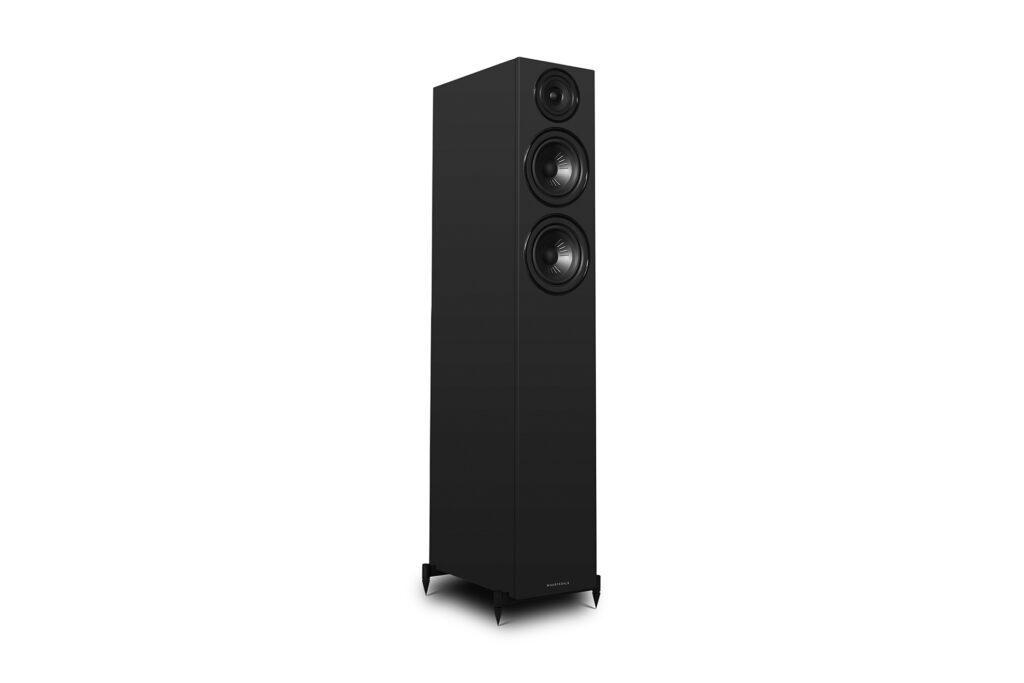
Wharfedale Diamond 12.4i Specifications
| Design | 2.5-way bass reflex floorstander |
| Tweeter | One-inch (25 mm) textile dome |
| Woofer / Mid-bass | 6.5-inch polypropylene-cone mid/bass driver and 6.5-inch polypropylene-cone bass driver |
| Frequency response | 40 Hz – 20 kHz (±3 dB); 35 Hz (-6 dB) |
| Sensitivity | 89 dB (2.83V/1m) |
| Impedance | Eight ohms nominal (five ohms minimum) |
| Recommended power | 30 – 200 watts |
| Crossover | 2.1 kHz |
| Dimensions (H x W x D) | 45.3 x 7.9 x 14.9 inches overall (cabinet 43.3 x 7.9 x 13.8 inches) |
| Weight | 49.4 pounds each |
| Finishes | All-Black, Classic Walnut with black baffle, Stone Grey |
| Price | $1,498 per pair (Music Direct) |
Why Should You Care About the Wharfedale Diamond 12.4i Loudspeaker?
According to Wharfedale, the Diamond 12.4i builds on the existing reputation of the Wharfedale Diamond series: budget loudspeakers that do not sound so budget. There is a lot of hot garbage you can get for $1,500-per-pair loudspeakers, even from other reputable manufacturers. For Wharfedale, their sole passion is loudspeakers, and it has been for nearly 100 years. This is relevant because any of Wharfedale’s loudspeakers at any price must reflect the well-earned accolades and value for which Wharfedale is known. The Wharfedale Diamond 12.4i is not an exercise in cost-cutting to hit a price point; rather the Diamond 12.4i has to stand on its own as a well-engineered loudspeaker capable of giving a whole lot of HiFi while packing a whole lot of value. Large budget loudspeakers that present like real high-end large loudspeakers are very difficult to engineer, let alone at the Wharfedale Diamond 12.4i’s $1,500-per-pair selling price. If my hunch is right, Wharfedale has dug deep into their bag of tricks to make a true budget large loudspeaker that can be called high end. If that isn’t something to care about, I’m not sure what is.
Some Things You Might Not Like About the Wharfedale Diamond 12.4i Loudspeaker
- The Wharfedale Diamond 12.4i is very tall, and tall speakers can sometimes tip over. The Diamond 12.4i stands a whopping 45.3 inches high. While it does come with quality outriggers that help stabilize the tower, it is a tip hazard if you have little ones, large dogs, live in an earthquake zone, and/or if your depth perception is off while twerking to Lil’ John’s “Get Low” in admiration of the Diamond 12.4i’s bass response. On a related note our editor, Jerry Del Colliano, gives some good tips about securing large loudspeakers in his article “An Audiophile’s Guide to Baby Proofing Your Stereo System” (read it here).
- The KlarityTM drivers in the Wharfedale Diamond 12.4i are fantastic. However, the tweeter lacks a little something special. The tweeter does nothing offensively wrong. Let’s get that clear. In fact, it is seamlessly integrated into the dual 6.5-inch woofers. The bee in my bonnet is that I find the tweeter almost reaches the sonic quality of the KlarityTM drivers, but it never quite gets there.
- There is only one set of binding posts on the Wharfedale Diamond 12.4i. If you are a fan of bi-wiring, you are out of luck.
Listening to the Wharfedale Diamond 12.4i Loudspeaker
After carting my reference PSB Synchrony T800 (read the review) out of the room, I measured out the right location and plopped the Wharfedale Diamond 12.4is into place. I also disconnected my latest addition, the PSB BP12 Subwoofer (review coming soon), to get a feel for Wharfedale’s new bass tuning of the Diamond 12.4i. I used my reference system primarily, but was fortunate enough to have the Quad Platina integrated amplifier arrive for evaluation, so I threw that in as well. The Wharfedale Diamond 12.4is were of such quality, I put them against my Sonus faber Lumina Vs (reviewed here), but the Lumina Vs are high-value loudspeakers in their own tier at $4,000 per pair, which is over twice the selling price of the Diamond 12.4is. I ultimately concluded the Lumina Vs are a little too superior in refinement to be a fair competitor, though the bass on the Wharfedale Diamond 12.4is was far superior in overall timbre and quantity. So, instead of a comparison, we will focus solely on the $1,500-per-pair Wharfedale Diamond 12.4is, because I found them to have way more HiFi Big Speaker Energy than I expected.
After 24 hours of pink and brown noise at break-in levels that sent my cats in all directions, I settled in for a listen to the Wharfedale Diamond 12.4is. It’s funny, but after being in the industry for some time, you develop a certain instinct and, within the first few seconds of serious listening, an inkling forms as to whether the gear you are hearing to will be special or not. The Wharfedale Diamond 12.4is had a lot of special sauce right from the first few notes of Nirvana’s “Oh Me” off their MTV Unplugged in New York album. The sense of the stage and hall were large and solidly present, as one would expect on a loudspeaker that has a much larger driver complement than the Diamond 12.4i. The strumming and pick-work on the guitars were present, and they were placed well in the soundstage. Kurt Cobain’s voice had the scaled fullness I only seem to find on much larger loudspeakers. The cymbals and upper midrange were good. I simply wish there were just a little more resolving power to be had from the Diamond 12.4i’s tweeter, but both were of better-than-average quality for a $1,500-per-pair loudspeaker. The bass was of a quality and quantity I have never heard on a sub-$2,000-per-pair loudspeaker before, at least not without sacrificing timbre, which is typical at these price points. The low bass note pressurized my room with its presence, while the gentle kick drum held its space without getting lost. I had to double-check if my PSB Speakers BP12 subwoofer was still on by accident. Yes, the bass was that good. The Wharfedale Diamond 12.4i certainly has made a stellar first impression, so let’s move on.
A couple of days deep into listening, I wanted to hear how the Wharfedale Diamond 12.4i can jam. I threw on the track Albert King’s “Blues at Sunrise” featuring Stevie Ray Vaughan off King’s album In Session. This song is classic blues/rock that has excellent dynamic range. More importantly, it tells an amazing story that ties in the likes of Janice Joplin and Jimi Hendrix. Woober joobers, the Diamond 12.4i did this track justice. The guitars of both Vaughan and King were distinct in tone, and their individual/unique playing styles were captured well, thanks to the Diamond 12.4i’s ability to sound like a much larger loudspeaker. This was at volumes overly-taught audiophiles would tell me to turn down, too. The soundstage was both wide and deep, with no hint of cabinet constraint in the low midrange of the lower end of both the guitars and the vocals. “Blues at Sunrise” does not work without the driving bass line and drums, and the weight and quantity of the bass was fantastic on the Wharfedale Diamond 12.4i. The kick drum had a deep, fast punch and never got in the way of the meaty walking bass line. The treble had a little sheen, nothing offensive, but lacked a little of the sophistication I heard from the Diamond 12.4i’s bass and midrange. Overall, another great musical experience that made me forget that I was listening to a very affordable pair of loudspeakers, instead of a very expensive pair.
In 2022, Sofia Isella dropped her album All of Human Knowledge Made Us Dumb. The title track, which came to me via a listening session with my 17-year-old daughter, is an excellent piece of music. Isella’s voice is unique and well-controlled over a myriad of skilled mixing/engineering of the music. The Wharfedale Diamond 12.4is carried themselves as well as any large full-range loudspeaker would with a highly complex recording. The soundstage was gigantic. The chorus of voices was enveloping. I was most impressed by the way the Wharfedale Diamond 12.4is handled the complexity without losing their musical integrity. The drums hit hard, driving the reality of this track straight to the heart. By the time I got to the track “All of Human Knowledge Made Us Dumb,” I had about 50-plus hours of listening time with the Wharfedale Diamond 12.4is and I was never less than impressed.
Will the Wharfedale Diamond 12.4i Loudspeaker Hold Its Value?
I do not think there is much to overcomplicate here. Wharfedale has a stellar reputation and makes products that stand the test of time. I can see the Diamond 12.4i remaining valuable in the used market for a while. When a product has this much value at retail, strong resale value is nearly a certainty.
What is the Competition for the Wharfedale Diamond 12.4i?
At $1,650 per pair, the Monitor Audio Bronze 500 (buy at Crutchfield) is another large budget tower. You get the same 2.5-way topography as the Diamond 12.4i, and larger woofers, but it is lighter for a larger cabinet, which is indicative of lesser build quality.
The Dali Sonik 5 (buy at Crutchfield) swings in at $1,800 per pair. It has smaller woofers and may not reach the same Big Speaker Energy the Diamond 12.4i does, but Dali is a serious loudspeaker contender packed with very serious technology. I would imagine this will make it as, if not more, refined-sounding than the Wharfedale Diamond 12.4i.
Final Thoughts on the Wharfedale Diamond 12.4i Loudspeaker
I was thrilled Wharfedale chose the high road of high fidelity instead of designing the Diamond 12.4i loudspeaker to simply boom-and-sizzle louder than the very-congested under-$2,000-per pair-loudspeaker market. For $1,500 per pair, Wharfedale has built upon their legendary Diamond series, allowing the Diamond 12.4i to hit some of the major key components that bring a high level of performance to a very affordable price. These elements include effortless deep bass response without a bloat or boom, a humongous soundstage, dynamics that rival much larger loudspeakers, a low-distortion neutral timbre, and very good looks, topped with stellar build quality. So what that the treble leaves a little on the table? The Diamond 12.4is are a $1,500-per-pair set of loudspeakers. I have cited the price a lot, but it is something I must keep repeating to myself, thanks to their high-performance-per-dollar value. It is hard to believe just how good a speaker that you get for your audiophile dollar with the Wharfedale Diamond 12.4i.
“These elements include effortless deep bass response without a bloat or boom, a humongous soundstage, dynamics that rival much larger loudspeakers…”




You speak of the mass os these Brits as more impressive than the Monitor Audio Bronze example. Brings to mind a memory of seeing old Wharfedales with SAND sndwiched between their wooden skins back in the late 60’s. They’ve obviously been proud of some of their cabinetry for a long time. I’ve not heard the modern Bronzes, but have been a fan of the Silver series for mid-fi recommendations. Maybe the last thibng you want at $1500 is a hot cheap tweeter?
Hi Ernie. Definitely NOT a hot cheap tweeter! I think these are a fantastic loudspeaker. I was hoping that isn’t what stuck with the audience, but it is more important for all to understand before laying out their hard earned money. I do think many budget speakers commit way worse sins. These omit very little.
Back when I worked for a small speaker company in the Boston area they came out with a small budget tower. We had to intentionally “dummy it down” or it would cut into the bread and butter step-up. It was a REALLY good speaker that never caught on. I made several hundred dollars modifying pairs of these speakers back to original form for customers so I could eat the fancy macaroni and cheese back in my college days.
Woober joobers? Reminds me of Ray Romano on SNL as a new sports commentator whose catch line was “great sassy molassy!” The Tim Meadows character just shook his head and got increasingly annoyed the more he used the line.
Re: your review – I sold Wharfedale at retail back in the late 90s and developed a deep respect for their budget-friendly but excellent sounding speakers. Particularly the Emerald and Diamond series of the day, which we had to demo in a room away from our “better and best” brands, Monitor Audio and Snell Acoustics. This was because clients who were already sold on one of the MA or SA models, and then ask to hear one of the Wharfedale models and decide to spend less than half the cost of the MA Silver 9 for a pair of what they perceived as only slightly inferior speakers.
I’ve worked in the HiFi biz for over 40 years, in my semi-retirement I repair and restore loudspeakers. I am aware of what parts cost, and it seems like Wharfedale could have used one of the very fine and exceptional sounding – for the dough – Tympany tweeters, which at the scale they build these, would likely cost less than $10/unit. $1500 speakers (hell, 99% of speakers) have compromises, but maybe a better tweeter and a $1600 price point would have been a better compromise. Then again, I can’t hear past 12kHz any more, so maybe I and my fellow 60+ music lovers wouldn’t notice the difference.
I enjoy my old-timey sayings. My kids tend to roll their eyes so hard at me it makes further tilt along our planatary axis.
What a great story Paul, thanks for sharing. I still think quality counts, even with diminished hearing because of harmonics. It can be a deep rabbit hole but I have been around enough fellow audiophiles to know everyone hears in their own way, and our limits don’t always make us “able to hear” music.
I do agree Tympany has some fantastic offerings and grace the high-frequency of a lot of my custom work. $1600 and a better tweeter would make these what they are SO CLOSE to being: Legendary. If these had a tweeter that was in the league of my Sonus faber Lumina Vs, or even as good as my Polk Reference Signatures there would be no need to own anything else in the $4k/pr range. Deal of the century territory. Instead they are VERY GOOD and a still a strong value in the $2500/pr.and under market…. Which is a pretty big window for loudspeaker and a nice place to be for Wharfedale.
Thank you pointing out this often mentioned nonsense when comparing bookshelves to floor-standers that the bs’s (pun intended) “take up less space….” I quickly loose respect for any review that mentions this. Over 10 years ago I purchased the original passive Dynaudio focus 260’s for this very reason when I was considering my space. Same or less in many cases footprint & better overall performance than most book-standers.
On a side note, why do I have to keep checking the “I’m not a robot” box” & then it won’t let me check it at all?
Glitch?
Thanks for your kind words Michael.
Can you be more specific with the “not a robot” box?
j