
 By
By The number of excellent loudspeakers currently available at the $6,000 to $9,000 price point is pretty remarkable. As audiophiles, we have a pretty distorted view of what a lot of money is to spend on audio equipment but, at this level of spending, you should get something that puts a smile on your face every time you sit down to relax, de-stress, and get away from reality. I’ve been fortunate to review a number of speakers in this price point lately, and own a pair myself, with the Paradigm 120H (read the review) currently serving as my reference speaker. At $7,995, the MOFI SourcePoint V10 Master Edition falls squarely in this price bracket.
That said, one area where they are an outlier from the jump is how they dwarf the others I have reviewed thus far in physical size. These are big speakers with big drivers. My audiophile neighbor Chris often comes over for a listening session or two while I have a speaker in my possession to review. Upon arrival, this was the first time I needed Chris to come over before we could listen to them, as there was simply no way I could logistically get them into my listening room on my own. These are big speakers, and as such, I had big expectations.
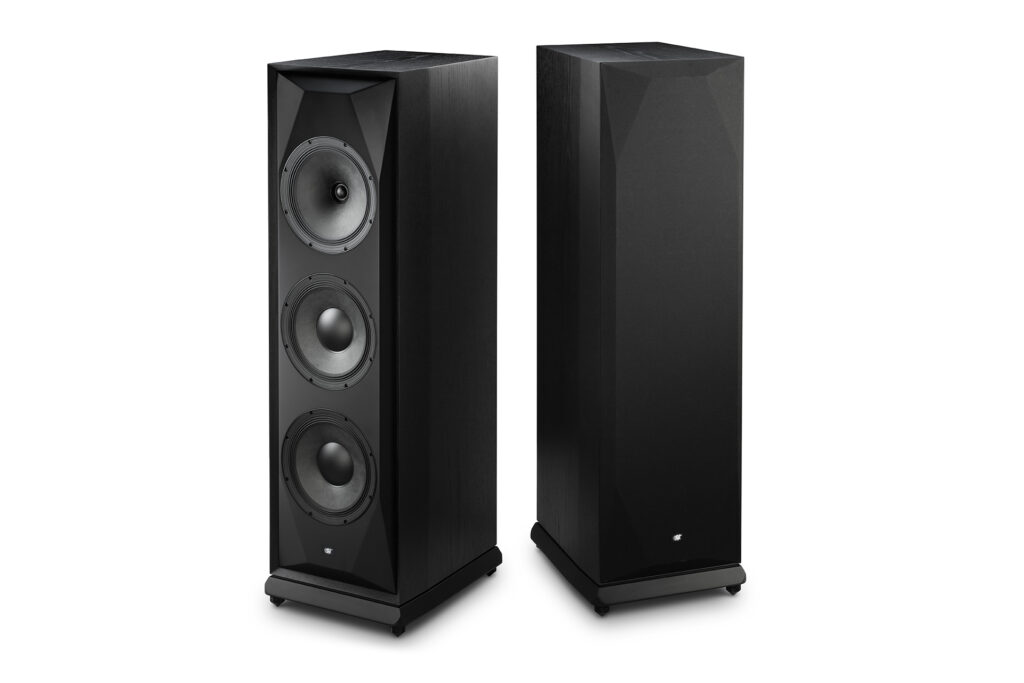
What Makes the MOFI SourcePoint V10 Master Edition So Special?
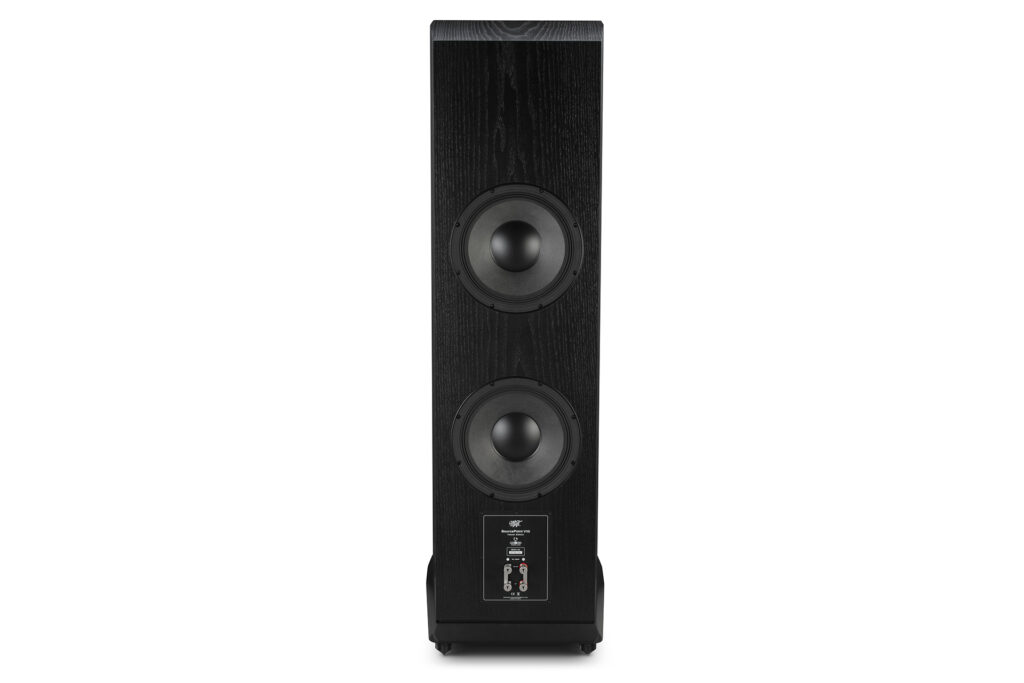
- The MOFI SourcePoint V10 Master Edition (buy at Crutchfield) uses five 10-inch drivers (thus the V in the name). The highlight, of course, is the 10-inch concentric driver designed by long-time speaker mastermind Andrew Jones. With two additional 10-inch active woofers, and two 10-inch passive woofers on the back, you need a big, inert cabinet.
- The SourcePoint V10 Master Edition cabinets are extremely solid and inert. With the size of these speakers being considered, this is not a foregone conclusion, as it isn’t cheap to make a rock-solid cabinet that is this big at this price.
- The MOFI SourcePoint V10 Master Edition has a switch on the back of the speaker to adjust your high-frequency output. Over the years, many loudspeakers have included switches and resistors to allow you to make these adjustments with varying degrees of success. I can confidently say it absolutely works with the MOFI SourcePoint V10 Master Edition. As each of our rooms sound and react differently, it’s an excellent feature to include in a speaker design, and one I wish we would see more often.
- These speakers have the ability to move some serious air. For those of us who like that feel-your-music type of sound, the MOFI SourcePoint V10 Master Edition is going to appeal. Every speaker can play string quartets and light jazz ensembles. The MOFI SourcePoint V10 Master Edition can play stadium rock, and not every speaker can do that.
- Designer Andrew Jones has a cult following dating back decades and across multiple speaker brands. Jones’ good mojo is a major draw to a specific group of audiophiles who really like his designs.
MoFi SourcePoint V10 Master Edition Loudspeakers Specifications
| Design | Three-way floorstander with concentric driver and passive radiators |
| Tweeter | 1.25-inch soft dome, concentric (adjustable) |
| Midrange | 10-inch paper cone, concentric |
| Woofers | Two 10-inch paper cones |
| Passive radiators | Two 10-inch |
| Frequency response | 27 Hz–30 kHz |
| Sensitivity | 91 dB (2.83V/1m) |
| Impedance | 6 ohms nominal; 4.5 ohms minimum |
| Dimensions (H x W x D) | 48.8 x 19.9 x 15.5 inches |
| Weight | 160 pounds each |
| Price | $7,995 a pair |
Why Should You Care about the MOFI SourcePoint V10 Master Edition Loudspeaker?
For years, maybe even a couple of decades now, there has been a trend towards loudspeakers that are narrow and house multiple drivers, none really exceeding seven or maybe eight inches in diameter. MOFI and Jones said to hell with that, and built a big, badass loudspeaker. Even in all black like my demo pair, there is no mistaking what is parked in the front of the room you place them in and what the intent is. Grilles on or off, they look like they mean business. They also sound like they mean business, which we will get to here in short order.
Some Things You Might Not Like About the MOFI SourcePoint V10 Master Edition Loudspeaker
- Well, there is no way around this. They weigh about 160 pounds … apiece. Yes, individually. For reference, I recently reviewed the Dali Opticon 8 MKII (read the review). They are big, with a similar box shape. They are 160 pounds for the pair. While the MOFI’s are actually pretty easy to “walk” around the room, you are going to need help moving the boxes into your listening room at a minimum.
- The MOFI SourcePoint V10 needs room to breathe in terms of placement. I’ve never been shy about my thought that too often audiophiles get hung up on not wanting to put too big a speaker into a room. Screw that. I listen to a lot of rock, I often listen loud, and I want a visceral experience at times. All that said, there is a point where even I feel you can overpower a room. This speaker could be one if you can’t at least get it 18 inches off the rear and side walls. The 10-inch woofers on the front can produce prodigious bass, and the passives on the back simply need some room to breathe. With the advent of room EQ and room treatments, you often can get away with placing speakers a bit too close to the walls. This is not a speaker to play games with. While it is very neutral-sounding, give it some breathing room. MOFI produces the SourcePoint 888 that I imagine performs awfully well also, if your room doesn’t allow the SourcePoint V10 to breathe a bit.
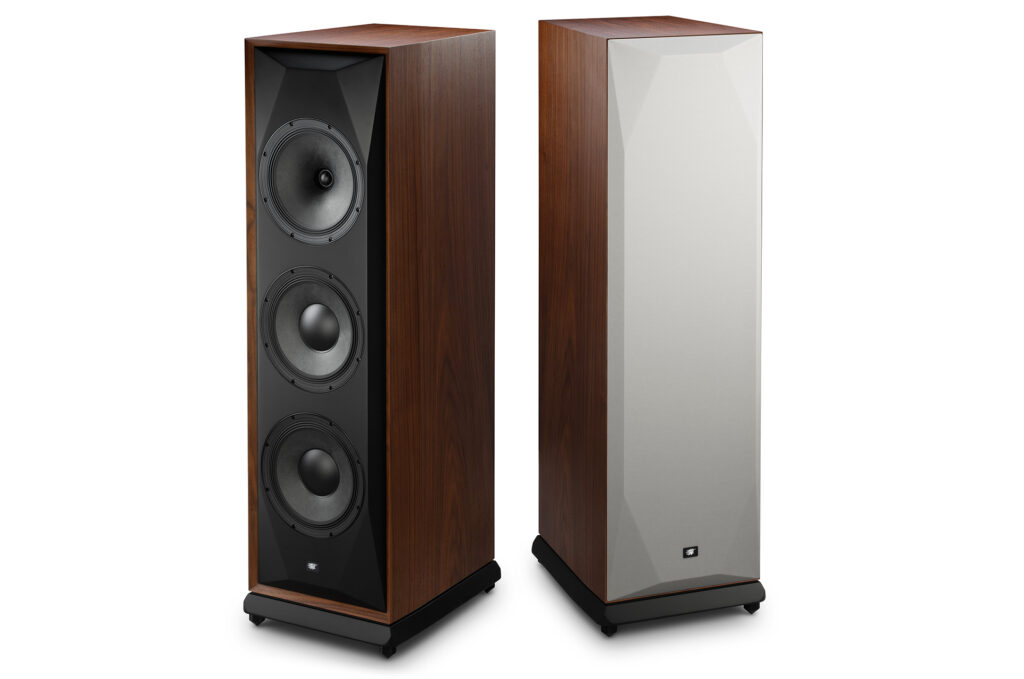
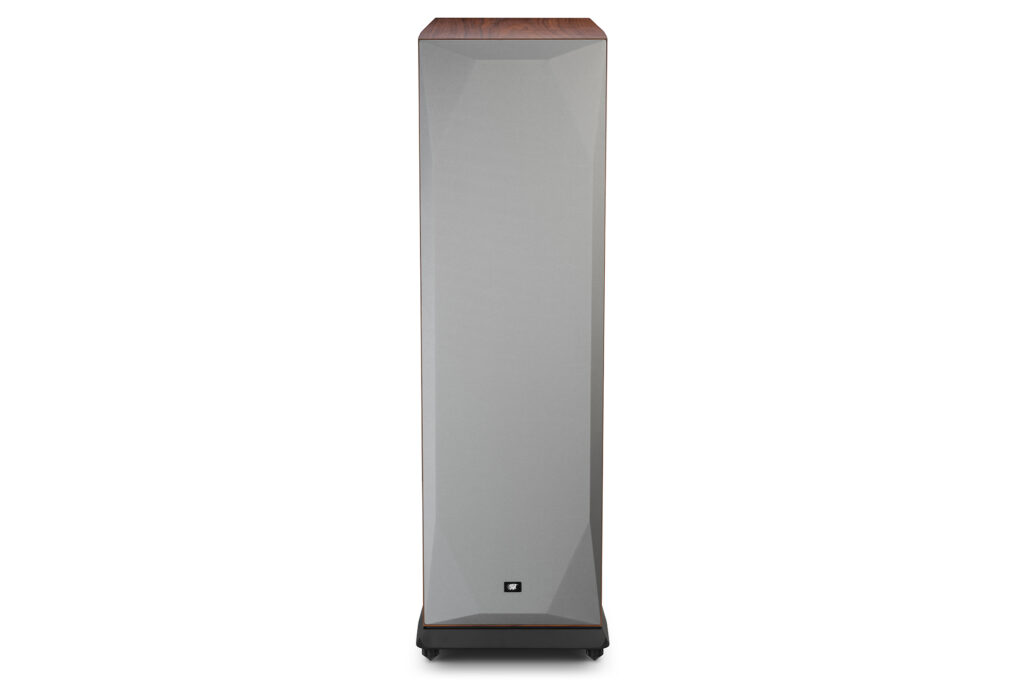
- The MOFI SourcePoint V10 Master Edition is more or less a big, rectangular box. With the grille off, the front baffle that has been engineered nicely to help with reflections looks good, but aside from being very well-built, there is nothing special-looking about the cabinets. Two finishes are offered (black and walnut) and, while they look nice, they are not distinctive.
Listening to the MOFI SourcePoint V10 Master Edition Speakers
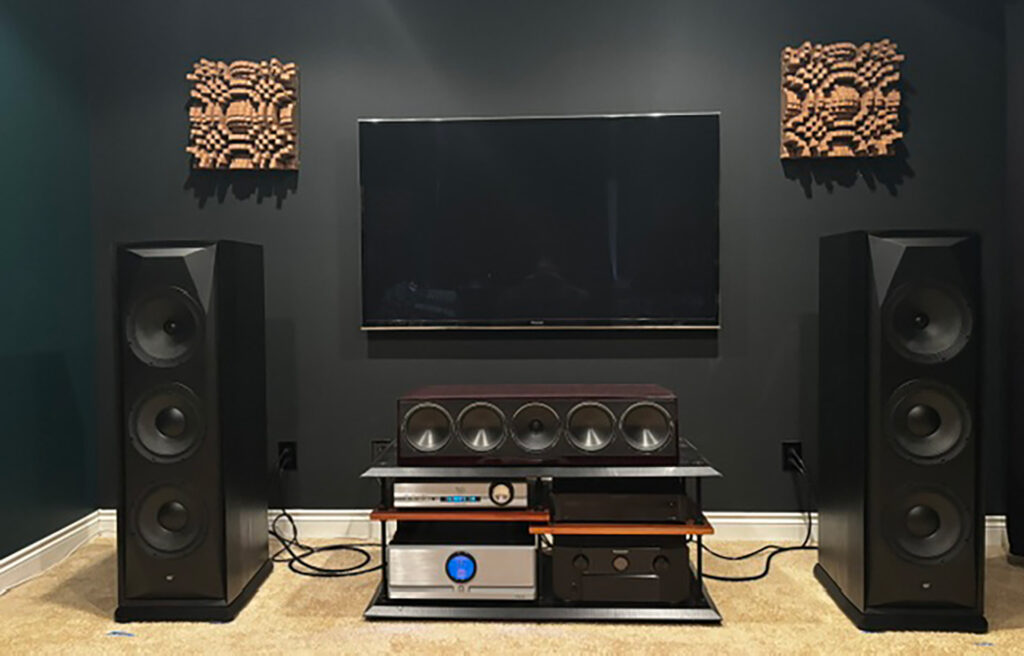
After (carefully) unboxing the MOFI SourcePoint V10 Master Editions, I connected them to my Pass Labs XA 30.8 amplifier (read the review) and set them up exactly in the same position as my reference Paradigm Founder 120H loudspeakers to begin the task of positioning them optimally in my room. I started my listening with them toed inward, so that the tweeters would cross slightly behind my head, with ample room to breathe. They sounded great. In fact, they are one of the most dynamic speakers I can remember in quite a long while, reminiscent of horns but without the honk. Before I dive deep into reviewing a loudspeaker, I try to listen for a good couple weeks with a wide variety of tracks while playing with positioning. With the MOFI, having that treble switch on the back extended my review “warm-up” period. I did start to find that, with the speakers angled in towards my listening position, I would get a bit fatigued over time. I flipped the Master Editions’ switch to cut the top end output. It absolutely worked, as I found they were a bit mellower this way. However, I did the same with the speakers placed straight ahead, playing with all three Master Edition adjustments. Over the course of two weeks, I found I preferred the MOFI SourcePoint V10 Master Editions positioned straight ahead and with the adjustment switch in the neutral position.
I began my listening for this review with the 2016 remaster of “War Pigs” by Black Sabbath. I find it to be an excellent example of a remaster done correctly. As soon as I hit play, I felt like Tony Iommi’s guitar amp was to my right, Geezer Butler’s bass amp was to my left, and Bill Ward’s kit was about where my TV is on the wall behind my rack. The absolute coherence and dynamics the MOFI SourcePoint 10 Master Edition can convey really stood out on this track. No instrument stood out more than another, and yet Ozzy Osbourne was standing right in between everyone at the front of the stage. During the breakdown about six minutes into the track, I really felt like I could hear every bit of distortion coming from the guitar, while getting a little gut punch from the kick drum. The MOFIs have a way of being almost visceral in their presentation of a recording.
“Fortunate Son” by Creedence Clearwater Revival off Willy and the Poor Boys (192khz 24bit courtesy of Roon) was another good test of these MOFI speakers. While the remaster of “War Pigs” sounds like it could have been recorded this century, that is not the case with the remaster of “Fortunate Son.” While it was still obvious the track was recorded in the 1960s, it was considerably more dynamic-sounding through the MOFIs. It absolutely was not colored in any way, shape or form. The MOFI’s concentric driver did not add any additional sparkle that you might get with a tweeter that was too bright. Rather, I heard a bit more separation of the instruments and vocals than I have in the past. The lead guitar parts sounded just a bit cleaner and more forward in the mix than I have heard with this track on other speakers. John Fogerty’s vocals were powerful, raw and raspy, and you could almost picture him in the studio recording the vocals for the track.
Finally, “Killing in the Name (remastered)” from Rage against the Machine’s self-titled debut absolutely explodes out of the MOFI SourcePoint V10 Master Editions. As with just about every Rage Against the Machine track, there is plenty of everything, From the first second of this track, you have explosive guitar, bass, and drums. What I really enjoyed about listening to this track through the MOFIs was their ability to convey its huge sense of scale, while still allowing you to hear each individual instrument. When Zack de la Rocha came into the track, his anger was palpable. His vocals were appropriately out front in their location from an imaging standpoint. Early in the track, you could hear the subtle plucking of the bass strings. You could hear Tom Morello and his guitar antics ever so slightly behind the vocals. I found myself saying “this is how this track should always sound” – with the excitement and dynamics of a live performance, but from a studio recording. Due to the coherence of the speakers, everything sounded as big as it should, but the MOFIs still conveyed the proper scale for this track. Just an awesome playback experience. I grinned through it, all five or so times in a row that I listened to it while writing this review.
Will the MOFI SourcePoint V10 Master Edition Loudspeaker Hold its Value?
MOFI is a relatively new name to the loudspeaker world. With a speaker that offers everything that the SourcePoint V10 Master Edition does, I believe this speaker will hold its value quite well. You would be hard-pressed to find a speaker better than this for twice the price.
What is the Competition for the MOFI SourcePoint V10 Master Edition Loudspeaker?
The Dali Opticon 8 MKII (read the review) is a speaker I reviewed very recently. It is $6,000 per pair. It also has a basic cabinet, with serious hardware bolted in. I would say the Dali’s bass can be equally impactful as the MOFI’s, while being a bit warmer-sounding than the MOFI, which I found to be slightly punchier than the Dali. The Dali might have even more detail than the MOFI in the top end, while the MOFI is even more dynamic than the Dali.
Another entry into the “I don’t care about the spousal acceptance factor” is the Tekton Ulfberht for $9,000. It’s a large box, coming in at a svelte 235 pounds each, eclipsing the MOFI by 75 pounds. The Tekton’s multiple driver array is very different in design to the concentric driver in the MOFI. One of the unique and fun things about our hobby is that speaker designers can use very different designs to produce something with the same objective: reproducing kickass music. The Tekton Ulfberht is available in multiple colors, even custom if you would like to pay for it.
The Klipsch RF-7 III at $5,000 (buy at Crutchfield) per pair is lower-priced than the other two speakers mentioned here as competition. However, it is a large, very dynamic loudspeaker in a basic boxy cabinet. I’ve heard the Klipsch multiple times; it’s a solid speaker. I would not put its refinement on par with the MOFI, nor will its low end hit as deep. That said, there is a similar character to the MOFI with its dynamic presentation and punchy bass.
Final Thoughts on the MOFI SourcePoint V10 Master Edition Loudspeaker
I really enjoyed my time with the MOFI SourcePoint V10 Master Edition loudspeakers. This is a big speaker with a big coherent sound that is also incredibly dynamic. When I had my audiophile buddy Chris by for a couple cold beers and a long listening session, we found ourselves looking at each other, quite often saying (yelling) “Holy shit!” This was often the result of a voice, snare drum snap, or even a single note sounding like it was jumping out of the speaker. It’s an attribute I enjoy that many horn speakers provide. However, so often with all but the best horn speakers, you get some coloration with those dynamics. The MOFI SourcePoint V10 Master Edition (buy at Crutchfield) is remarkably uncolored. I’ve listened to very few speakers, particularly in this price range, that offer this combination of coherence and dynamics. The 10-inch concentric driver designed by Andrew Jones is pretty darn special.
The 10-inch woofers and passives, along with the big cabinet, allow the speakers to convey a real sense of scale when listening at higher volumes. The bass they can produce is deep, big and, most importantly, tuneful. These are not a one-note wonder like an older Cerwin Vega (and there is likely a place for Vegas in this world still, even if not in the pages of high-end audio magazines). They can absolutely shake your room while being extremely accurate and tuneful on the bottom end. While they do need a bit of room to breathe, the ability to adjust the top end of the speaker with a simple switch is really appreciated. We all have different rooms with their own unique challenges, and sometimes you just have a hot recording (remastered ‘80s metal and thrash, I’m thinking of you). For those without tone controls, the ability to take a little heat off the top end (or, with a flat recording, to add some chili powder) is really appreciated. It would be a shame for a speaker this size to call for a subwoofer and, fear not, the MOFI delivers in spades with deep, punchy and tuneful bass. If you have the space and lower back to move them in and unpack them, I am very confident in my belief the vast majority of audiophiles looking in this price range would be thrilled to have a pair of the MOFI SourcePoint V10 Master Editions as the focal point of their listening rooms. I’m sure these speakers will put a smile on your face.
“This is a big speaker with a big coherent sound that is also incredibly dynamic.”




Kick-ass, beers…ok. This is a lot of arena-rock value for the money, but like the smaller Sourcepoint iterations…even the smallest 8, there’s an impurity ion the crossover region that results in their departure from utter smoothness and audiophile midrange. It can’t be helped at their pricepoints with coaxial drivers, I suppose, but there are indeed better choices for honest midrange purity than from these “party” speakers. Big, ballsy, etc., but not the last word in refinement. Andy Jones could only do so much given the cost and design imperative of dynamics and broad listening axis. The Sopurcepoints are GREAT if you’re flooding a room for listeners who stand, walk around, drink a lot of brewski, but as a 2-ch stereo reference from the sweet spot that hardness around $1.5-2k limits their appeal. Don’t you think your Panasonic Founders are a little smoother?
ErineM,
Thanks for reading the article. It’s funny, Jerry D also asked me about the song selections I used in the article. I take a long time to do a review. I try to listen to a wide variety of tracks. As for this review, I happen to think all three songs highlight some of the strengths of the MOFI’s. I also happen to think they are important songs, and if a “future audiophile” happens to be inspired to go listen to one after reading the article, that is also great.
If it makes you feel better my buddy Chris that comes over happens to be a medical doctor, a surgeon in fact and has a nice taste in wine. Had I mentioned we were having a glass of Pinot, and listening to Morph the Cat I’m not sure if you would have felt better about my thoughts on the MOFI’s performance. That’s actually half true, while we did have a beer that evening, one of the tracks we both did look at each other and were fairly stunned was indeed Morph the Cat. I really thought about using that as a track in the article, but I figure there are a good 100 or so reviews out there that mention that track. I also happened to listen to Beethovens 9th through them, and again they did happen to “kick-ass”. I like a dynamic loudspeaker, and appreciate one that is coherent. There are 100’s of great loudspeakers out there that can give you an excellent midrange, many of which are bookshelves.
In this price bracket, you are still going to deal with trade-offs. Andrew Jones doesn’t shy away from talking about the trade-off’s in his designs. You mention “utter smoothness”, are you looking for a lack of any coloration… or something that others might find as easy on the ears, or laid back? There are great speakers out there that indeed offer that. Sonus Faber comes to mind. (They also happen to be great looking in most cases also).
The MOFI’s as mentioned even have a switch on the back to adjust the top end (it works well), and of course it can help with a room issue, but not like EQ can on the bottom end.
Here is the thing, the midrange with the MOFI is outstanding, it’s dynamic, it’s coherent, and it plays with an ease that other speakers do not. It also happens to be able to play loud and not lose its composure. There are 100’s of loudspeakers out there with a pretty darn good midrange… Under 10k I would be hard pressed to give you 20 that can do all the MOFI’s can. I wouldn’t call them a party speaker (here is looking at you Cerwin Vega DX9), I would call them an excellent, well rounded speaker that happens to have the ability to party.
I came very, very close to purchasing the review pair. I could be very happy with them listening to artists from Donald Fagen, to AC/DC, to Beethoven, to Snarky Puppy. While we don’t do measurements at Future Audiophile, there are sites out there that do and these also measure quite well.
The Founder 120H is also an excellent speaker, but also has trade-offs, it also has built-in EQ from 300hz down.
Doug great review.
I’ve been into audio for years, and I’ve listened to a lot of speakers in this price range. After spending some time with the MOFI SourcePoint V10 Master Edition, I can honestly say couldn’t agree more with Doug P.’s review. These are one of my favorites and easily in my top five speakers at this price range.
Comparing them to speakers from KEF, Bowers & Wilkins, Focal, and Sonus Faber, and the MOFIs just sound more natural to me. Nothing feels exaggerated—they don’t try to impress you with overly bright highs or overblown bass. Everything just sounds balanced, effortless, and real.
The first thing I noticed was how well they disappear into the room. Close your eyes, and the speakers seem to vanish. Vocals are incredibly lifelike, instruments have their own space, and the soundstage is wide and deep. The bass digs low but stays tight and controlled, and the highs have plenty of detail without ever sounding harsh or fatiguing.
My music tastes are all over the place—acoustic, blues, Motown, old-school rap, classic rock, metal, and even some yacht rock—and these speakers handle every genre with ease. No matter what I throw at them, they just sound musical.
They’re also excellent at lower listening levels, which is a big plus since I don’t always crank the volume.
When you compare them to other speakers around the $8,000 price point, I think they offer some of the best overall sound for the money. To my ears, they easily compete with speakers that cost quite a bit more.
If you’re shopping in this price range, do yourself a favor and give the MOFI SourcePoint V10 Master Edition a listen before making a decision. They exceeded my expectations.