
 By
By PS Audio is a true American classic when it comes to high-end audio. Run by engineer Paul McGowan, the company has been at the forefront of selling audiophile gear manufacturer direct, and now has a full complement of products ranging from affordable to reference-level electronics, digital audio components as well as a growing line of loudspeakers and even a subwoofer. But when I think of PS Audio, I think of their Power Plant power regeneration devices. There have been a lot of companies that have tried to deal with AC power maladies for the benefit of us audiophiles, but I am not sure that anybody has taken a more creative or effective approach to audiophile AC power than McGowan and his design team in Boulder, Colorado.
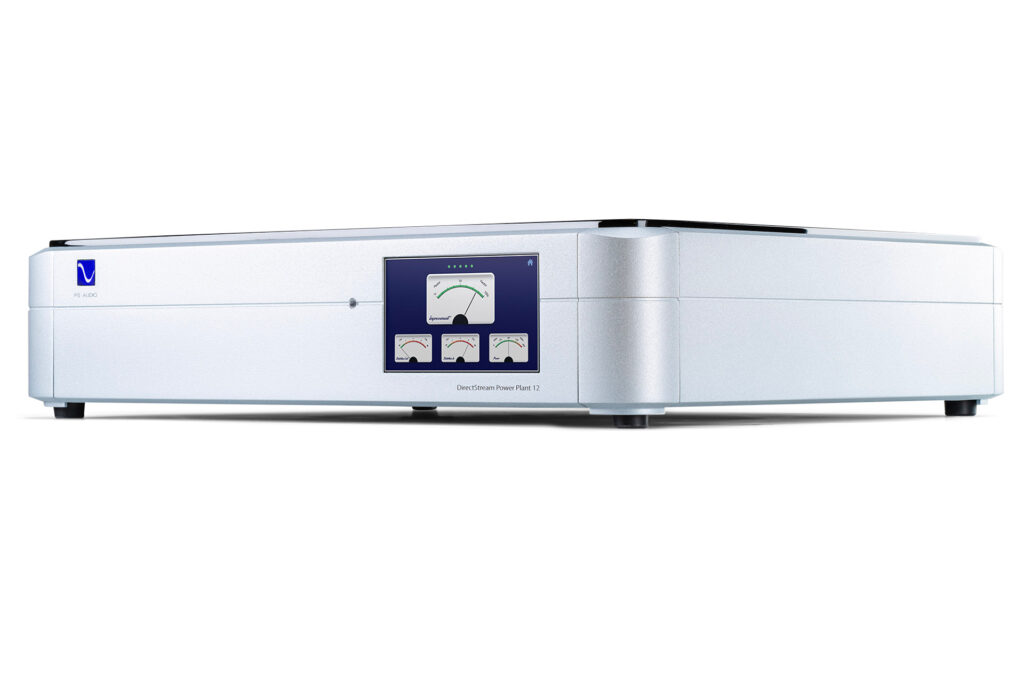
The PS Audio Power Plant 12 is a $5,999 power regeneration device that is a standard width and a modest two-rack-spaces-high that takes your often crappy AC power, converts it to DC, and then uses amplifier technology to create sine wave-perfect power for a whole bunch of your audiophile components. There are other, more traditional AC power products that reserve, clean and provide power for your gear. Producing ultra-clean (perfect) power is a whole other level of excellence that, for a more evolved high-end audio system, can be very tempting. We all need some place to plug our gear into when we assemble a high-performance stereo system, but what if that power product could improve our system’s sound? Now we are talking, right?
What Makes the PS Audio Power Plant 12 Power Regenerator Special?
- Using amplifier technology to take AC power from the wall into DC and then back out as AC is still pretty unique in the audiophile marketplace to this day. PS Audio isn’t the only company doing power regeneration for audiophiles but it is likely the best known. The idea of giving your components the clean, perfect power that they might see in the lab when they are being designed should be appealing to an audiophile who is chasing that Nth degree of performance. At a certain level of system development, there aren’t any big performance gains to be had, but like an F1 race team, finding all of the weaknesses in your setup can lead to better and better performance.
- Audiophiles use the word “dark” or “black” to describe the sound of the best AC power products. Far too many audiophile listening rooms suffer from noisy, unclean and nasty power. These problems often are endemic to the grid or the internal wiring of your home. A product like the PS Audio Power Plant 12 can solve those nasty issues and make the world a better place for your audiophile system in ways that most other AC power components simply cannot.
- PS Audio’s MultiWave technology recovers fast from big current draws during demanding musical passages. Having huge reserves of current is a very good thing, especially when you plug in your system at a good level and are listening to demanding tracks. The PS Audio Power Plant 12 can respond very quickly to the AC power needs of your system, even when you are rocking out hard.
- There are a generous eight outlets on the PS Audio Power Plant 12 power regenerator. Before we get to what the PS Audio Power Plant 12 can do for you under the hood, you need to be able to understand that you can plug a whole lot of audiophile components into it. Less expensive AC power products often have less outlets. PS Audio has bigger Power Plant models, like the PS Audio Power Plant 20, which can accommodate 16 components.
- There is 1,200-volt output, which is enough to drive even demanding power amps. Because of my system logistics, it was hard to plug in my Pass Labs XA 160.8 Class A monoblock amps (read the review), not that I didn’t want to or didn’t try them out. There is enough juice to run my entire system in the PS Audio Power Plant 12 for certain.
- PS Audio makes a big point of how its regeneration process is very low-impedance. This term is more often associated with loudspeakers than with AC power, but the idea that low impedance can help deliver more clean power to your components (specifically your power amp) in ways that amps really like to see.
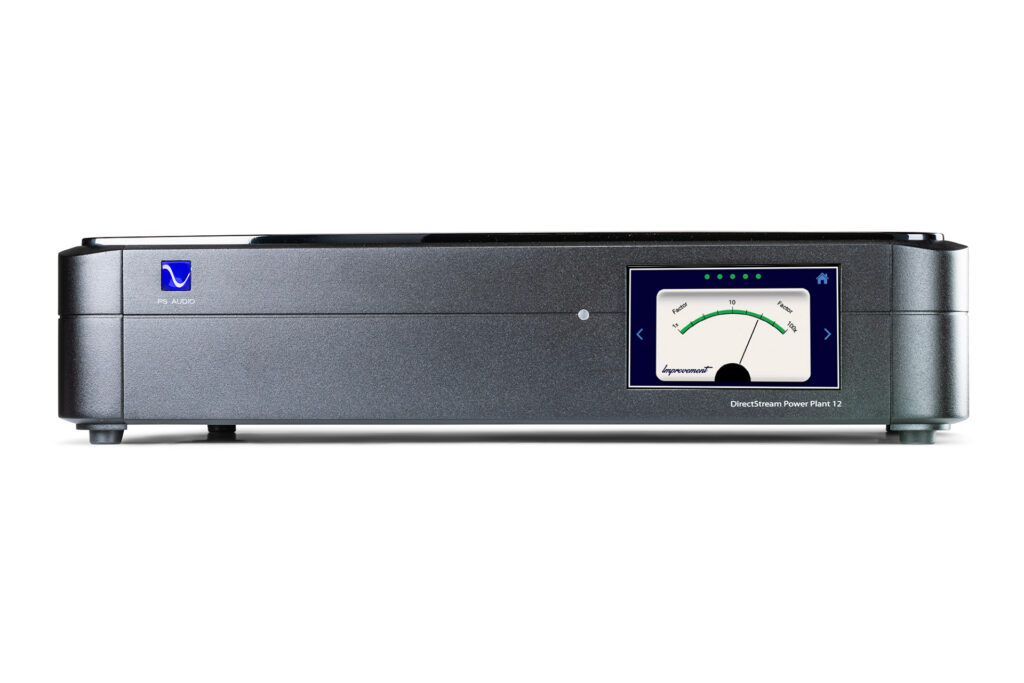
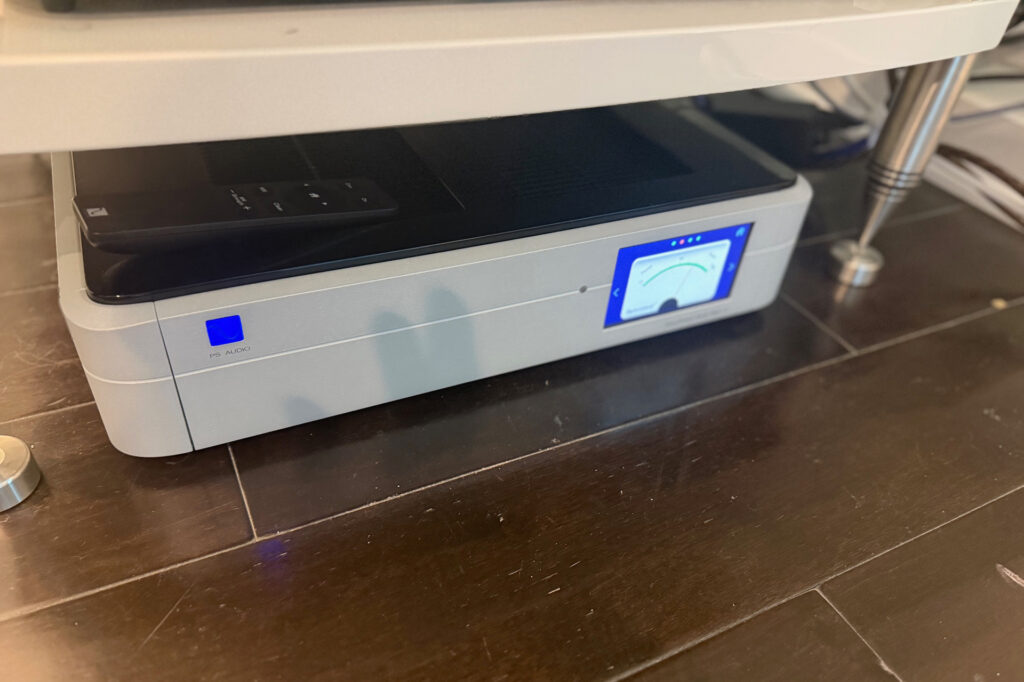
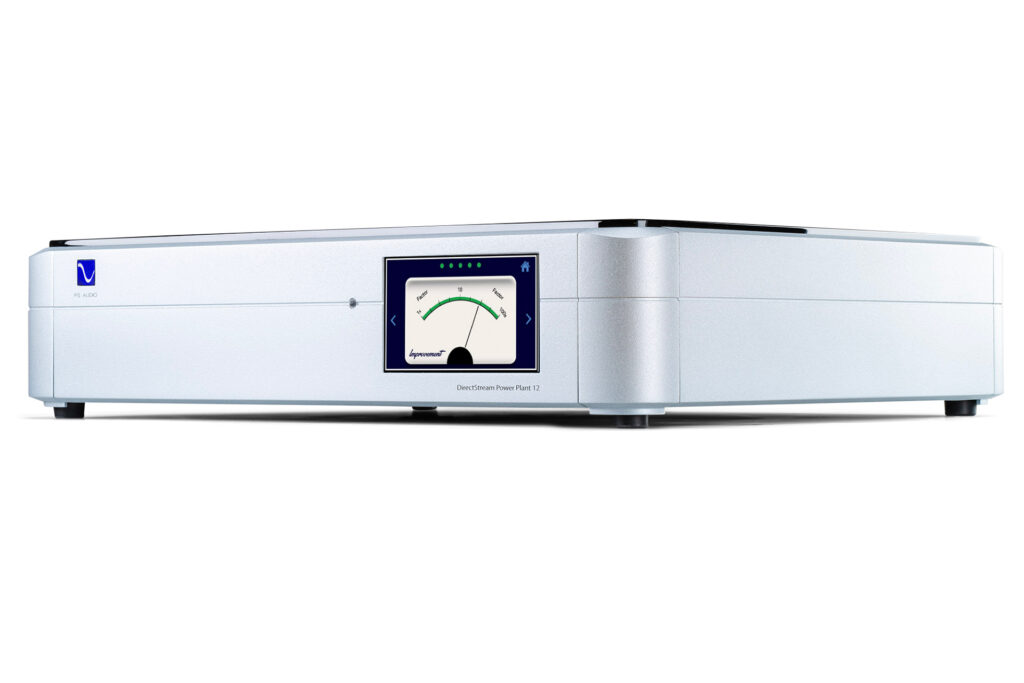
- In a touch of audio jewelry with some actual purpose, the PS Audio Power Plant 12 has a 4.3-inch screen on the front panel. You can see how clean or dirty your power is and/or see how much power your system is drawing from the wall. This is hard to see from across the room but, like those of a D’Agostino, McIntosh, Vinnie Rossi or Pass Labs amp, the gauges swaying to the music add to the cool factor of the PS Audio Power Plant 12.
- The PS Audio Power Plant 12 is lovingly made in Boulder, Colorado. This makes it a tariff-proof product. I toured the factory a few years ago and there are craftsmen who love their job, and love audio, making your audio toys. Made in America is a nice touch when you can find it.
- PS Audio talks about their clamping technology as a way to protect your audiophile gear from an AC power issue like a surge. Reviewer Paul Wilson unplugs his system in North Carolina when he travels, as he has had gear destroyed thanks to nearby lightning strikes. I am not sure if there is anything a product like the PS Audio Power Plant 12 can do if there is a direct strike, but it is designed to protect you from many a power issue or emergency, and that is reassuring. I wrote about the importance of having specific insurance for your AV equipment, because your electronics are not covered under your increasingly expensive homeowner’s insurance. It isn’t just because you need your own unique VPP (valuable personal property) or specific electronics insurance, as I had with The Hartford for the Palisades Fires, as it saved my ass. Having a component designed to protect your gear like a PS Audio Power Plant 12 is a strong argument for why your specific AV insurance should cover your audio gear in the event of an emergency.
PS Audio PowerPlant 12 AC Power Regenerator Specifications
| Continuous Output | 1,000 VA (US) |
| Peak Output | 3,600 VA (US) |
| Outlets | Eight, in four zones (US) |
| Output Distortion | Under 0.5% (0.1% typical, reactive load) |
| Output Impedance | Under 0.008 ohm |
| Noise Reduction | Over 80 dB (100 kHz to 2 MHz) |
| Efficiency | Over 85% |
| Input | 120 volts, 15 amps, 60 Hz |
| Dimensions (W x D x H) | 17 x 14 x 4 inches |
| Weight | 37 pounds |
| Price | $5,999 at review |
Why Should You Care About the PS Audio Power Plant 12 Power Regenerator?
The audiophile who is paying $5,999 for an AC power regenerator is an advanced one. He or she is seeking that Nth degree of performance and is looking anywhere and everywhere to find it. I have yet to meet the audiophile with pristine AC power running into their home or listening room, but power quality varies greatly from residence to residence, as well as region to region.
My AC power situation is pretty good in my current condo, as the building is not very old and the build quality is high. It wouldn’t take more than a two-minute walk in my neighborhood to find homes that are in desperate need of a product like a PS Audio Power Plant 12. Perfect power is perfect, but what’s coming in ranges from system to system. The PS Audio Power Plant 12 is designed to output the AC power that your system is craving, no matter what is fed into it.
Some Things You Might Not Like About The PS Audio Power Plant 12
- By design, the PS Audio Power Plant 12 can run out of current. This doesn’t mean that the unit will shut down on you per se, but if you are crushing on your system, the PS Audio Power Plant 12 is basically limited in its power output, just as a traditional Class-A/B amp might be.
- You lose some of your power to heat as part of the inherent design of the component. The reports are that this is about 15 percent, which years ago was much higher percentage, thus this is a massive improvement.
- The top plate of the silver chassis is black and takes away from the gorgeous casework on the PS Audio Power Plant 12.
Listening to the PS Audio Power Plant 12 Power Regenerator
Most of my listening was with the PS Audio Power Plant 12 powering my front-end components, which include a BlueSound Node ICON music streamer and a Pass Labs XP-32 fancy stereo preamp, as well as a Bricasti M1 SII DAC. I was able to move the unit to the floor of my listening room for my big Class-A Pass Labs XA 160.8 monoblocks, but that was a very temporary installation/configuration.
Yes, Diana Krall is musically a little audiophile cliché, but her country-inspired cover of Neil Young’s “Heart of Gold” on Qobuz is about as good as female vocals will sound in an absolutely gorgeous recording. With the PS Audio Power Plant 12 taking care of my front end, the sound was incrementally improved from the first note. No power product has ever left me slack-jawed, and I would warn you to set your expectations correctly when auditioning said category of components, as they have benefits but subtle ones. What I heard was more detail in Krall’s voice, which also sounded smoother and more silken. I was drawing just a little bit more with the PS Audio Power Plant 12 in the loop, which was pretty exciting to experience.
Other than perhaps Steely Dan, no artist says Yacht Rock more than Michael McDonald. Dial your satellite radio into the Yacht Rock channel if you don’t believe me – in that era, he was performing on everybody’s hit playlist. I was just a kid back then, but I remember these songs clearly from my youth, driving back and forth from South Jersey to Philadelphia with my dad in the old 300 SD Turbo Diesel beige Mercedes. On McDonald’s “I Keep Forgettin’ (Every Time You Are Near),” the dynamics were incrementally improved, which was very welcome. The female backup singers had that silken sound that I described with Diana Krall before. The funky little guitar riffs were detailed and lively. The knock on a product like the PS Audio Power Plant 12 is that it limits the current and becomes a bottleneck.
You wouldn’t respect me if I didn’t torture-test the PS Audio Power Plant 12 a little bit, would you? That’s what I thought … On Tom Morello’s musically ambitious (who else has the balls to cover Jimi Hendrix’s most iconic song?) track “Voodoo Child” on Qobuz, I cranked up the volume and let it fly. This cover is a favorite of mine and often played when evaluating audio gear in my reference system. What I noticed with the PS Audio Power Plant 12 was the coherence sonically when I was flooring it with volume on this balls-to-the-wall track. Things just held together better musically with the PS Audio Power Plant 12 in the loop. There wasn’t that compressed or shrill sound that you get when a system is at its limits (yes, I was trying to push my limits on purpose here).
Will the PS Audio Power Plant 12 Hold Its Value?
PS Audio products are pretty well-known with audiophiles, so the brand will not hurt resale. The PS Audio Power Plant 12 is not crazy heavy like other audiophile AC power products are, so it isn’t too hard to ship. There are tens of thousands of music-loving audiophiles who might want a power regenerator, and they likely all would benefit from that. With all that said, I think your investment in a PS Audio Power Plant 12 is a pretty safe bet with your audiophile capital investment.
What is the Competition for the PS Audio Power Plant 12 Power Regenerator?
There is a company called Pure Power, based in Canada, that I knew years and years ago, which also makes amplifier-based power regeneration products with reportedly even higher efficiency than PS Audio. It isn’t clear if they still are in business. There was all sorts of controversy, because their OEM started making their product and selling it into the United States under the same brand name, resulting in a big legal battle (and a Pure Power victory). Pure Power reports having brought their manufacturing back to North America from China, but they have historically had issues with production. PS Audio, as a company, is a much more stable, blue-chip option, but the comparison is hard to ignore.
U.K.-based IsoTek is a product with solid U.S. distribution through MOFI. I use their more traditional Aquarius V product, which is a non-power regenerator, but costs about half of the price at $2,999 and is also a very good performer. IsoTek makes a very expensive power regenerator, which is a technically (not financially) comparable product called the EVO3 Genesis. WOW on the industrial design and this is a pretty high-power output device but, at $28,995, this IsoTek product is in a whole other price category. However, it is a power regenerator.
There are all sorts of other more traditional audiophile power conditioners, such as ones from Transparent, Shunyata Research and, specifically, AudioQuest’s Niagara products. These are all good products, but work in very different ways than the PS Audio Power Plant 12.
Final Thoughts on the PS Audio Power Plant 12 Power Regenerator
Improving your audiophile AC power is an absolutely legitimate way to find more performance for your high-end audiophile system. No matter where you live in the United States, you likely don’t have perfect (or anything close to perfect) power coming into your system. If you can feed your components a perfect sine wave AC power, then your gear is just a little more likely to perform up to its sonic potential. At a certain level of system development, this type of upgrade can be just what the doctor ordered.
The benefits of the PS Audio Power Plant 12 on my front end were real and easily audible. The component is filled with forward-thinking and evolved technology, which is refreshing. The logistics of how to plug my system into the PS Audio Power Plant 12 made life pretty easy, but it was the smooth, layered and detailed sound upgrade that most impressed me. The PS Audio Power Plant 12 is an evolved and powerful tool designed to take you to the next level of audio performance in a developed and refined system.




Torus Power, based in Toronto Canada is a similar competitor, with models that can supply up to 100A and are basically a replacement electrical panel with a massive built in transformer that recreates the power sine wave. 120 and 240v models as well. Highly recommended.
I had a tremendous amount of noise and grunge coming through my line in my dedicated listening room. So much so that I contacted our electrical supplier as the power transformer outside the house was very loud and annoying The company rep said the transformer was much louder than normal but within spec so good luck.
I came across the powerplant 15 and the 90 day try it before you buy it offer convinced me to pull the trigger. Very happy that I did as after installing it and hooking it up it basically solved all the noise. I have large electrostatic speakers, Monoblock tube amps, tube preamp, and use low output moving coils so definitely tested the 15’s capabilities.
A very rewarding and positive purchase for this buyer. Been running it for the past few years without a hiccup or issue. Very happy with mine and glad I bought one.
Great feedback.
I am very glad this worked out for you. I really liked this unit.
I own the PowerPlant 3 and regret not jumping to the 12 out of the bat. Works as advertised, for my system I find everything is more confident in quality of output to my Focal Speakers via M700 Mono Amps.
Good report, fun read. You had the integrity to highlight Affiliate Links at the top (which would make me want to use them to help support your work). You were also honest that the effects can be subtle. Your findings mirror mine with the P12. Wouldn’t be without it. Almost all high-end audiophiles who live in a high rise should be using a PS Audio regenerator. Maybe you could add a few paragraphs addendum to discuss the different MultiWave and CleanWave settings? -JAS in Philadelphia