
 By
By We hope that Arkansas-based Klipsch does not require a lengthy introduction as one of the most recognizable legacy audio brands of the modern audiophile era. Like many big-name manufacturers, Klipsch makes everything from entry-level bookshelf speakers, sold at big box stores, to $40,000-per-pair custom Klipsch Heritage Jubilee floorstanding speakers, with seemingly endless product offerings in between.
Over the past decade-plus, Klipsch has leaned into its roots, expanding its excellent Heritage lineup while also introducing retro-inspired powered and wireless speakers designed to appeal to modern audiophiles seeking convenience without sacrificing style. I was first introduced to the Klipsch Heritage-inspired product line in 2017 after winning a Gear Giveaway (thanks, Crutchfield!) that included a Klipsch the Three tabletop speaker (buy at Crutchfield). This stylish little speaker has remained a permanent fixture in my combined kitchen and living room area, earning countless compliments over the years, thanks to its high WAF (wife acceptance factor), midcentury-inspired design, and surprisingly impressive sound production.
Which brings us to 2020, when Klipsch quietly dropped something of a bombshell in the powered speaker category. The original Fives launched at $799 – an absurdly competitive price point for speakers that earned immediate attention by becoming the first powered bookshelf speakers in the world to include HDMI ARC. That single feature turned a two-speaker desktop setup into a legitimate TV audio solution, no receiver required. The Fives went on to become one of the most popular powered speakers on the market, and Klipsch followed them with the larger Sevens and Nines (buy at Crutchfield), each scaling the formula upward.
Fast forward to CES 2026, and Klipsch marked its 80th anniversary by rebuilding the entire powered speaker lineup from the ground up. The result is the Klipsch The Fives II powered stereo speakers ($1,399, buy at Crutchfield), a substantially upgraded, decidedly premium take on the speaker that started it all. At $1,399 per pair, these speakers are no longer a pure budget play. The question is whether Klipsch has delivered a product worthy of that new price tag or simply added features and raised the cost accordingly. Let’s delve deeper and find out.
What Makes the Klipsch The Fives II Powered Bookshelf Speakers So Special?
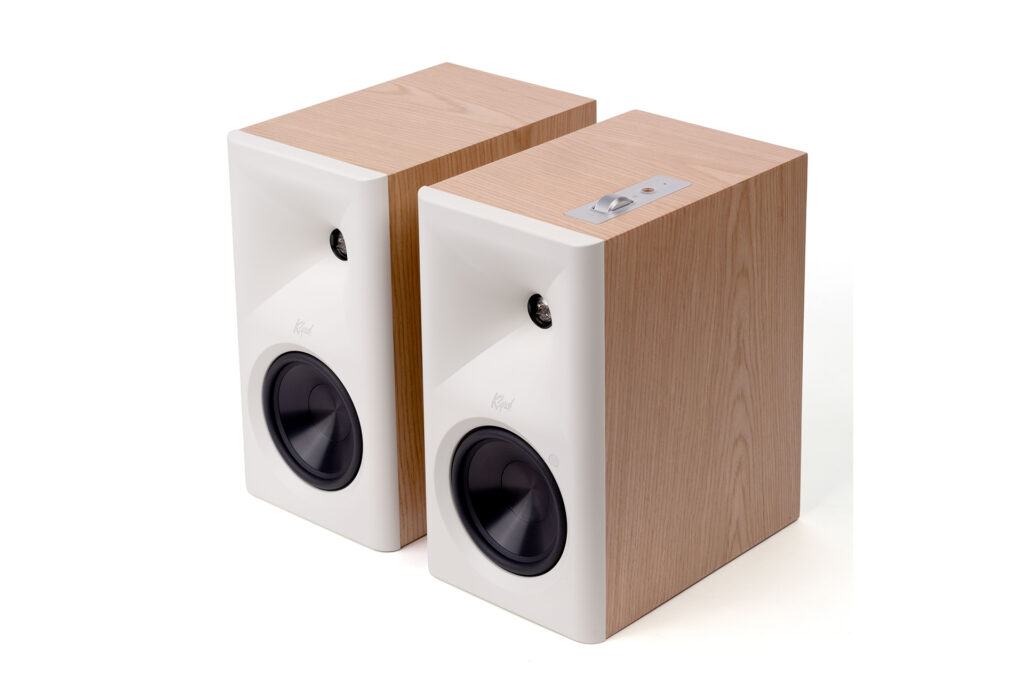
- The Klipsch the Fives IIs feature 5.25-inch Cerametallic woofers, paired with one-inch titanium LTS tweeters on Tractrix® horns. The woofer material (a lightweight, rigid ceramic/metallic composite) is borrowed from Klipsch’s higher-end Reference lineup and provides exceptional stiffness-to-weight ratio for reduced distortion. The Tractrix horn, meanwhile, is essentially the signature Klipsch calling card: it loads the tweeter for high efficiency, wide dispersion, and the kind of dynamic snap that horn-loaded designs are prized for, aka the “Klipsch sound.”
- The Fives IIs feature Onkyo-engineered interior electronics with essentially full AVR architecture built into them. This is arguably the most significant under-the-hood upgrade from the original Fives. Klipsch partnered with sister company Onkyo to integrate a complete audio/video receiver architecture into the primary/master speaker cabinet. This enables proper Dolby Atmos decoding with virtual height channels, precise input switching, and dynamic audio optimization that a simpler powered speaker simply cannot match.
- The inclusion of an audiophile-grade, 24-bit/96 kHz DAC means high-resolution digital audio files are handled natively and with appropriate digital processing. This is important, as not all powered speakers handle high-resolution audio with equal care, and the difference between a capable DAC and a mediocre one is something even casual listeners can detect on the right material.
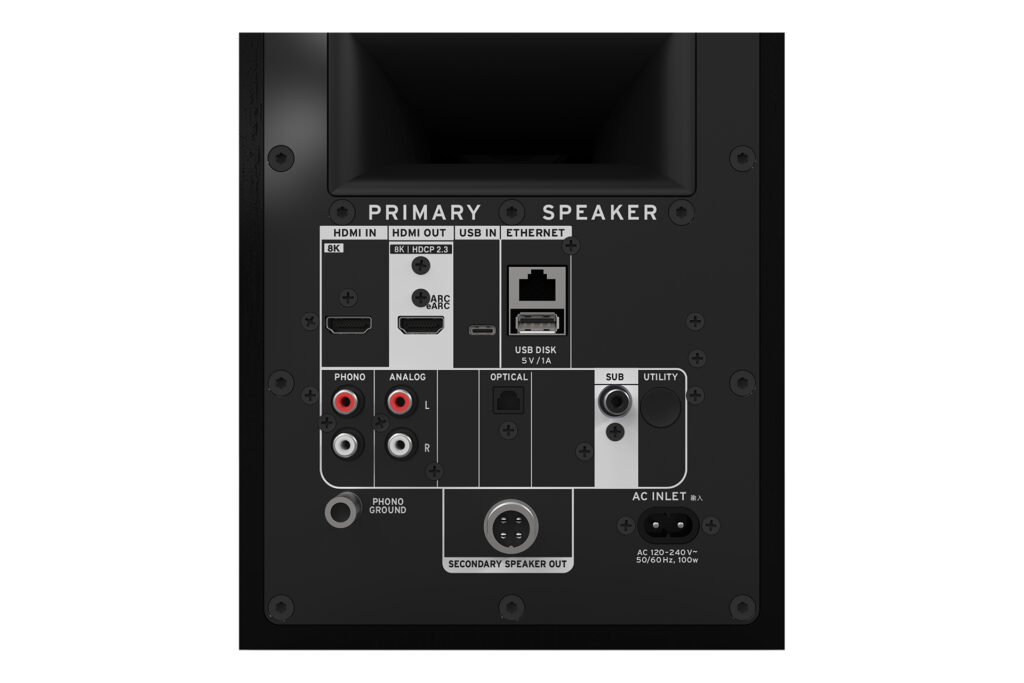
- Connectivity options are excessive, and that’s definitely a good thing. The Fives IIs feature an HDMI eARC port (8K-rated) for TV connection, a second HDMI input for a disc player or game console, optical digital audio input, RCA stereo analog input, a phono input with built-in MM phono preamp, USB-C for computer audio, a USB-A port for thumb drive playback or firmware updates, and an RCA mono output for a powered subwoofer.
- Wireless streaming options are also plentiful and cover all major platforms. These include the latest version of Bluetooth 5.4 for casual streaming, and built-in WiFi allows for lossless streaming via Apple AirPlay 2, Google Cast, Spotify Connect, Tidal Connect, and Qobuz Connect.
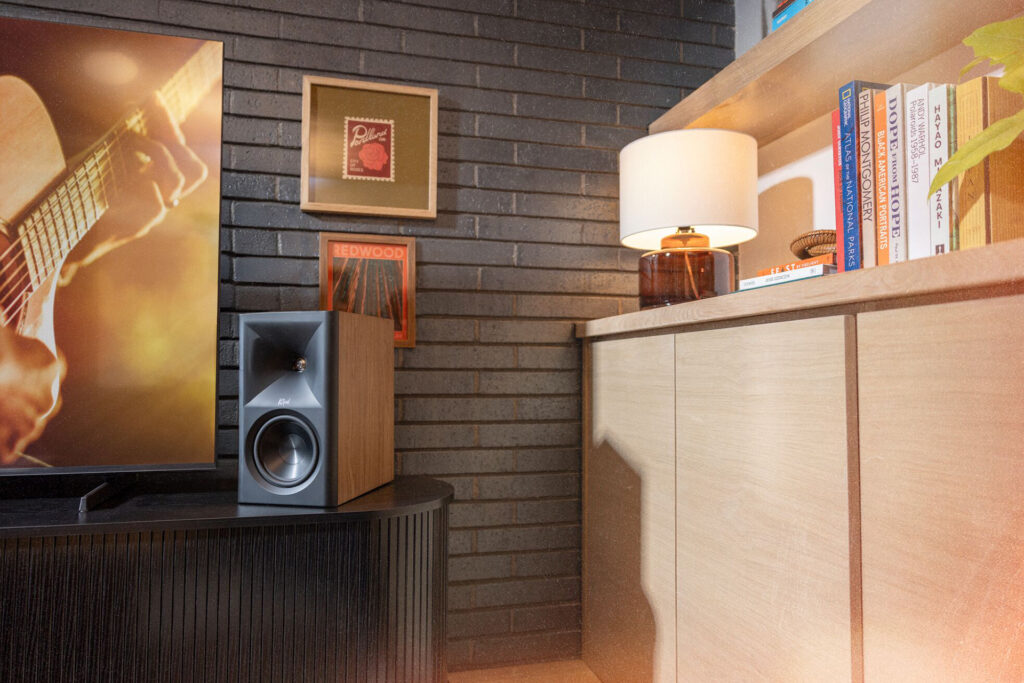
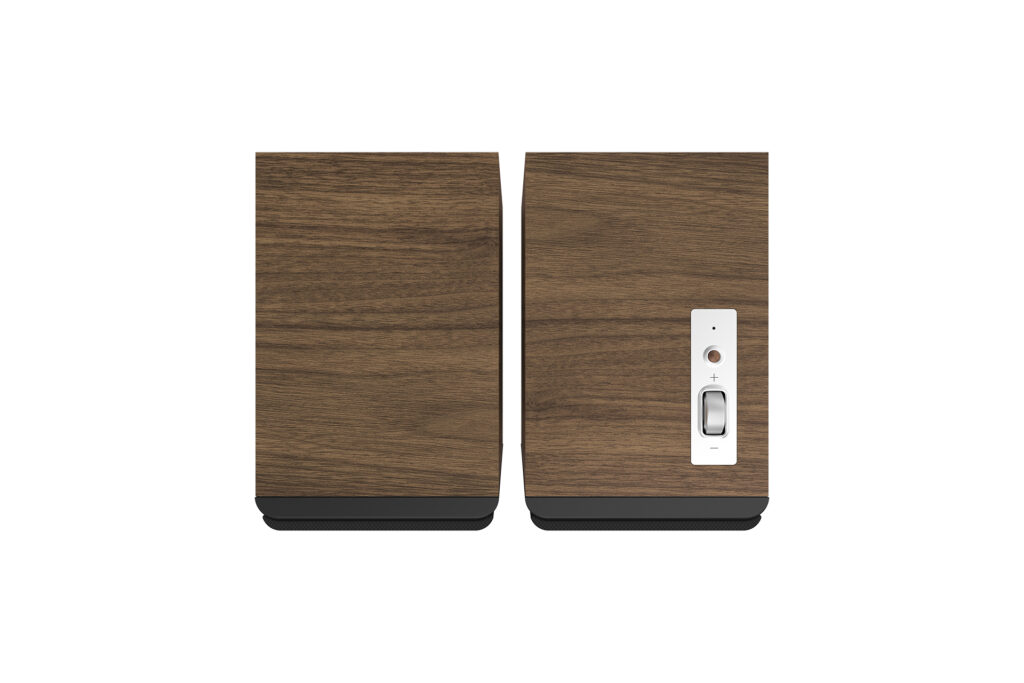
- As soon as I unboxed them, I noticed just how premium the fit and finish are on The Klipsch The Fives IIs. MDF cabinets with genuine, high-grade wood veneer keep The Fives II in the aesthetic conversation with the Heritage lineup, and the top-mounted artisan metal volume dial and power button feel appropriately premium. They are available in red oak, walnut (the sample I received), and ebony finishes. The included backlit remote is also of high quality.
- At 18.2 pounds for the primary speaker and 15.5 pounds for the secondary, these are not lightweight desktop speakers. That heft reflects real cabinet density and internal electronics, and it pays dividends in the form of reduced resonance and a solid, lively, beefy sound.
- The Klipsch Connect Plus app serves as the command center for The Fives II, and it works fairly well in real-world use. It handles input selection, custom EQ adjustments, Dolby Atmos sound mode control, night mode, dialog mode, and subwoofer output level, along with a My Input feature for quick one-tap access to your most-used sources. It is worth noting that Dirac Live room correction, available on The Sevens II and Nines II through the same app, is not supported on The Fives II. More on that in a minute.
- The Fives IIs are backed by a two-year warranty and a generous 90-day return policy (at Klipsch.com), which should give even hesitant buyers the confidence to take the plunge.For a powered speaker system at this price point, this level of warranty coverage and customer satisfaction protection are in line with industry standards.
Klipsch The Fives II Powered Speakers Specifications
| Design | Powered two-way bookshelf pair |
| Tweeter | 1-inch titanium LTS with Tractrix horn |
| Woofer | 5.25-inch Cerametallic |
| Frequency response | 50 Hz–25 kHz, ±3 dB |
| Inputs | HDMI eARC, MM phono, RCA line, optical, USB-C, USB-A |
| Streaming | Google Cast, AirPlay 2, Spotify, Tidal and Qobuz Connect; Bluetooth 5.4 |
| Outputs | Subwoofer out |
| Dimensions (H x W x D) | 12.9 x 7.2 x 10.7 inches |
| Weight | 18.2 pounds (primary), 15.5 pounds (secondary) |
| Price | $1,399 a pair at review |
Why Should You Care About the Klipsch the Fives II Powered Bookshelf Speakers?
The original Fives succeeded because Klipsch identified a gap that most audio manufacturers were either ignoring or too slow to fill: the growing number of listeners who wanted better-than-soundbar performance for their combined TV and music setup but had zero interest in assembling a traditional receiver-and-speaker system. Those buyers didn’t necessarily want to learn about impedance matching or run speaker wire through walls. They wanted to plug something in, connect it to their TV and/or turntable, and have it sound genuinely good. They also recognized that plain black, vinyl-wrapped boxes just don’t cut it visually for the majority of living rooms and listening spaces. The Fives delivered that in spades, and the audiophile community, to its credit, recognized this.
The Fives II powered bookshelf speakers take that same premise and escalate it considerably. Premium finishes, Dolby Atmos decoding, a full Onkyo AVR electronics platform, dual 8K-rated HDMI ports, a high-res DAC, and WiFi streaming with every major platform built in means this is no longer a clever convenience product. Klipsch is positioning The Fives II as a legitimate high-performance two-channel system that also happens to be dead simple to set up and possess.
Some Things You Might Not Like About the Klipsch The Fives II Powered Bookshelf Speakers
- The price represents a significant category jump from the original Fives. The original model launched at $799 and eventually settled at an MSRP around $969. At $1,399, The Fives II costs a meaningful amount more than its predecessor even at peak pricing, and buyers who loved the original Fives specifically for their value proposition should be aware that this new version is playing in a different league entirely. The added features more than justify the increase, but it is worth going in with eyes open on the price.
- The omission of Dirac Live room correction is kind of a bummer. The Sevens II and Nines II (the more expensive models in the same updated Klipsch lineup) include Dirac Live calibration through the Klipsch Connect Plus app. The Fives IIs do not. Given that room correction can make a meaningful audible difference (looking at you, Dutch & Dutch), especially in acoustically challenging spaces like small rooms with hard surfaces, its absence here feels like a deliberate feature holdback to separate the product tiers rather than a genuine cost-driven omission. This is not a dealbreaker, but worth knowing before you buy.
- The secondary speaker is passive, connected to the primary via the included 13-foot cable.This is pretty much standard practice for powered speakers in this format and entirely functional, but it does require that cable be stretched between your two speakers. In certain room layouts, that run can be limiting or visually awkward without thoughtful wire management. At this price point, it would have been awesome to see dual-amped speakers that could connect wirelessly, but with all of the other included technological upgrades, I understand why this was not included.
Listening to the Klipsch The Fives II Powered Bookshelf Speakers
With Death Cab for Cutie releasing their 11th studio album this year, I have found myself revisiting the band’s back catalog and side projects more than ever, including frontman Ben Gibbard’s celebrated 2003 collaboration with producer Jimmy Tamborello, aka Dntel, The Postal Service. The duo’s first and only album, Give Up, is not only a landmark of early 2000s indie-electronica, but also an excellent test record for audio equipment, thanks to its rich, layered electronic composition and exceptionally high recording quality.
While listening to their most popular single, “Such Great Heights,” I was immediately struck by the incredibly wide, immersive soundstage The Fives IIs were able to produce. During the opening of the track, the coordinated stereo panning image was crystal clear. As the track built, bass and midrange made themselves known without any bloat or boominess, and the electronic drums and effects were punchy, full, and delivered with velocity. Excellent separation between Gibbard’s vocals and the track’s various electronic instrumental layers was on full display, and the female harmonies in particular came through with a distinctness and clarity that genuinely impressed me, especially during the chorus, where I found myself picking up details in a song I have heard hundreds of times that simply did not register on lesser systems.
Next up was “The District Sleeps Alone Tonight,” also from Give Up, and to say that The Fives IIs filled my listening space would be a vast understatement. Deep, punchy electronic bass, glitchy instrumentation, and clear, forward vocals absolutely enveloped the room in a way that is difficult to achieve from a compact powered speaker system at any price point. At low, medium, and medium-high volumes, these speakers shined without reservation. As I pushed the volume dial closer to 100 percent, however, I did notice a slight muddying and loss of separation, likely a sign of the onboard amplifier being pushed toward its theoretical limits. Interestingly, when I connected my REL T/5x subwoofer (read my review), the internal amp powering the Klipsch the Fives IIs seemed to breathe a little easier, allowing for louder playback with noticeably more clarity and crispness.
For its next test, I cued up the ironically-titled track “Loud” from Olivia Dean’s excellent 2025 album The Art of Loving. During the introduction, the picked guitars sounded plucky and firm, leaving plenty of space for Dean’s distinctly sultry vocals, which were represented with impressive accuracy and imaging. As the track’s additional layers began to build, The Fives IIs brought the song to life with excellent dynamics and strong mid-bass performance, but the real stars of the show were the mid- and upper midrange. Dean’s vocals, at every amplitude level tested, remained strongly centered and utterly convincing. Instrumental separation was equally impressive during the track’s latter half, as layer after layer of instrumentation was added without ever crowding or muddying the mix.
The swelling climax of the track, ending with an abrupt stripping away of everything except Dean’s voice and a simple piano progression, may have been the most revealing moment of my entire listening session. In that quiet, exposed space, The Fives II powered bookshelf speakers demonstrated a nuanced musicality that goes well beyond what most powered speakers are capable of delivering at this price point, and possibly even above it.
Learn how to position your audiophile speakers better with help from editor, Paul Wilson.
Will the Klipsch The Fives II Powered Bookshelf Speakers Hold Their Value?
The powered speaker category tends to depreciate faster than traditional passive speakers, largely because the integrated electronics are subject to obsolescence in ways that a well-built passive cabinet simply isn’t. That said, The Fives II powered bookshelf speakers have a few things working in their favor on the used market. The Klipsch brand carries significant name recognition even among casual buyers, the wood veneer finishes have a timeless visual appeal that ages well, and the combination of Dolby Atmos, dual HDMI, WiFi streaming, and a phono stage in a single pair of bookshelf speakers remains genuinely rare at this price point, which means a used pair still offers considerable value to a secondhand buyer.
I’d expect a gently-used pair in good cosmetic condition to move without too much difficulty, particularly as more listeners continue gravitating toward simplified, all-in-one audio setups. That said, the electronics-heavy nature of these speakers introduces more potential failure points over time than a comparable passive option, which is worth factoring into any long-term ownership proposition. Overall, I’d expect The Fives IIs to hold respectable value, though I wouldn’t count on them appreciating the way a passive speaker from the Heritage lineup might.
What is the Competition for the Klipsch The Fives II Powered Bookshelf Speakers?
The Kanto TUK Grand ($999, buy at Crutchfield) is the competitor I’d be most remiss not to mention – both because it’s a legitimately compelling option at $400 less than The Fives II powered bookshelf speakers, and because I have some personal history with the brand. I reviewed and eventually purchased the original TUK Premium Powered Speakers (read my review), largely on the strength of its Air Motion Transformer (AMT) tweeter, which is lively and crisp in a way that most dome tweeters simply cannot replicate. Kanto’s DSP tuning also lends the originals a fun, dynamic character that makes them a genuine joy to live with, particularly in a desktop near-field setup used for mixed media.
Debuted at AXPONA 2026, the TUK Grand (along with the slightly smaller next-generation TUK) represents Kanto’s most ambitious speaker lineup to date, featuring a larger cabinet with increased internal volume, updated drivers, and greater amplification headroom, designed to deliver a wider soundstage and stronger sense of presence than its predecessor. If the Grand builds meaningfully on the original TUK’s already-excellent AMT performance while retaining that lively, DSP-tuned character, it could be a genuinely special speaker at the price. Like The Fives II, it includes Bluetooth streaming and a built-in phono preamp. What it does not offer is HDMI eARC, WiFi streaming, Dolby Atmos decoding, or the Onkyo-engineered AVR electronics platform that give The Fives IIs their home theater muscle. For a buyer focused primarily on music who doesn’t need TV integration, the TUK Grand is a serious conversation and, at $999, it makes The Fives IIs work considerably harder to justify the price gap. Stay tuned for my full review once the new TUKs become available.
The KEF LSX II (buy at Crutchfield) is a $1,499.99 compact wireless speaker system built around KEF’s signature coaxial Uni-Q driver array, which places the tweeter in the acoustic center of the woofer cone for exceptional imaging and point-source dispersion. It supports AirPlay 2, Google Cast, Bluetooth, and wired digital inputs, and the KEF Connect app provides solid EQ and room-tuning options. However, it does not include HDMI eARC or an onboard phono stage, two areas where The Fives IIs hold a real connectivity advantage for anyone who wants TV integration or vinyl playback without additional hardware. Sonically, the two speakers take distinctly different approaches: the KEF leans toward analytical precision and spatial detail, while the Klipsch delivers the kind of fun, dynamic punch and impact that the brand has been known for since Paul Klipsch was building horn-loaded speakers in an Arkansas tin shed. Which one wins depends entirely on the listener; both are worth auditioning and potentially placing in your listening room, depending on your preferences.
Next on my list are the excellent Wi-Fi and BluOS-enabled PSB Alpha iQ powered streaming speakers. The PSB Alpha iQ (buy at Crutchfield) is a $1,300 compact streaming powered speaker that I had the pleasure of reviewing in 2025, and it left quite an impression. Don’t let its small footprint fool you – at just under six inches wide and 10 inches tall, the Alpha iQ is remarkably compact, yet feels hefty and well-constructed, and had no trouble filling my listening spaces with high-quality, full-range sound and convincing stereo imaging. The real star of the show, however, is the integration of the BluOS platform: essentially a Bluesound Node streamer built directly into the speaker, which opens up over 20 streaming services, multi-room audio with up to 64 BluOS components, Roon readiness, and smart home integration via Control4, Crestron, and others. AirPlay 2, Alexa, Google Assistant, and Siri support round out an already impressive streaming feature set. Physical connections include HDMI ARC, optical, a moving magnet phono input, Bluetooth, WiFi, and Ethernet. And while impressive for its size, the PSB Alpha iQ cannot match the dynamic scale and low-end authority of the Klipsch. For a buyer who prioritizes streaming versatility and a compact, placement-friendly form factor over home theater integration, however, the Alpha iQ is a serious and well-priced alternative, and one I can personally vouch for.
Final Thoughts on the Klipsch The Fives II Powered Bookshelf Speakers
At the end of the day, the Klipsch The Fives II powered bookshelf speakers are exactly what the best audio products aspire to be: a meaningful leap forward that makes you wonder how you ever lived without them. Klipsch (in partnership with Onkyo) has taken an already-beloved formula and rebuilt it from the ground up with a level of technological ambition that is rarely seen at this price point. For the music-first audiophile, The Fives IIs deliver the dynamic punch, wide soundstage, and nuanced midrange performance that Klipsch’s horn-loaded heritage has always promised. For the TV and home theater enthusiast, the combination of HDMI eARC, Dolby Atmos processing, and user-friendly setup makes a compelling case that a traditional receiver-and-speaker system is no longer a prerequisite for a genuinely immersive listening experience.
Is $1,399 a lot of money for a pair of powered bookshelf speakers? On paper, sure. But when you factor in everything living inside these cabinets, including hardware that would otherwise require a separate streamer, DAC, phono preamp, and AV receiver to replicate, the value proposition becomes surprisingly difficult to debate. The powered speaker market has never been more competitive, and yet very few products at any price manage to strike this particular balance of sonic performance, connectivity, and visual appeal in a single, elegant package. If you are in the market for a system that can genuinely do it all, look no further.
“At the end of the day, the Klipsch The Fives II powered bookshelf speakers are exactly what the best audio products aspire to be: a meaningful leap forward that makes you wonder how you ever lived without them.”




Nice review, Eric. This is one of the few times where, because the white baffle in your first excellent pic tends to hide the relatively-ugly boxy horn waveguide compared to the black one, I actually prefer the former. More importantly, large cost constraints all along the build limit the top octaves’ detail and cleanliness. So the choice to provide a more-forgiving and “party punch” response is right in Klipsch’s bailiwick. The path KEF chose is trickier, especially with a coaxial driver. At their well-under $2k prices I would NOT quibble with cost of either. And, as you said, maybe the Kanotos are real contenbder. Kudos to these makers to accomplish all-in-one active speakers affordably. Just don’t expect miracles at the spectral extremes nor gobsmacking soundstage realism.
ErnieM
Does the Fives ll app allow level control of the HDMI surround sound downmix to stereo? If so, these will be the first powered speakers to offer this. All AVRs offer this. Reduction or elimination of the surround channels in the mix may improve speech intelligibility compare with the standard downmix available from most TVs. Cheers!