
 By
By Today, we look at the Lyngdorf TDAI-2210, an integrated amplifier that also addresses that eternal bottleneck of home audio: room acoustics. Untreated, room effects can cause bass peaks and dips of 20 dB or more at the listening seat, along with harshness in the treble. The first step in improving that situation is careful speaker and listener positioning. Acoustic panels and bass traps can bring further improvement, especially in the midrange and upper frequencies – but controlling bass below 200 Hz typically means large, purpose-built bass traps (with their high space and budget demands), as low bass remains the most challenging aspect of room treatment.
Instead of – or even better, in addition to – acoustic treatments, you could try digital room correction (DRC). Having used DRC in various forms for over 20 years, I’ve found that a well-set-up DRC system can deliver remarkable sonic improvements, including at low frequencies that are difficult to control with physical treatments. Also, the digital crossovers in DRC systems can improve subwoofer integration. Over those 20 years, DRC systems have progressed, so that today, the best ones’ sonic footprints are all but undetectable, apart from better sound.
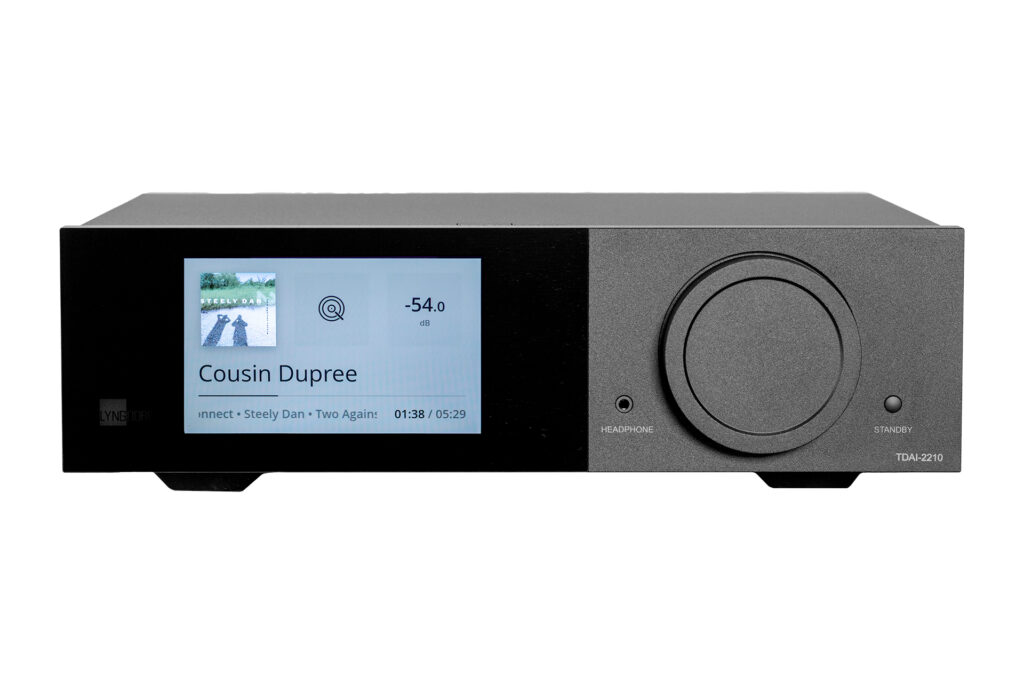
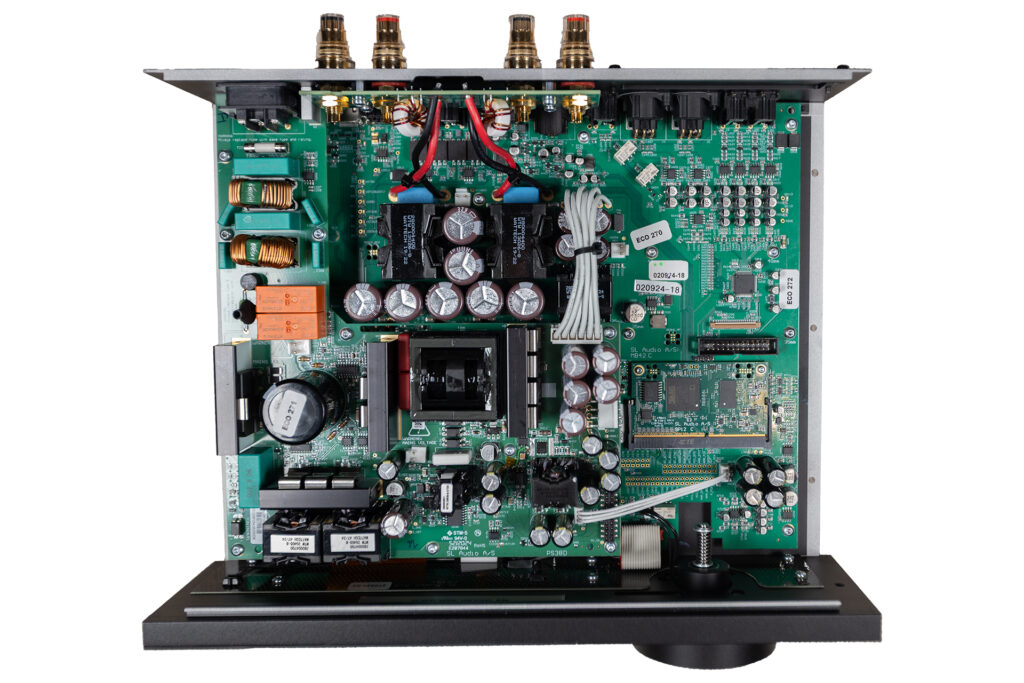
The Lyngdorf TDAI-2210 ($4,808 basic model; $5,392 with added high-end analog card; $5,499 with added HDMI 2.1 inputs) is a compact integrated component, combining streamer, DAC, preamp, headphone amp, and power amp. The TDAI-2210 includes extensive digital signal processing (DSP) abilities, including its RoomPerfect DRC system, digital tone controls, and flexible crossover options for one or two subwoofers in mono or stereo. It also includes a voicing system well-suited to fine-tuning overall system balance, as well as to taming tonally flawed recordings – classical releases, for example, which are often light in the bass and overly bright on top.
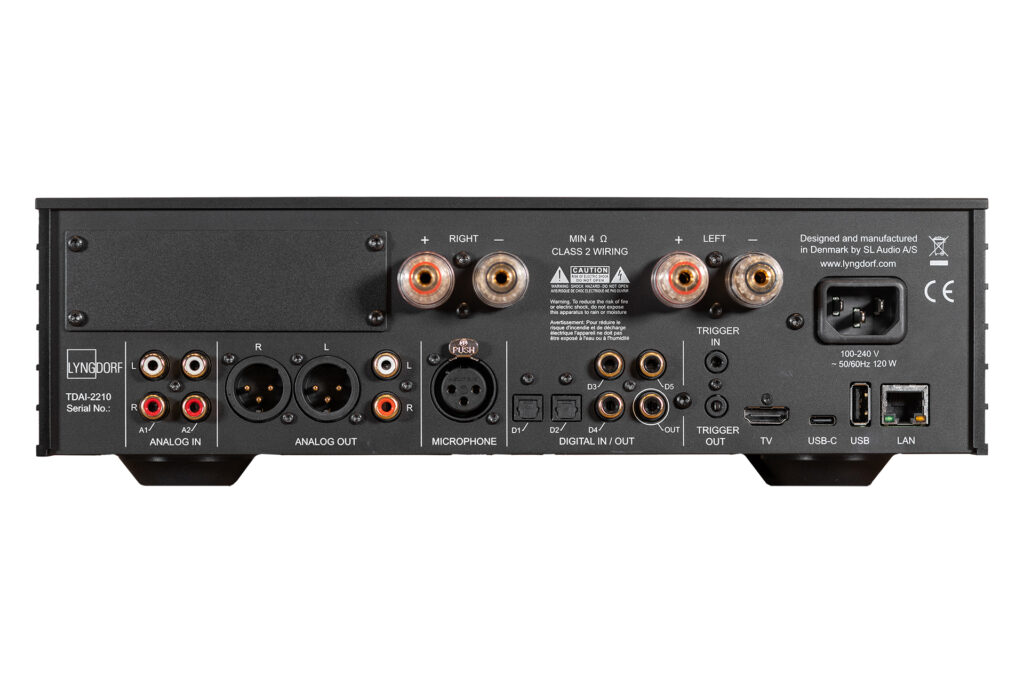
The TDAI-2210 has a glass color touchscreen, lossless volume control with a large silky knob, two line-level inputs on RCA jacks, and seven digital inputs, including coax, optical, USB-C, and HDMI 2.1 eARC. As is typical of components with DRC, analog signals are converted to digital for processing; SACD must be converted to PCM (likely by the player). A wide variety of streaming protocols is supported, as well as Bluetooth. The power amp section is rated at 210 or 105 watts per channel into four or eight ohms, respectively.
What Makes the Lyngdorf TDAI-2200 Streaming Integrated Amplifier Special?
- The Lyngdorf TDAI-2210 is a great-sounding component that combines a wide range of features into a single compact chassis. Its Danish design and modest footprint (12.8 × 4.0 × 11.8 inches; 10.6 pounds) make it especially well-suited for apartment living, or for anyone wanting audiophile sound without clutter.
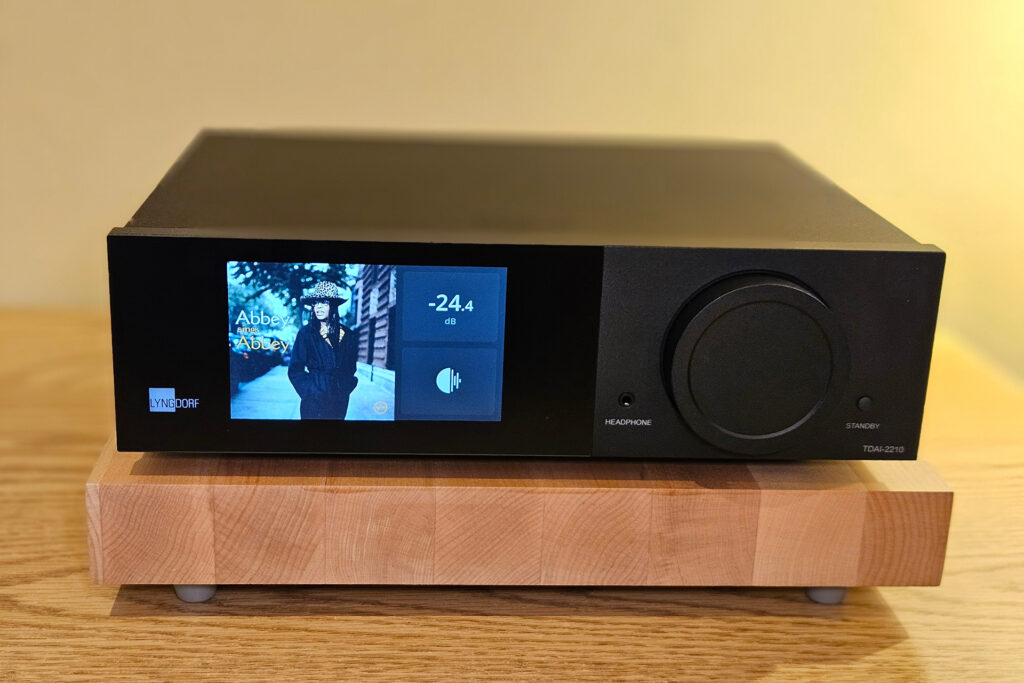
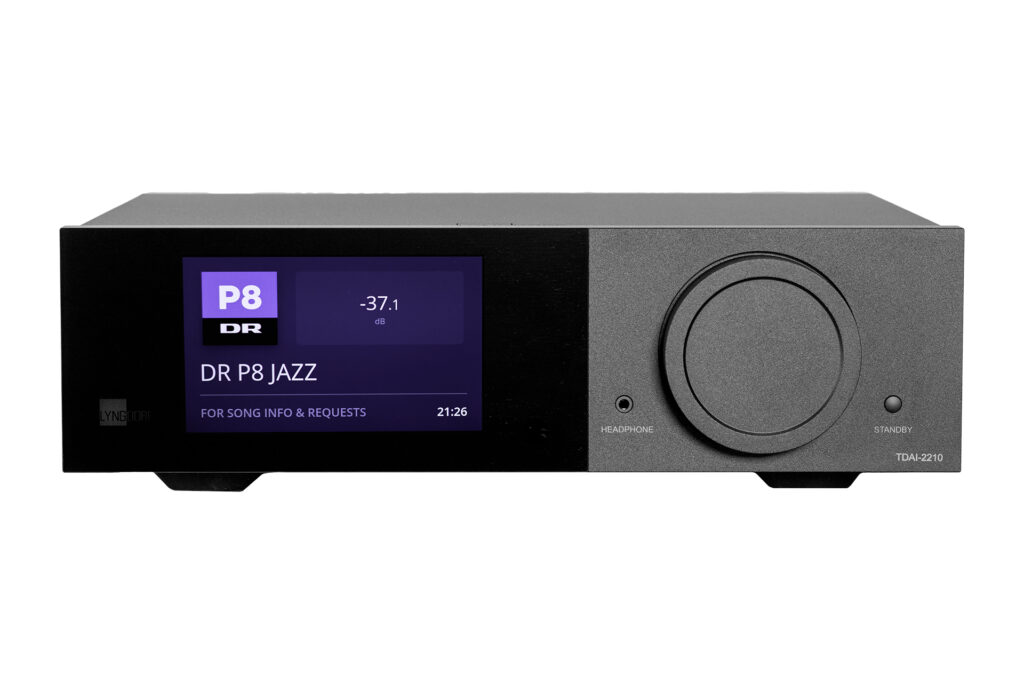
- The interface design of the Lyngdorf TDAI-2210 is outstanding. The touchscreen is bright and responsive, with app and web interfaces duplicating its functions. (I used the included remote mainly to change volume.) A typically thoughtful touch: during firmware updates, the TDAI-2210 displays clear progress indicators, far more helpful than the blinking lights of some other components.
- Two optional modules give extra features if you want. The high-end analog module adds a moving-magnet phono input, two line-level inputs, and a balanced line-level input on XLR connectors. The HDMI module adds an HDMI output and two HDMI inputs with eARC/ARC and CEC integration. There is a single slot, so only one module can be installed at a time.
- The TDAI-2210’s power amplification uses Lyngdorf’s unique Equibit technology, in which the signal stays in the digital domain without attenuation until the output stage, where gain is set by adjusting the voltage supply. Since it was introduced in the Tact Millennium amplifier in the late 1990s, Equibit topology has been widely praised for naturalness, detail, and soundstaging (Peter Lyngdorf was a partner in Tact Audio.) I consider it a worthwhile alternative to today’s excellent Class-A, -AB, and -D amplification.
- The RoomPerfect room-correction system is effective and simple to operate. In both systems where I tried it, it smoothed out bass response without making the sound unnatural. The TDAI-2210 also did a very good job of integrating subwoofers. All in all, I found RoomPerfect one of the simplest to apply, yet most effective, DRC systems I’ve used.
- The Lyngdorf voicing system lets the user customize the sound (with or without RoomPerfect) with up to 30 customizable voicings. Each can contain up to eight shelving filters or parametric EQ points, all fully adjustable, with the resulting curve shown graphically during set-up and selection. I love that voicings can be edited or switched on the fly without dropouts (moments of silence), so that changing voicings doesn’t disrupt musical flow. This is something I’ve wanted to have for years but not found in competing DSP systems.
- The TDAI-2210 lets you save and restore all settings (including RoomPerfect calibrations and voicings) to and from a USB thumb drive. Something like this is a must in today’s digital audio components, many of which have extensive configuration options. I appreciated that my work was never at risk, no matter how many flubs I made while using the device.
- The Lyngdorf TDAI-2210 is designed, manufactured, and tested (before and after burn-in) in Denmark. Lyngdorf tells me that they can repair almost any product they have ever made. That is the kind of service that audiophiles deserve when spending thousands of dollars on a component.
Why Should You Care About the Lyngdorf TDAI-2210 Streaming Integrated Amplifier?
The Lyngdorf TDAI-2210 is especially well-suited to audiophiles who want, besides true high-end performance, some or all of the following: outstanding visual and interface design, unobtrusive size, simplicity of operation, excellent room correction, and a restrained yet elegant design. For many such buyers, the Lyngdorf TDAI-2210 will be a home run. Combining so many functions into one chassis means less clutter and fewer cables.
A standout feature is RoomPerfect, which is easier to use than many digital room-correction systems, yet is powerful and effective. Like most DRC solutions, it allows more flexibility in speaker placement and can reduce the need for acoustic treatment considerably. The TDAI-2210’s voicing feature is similarly intuitive and pleasing to use, with effects I found consistently musical. It will be a godsend to those sensitive to timbre and whose tastes include both old and new recordings. Unlike other components in this category, the mic, cable and stand are included with your purchase.
The Lyngdorf TDAI-2210, then, is not about audiophile bling or endless tweaking; rather, it’s about delivering musical satisfaction from a component with a clean, understated design that hides its exceptional functionality.
Some Things You Might Not Like About the Lyngdorf TDAI-2210
- Some may prefer a larger form factor or fewer functions in one cabinet. This is a matter of taste: I found the design attractive and refreshingly compact. That said, an integrated device is not the best choice for an audiophile who expects to swap single-purpose components in and out frequently.
- In digital room correction, some users will want more graphs and controls. According to Lyngdorf, RoomPerfect aims to correct a set-up’s main sonic problems while preserving the speakers’ intrinsic sound. It does this while being a bit of a black box, in which users focus on audible results rather than graphs. Those who want to flatten every bump or to discuss and tweak target curves may prefer a different system. Those who prefer simplicity and a gentle touch may prefer RoomPerfect.
- Analog inputs are converted to digital for compatibility with the TDAI-2210’s signal path. The conversion is made at 24 bits, 96 kHz, which through a good ADC (Lyngdorf’s add-in card has a very good one) should be transparent. The best course for the analog audiophile is just to listen carefully to the TDAI-2210 with its added analog card. For many listeners, any sonic differences between the TDAI-2210 and comparable pure-analog gear will be outweighed by the overall value and utility of the TDAI-2210, including RoomPerfect.
- Some audiophiles might want some more power. The TDAI-2210’s 105 watts per channel at eight ohms make it a relatively high-powered amplifier, yet any DRC reduces headroom somewhat. The audiophile who wants high volume from inefficient speakers, especially in a large room, may desire more power.
Setting Up and Listening to the Lyngdorf TDAI-2210 Integrated Amplifier
I auditioned the TDAI-2210 with my usual Janszen Valentina P8 hybrid electrostatic speakers. (My NAD M66 DAC-preamp and Orchard Audio monoblocks were out of the system.) I did a little listening without RoomPerfect, but since it’s a big part of what the TDAI-2210 offers, I listened mostly with it on.
I set up RoomPerfect with the supplied measurement mic, following onscreen instructions in the MyLyngdorf app. Running a calibration involves placing the mic in varied spots around the room as the TDAI-2210 emits calibration tones; it took me about 15-20 minutes. Because processing is done within the TDAI-2210, no computer is needed.
Up to two speaker set-ups can be configured in RoomPerfect. My primary set-up had the Janszens run full-range; the secondary setup added two SVS SB-3000 subwoofers (read the review), crossed over in stereo at 70 Hz by the TDAI-2210. Phase alignment of subs is approximated by entering (in MyLyngdorf) distances to each speaker and the DSP latency of the subs (six milliseconds, according to SVS). Each speaker set-up can store corrections for several listening positions, but I stored just one, my central listening chair. After running RoomPerfect, the bass was much smoother in both speaker set-ups.
The TDAI-2210 is Roon-Ready, so after connecting it to our home network, I could use Roon to send it anything from my library of local FLAC files or from Qobuz. For those not using Roon, the MyLyngdorf app provides access to many streaming services and Internet radio stations, as well as network shares and files on an attached USB drive, if one is connected. The TDAI-2210 also is compatible with DLNA, Tidal Connect, Qobuz Connect, and Bluetooth.
One of my go-to recordings for female voice is “Blue Bayou” from Linda Ronstadt’s Simple Dreams (40th Anniversary Edition, 24/96, Qobuz). The initial bass line sounded nice and even, thanks to RoomPerfect. When, at about 0:44, Ronstadt pulled out the stops, I heard dynamic and well-controlled sound, with no nasties. Don Henley’s background vocals came through clearly, easily distinguished from Ronstadt’s voice, as did the great instrumentation, including marimba, slide guitar, and acoustic guitar. The TDAI-2210 did an admirable job presenting the fun of this hit song from 1977.
I don’t think the classical repertoire has a more popular trumpet concerto than Joseph Haydn’s.(This piece may be familiar to some from its use in a Baby Einstein video and in Netflix’s Squid Game.) Even if you know and love older recordings, I’d urge you to try the 2007 one (16/44.1, Qobuz) by Norwegian trumpeter Tine Thing Helseth, aged 20 at the time of performance. Helseth plays her own brilliant and extended cadenza (solo passage) in the first movement, starting at about 5:09 in the linked video. Through the Lyngdorf, I sensed that the recording didn’t try to mimic a live performance but had a little more detail (though not harsh or etched detail), with a soundstage heard mainly between the speakers. The TDAI-2210 presented instrumental timbres as I expected them, and it kept instrumental lines quite distinct – very nice! Reproduction of Helseth’s trumpet was sonically stress-free at all volumes, from softest to loudest. In short, this new-to-me version of an old standard was handled with aplomb by the TDAI-2210.
Some of the world’s most moving music is religious, whether a Bach mass, a gospel standard like “Amazing Grace,” or religious songs favored by many bluegrass musicians, as in our final selection. From the album Family & Friends by Ricky Skaggs and the Whites (contributors to the O Brother, Where Art Thou? soundtrack), I put on “Talk About Suffering,” sung a cappella in perfect three-part harmony. This lovely track is ear candy at its finest and also can be a system test. If each voice sounds natural and distinct, if you easily can tell Skaggs from the White sisters, and the parts never blur together, your system has excellent resolution. The TDAI-2210 passed this test with honors.
Will the Lyngdorf TDAI-2210 Streaming Integrated Amp Hold Its Value?
The TDAI-2210 is a product that aligns with modern preferences for compact, multi-function components, which should keep demand high. Whether an audiophile is just starting out or is at the downsizing stage, a smaller living space increases the need for room correction (e.g., RoomPerfect), while limiting the feasibility of acoustic treatment. Another positive is that design, manufacturing, and testing are all done in Denmark by Lyngdorf. For those reasons, I expect the TDAI-2210 to hold a higher-than-average portion of its value on the used market.
What is the Competition for the Lyngdorf TDAI-2210?
Though audiophiles are seeing more streaming integrated amplifiers with room correction, the category is still small, compared to non-DSP integrated amps. Here are some you might consider (all a bit more costly than the TDAI-2210):
Lyngdorf offers its own more powerful integrated amp, the TDAI-3400 ($7,449). It lacks the TDAI-2210’s color touchscreen, but as compensation outputs 200 watts per channel into eight ohms and 400 into four ohms. It uses the same RoomPerfect technology and same voicing system as the TDAI-2210, though Lyngdorf advises that.
The Arcam SA45 streaming integrated amplifier ($5,499 buy at Crutchfield) provides 180 watts per channel into eight ohms and 200 into four ohms. It has a large color display and comes with Dirac Live (but does not support Dirac Live Bass Control), outputs for main speakers and two subs, and many inputs, among them moving-coil and moving-magnet phono circuits, digital and USB inputs, and Ethernet. It is Roon-Ready.
Another choice is the NAD Master’s Series M33 v2 integrated amp ($7,199 buy at Crutchfield). It outputs 200 watts per channel into eight ohms and 380 watts into four ohms, using second-generation PuriFi modules. It includes a license for Dirac Live up to 500 Hz; full-range Dirac Live and its Bass Control add-on are supported if the user buys licenses for them. Its runs on BluOS, which supports Roon and a long list of streaming services. The NAD M10 (read the review) is another integrated that is worth looking at too.
Anthem’s STR Integrated Amplifier (read our review) ($4,999 buy at Crutchfield) lacks a streaming input, so total system cost will be higher. Its Class-AB output stage provides 200 watts per channel continuous into eight ohms, 400 into four, and 550 into two. It includes both moving-magnet and moving-coil inputs, among others. The STR Integrated includes Anthem’s ARC room-correction software, which is well-thought-out and, to my ears, gives results similar to RoomPerfect. The STR, which is designed and made in Canada, has been in Anthem’s lineup long enough that some users are getting curious about a replacement.
Final Thoughts on the Lyngdorf TDAI-2210 Integrated Amplifier …
Though some of my colleagues may disagree, I think it’s good for audiophiles (especially audiophiles without unlimited funds) to have related functions put into the same chassis, especially by a manufacturer that prioritizes sound quality. Combining functions eliminates compatibility issues, reduces costs and connecting cables, and can improve digital signal handling by avoiding extra conversions.
As with everything I review, I invited a few experienced audiophile friends to listen to the Lyngdorf TDAI-2210 with me. A younger friend, skeptical about digital sound, lit up when the music started. Later, he characterized the sound as “smooth as silk.” I suspect the TDAI-2210 changed his mind about digital, and that’s a good thing in my book. Other visitors also had a great time.
To get an even fuller picture, I used the TDAI-2210 briefly in two other systems. In my desktop set-up, the TDAI-2210, used without RoomPerfect or other EQ, sounded better – more natural and open – than my twice-as-expensive (but somewhat dated) gear. I’m sure it would have been better still with RoomPerfect turned on. In a friend’s system, the Lyngdorf TDAI-2210 drove a pair of Harbeth P3ESRs very nicely indeed. In that system, I thought that applying RoomPerfect took the sound to another level. My friend agreed about improved bass, but he missed the sonic signature of his usual gear. As always in audio, preference and habituation play large roles.
Did I think the TDAI-2210 had all the grunt and ambience of my usual electronics, which have about 2.5 times the MSRP and 2.5 times the power? Not quite – though, it should be noted, I’ve spent about a year perfecting DRC results in my own system, and I couldn’t spend that much time with the TDAI-2210.
The Lyngdorf TDAI-2210 gets a definite recommendation from me as a great-sounding, elegant integrated amplifier with a host of musically valuable functions. If I wanted a more compact system myself, the TDAI-2210 would be high on my list. If you are searching for a streaming integrated amp, arranging a home audition of the TDAI-2210 should be a priority. You may well find that your search is over.




Excellent article, thank you!! There does seem to be some missing text where you talk about the TDAI-3400, the last sentence stops suddenly while you meant to add some additional information from Lyngdorf concerning that particular units use or voicing.
Thanks for this review! Lyngdorf has been at the top of my wish list for a while, and this helps cement that position. It looks like something was left off the end of this sentence: “It uses the same RoomPerfect technology and same voicing system as the TDAI-2210, though Lyngdorf advises that.”
Ted and Mark,
Thanks for letting us know about the dropped text. This should have read: “It uses the same RoomPerfect technology and same voicing system as the TDAI-2210, though Lyngdorf advises that, as the TDAI-3400 is based on an older platform, its voicing changes are not instantaneous.”
I have since heard from an owner of the TDAI-3400, who stated that in his setup, voicing changes have been instantaneous. Best to check during a home trial, I would say.
Mike