
 By
By The moon landing was faked. 5G is going to control your mind. It keeps getting crazier, too. Did you know the Earth is flat? Worst of all: subwoofers are not loudspeakers, just accessories! To me, this last conspiracy is the most interesting. So many audiophiles have countless reasons as to why subwoofers are nice to have in specific situations, but are ultimately more of an accessory than a necessity. I rarely evaluate subwoofers. There are just too many that are poorly executed from five figures all the way down to two. I warned the Future Audiophile editor of this, I even shot across the bow of PSB Speakers, letting them know I am hesitant about these beasts.
Why do I need a subwoofer, anyway? My PSB Speakers Synchrony T800 loudspeakers (read here) pressurize my large listening space all the way down to 20 Htz. Perhaps the evaluation made sense simply because PSB Loudspeakers’ flagship subwoofer, the 130-plus-pound BP12, was designed to match the Synchrony T800? Who knows at this point. What I do know is the $4,199.99 PSB Speakers BP12 has shown up via freight-forwarder on a pallet, so it’s high time I get this beast into my listening space. Let us see if my age-old findings with subwoofers stand true, or if there is finally a subwoofer out there that has been designed with all the detail and precision of the finest loudspeakers out there. At this point, 30 years into my audiophile journey, when it comes to subwoofers, I will be happy if the PSB Speakers BP12 can squeak out a passing grade against my unreasonably high subwoofer standards. Here goes.
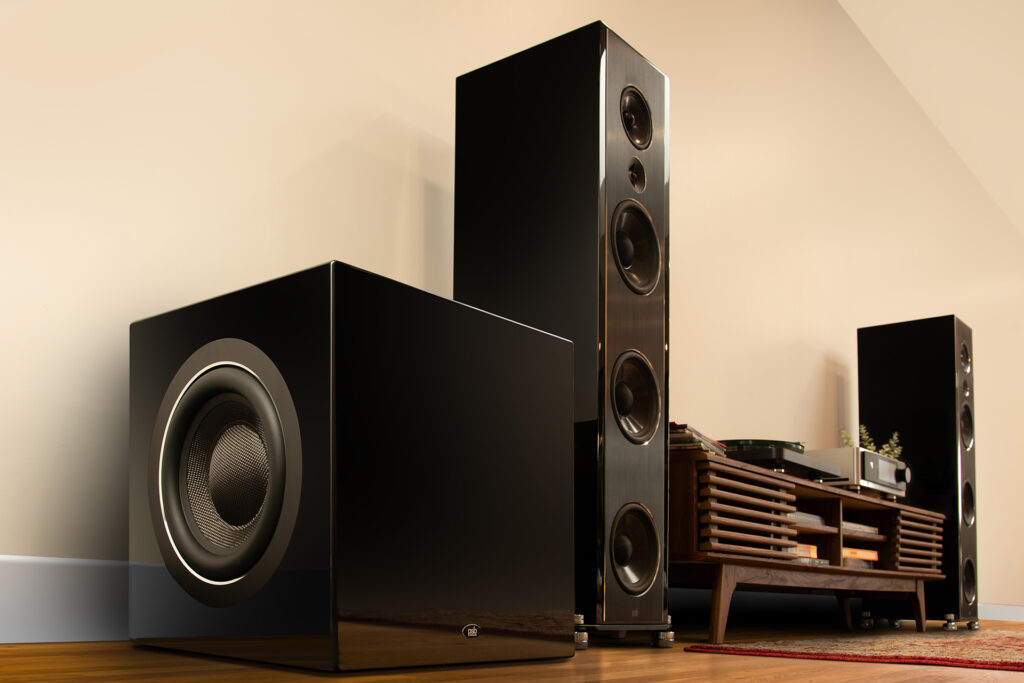
What Makes the PSB Speakers BP12 Subwoofer So Special?
- The PSB BP12 possesses legendary driver design, born of the Synchrony series. Every company has an exploded view of their massive subwoofer drivers (the actual woofer itself) and box to show … Wait, what are they really showing, again? Every subwoofer driver has a large motor, optimized to prevent the kinds of distortion a high-power, high-excursion (long-throw) driver has, but the 12-inch driver, two of which are used in the PSB Speakers BP12, have been optimized over several years of design not only to test pretty on a bench, but to perform like true high fidelity loudspeaker drivers in their intended application of a bipolar configured subwoofer.
- The PSB Speakers BP12 Subwoofer has a bipolar design. Bipolar subwoofers are simple in theory, but difficult to get right. When they are a slam dunk, a bipolar subwoofer like the PSB Speakers BP12 offers less localization, reasonable cabinet sizes, less distortion, and improved transient response. The tradeoff is that the cabinet pressures and opposing woofers can cause some pretty ugly non-linearities that drive up distortion when not engineered properly. Good thing that, when PSB Speakers designed the BP12, the purpose-made high-fidelity 12-inch driver was optimized in its intended application and not just on some bench at the Canadian National Research Council.
- The cabinet of the PSB Speakers BP12 subwoofer is the correct acoustical match for the dual 12-inch drivers. When the PSB Speakers BP12 subwoofer was designed, the correct acoustics were prioritized first. In my conversations with Joe de Jesus, product manager for PSB Speakers, they had no interest in hamstringing the acoustic response by making the cabinet smaller than optimal, then beating the response of the BP12 subwoofer into submission with Digital Signal Processing (DSP). This is often the unfortunate case with many subwoofers, even extremely expensive ones, but not the BP12. The DSP used in the PSB Speakers BP12 is mostly relegated to allowing the user to interface with the subwoofer from the listening location. There is no need for fancy equalization when you get the acoustics right.
- You can control the PSB Speakers BP12 from your listening position via Bluetooth. Controlling a subwoofer’s response from the listening location is not all that rare for high-end subwoofers these days. PSB Speakers kept it simple and allows for control over the BP12’s volume, phase, and crossover. This simplification of control is interesting when many companies are allowing for microphone-based set-up and auto-tuning of subwoofers. PSB Speakers has sound reasoning for their choice. In the instance of room set-up of subwoofers, a single microphone measurement of one point in space and optimizing for that one point is less than ideal, due to the way bass response, in more audible ways than not, is determined by the total acoustic listening space.
- There were no corners cut in the amplification of the PSB Speakers BP12 subwoofer. If you check out Amazon.com, you can find small Class-D amplifiers from China, for less than $100, posting huge wattage ratings. The moral of this story is: lots o’ watts is easy. What they do not tell you is the distortion, damping factor, usable frequency response, and a myriad of other truly useful specifications of an amplifier. Since it is becoming evident that the design of the PSB Speakers BP12 was treated more like a high-fidelity loudspeaker, it only makes sense that PSB Speakers chose to use amplification by PureFi with a dedicated, high-fidelity amplifier per subwoofer driver. At 500 watts per subwoofer driver, the PureFi amplification pair delivers true low-distortion, high-peak power that can control the PSB Speakers BP12’s finely-tuned acoustic dance between the subwoofer derivers and the inert enclosure.
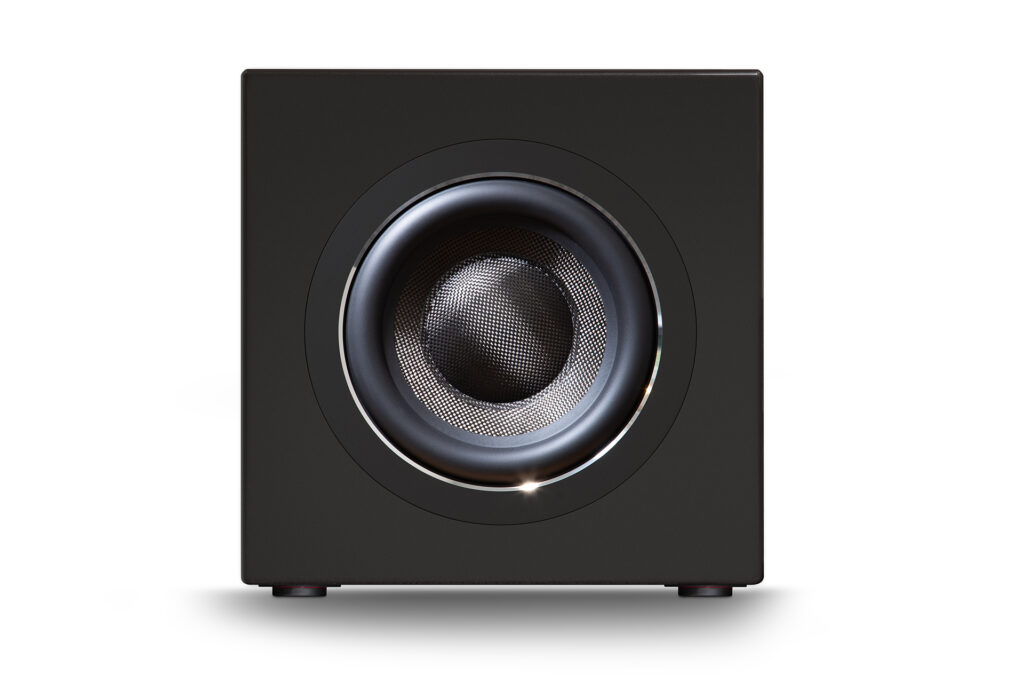
PSB SubSeries BP12 Subwoofer Specifications
| Drivers | Two 12-inch carbon-fiber woofers |
| Amplifier | 1,000 watts continuous (2 x 500), Purifi |
| Frequency response | 20 Hz to 150 Hz (±3 dB); 17 Hz at -10 dB |
| Enclosure | Sealed |
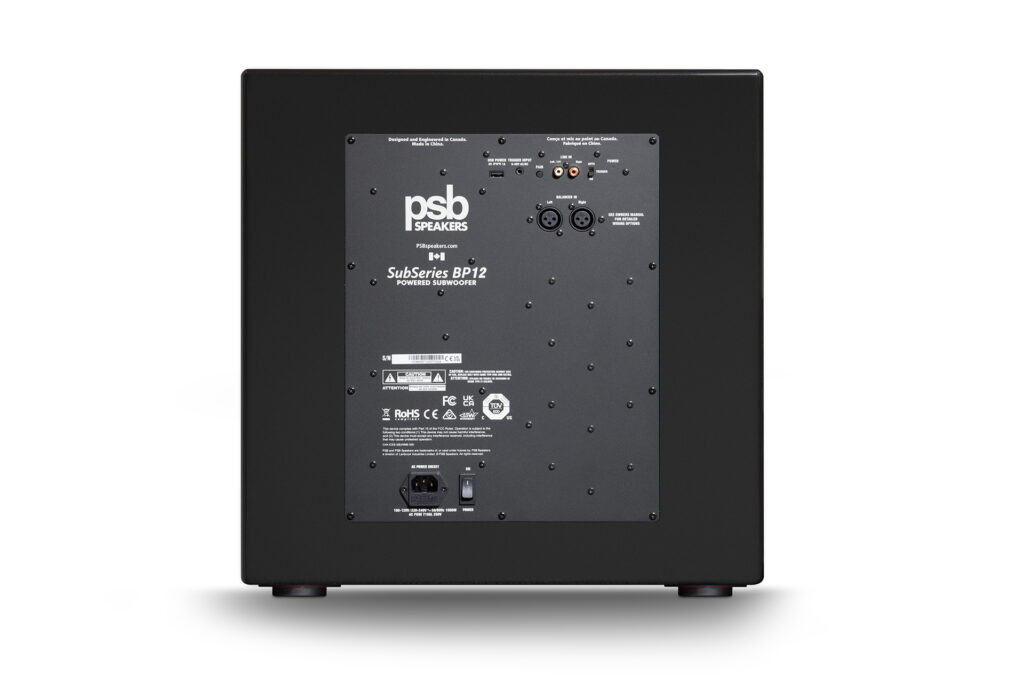
| Inputs | Balanced XLR and RCA (LFE or L/R), 12-volt trigger |
| Crossover | Variable 30 to 150 Hz, plus LFE |
| Control | Free iOS/Android app |
| Dimensions (W x H x D) | 18.9 x 19.3 x 18.9 inches |
| Weight | 132 pounds |
| Finishes | Basalt Brown, Carbon Grey |
| Price | $4,299 at review |
Why Should You Care About PSB Speakers BP12 Subwoofer?
True to PSB Speakers’ mission, the BP12 offers no frills, just high-grade engineering without the marketing twists. PSB Speakers chose a bipolar configuration for the BP12, which is one of two (the other being sealed) types of enclosures that do not subtract more from the music’s quality than they add when strictly talking deep bass. PSB Speakers treated the design of the BP12 like a true high-fidelity loudspeaker with high-fidelity amplification. A relentless pursuit of “nothing left on the table” went into the PSB Speakers BP12. From multiple iterations of the BP12’s massive drivers just to perfect where the voice coil meets the cone, to data-based battles with bean counters as to why corners could not be cut for cost that made the PureFi amplification non-negotiable, the BP12 is a master class in design and execution. I am unsure there are any other subwoofers near the PSB Speakers BP12’s selling price that approach its level of engineering. This engineering makes the BP12 a dedicated loudspeaker versus just an accessory, which flips the typical script on subwoofer design, and that is something to care about.
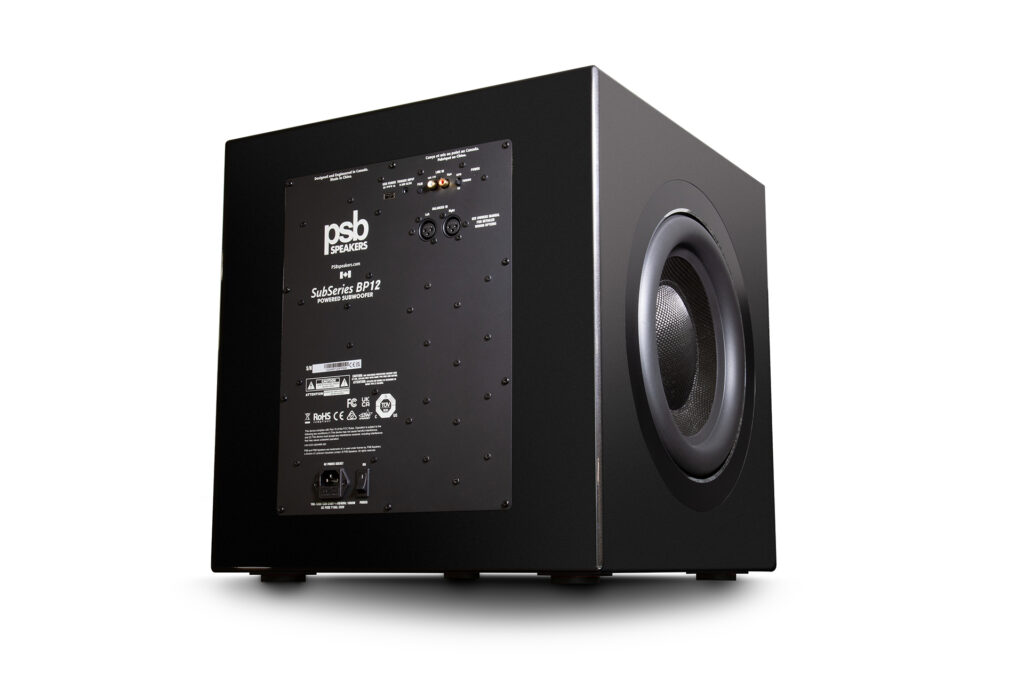
Some Things You Might Not Like About the PSB Loudspeaker BP12 Subwoofer
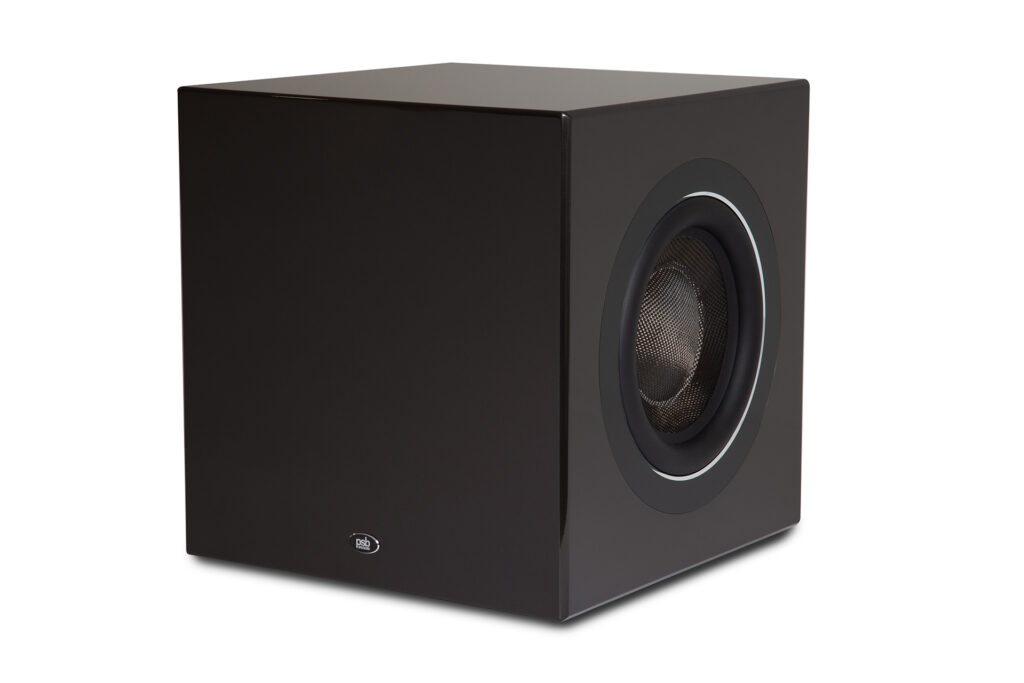
- The PSB Speakers BP12 is really big and really heavy. The BP12 is 18.9 inches by 19.3 inches by 18.9 inches and weighs a staggering 132 pounds. In medium spaces, it is not the easiest thing to just tuck away.
- The BP12 does not have parametric equalization or automatic room correction. Some tweakers may not like a subwoofer at the BP12’s price point lacking self-calibration or fancy equalization. The approach PSB Speakers chose was to allow for remote control of the volume, crossover, and phase, so the BP12 can be tuned by the end user from the listening position to their preference. A discussion around what is better leads down several rabbit holes about bass interaction with rooms, optimizing large wavelengths at one point in space/time, and the corrections being made causing worse issues than exist in a natural environment. Not a discussion for here. Alas, what matters is what the end user wants, and many end users want more tweakability for their subwoofers.
- The PSB Speakers BP12 is a high-fidelity subwoofer, not a boom box. This is a weird thing to put as something you may not like, but follow my madness for a second: when listening to a recording like “Since I’ve Been Loving You” by the mighty Led Zeppelin, those intimately familiar with the recording understand that it just does not have deep bass. The BP12 will most definitely add some weight and fortification to the low frequencies of songs recorded with less bass like this one, but it does not boom or kick harder than the music asks when blended properly into a system. If you are looking for more boom and kick by adding a subwoofer, there are other brands for that, but if you are looking for a seamless blending of sub-hearing-range bass through midbass, this is where the BP12 shines. This does not mean the BP12 is a lightweight AT ALL. It effortlessly compressed my large, 3000-plus-cubic-foot listening space when the music demanded it should.
- The PSB Speakers BP12 does not have grilles over the drivers. The drivers are certainly impact-resistant and tough as nails, but the lack of grilles makes the BP12 look a little unfinished.
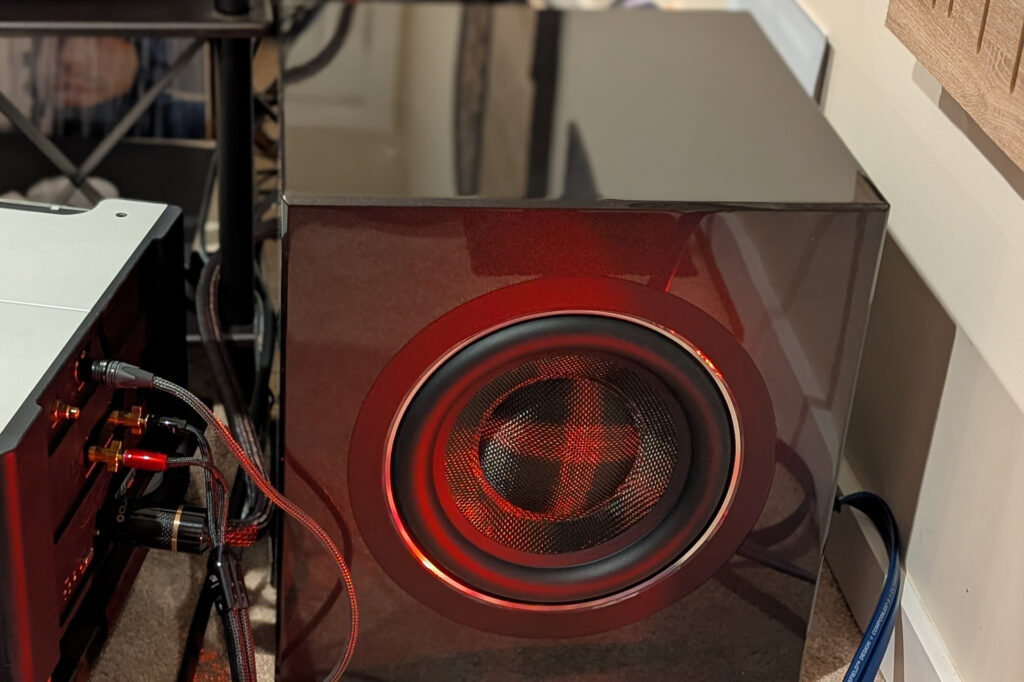
Listening to the PSB Speakers BP12 Subwoofer
For listening evaluations, I got my system back into its reference configuration, including the PSB Speakers Synchrony T800 loudspeakers. After fine-tuning loudspeaker placement, I shoehorned the BP12 subwoofer just behind my right-side Bricasti Design M30 Mono amplifier (read here). PSB Speakers provides recommendations for the BP12’s placement and, where it landed in my room, the BP12 had slightly more output while maintaining balanced bass response. Placement is important, since the listening space is an integral part of a subwoofer’s performance. Tuning in the BP12 was simple, thanks to the mobile app, and adjustments landed with the phase around 90 degrees, crossed over to the Synchrony T800s around 70 Hz. I ended up plugging the ports of the T800s with the factory plugs as well. It improved integration and fidelity, with the BP12 handling the heavy lift down low. After a few days of listening and tuning to warble tones and silly reference tracks, I was finally ready for some real music with the BP12 in my rig.
Those who follow my articles will find I have used this track before. There is a reason for that: it is one of my all-time references when testing the full range capability of a system. Boz Scaggs’ “Thanks To You” sits on the cusp of R&B and blues, is recorded VERY well, has incredibly deep bass over a punchy kick drum, and is lyrically poetic with a relaxed feel. Just about every time I have heard a subwoofer in a system, no matter how well it was integrated, either by ear or measurement, I found it to be distracting from the music. The exception was this insane Magico set-up I was fortunate to happen upon. The constant disappointment with subwoofers’ performance led me to a preference for full-range towers and big amps that could produce their own bass. Enter the PSB Speakers BP12. By the first dive of the bass, the PSB Speakers BP12 was reminiscent of that $15,000 Magico subwoofer I heard. It was absolutely invisible, compressing my room to levels where it felt as if I had a bass shaker in my couch. The BP12 NEVER overpowered the rest of the music or disrupted the soundstage. The kick drum was always pinpointed in the soundstage and the deep bass never interfered with the low-frequency timber of the kick. So many subwoofers, even expensive ones, have so much box loss from mid-bass vibrations and harmonic distortion that the timbre often will vary with sound volume. The BP12 maintained the sub-bass timbre integrity through the integration with the loudspeakers as well as if it were not even there. Truly magnificent.
I could go on and on with crazy pipe organ recordings and the BP12’s ability to play sub-bass so well the cuffs of my jean would shake (check out Reference Recording’s Pomp and Pipes), but there are a lot of monster subwoofers that can do this. I feel it’s better to dial in more on the integration with the loudspeakers, and the PSB Speakers BP12’s ability to deliver from the 15 Hertz range through the 70 Hertz crossover point. That is three octaves of your music, mind you, so why would you think it is less important than the rest of the musical spectrum and treat a subwoofer as a mere accessory or add-on? I digress. The track “R U Mine” by the Arctic Monkeys fit the bill well for another reference, thanks to its bombastic bass drum and hardcore bass line over some insane punk rock funk. There is nothing negative to say about the PSB Speakers BP12’s ability to blend seamlessly with the loudspeakers and paint a complete picture of the music. It simply does so with a level of fidelity I thought was impossible with subwoofers. The BP12 never got in the way of the music, just danced with it, building a foundation that kept my head bobbing and finger on the volume-up button to get my system to rock concert levels.
We have established the PSB Speakers BP12’s ability to maintain fidelity under high demand, and play down below our hearing range effortlessly, so what’s left? How about a solo double bass? Acoustic instruments are another challenge for most subwoofers, since their harmonically complex sounds end up getting muddied by losses. These losses include, but are not limited to, cabinet resonances, bass reflex port noise, passive radiator latency, high Q tuning, intermodulation distortion due to excessive driver excursion, and poor quality amplification, among other things. The usual argument I hear as to why some of these losses are A-OK is because our hearing is less sensitive to bass frequencies. Here’s the catch: distortion has harmonic components. A distortion at 40 Hertz will easily show up at 80 Hertz and 160 Hertz, WELL into the midbass where our ears can readily detect it! This means Jaime Branch’s well-recorded upright bass in the track “The Mountain” can quickly lose its natural integrity. One thing I have noticed with lesser subwoofers and even some poorly-designed loudspeakers is how the deep bass component sounds separated from the rest of the instruments. As you can guess, this was not the case with the BP12. Whether a bow was being dragged across the strings, or plucking of fourths and fifths were taking place, the BP12 simply stepped out of the way, let the instrument be cemented in the soundstage, and delicately built a seamless yet weighty foundation for the musical message to be built upon. The result of having the BP12 in my system was quite the musical experience and very additive to my musical enjoyment.
Will the PSB Speakers BP12 Subwoofer Hold Its Value?
Long-term desirability in audio gear stems from name recognition, and a reputation of generational performance. PSB Speakers has developed loudspeakers over the years that easily have become legendary. Since the BP12 is another in a long line of high-value, high-end products from PSB Speakers, I would bet good money the BP12 will hold its value for many years to come. Logistics are easy with local as well as shipped sales.
What is the Competition for the PSB Speakers BP12 Subwoofer?
My colleague Andrew Dewhirst had the pleasure of listening to the Bowers & Wilkins DB1D (read here). At $7,200, it is significantly more than the PSB Speakers BP12’s $4299 selling price, but I gather through his writing he had a similar experience to mine. This would make the DB1D one of the few subwoofers out there that can truly perform like its own loudspeaker.
Paradigm swings in heavy with their XR13 subwoofer. At $4,999, it is a price point competitor for the PSB Speakers BP12. The Paradigm XR13 comes in fancy colors, looks great, has room correction, and several catchy marketing phrases for “well-engineered cabinet.” It is an option if one desires room correction, though a single 13-inch driver needs to move a LOT more to get high sound pressure levels when compared to the dual 12-inch drivers the BP12 has. Overly high excursions are one thing that can quickly drive up distortion, though companies like Paradigm do have the design chops to minimize this problem.
Final Thoughts on the PSB Speakers BP12 Subwoofer …
The $4,299 PSB Speakers BP12 subwoofer is a force of nature. Out of the countless subwoofers I have heard in my 30 years in audio, the BP12 is one of two I would consider owning. It is rare that the sum of engineering, not just for its own sake but for purpose yields a subwoofer that truly stands as its own high-fidelity loudspeaker and not just an accessory. PSB Speakers clearly understood the assignment with the PSB BP12, bringing a true reference subwoofer to the market at a relatively low buy-in for the use of the word “reference.” The BP12 will not win any beauty pageants, is bulky and heavy, and may not cut the mustard for those looking into subwoofers to strictly add extra emphasized boom and kick to their system but, friends, the PSB Speakers BP12 ticks every checkbox for me and my high-fidelity listening habits.
No AI was used in the writing of this article.



