
 By
By I had the opportunity to review the sub-$1,000 per pair Chesky Audio LC1 bookshelf monitors (read the review) in 2025 and came away impressed by what was likely the first of many loudspeaker designs by college student and audio prodigy Lucca Chesky. The unique 3D-printed cabinet and quality components Chesky employed in the LC1s have made their way into the second-generation LC2s but are now refined with a series of meaningful upgrades. Of course, those improvements come with a notable price increase, with the larger and more powerful Chesky Audio LC2s retailing for $1,995 per pair.
At roughly 13 inches tall, 8.5 inches wide, 12.5 inches deep, and weighing in at 30 pounds per speaker, the Chesky Audio LC2 reference monitors certainly feel bigger, bolder, and more high-end than the LC1s. But the real question is whether a relative newcomer to the high-end audio scene can deliver performance on par with established industry stalwarts and justify asking audiophiles to part with nearly two grand. I also had to ask myself during the review process if the Chesky Audio LC2 reference monitors represented enough of a leap in performance over the Chesky Audio LC1 bookshelf monitors to justify a 100 percent price increase. There’s a compelling case to be made … Let’s explore these questions and more in the review ahead.
What Makes the Chesky Audio LC2 Reference Monitors So Special?
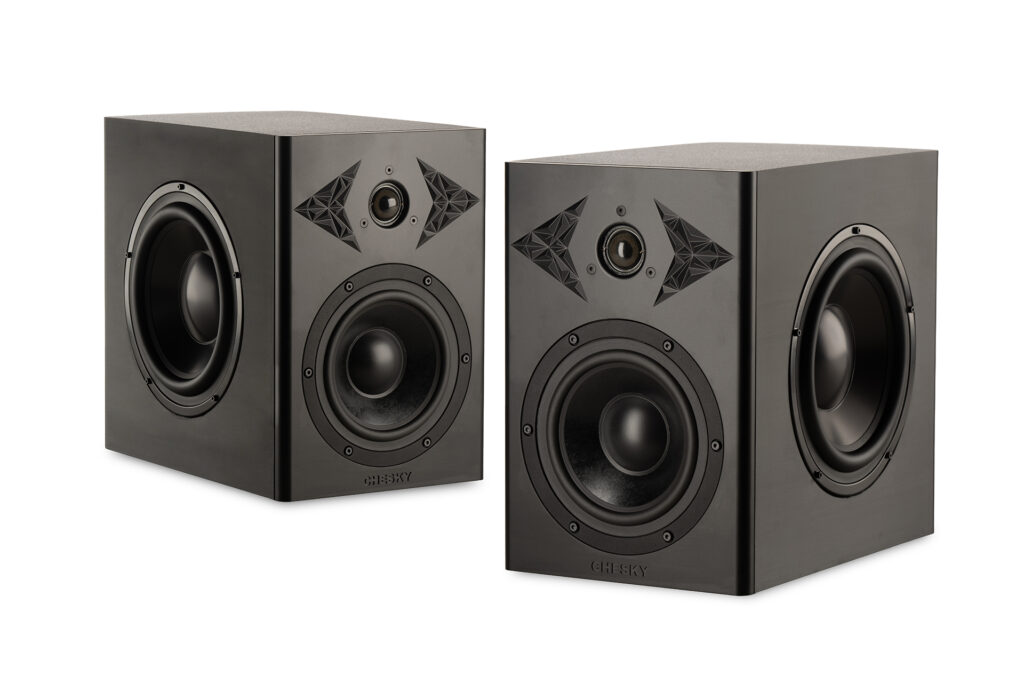
- The Chesky Audio LC2 reference monitors are fully comprised of 3D-printed, acoustically inert, double-walled composite. Calling these cabinets solid is an understatement. They are thick, heavy, dense, and provide an essentially vibration-free listening experience. After unboxing the LC2s, the first thing I did was perform a knock test with my knuckles. I was impressed by the absolute deadness of the cabinet. No resonance, no echo, no hint of hollowness whatsoever. Chesky is definitely onto something with his 3D-printed cabinet technology, and I’m here for it.
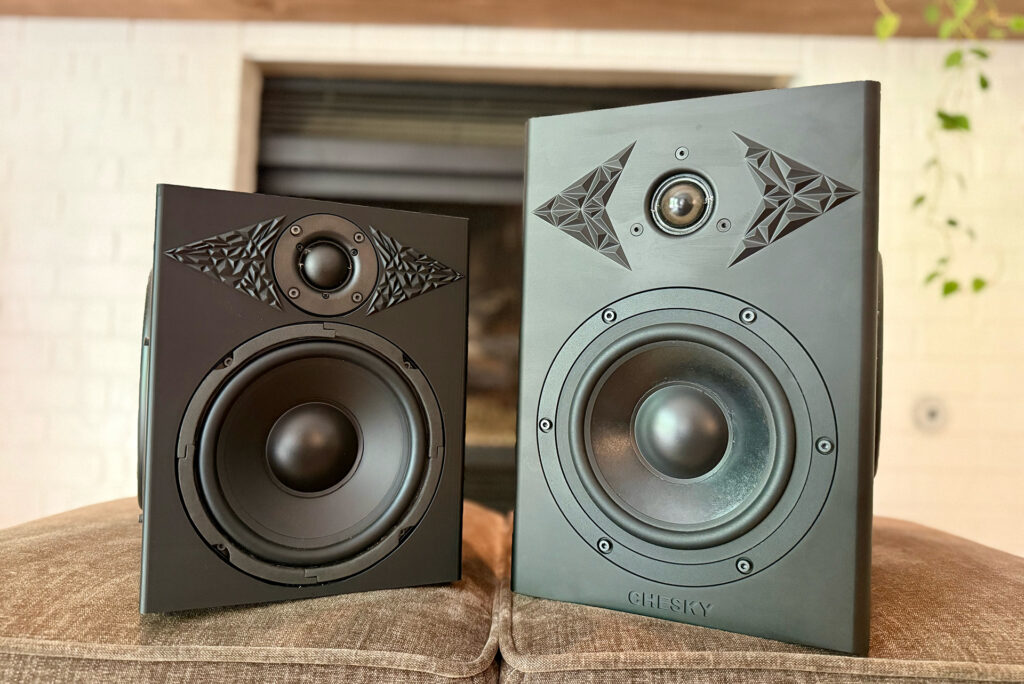
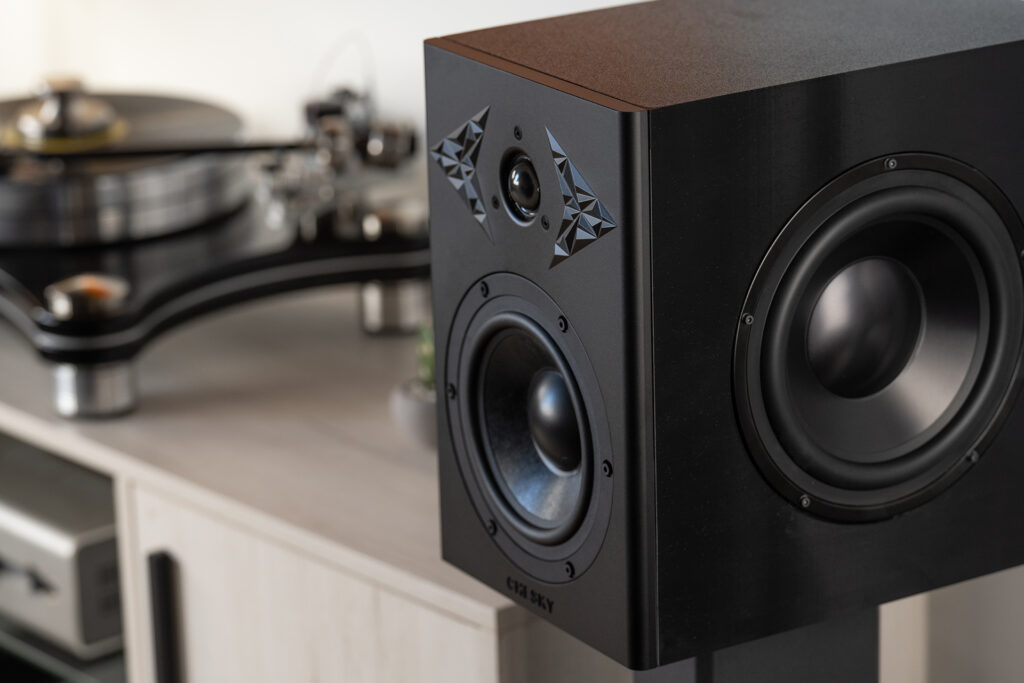
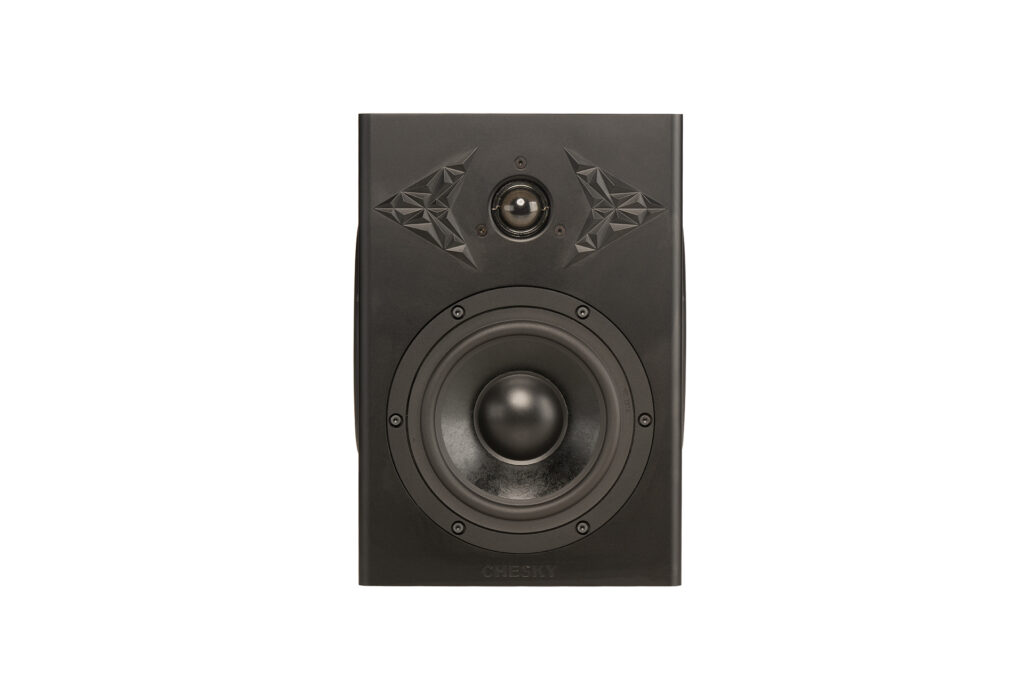
- The tweeter has been upgraded to a one-and-one-eighth-inch dual-chamber, aperiodic low-distortion dome tweeter that offers significantly improved linear dispersion and imaging. High-frequency sonic information came across as clear, vibrant, and spacious, filling my listening space with ease. Thankfully, Chesky also brought back the signature embossed “flying V” pattern, which envelops the tweeter and serves as a means of tessellation diffraction control – and also looks badass.
- The approximately 6.5-inch midrange driver is all new, now featuring a cast-basket and a tri-laminate cone and poly dust cap. This is the kind of upgrade you typically don’t see until you move beyond entry-level and mid-tier bookshelf speakers, where stamped steel baskets are still the norm.
- The front of the Chesky Audio LC2 reference monitor has been upgraded to feature five-eighths-of-an-inch solid aluminum baffle, mounted directly to the cabinet. In theory, this minimizes vibration and resonance from the driver and its enclosure. It also looks more high-end and gives the LC2 reference monitors a more polished look overall. The addition of an imprinted Chesky logo on the bottom is also a nice touch that gives the LC2 a slightly more refined and professional appearance, compared to the original LC1 bookshelf monitor.
- Bass performance is strong for a modest-sized speaker. I expected good low end from the LC2s, as their twin eight-inch passive radiators and reworked seven inch woofer looked very bass-friendly on paper. What I did not expect was for the low end to have as much presence and body as it did. Rated down to 40 Hz, the Chesky LC2 reference monitor is certainly a full-range speaker in every sense of the word, and those who prefer a slightly warmer sound and capable low-end extension should be satisfied.
- While they are more rectangular and slightly bigger than the LC1s, the Chesky LC2 reference monitors are still compact enough to be placed in a variety of settings. They are quite heavy at 30 pounds each, so don’t expect a lightweight, moveable compact bookshelf speaker, and I probably wouldn’t plan on using these on a desk. But they aren’t mini towers masquerading as bookshelf speakers either. They are likely a little too big to be placed on an actual bookshelf but could fit in a medium-sized entertainment cabinet or sit neatly on a set of stands.
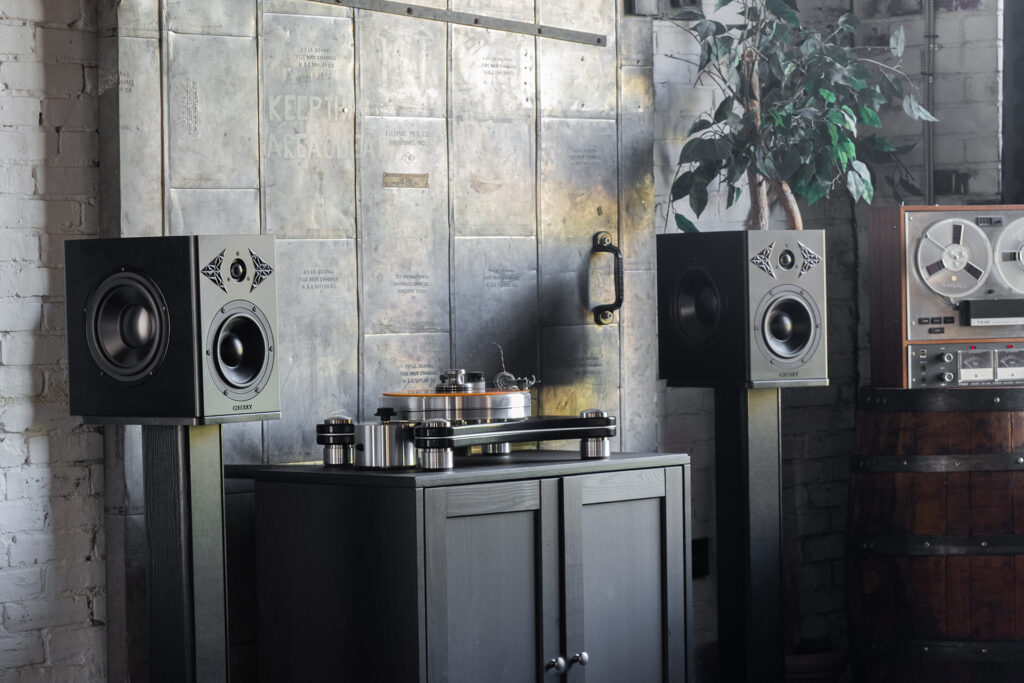
- The Chesky Audio LC2 reference monitors are available in either black or a distinctive silver finish. The black option immediately appealed to me with its understated, modern look, but the silver/gray variant brings a more unique, almost industrial aesthetic that will likely resonate with potential buyers looking for something a bit different. Chesky Audio had these on display at Axpona 2026 (though Lucca Chesky was not present, due to college midterms), and they looked pretty cool up close, and garnered plenty of attention among convention-goers.
Chesky Audio LC2 Reference Monitor Speakers Specifications
| Drivers | Dual-chamber aperiodic tweeter; cast-basket bass/midrange driver |
| Bass Loading | Dual passive sub-bass radiators |
| Cabinet | 3D-printed double-walled composite with 5/8-inch aluminum baffle |
| Frequency Range | 40 Hz to 20 kHz |
| Sensitivity | 86 dB (2.83 volts at one meter) |
| Impedance | 4 ohms nominal (3.1 ohms minimum) |
| Dimensions (H x W x D) | 13 x 8.5 x 12.5 inches |
| Weight | 30 pounds each |
| Price | $1,995 at review |
Why Should You Care About the Chesky Audio LC2 Reference Monitors?
The new LC2 reference monitors represent Lucca Chesky’s push into premium territory. $2,000 for a pair of loudspeakers is nothing to scoff at, especially in today’s economy, and there are ample options from a seemingly endless selection of brands and manufacturers.
What sets the Chesky Audio LC2 apart is its unapologetically unconventional approach to speaker design. Chesky could have followed the well-worn path: MDF cabinets, a traditional two- or three-way driver configuration, and a safe, market-proven formula, but instead chose to keep pushing forward. The use of 3D-printed, acoustically inert cabinetry and unique construction techniques gives the LC2 a distinct identity in a crowded field, which should appeal to any audiophile looking to try something new.
Some Things You Might Not Like About the Chesky Audio LC2 Reference Monitors
- Despite being rated at four ohms, the Chesky LC2 reference monitors are slightly inefficient at 86 dB at 2.83 V/1 m. Performance was adequate when connected to my Marantz Slimline receiver (50 watts per channel), but the Chesky LC2 reference monitors did seem to be craving a bit more power. They sounded significantly bigger and wider with my moderately-powered Advance Paris X-i75 Integrated Amplifier (110 watts per channel into four ohms). Audiophiles considering the LC2s may want to ensure they have enough power on hand in order to maximize performance (and minimize disappointment).
Listening to the Chesky Audio LC2 Reference Monitors
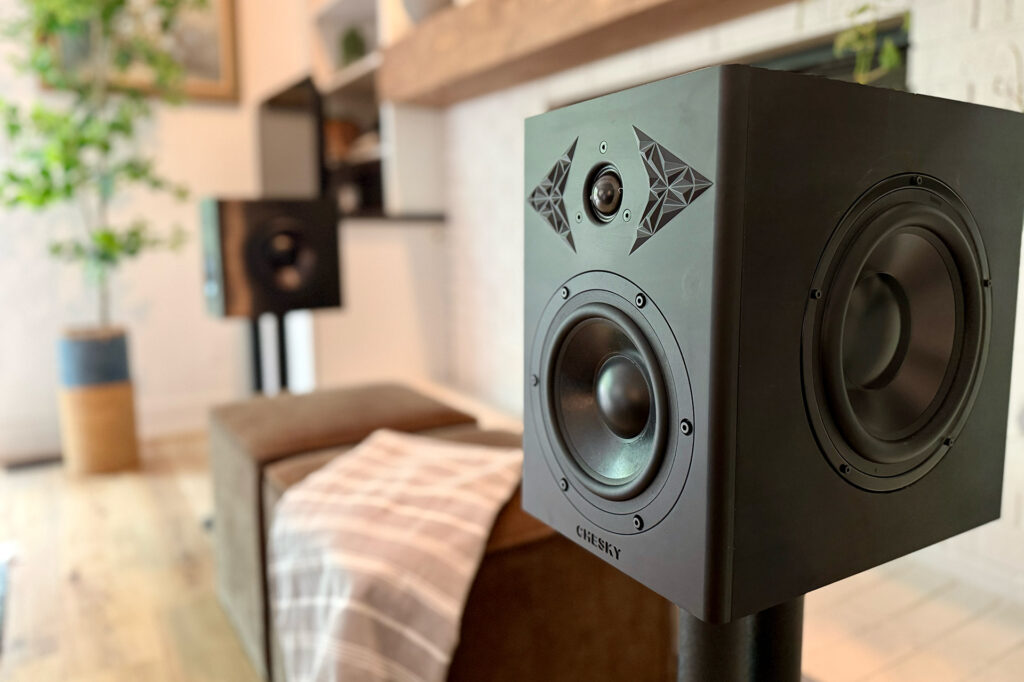
I set up my review samples of the Chesky LC2 reference monitors in my primary listening space – a large, rectangular living room that extends into my kitchen. With the LC2s positioned on stands, four feet from the wall per Lucca Chesky’s recommendations, I started testing a variety of genres to let the speakers warm up.
I was immediately struck by the LC2s’ imaging and soundstage. I started off with “If I Get High” by Nothing But Thieves, a slow-burning indie rock track layered with reverbed guitars, airy vocals, and a powerful crescendo. The Chesky LC2 reference monitors produced a strong stereo image, giving the guitars and vocals a sense of realism and presence. Drums were consistently punchy, thanks in part to the upgraded tweeter, and lead singer Conor Mason’s vocals had an incredible sense of clarity and openness. The bassline remained hefty and present throughout the track as well, and the kick drum was presented with velocity.
I did notice a slight loss of instrumental separation during the busier moments of the track at higher volumes but, overall, the LC2s held their own throughout my listening session. The most enjoyable moments were definitely when the track was more stripped-down and intimate, though.
Just as impressive was how effortlessly the LC2s energized my larger listening space. The presentation extended well beyond the speakers both horizontally and vertically, creating an expansive, room-filling sound that never felt constrained. The overall presentation felt slightly warm, bordering on warm-neutral, and was enjoyable start to finish.
Next, I wanted to give the eight-inch passive radiators a workout, so I chose a few lower midrange and bass-heavy tracks off of Joji’s 2026 Piss in the Wind. On “Hotel California,” the guitars sounded fantastic right off the jump, soaking my entire room in reverb that seemed to radiate outward in all directions. The track then introduces a subtle bassline before a moderate bass drop, which is then followed by a deeper bassline. Throughout this short song, bass performance was strong and weighty, with absolutely no bloat or chuffing noted, even at medium and higher volumes. The next track on the album, “Tarmac,” is even more intense, featuring a glitchy, deep bassline that gives even my most powerful subwoofers a run for their money. The Chesky Audio LC2 reference monitors didn’t fully escape the laws of physics, but they came impressively close, delivering deep, impactful bass without completely losing composure. During the most demanding parts of the track, I did notice a hint of fatigue that crept in as the drivers were pushed toward their limits. Still, the Chesky LC2s never fell apart; they just reminded me that I was asking a bookshelf speaker to do the work of a subwoofer. Within that context, their bass performance was seriously impressive and fun.
Will the Chesky Audio LC2 Reference Monitors Hold their Value?
Given Lucca Chesky’s success thus far with both the Chesky Audio LC1 and the LC2, I anticipate the evolution of the Chesky brand over the next decade-plus. That being said, as of this writing in 2026, Chesky Audio is a relatively new brand with plenty yet to prove. Like many audio products from lesser-known manufacturers, it can be difficult to move them on the used market solely due to lack of mass appeal and brand awareness.
If the brand continues on its current trajectory, that could change. But for now, the LC2s are better viewed as a long-term purchase rather than something you’ll flip in a year or two. The upside is that their unique design, strong performance, and quality construction may help them stand out to the right buyer, but you’ll likely need to be patient if and when it comes time to resell.
What is the Competition for the Chesky Audio LC2 Reference Monitors?
The KEF R3 Meta bookshelf speakers (buy at Crutchfield) are a pair of monitor-style bookshelf speakers that feature a three-way design and employ KEF’s signature UNI-Q driver technology. They come in beautiful walnut, black, white, and indigo colors. At $2,499 per pair, they are slightly more expensive than the Chesky LC2 reference monitors but boast impressive performance, thanks in part to KEF’s exclusive MAT (Metamaterial Absorption Technology), among other features. They are also a hair more efficient at 87 dB at four ohms. With a frequency response only reaching down to 58 Hz, however, buyers will likely need to add a subwoofer in order to achieve a truly full-range experience – not something total necessary with the Chesky LC2 reference monitors.
The $2,200-per-pair, neutral-sounding Revel Performa M126Be bookshelf speakers (buy at Crutchfield) are another similarly-sized bookshelf speaker option and feature a high-gloss finish and come in black and walnut. These two-way speakers possess a ton of high-end technology built in, including a one-inch beryllium dome tweeter with proprietary acoustic lens waveguide, 6.5-inch “Deep Ceramic Composite” (DCC) aluminum cone woofer with cast frame, and advanced high-order crossover. They have a modern look and feel and, despite being a few inches larger overall, the Performa M126Be bookshelf speakers won’t play nearly as deep as the Chesky LC2 reference monitors, as they are only rated down to 54Hz.
I’d be remiss not to mention the $1,498 GoldenEar BRX bookshelf speakers (buy at Crutchfield), as they similarly feature dual passive radiators and excellent bass performance (see my GoldenEar BRX review here). The sleek, glossy BRX bookshelves also feature a high-gauss reference HVFR™ (high-velocity folded ribbon) tweeter and are extremely efficient at 90 dB. They are smaller and significantly lighter in weight (12 pounds per speaker) but can dip down into the low 40 Hz range, offering excellent deep bass performance for compact bookshelf speakers. They are also backed by a five-year warranty and are manufactured by a well-known and well-respected brand.
Final Thoughts on the Chesky Audio LC2 Reference Monitor
The Chesky Audio LC2 reference monitor has one of the more intriguing (and frankly gutsy) speaker designs I’ve had in my listening room in quite some time. Lucca Chesky isn’t chasing trends with the LC2 reference monitors. He’s building something different and, in a market flooded with safe alternatives, that alone deserves some attention – especially considering he is not even old enough to order a cocktail.
More importantly, the Checky Audio LC2s perform like speakers in and above their price point. They nail imaging like much more expensive speakers, produce a wide, room-filling soundstage, and deliver bass that borders on shocking for bookshelf speakers. These are engaging, full-range, and unapologetically fun when given the right power.
That said, they’re not without a few minor flaws. The finish might still need some refinement, and they’ll absolutely expose an underpowered system. But these are minor issues, not dealbreakers. What’s harder to manufacture is a unique identity, and the LC2s have that in spades.
At the end of the day, the Chesky LC2s aren’t for everyone, and that’s exactly why they matter. If you want safe, go buy safe, as there is nothing wrong with that audiophile decision. If you want something that seeks to challenge the status quo and actually makes you sit down, listen, and raise an eyebrow at the first bass drop, the LC2s are more than worth your time and money.




They definitely seem promising, but I have one nit to pick. The author says, “ Rated down to 40 Hz, the Chesky LC2 reference monitor is certainly a full-range speaker in every sense of the word.” While that may be sufficient in many circumstances, reaching 40Hz would be better characterized as full-range in one sense of the word.
I’m also struggling to find any common ground with a lot of the music chosen to review products these days, but I’ll concede that I’m part of the problem there.
40 Hz is below the depth of any mainstream instrument that we listen to outside of say a pipe organ or a Roland 808 synth.
A sub would take these lower and I would match them with a good sub – no question – but they go low.
Yes, I get that, but after nearly 50 years in this hobby this strikes me as a strange turn of phrase for a 40Hz speaker. Not trying to bust any balls here, just saying the “in any sense of the word” part is out of place here — as you basically just illustrated with your comment.
The Revel Performa M126Be are listed at Crutchfield at $2200 EACH, not per pair, so not really a good comparison.
They might be.
Revels are good. So are these. 🙂
Sorry all the speakers mentioned are toys compared to the BMR Philharmonic Monitors.
And why is that? Not much of an argument made as to why.
Glad you asked, assuming a user willing to:
1. Have a good amount of absorption/diffusion at the side wall 1st reflection point to the listening position. Need enough space at the sides to get the full soundstage – my 14′ wide is just enough.
2. Have the tweeters right at ear level.
3. Not near field – 9.5′ the closest where the stage/instruments coalesce.
4. Have an ample amp to drive them. My first the Schiit Ragnarok 2 – enough, my current amp: Schiit Wotan is more than enough.
5. Not for head banging horn speaker dynamic listeners.
Still with me? There is no speaker under $4400 that I know that has so much going for it. 34-20k +/- 2db. stage width, instrument focus, timbre, low distortion. Partly because there is no retail markup. None of these 2 way, cube, desk top, stand mounts have bass than can match – proper timbre, excellent clean Q, good dynamics, but again not head banger stuff. For Classical, jazz, well recorded pop/rock.
At $4400 you have the big brother Philharmonic Towers – more power handling, bigger woofer, flat to 25 Hz, MTM arrangement of drivers, and easier to drive than the Monitor v2.
The next step up is $5600 for the ridiculously low priced ET LFT 8c (need a 20×24) room, and ability to get the panels 4′ from the front wall behind them, and a not a overly live room in particular behind them. Better than the MG 3.7i, ML 9 and 11, and any other panel I know under $12k.
Ironically, most of the music that you listen to was MADE on a JBL but I digress. 🙂
Philharmonic Audio has a pair of speakers in for review with Eric Forst RIGHT NOW.
I heard them at AXPONA. Very good stuff. Small company but we gave them a shot. Review pending.
Magnepans are, in effect, headphones. Don’t move your head up or down. Don’t expect any bass or dynamics. Real music isn’t like ANY of that. Sorry.
I’d say that Eric’s review did a great job of telling us about the details of the speakers and the details of the sound…but somewhat less about their “musicality”.
Having heard these at the Florida audio show and having been drawn back to the room numerous times by what I’d heard…at least to me, these speakers were “shockingly musical”…speakers that you could just set back and get lost in the music.
There are a lot of great speakers at this price point…but these little guys have the look that will probably appeal to young people…let alone their 3d printed coolness, their optional faceplates and their Chesky pedigree.
I get that he likes these a lot. But I’d like to know how he compares these to the LC1, are they worth the double price increase, probably (?), but more detail please. Thanks.
Hey guys it’s real easy to figure this one out.
Go to Crutchfield and look at the JBL L100 classic. Nope I thought these were still $2000 pair. No way but way better sound.
The JBLs are radically different speakers.. Retro but radically different.
Never heard a JBL that sounded like music, but I grew up with a set of Quad ESL-57’s.