
 By
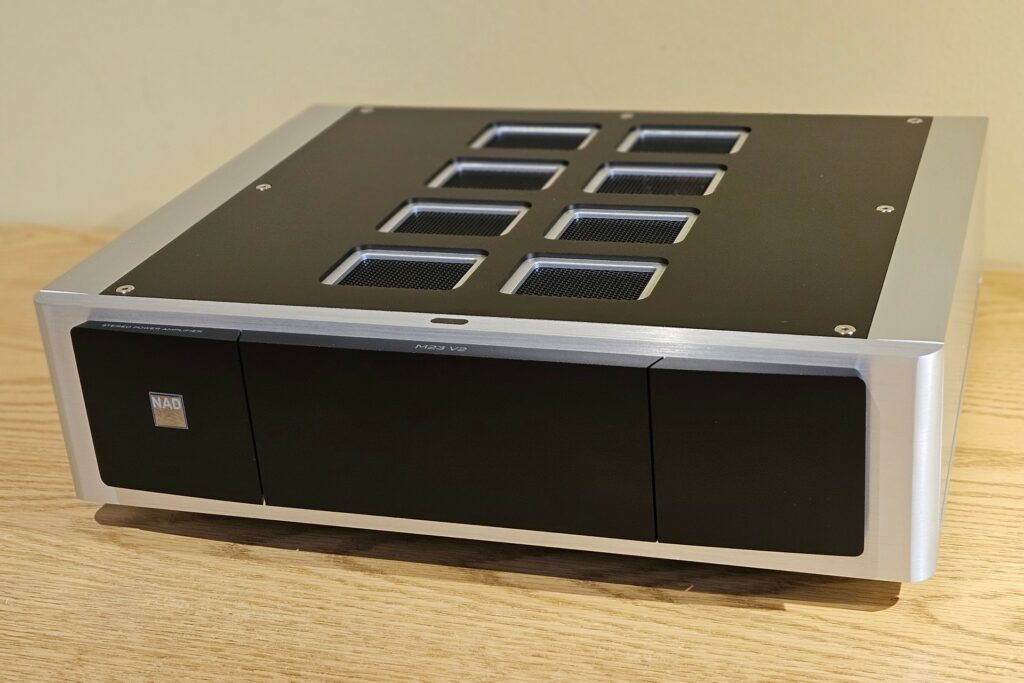
By Last year, when I reviewed the NAD M23 (read my review), the stereo power amplifier in NAD’s top-of-the-line Masters Series, I enjoyed its smooth and transparent sound. Now, NAD has released an update, the NAD M23 V2 ($4,999; buy at Crutchfield). When I asked NAD what has changed, they told me: “The primary update … is the upgrade from the first-generation Purifi Eigentakt amplifier module to the second-generation version. This new module lowers the noise floor and delivers a modest improvement in dynamic range. There are also incremental gains in linearity and power handling, particularly when driving more demanding loudspeakers. The NAD M23 V2 introduces a 12V trigger out, [including] a slight delay on the trigger output to reduce in-rush current on the [AC power] mains.”
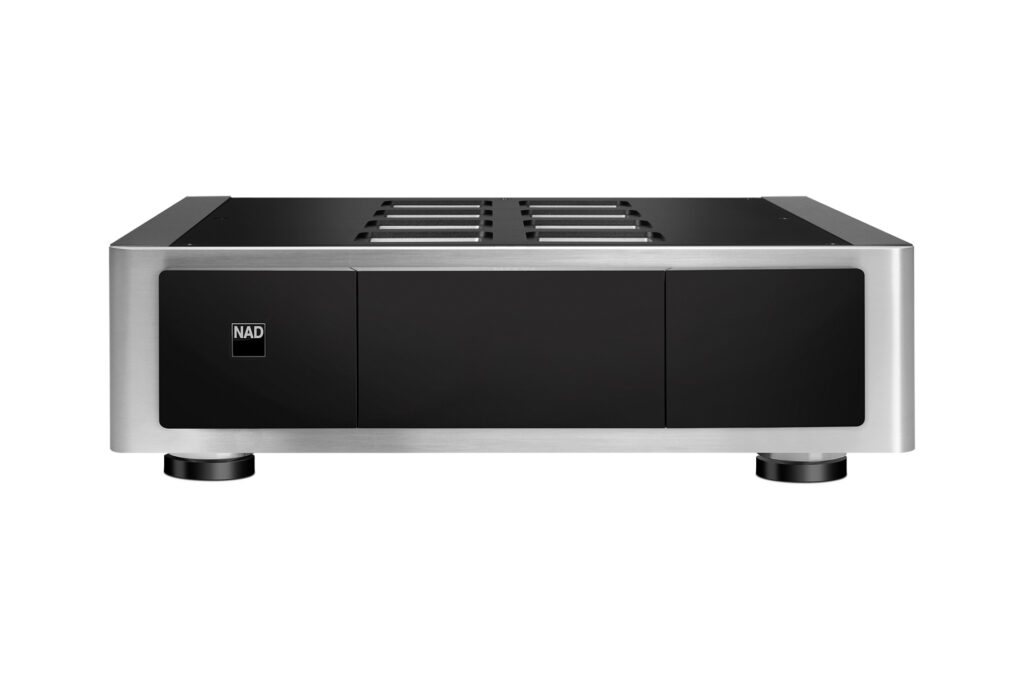
In published specs, the NAD M23 V2 appears identical to the original version. Like the original, the new amp has a power supply and an input stage designed by NAD and output modules produced by NAD under license from Class-D technology leader Purify. As a member of NAD’s Masters Series, the M23 V2 is housed in a handsome aluminum case that will pair perfectly with NAD’s M66 streaming DAC-preamp (read my review) and other Masters Series components. It’s not meant for use with only NAD gear, though – with its flexible gain and input options, the M23 V2 should mate well with almost any audiophile preamplifier. Today’s question is: with the changes NAD has made, how does the new NAD M23 V2 stack up sonically? Please join me as we find out.
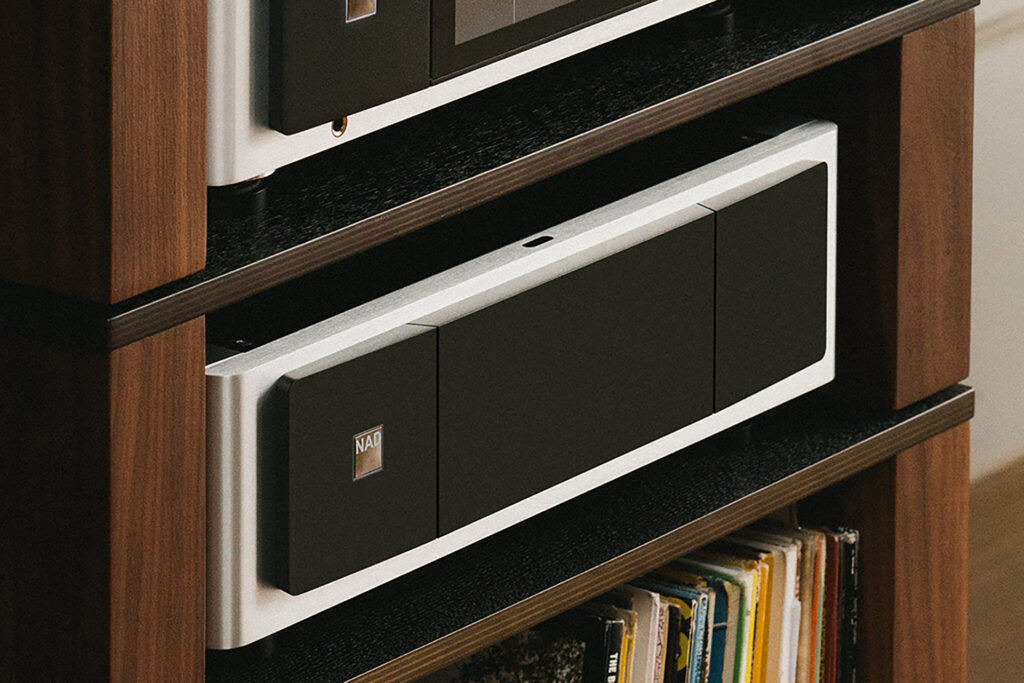
What Makes the NAD M23 V2 Stereo Power Amp Special?
- The NAD M23 V2 is a powerhouse capable of driving most audiophile speakers, with continuous power output exceeding 200 or 380 watts per channel into eight or four ohms.Dynamic (short-term) power specs are 260 or 520 watts into the same impedances.
- For even more power, the owner can switch the M23 V2 into bridged mode, with continuous mono output of over 700 watts into eight ohms. For stereo at that power, you’d need two NAD M23 V2 amps – or one plus a NAD M33 V2 integrated amplifier, which uses the same output stage.
- The NAD M23 V2 is quiet and accurate. Choosing an audiophile power amplifier is always a matter of taste and system synergy, and those valuing a high degree of transparency may find the M23 V2 exactly right. The specified signal-to-noise ratio of 127 dB and distortion of less than 0.0007 percent, 20 Hz to 20 kHz (both at full power into eight ohms) are about as good as it gets.
- The NAD M23 V2 has extremely flat frequency response (±0.06 dB, 20 Hz to 20 kHz, -three dB at 60 kHz) and extraordinarily low output impedance. You will hear the true response of your speakers, not frequency-dependent interactions between speaker and amp. The damping factor (which goes up as output impedance goes down) is specified at greater than 800.
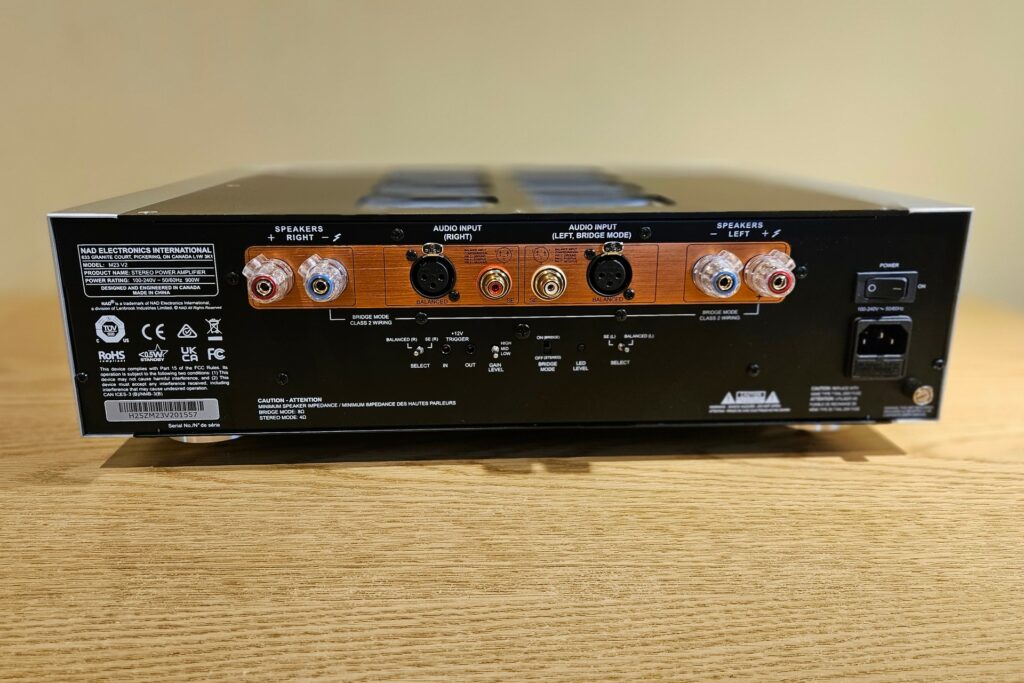
- For wide compatibility, the NAD M23 V2 offers selectable gain settings (19 dB, 23.9 dB, and 29.2 dB). This feature lets you reduce noise by using the lowest gain, giving adequate volume when used with your preamp and speakers. Conversely, you can use a higher gain setting to match with a low-gain stereo preamp.
- The NAD M23 V2 is excellent at maintaining clarity and composure as music gets complex. This applies as much to rock and reggae as it does to orchestral music.
- The NAD M23 V2 runs cool and is relatively light (21.4 pounds). You won’t need your air conditioning set to MAX: my review sample never got much above room temperature. Nor will you need three friends to help you place or move this amplifier without a sore back.
NAD Masters M23 V2 Stereo Power Amplifier Specifications
| Type | Stereo power amplifier, second-generation Purifi Eigentakt |
| Power | 200 watts per channel into eight ohms; 380 into four |
| Bridged power | 700 watts into eight ohms |
| THD | Less than 0.00069% (XLR) |
| Inputs | Balanced XLR and RCA, three-position gain |
| Dimensions (W x H x D) | 17.1 x 5.25 x 15 inches |
| Weight | 21.4 pounds |
| Price | $4,999 at review |
Why Should You Care About the NAD M23 V2 Stereo Power Amplifier?
At its price point, the NAD M23 V2 offers an outstanding combination of power output, features, appearance, and sound quality. It’s got plenty of power to drive most audiophile speakers with ease, and it’s unlikely to be bothered by speakers with impedance fluctuations. Some desirable features not found on every amp include selectable gain, balanced and single-ended inputs, and a rear panel with plenty of room for connections. The full-width cabinet, while not as elaborate as one from, say, Pass Labs, is solid and handsome and a definite step above the budget category. Most importantly, sound quality is objectively and subjectively excellent, with plenty of clarity, grip, and non-irritating upper octaves. An audiophile looking to step up from an inexpensive or dated amplifier may well find the NAD M23 V2 just the thing, as sound quality it offers was difficult (if not impossible) to find at this price point just a decade ago. It’s also a great amp to begin with, and have amplification in your system sorted for a long while to come.
Some Things You Might Not Like About the NAD Masters Series M23 V2 Stereo Power Amplifier
- Bridged-mode operation is rated at eight ohms only. In the owner’s manual, NAD states: “Low impedance speakers (under 8 ohms) are not recommended when using Bridge Mode as these may cause the amplifier’s thermal cut-out to operate if played at high levels.” If you need extremely high power to drive a speaker with impedance that drops below eight ohms, you would be best off looking at amps specifically designed for such conditions.
- NAD’s magnetic Iso-Point Feet are finicky and of dubious sonic value. These pointed feet, with magnetic saucers to protect your shelving, are also used on other Masters Series components. Unfortunately, the arrangement can be tricky and difficult to align when you are moving a component. I prefer simple, resilient feet, but honestly, this is a small nit to pick, one that doesn’t change my overall opinion of this amp.
Listening to the NAD Masters Series M23 V2 Stereo Power Amplifier
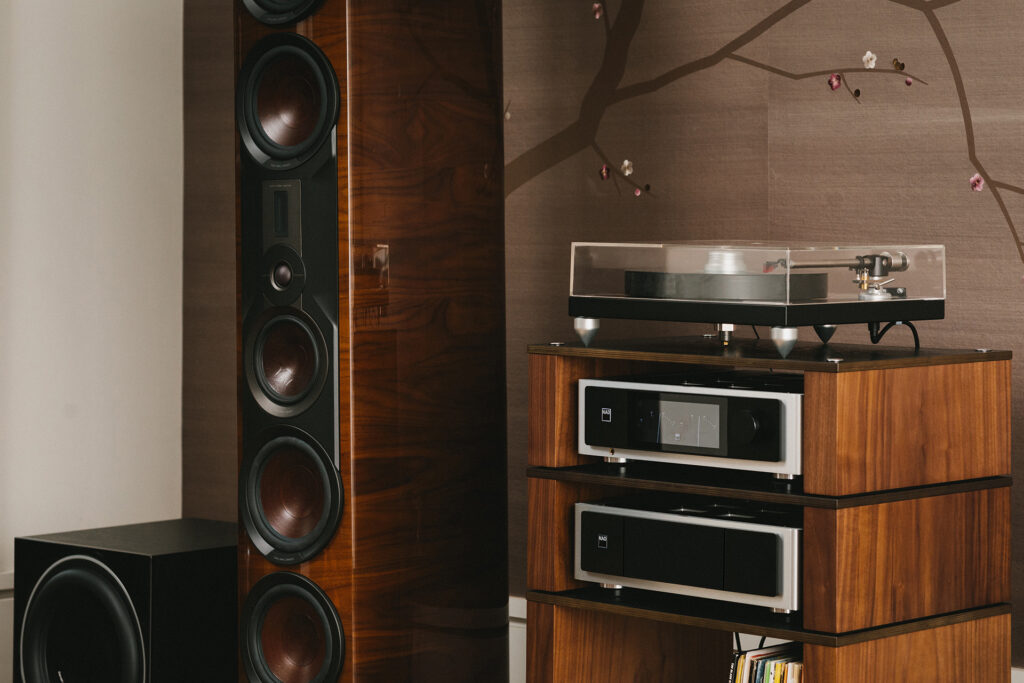
The NAD M23 V2 was inserted into my current reference system, which includes a NAD M66 streaming DAC-preamp (read my review) and Janszen Valentina P8 hybrid electrostatic speakers (read my review). I disconnected my SVS SB-3000 subwoofers, so sonic impressions were of the NAD M23 V2 at all frequencies. Music came through my custom-built Roon server, with Dirac Live used to take down the bass bumps characteristic of my low-ceilinged basement audio room.
During the months the NAD M23 V2 was in my setup, it handled a wide variety of music, including noisy surf rock, more melodic rock, male and female vocals in jazz, pop, bluegrass, blues, and opera, orchestral symphonies and concertos, solo guitar, harpsichord, cello, violin, and piano, and a few of my minimalist recordings of friends. I was impressed that the NAD M23 V2 did not favor any type of music, but rather sounded excellent on all of them. In particular, I noted on several occasions how good voices sounded, both male and female – lively yet lacking any excess high-frequency emphasis or hardness. Toward the end of the review period, I hooked up two SVS SB-3000 subwoofers. The sound in the midrange was unchanged, as expected, and the bass, as always in my room, benefitted from subs to reinforce the bass at the listening position.
The live version of Bob Marley’s “No Woman, No Cry” (16/44.1, local file) is a reggae classic, recorded live in July 1975. I enjoyed it through the original M23, and the M23 V2 also did a great job of rendering Marley’s voice in a lively way. The late J. Gordon Holt (subjective audio-reviewing pioneer) had a “goosebump test” for great sound, and this playback raised goosebumps on my arm, with Marley’s abundant charisma almost palpable. Imaging was stable and realistic, conjuring up the atmosphere of the live performance and the enthusiastic audience singing along at times. The electric keyboard was not the cleanest I’ve heard, but I chalk that up to the recording, not the playback equipment. As with the original M23, I found the electric guitar at about 4:10 forceful yet without irritation, and I wondered what recording techniques were used to make it stand out so much. Bass was suitably strong. In summation, the M23 V2 did a great job on this old favorite track.
While in a twentieth-century mood, I put on “Falling in Love with Love” from Art Blakey’s album Straight Ahead, recorded in 1981 at the San Francisco’s Keystone Korner jazz club. In his long career, Blakey brought up many notable players; on this album, it was Wynton Marsalis (learn more here), in what I believe was his first commercial recording. Notable on this track was excellent timbre reproduction of trumpet and sax, along with Blakey’s drum kit. Cymbals sounded great, not fuzzy or hissy, as they sometimes are on albums of this age (or even some newer albums); cymbals also can sound wrong through mediocre components. String bass was convincing both in the plucked quality and the woody character of the sustain. Dynamics were exciting.
“The Mozart Clarinet Concerto” with Swedish clarinetist Martin Fröst and the Amsterdam Sinfonietta (96/24 downloaded files) let me hear the M23 V2 on a well-recorded, familiar classical piece. In the first movement, I noticed immediately the clarity of reproduction, with instrumental lines always distinct, partly reflecting the superb clarity of the NAD M23 V2 and partly the recording technique. Dynamics were effortless (admittedly, Mozart’s not the most dynamic of composers), and timbre of the clarinet remained realistic at all levels. High strings (violins and violas) were reproduced without stridency. Low strings (basses and cellos) had a quiet yet undeniable impact. This recording is a bit more detailed and brighter than the sound of a live orchestra as heard in my usual mid-hall seats. That was apparent, as it should be, through the M23 V2. From a performance and playback point of view, it is a lovely recording – nothing seems difficult for Fröst – and it was beautifully handled by the M23 V2.
Will the NAD M23 V2 Stereo Power Amplifier Hold Its Value?
Like other NAD Masters Series Components, the M23 V2 offers NAD’s best sound and most elaborate casework – a bit of a splurge in a rugged sort of way. Because NAD has a large dealer network and its products frequently are reviewed as offering excellent value, audiophiles have widespread interest in the brand. For those reasons, I think a used M23 V2 should sell more quickly than exotic brands and retain a good fraction of its value on the used market.
What is the Competition for the NAD Masters Series M23 Stereo Power Amplifier?
Around this price point, any of the following amps would be well worth a trial. These Class-D components (learn more here) are especially well-suited to music lovers who appreciate – along with excellent sound – lower weight, lower power consumption, and lower heat emissions. And remember: amplifier classes reflect only chronology (when the type of amp was introduced), not predictable differences in sound quality.
Orchard Audio’s Mono Ultra Premium amps ($5,199.90 per pair at time of writing; price increase expected on June 1, 2026 – read the review) are rated at 250 watts or 500 watts of continuous power into eight or four ohms from Orchard’s proprietary GaN-FET output modules. Their casework, attractive yet more basic than the NAD, is unobtrusive when placed next to speakers. Potential buyers should be aware that the Orchard amps’ relatively low gain (19 dB), while well-chosen to lower noise, might limit playback volume in some systems, particularly when used with low-output preamps or insensitive speakers.
Also using Orchard Audio’s “Ultra” modules, the ArgentPur DUO stereo amplifier ($5,300 – read the review) adds silver internal wiring and an attractive aluminum case. Brian Kahn (check out his reference system) reviewed it for us, so check out his review at the link given.
A different perspective is taken by Atma-Sphere in their Class-D monoblocks ($6,350 per pair; read my review). The designer, Ralph Karsten, is well-known for his tube amps, but he has replaced the tube amps in his home setup with his GaN-FET monoblocks. They feature 100 watts continuous into eight ohms (200 watts into four ohms), custom linear power supplies, balanced and single-ended inputs, and Atma-Sphere’s own circuitry from start to finish.
Michael Zisserson reviewed the Amped America AMP 2400 ($6,000 – read the review), another powerhouse amplifier, and concluded: “If extremely honest, powerful, yet neutral sound sans the audio jewelry is the desire for your system, it would be hard to beat the AMP 2400 without spending at least three times its asking price.” It carries a five-year warranty. The Pascal chip is the rarest of the modern Class-D options today, as well as a very good one, also used for a time by Jeff Rowland.
Final Thoughts on the NAD Masters Series M23 Stereo Power Amplifier
Because I didn’t have the original NAD M23 on hand, I couldn’t make direct sonic comparisons. What I can say is that, like the original M23, the NAD M23 V2 is an excellent-sounding stereo power amplifier, as I expect from NAD and Purifi. I repeatedly compared it to my Orchard Audio monoblocks, but because of the need to swap cables, comparisons could not be instantaneous. Perceived differences were difficult to pin down, with the Orchard amps sometimes seeming slightly more open-sounding, and the NAD M23 V2 sometimes a bit more laid-back in the treble. Which amplifier I preferred depended on the recording, and I imagine those preferences might change with different speakers or a different preamp. An embarrassment of riches, really! I remain uncertain why two amps, each with superb measurements, should sound slightly different. It’s a sometimes frustrating, sometimes fun part of audiophilia, choosing from among excellent components.
These days, many amplifiers (by makers such as Denon and Germany’s T+A, as well as small assembly firms) use the same Purifi modules. In the M23 V2, NAD has designed their own input stages and power supply, which presumably contribute to the dynamic and engrossing sound of the M23 V2. This amplifier is another excellent component from NAD, one that uses some of today’s best amplifier technology in service of great sound. I could use the NAD M23 V2 as my everyday amplifier with pleasure. I strongly recommend that audiophiles shopping near its price point give a careful audition to the NAD M23 V2 power amp.
Read more about distortion and how it affects an audiophile system from FutureAudiophile.com editor, Paul Wilson
Compare it with our reviews of the Orchard Audio Starkrimson Mono Ultra Premium, Amped America AMP 2400 and NAD Masters M23. Comparing options? See the best audiophile power amplifiers we’ve reviewed from FutureAudiophile.com.
“Like the original M23, the NAD M23 V2 is an excellent-sounding stereo power amplifier, as I expect from NAD and Purifi.”




Hi Mike. Thanks for mentioning ArgentPur. It may be helpful to note that of all the GaN-FET or other Class D amplifiuers extant our Monobloc and DUO aren the only to employ very high end Mundorf SGO caps in the critical output filters for utmost soundstage pellucidity. They do make a difference in extremely resolving systems.
Excellent write-up Mike – digital amps are on my list of things to try, and you’ve given us an excellent primer in the context of a focused review of a brand that helped many of us cut our audiophile teeth. How many NAD 3020 amps are in our collective attics?