
 By
By There was a time when my concerted opinion of the entire subwoofer category, at least as it applied to a two-channel audiophile system, was something in which I was totally uninterested. I had floorstanding speakers easily capable of a low end of 30 Hz, or lower, so why bother? I was not at all impressed by low frequencies typically described as subterranean and glass-breaking. I wanted to hear the majesty of a bass guitar and the visceral impact of a drum kit, not break glass. I also did not want one or two additional boxes taking up space in my audio room. And the thought of needing yet more cables, and any other ancillary whatnots, sent cold chills down my spine. Let me also say I was so very mistaken. When, some eight years ago, I actually installed a stereo pair of REL G1 Mark II subs, I found out just how wrong my opinion of subwoofers for two-channel audio had historically been.
For a two-channel system, subs are ideal for helping to complete, or “fill in,” if you will, the lower octaves of the frequency span of 20 Hz to 250 Hz, the presumed range of audible low bass to the low midrange frequencies. This is a very real sweet spot for a subwoofer. Can they be made to thunder the walls and cause pictures to fall to the floor? Of course they can. But why? If the goal is to make music sound like it does in a natural setting, then paint-peeling bass is patently unrealistic. I’m looking to take some low-frequency pressure off the mains, and provide the weight, depth and realism of full-range music one hears in a live setting – or do so as reasonably close as I am able. Audiophile subwoofers help the mains do a much better job of recreating the full scope of believable low-end frequencies and also the lower midrange. And if the system is using bookshelf speakers, then subwoofers make the overall musical presentation even more enjoyable.
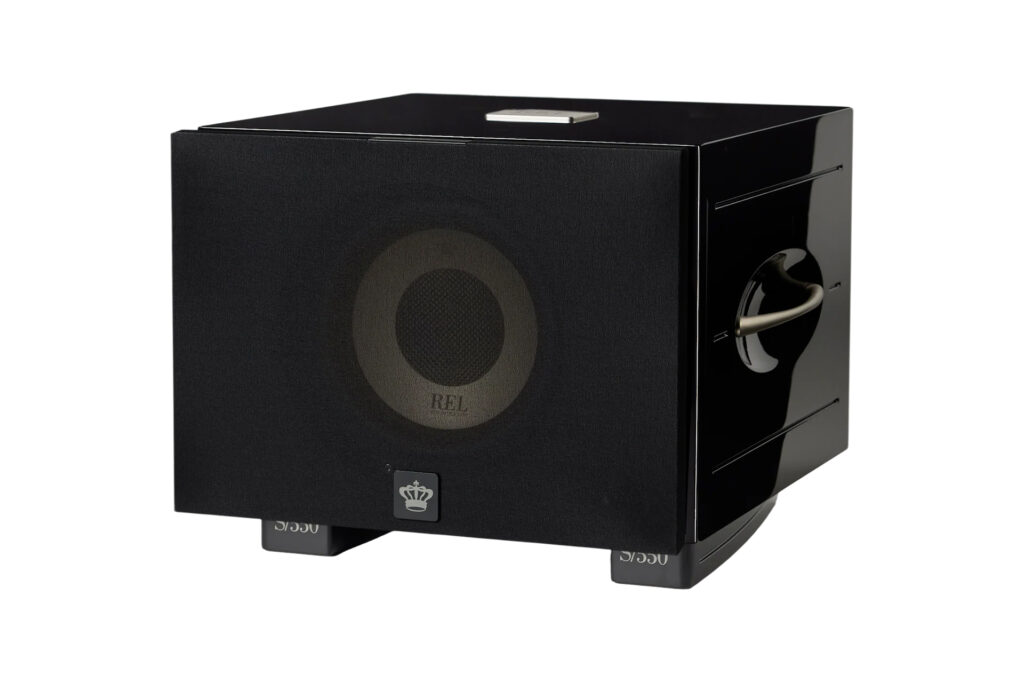
Why Would Anyone Want Six Subwoofers in a Line Array Configuration?
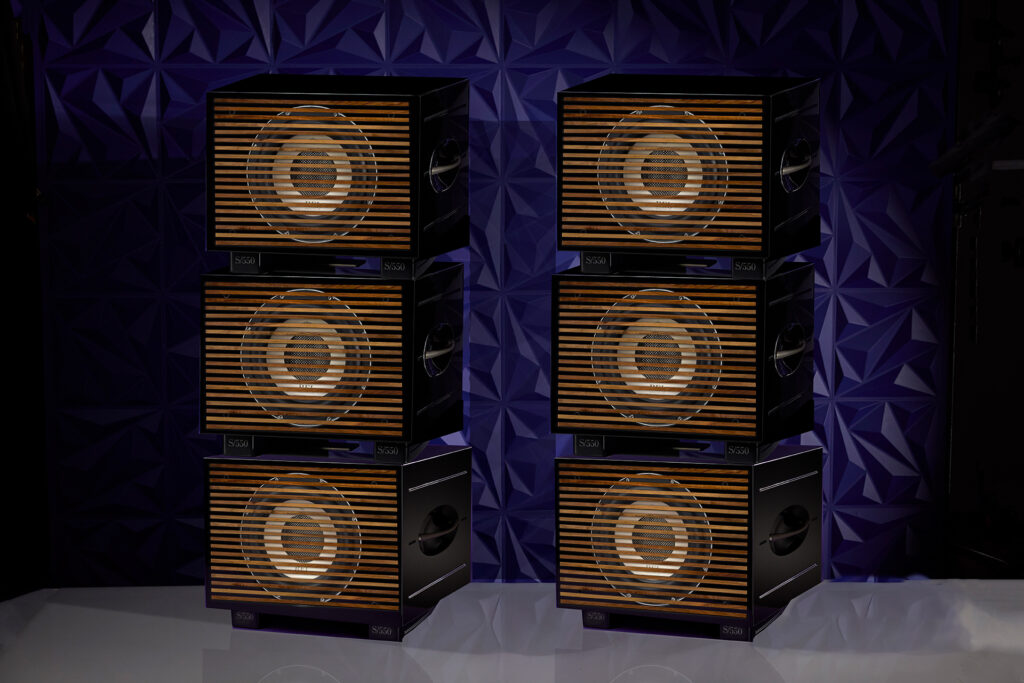
To better understand the function of a six-pack line array of REL S/550 subwoofers, it helps to first clarify what they are not designed to do. According to REL, their intention is not to deliver glass-breaking, chest-pounding, massive levels of 20 Hz, 110 decibel energy in an audio room. Instead, they prioritize efficiency, system-matching, high-level connections, fast transient response and less excursion over brute force. Their intentions with a six-pack line array are actually threefold. One: the bottom subs in a three-stack are intended to provide a foundational level of low bass. A subwoofer coupled to the floor is an excellent location to allow the long wavelengths of low frequencies to spread throughout the room. The middle subs, while decoupled from the floor, are responsible for the attack and dynamic intensity of mid bass frequencies. Think the powerful thwack each time a kick drum’s mallet strikes the membrane of a kick drum. And the top subs provide the higher frequencies and spatial effects one might hear in a concert hall or any live venue. One single sub, or even a stereo pair of subs, will almost never recreate all these effects individually. To hear the venue itself, along with the full measure of what low frequencies can do for an audio signal, REL mandates a line array is necessary.
Specifically, a line array of subs, as with the REL S/550, tends to excite a larger number of room modes on a more linear basis, which will very often reduce peaks and nulls and provide a more consistent bass presentation throughout the room. And, oddly enough, the entire midrange may even become more detailed and present sounds never before heard. I found this to be one of the more impressive attributes of a line array using six REL S/550 subwoofers. A line array of subs may also improve vertical and/or horizontal dispersion of low frequencies – thereby raising the low-frequency presentation higher up in the soundstage. And, perhaps most providentially, a line array of subs will very often make the low bass sound as if it is coming from the entire soundstage, not a box in a corner. These improvements may not be dependably possible with the use of one conventional subwoofer, or even a stereo pair. Let’s look first, however, at the REL S/550 on an individual basis.
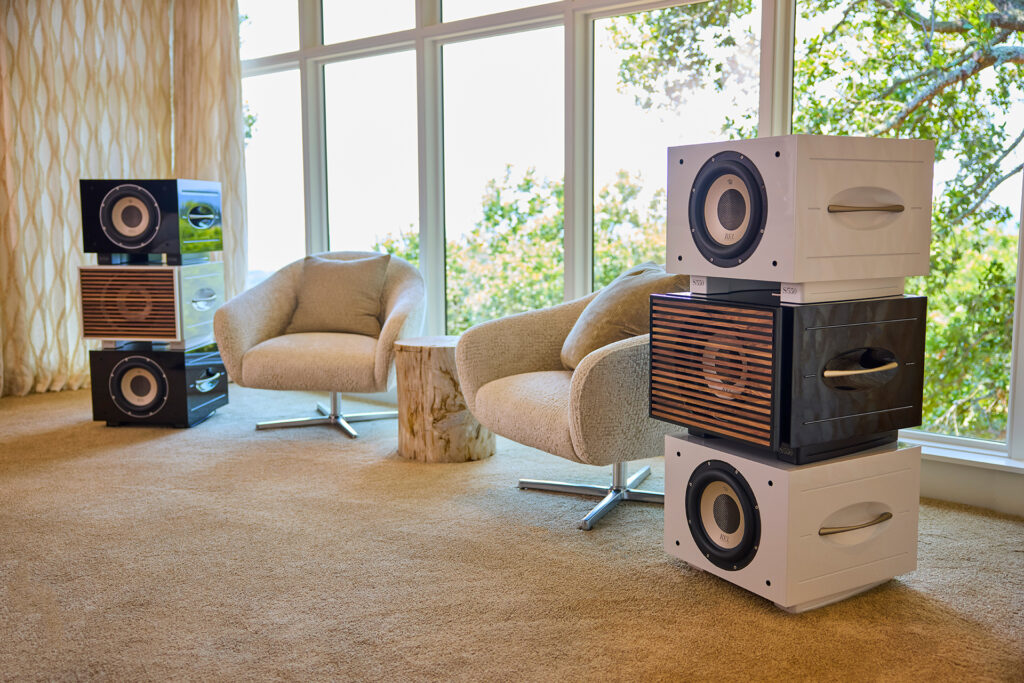
What Is So Special About the REL S/550 Subwoofer?
- The REL S/550 features a front-firing 10-inch CarbonAlloy active driver, coupled to a 550-watt Class-D amplifier. A downward-firing 12-inch passive radiator claims to extend dynamics and adds an overall feeling of low-frequency authority. The 10-inch driver in the REL S/550 has been re-engineered for increased excursion with greater headroom, making it a controlled, high-amplitude, long-throw design. REL claims this is the fastest and lightest driver they have ever used in this class of subwoofer.
- The amplifier delivers 550 watts RMS continuously, with REL reporting 600 watts in their tests. The CarbonAlloy active driver enables a higher output without requiring a larger, more powerful amplifier, due to its lighter and faster design.
- Just as in their reference series, REL uses the same polypropylene capacitors, with the intent of delivering a more open and natural-sounding low-bass presentation.
- Three types of subwoofer connections are available. First is a high-level input, which allows the REL S/550 to be connected directly to the speaker terminals of an amplifier. This is my preferred connection method. A high-level output is used when connecting one REL S/550 to another – as is the case in a line array application. A 32-foot speaker cable with a Neutrik SpeakOn connector on the subwoofer end is included. An upgraded cable REL called Baseline Blue is available as a separate purchase. This is the cable I have always used with my REL subwoofers. The second connection method is a left-and-right-channel RCA low-level input. An RCA low-level output is provided to daisy-chain one REL S/550 to another. These connection methods are used when the REL S/550 is connected to a preamplifier or an integrated amplifier. Lastly is a .1/LFE connection in both RCA and XLR terminations, which is used primarily in home theater applications. REL very conveniently tied the .1/LFE and high-level connections together. This means the S/550 may be used in dual systems operating as two-channel and also home theater – one sub for two applications.
- There is a single adjustment knob for both high- and low-level volume settings. A separate volume control for the .1/LFE connection is also included. A third control knob provides adjustment for the crossover frequency. A phase switch offering the choice between zero degrees and 180 degrees is also included. A standby switch, and a power on/off switch, complete the rear-mounted controls.
- When the standby setting is activated, and after 30 minutes of no audio signal, the subwoofer will switch to a low-power mode, thus saving electricity. Normal operation is resumed when an audio signal is detected. An “always on” option is also provided, ensuring the REL S/550 is continuously warmed up and ready for use.
- A protection circuit will prevent the REL S/550 from being over-driven, which keeps the amplifier out of clipping. A feature REL calls Safe-Net detects when the amplifier section might overload and reduces the power level to prevent clipping from taking place.
- A cloth grille affixed to a surprisingly heavy wooden frame is included. An optional premium wood grille is available as a special order at an additional cost.
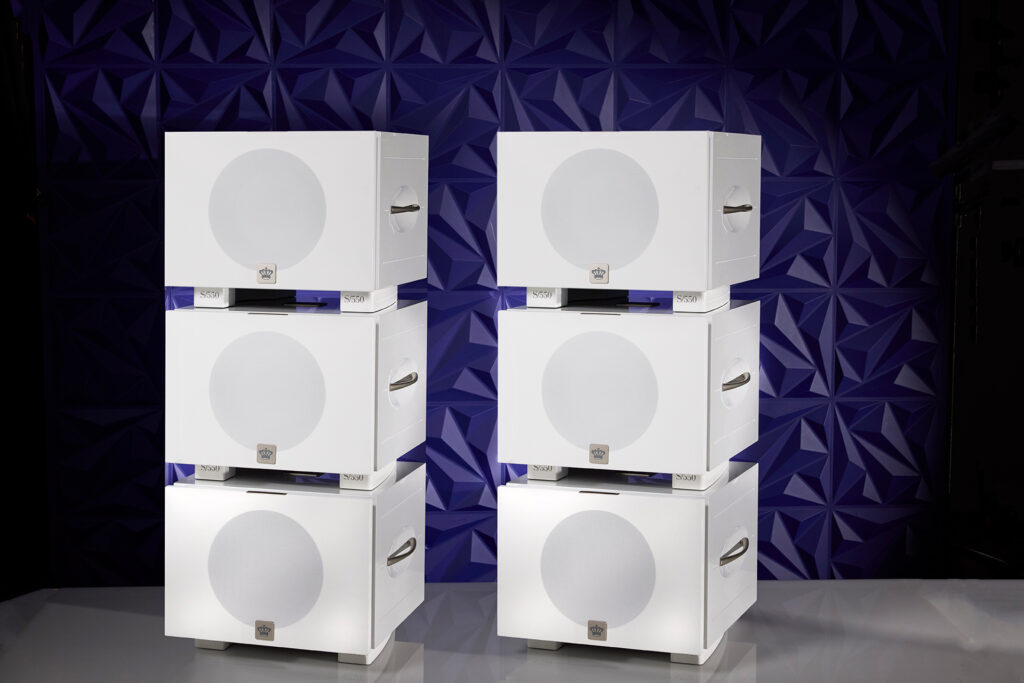
- Piano gloss black and white are the available colors, and there are two convenient handles, enabling this 68-pound subwoofer to be moved very easily.
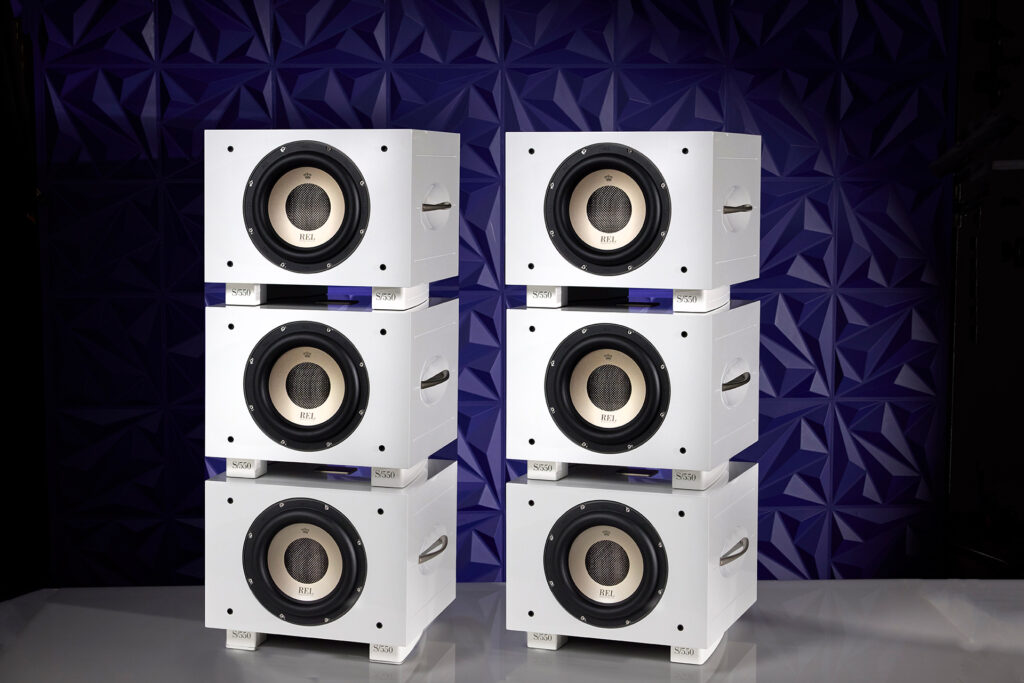
Setting Up a Six-Pack of REL S/550 Sub-Bass Transducers
REL does not believe in the use of a power conditioner. They feel power conditioners may possibly filter or limit the current between the wall and the subwoofer. If so, dynamics, and/or the sense of immediacy, may be negatively affected. This ruled out my AudioQuest Niagara 7000 (read review here). I instead used the standard wall outlets in the room. Because I needed six total outlets, I used two Wireworld Matrix 2 Shielded Power Cord Extenders plugged into the standard wall outlets. I also replaced the stock power cords with six Wireworld Aurora 10 Power-Conditioning Cords.
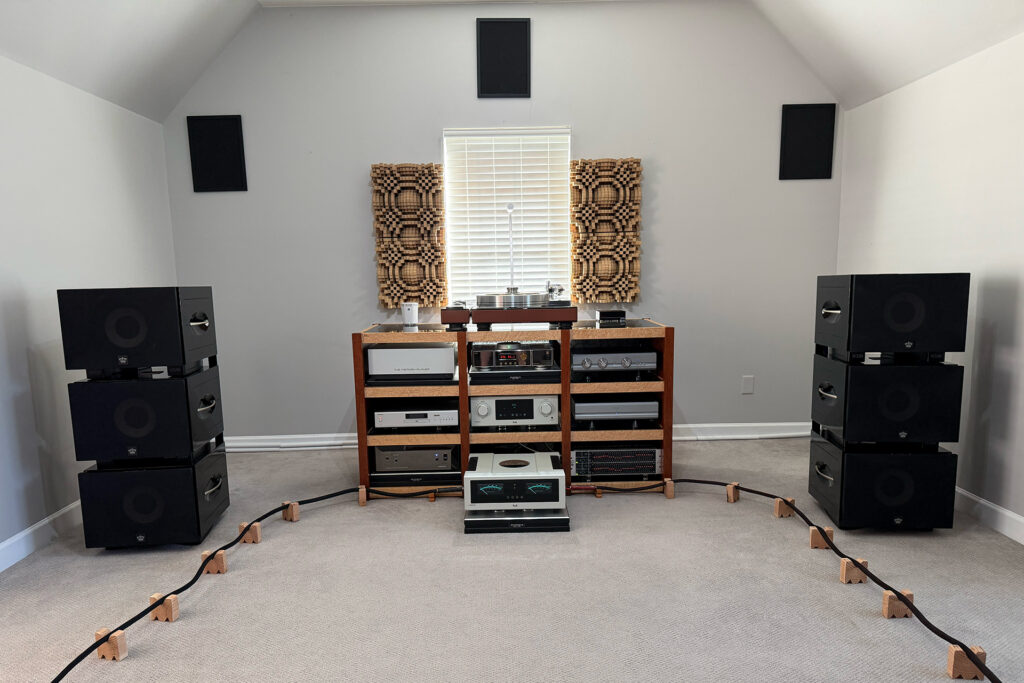
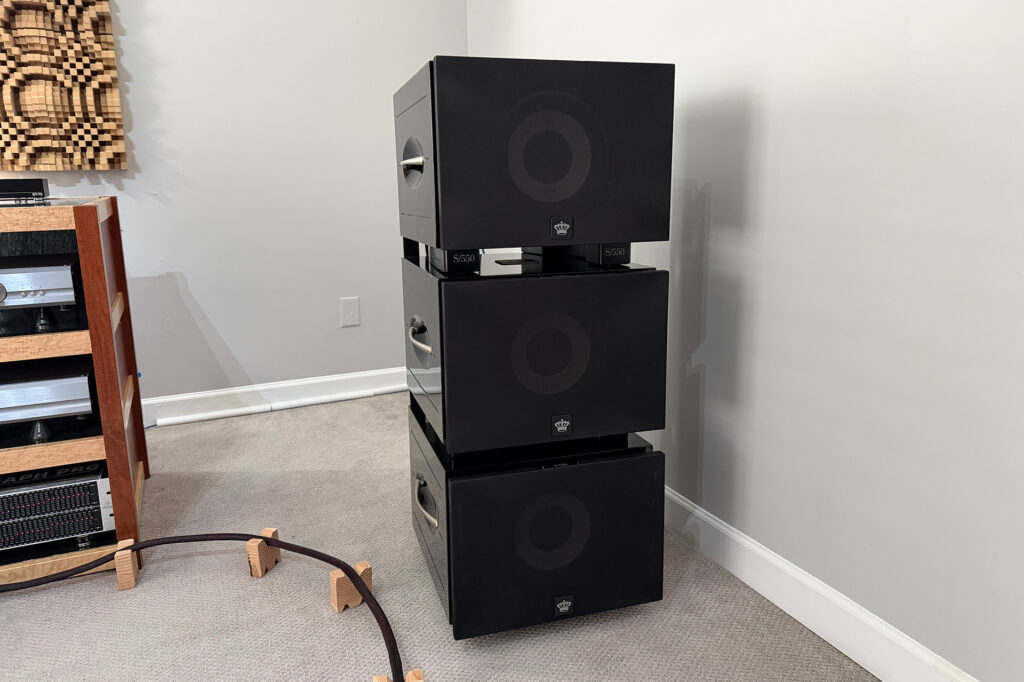
As expected, set-up was performed on one subwoofer at a time. First the left channel was calibrated for optimal placement to ensure total and seamless integration with the main speakers. Once completed, the bottom sub on the right channel was similarly positioned. The middle left, then middle right sub, came next. Finally, the top left and right subs were appropriately placed. All six subs were positioned to completely combine with the mains and calibrated for gain, crossover and phase individually – with power applied to that device only. After connecting the signal jumpers from the bottom sub to the middle, and then to the top, the gain and crossover on all three subwoofers for both channels were adjusted. The three subs were then attached together with supplied brackets so they would not move or be knocked off. After more listening, and some minor and final positioning and setting changes, the set-up was deemed complete and the process was ended.
REL S/550 Subwoofer Specifications
| Active driver | 10-inch long-throw CarbonAlloy |
| Passive radiator | 12-inch Carbon/Carbon |
| Amplifier | 550 watts RMS, Class D |
| Low-frequency extension | -6 dB at 19 Hz |
| Inputs | Neutrik Speakon high level, two RCA, LFE RCA, LFE XLR |
| Dimensions (W x H x D) | 14.75 x 17.5 x 19.75 inches |
| Weight | 68 pounds |
| Price | $2,749 each at review |
Why Should You Care About the REL S/550 Sub Bass System?
REL prefers the name “sub bass system,” and not exclusively the subwoofer classification. I find this an interesting distinction, because it means the REL S/550 is designed to expand on the entire body of low frequencies being presented by the recording and the room itself, while seamlessly partnering with the midrange and upper frequencies. REL redesigned the S Class of products to offer much faster transients, and better overall bass, or low-frequency implementation, thereby enhancing the musical performance. This increased speed explains why the driver had to be redesigned. Because of the S/550’s ability to connect directly to the terminals used by the main speakers, both transducers see the same basic signal. All these improvements lead to a more natural and increased cohesiveness across the entire frequency spectrum in the overall presentation.
Some Things You Might Not Like About the REL S/550 Subwoofer
- There is no physical remote control and there is also no remote app available for download.For anyone using a single or stereo pair of subs, this might be a concern. However, in a line array, a remote would not really work anyway.
- The volume and crossover settings are not numerically identified. They are typically calibrated by listening. Setting the REL S/550 to a predetermined volume and crossover is therefore not possible.
- If the choice is to connect the S/550 directly to an amplifier, specifically the high-level connection, the only outlet on the subwoofer has a Neutrik SpeakOn termination. There are no provisions for a standard speaker terminal or any other termination on the high-level connection. This effectively rules out a user choice of cable – unless the cable manufacturer will re-terminate the connection. (Note: REL uses a Neutrik SpeakOn connection for the high-level terminal, because it provides high-current potential, prevents shorts from accidentally happening during connection, and the twist lock means the cable will not slip out.)
Listening With the REL S/550 Sub Bass System
As soon as my system was powered back up and we started playing music, never mind break-in, I could immediately hear the difference a line array of subwoofers made. There was a certain sense of scale and a level of completeness my system had not previously displayed. Over the next couple of weeks, I began to hear what a line array could really do. On many tracks, I heard this very low-frequency wave moving along the floor. This is the foundational bass REL talks about the bottom subs providing. I could clearly hear, for instance, the stick impact followed by the full bloom of the tom-tom’s resonance on a drum kit. Bass guitars, and the transient quick pop, pop, pop of the strings, were readily portrayed. All these sounds had a certain dynamic impact which, according to REL, the middle subs provide. The top subs are responsible for recreating the higher bass frequencies and the sound of the venue. While this was more noticeable on live recordings as opposed to studio work, I was able to hear how the venue provided its own substance to the entire presentation.
Perhaps most surprising was the IMAGING on low frequencies (yes, you read that right). This transcended what one sub stuck in a corner could ever accomplish. I actually heard an image presentation on the low-frequency instruments. This went beyond being able to mostly differentiate between the drum and bass guitar, which could be heard somewhere in the room. On certain tracks, it was profoundly simple to determine the precise location of the bass player compared to the drummer – and still easily identify the individual notes of the bass, and the snap of the stick hitting the drum kit. Combine this with the amazing, world-class imaging, clarity, accuracy and incredible dynamics of the mids and highs of the Teknik Audio Grand Notes, designed by Mark Porzilli (read review here), and I can attest that the entire musical presentation was something to behold. I went from a total of four transducers to eight, and all of them completely disappeared in the room. I did not even have to close my eyes to hear a wall of sound. It is just there. I have never heard my system sound better. The line array of six REL S/550 subs has transformed my listening room from something very nice to completely amazing.
In the track “Circles” by Post Malone, at the 20-second mark, both the bass guitar and the drums jointly come in with a steady tempo and a pulsing beat. The imaging was surprisingly delineated, allowing both low-frequency instruments to be easily distinguished. In fact, the lows throughout the track were balanced, tight and precise. They also blended with near perfection to the guitar, and Malone’s vocals were made better by the use of a slight amount of reverb. Overall, this track had excellent bass, while not calling too much attention to the 250 Hz and below presentation. All in all, this track was a standout on the REL S/550 line array.
Stevie Nicks positively shimmers on the track “Edge of Seventeen” from the Timespace: The Best of Stevie Nicks release (Qobuz). The track begins with a repeating guitar riff, played in a rapid-fire, almost pulsating manner. This guitar riff continues throughout almost the entire song. Concurrent with the guitar is a rock-steady bass line that is a perfect balance to the pulsing guitar. On my system, the imaging of both bass and guitar were separated enough to be able to identify both instruments independently. Through the REL S/550 line array, the low bass moved throughout the area of image development while the guitar, keyboards, and Nicks’ almost ethereal vocals flowed right along. I have heard this track many times on my system, but this time, it was significantly improved.
Will the REL S/550 Audiophile Subwoofer Hold Its Value?
My REL G1 Mark II subs are currently eight years old. They have, in fact, been discontinued by REL and replaced with a newer, more refined version. And while my stereo pair are not on the level of a line array, they still sound very, very good. REL does not replace their products on a yearly basis, as other brands with mainstream AV distribution do. REL subs are designed to last for years, as well as to retain their value. REL subs also enjoy a thriving resale life on the used market. So, yes, it is perfectly reasonable to expect the REL S/550 to hold its value, even though subwoofers are logistically tough to sell because of shipping costs, weight, box storage and beyond. With that said, resale value isn’t any kind of major concern here.
What is the Competition for the REL S/550 Sub Bass System?
Not surprisingly, stacking three subwoofers per side is not something the industry has comprehensively embraced. Historically, the more notable subwoofer brands have not readily supported a line array configuration. There are brands with designs that feature multiple drivers in one cabinet, thereby somewhat replicating a line array. Because of the success REL has enjoyed in their years of promoting a line array configuration, more companies are beginning to offer their own designs. Given the sonic capability, this is not a surprise.
Having recently released a subwoofer to complement their new speaker line, the PS Audio Foundry F12 subwoofer, priced at $2,749 each, or $16,494 for six, has the capability to be stacked three high in a line array configuration. The F12 features a 12-inch long-throw driver, a 1000-watt amplifier, DSP room correction and room EQ – something not many brands offer. The PS Audio Foundry F12 has high-level inputs in the form of standard speaker terminals and XLR connections. There is a downloadable control app, which provides control over all subwoofer functions. However, it is unclear if this app will work with a line array or if the various controls must be individually managed. A stacking kit is $99 extra and audio signal cables are user-furnished.
While not necessarily a line array in the same sense as the REL S/550 is, the JL Audio v2 Fathom powered subwoofer has two 12-inch drivers stacked one on top of the other. The v2 in the two-driver configuration claims to provide up to 3,600 watts of power. An impressive range of front-mounted controls provide adjustment of settings such as digital room optimization, volume, a 12 dB and 24 dB internal filter, a low-frequency trim filter, variable phase adjustment and polarity. The two-driver version is only available with a 12-inch driver. At a cost of $10,000 per unit, a stereo pair is right in line with the total cost of six REL S/550s.
It seems only fair to mention the REL Serie S 212 Black Label (read Greg Handy’s review) which retails for $5,999 each or $11,998 per pair. While not as costly for a stereo pair as six REL S/550s, the 212 Black Label design features two 12-inch drivers and a 1,000-watt amplifier. While it does have two drivers, they are not independently controlled in the same manner as the S/550 under review. REL clearly states the Serie S 212 has “extraordinary scale and dynamics approaching line array performance.” However, it is also classified as a home theater product. This makes perfect sense since, for the most part, all REL subwoofers will work in both a two-channel stereo system and a home theater application.
Final Thoughts on the REL S/550 Line Array Subwoofer System
Generally speaking, subwoofers have any number of design challenges, which must be taken into consideration. And of course, subwoofer design varies between different brands. Manufacturers go to great lengths to ensure their designs are capable of creating a quality low midrange, and as realistic a low-frequency presentation as possible. The actual method, and effectiveness, by which this accomplishment is achieved varies between manufacturers, but it is a goal all subwoofer designs strive to attain. Set-up is typically quite involved. For instance, actually positioning one subwoofer to seamlessly integrate with the mains is an involved process. Doing so with six is decidedly more intricate.
With the REL S/550 in a six-pack line array configuration, the sonics in my audio room became breathtaking. The redesigned CarbonAlloy driver in the REL S/550 sounded magnificent. REL clearly did their homework. The lower midrange and the low bass combined with the main speakers so completely that it yielded an amazingly natural presentation. The entire scale of the lower-frequency bands were well-defined and offered weight and substance. Never was the bass overwhelming or bloated. It was always tight and controlled, yet still powerful and articulate. There was almost no discernable, and highly irritating, unwanted level of distortion or congestion. Instruments like a snare drum had a well-defined snap, and the resonance of the stick striking the drumhead skin was instantly recognizable – depending, of course, on the recording. Perhaps most surprisingly, the level of previously unheard detail and musical scope was profound. Equally impressive was the manner in which the midrange was spread across the audio room. On many tracks, the image presentation expanded laterally as the song progressed. Upper midrange sounds, clearly above the frequency cut-off for the subs, and obviously coming from the speakers, seamlessly interacted with low-frequency sounds from the subs. It blended so effortlessly that it really did not lend itself to sounding like a recording – it had a profoundly natural quality I enjoyed. Generally speaking, the music overall had a sense of immediacy and a presence I found very appealing. All these attributes of a line array of REL S/550s made the music in my audio room come alive in a way I had never before experienced.
I fully realize having six subwoofers in a system is a difficult and potentially expensive proposition. However, for anyone with an upper-end, high-performance audiophile system, a line array is something which could quite possibly make a significant, even transformational, sonic improvement. A line array may even completely redefine the listening experience. For those who might be interested, contact your local REL dealer to see about a demo. This amazing sonic presentation is something to be experienced.




Nice write-up Paul!
Some thoughts with no reservations saying I bet these are an incredible listen:
This is where bass gets wonky for me though. 6 ten inch woofers only have the same effective radiating area as two 15″ woofers. That is what limits your output at sub-bass frequencies, not how many woofers your have. Further, in the footprint of these subs, you can fit a cabinet with dual 15″ or and 18″ woofer. Bass fidelity is not because “small drivers are faster” but mostly exists in the time domain – so a well designed system with larger woofers would yield both deeper sub-bass and higher outputs (with less required power due to significant efficiency gains) more effortlessly…All in a sealed enclosure with far better step response than any passive radiator design could have die to the inherent trade offs of passive radiators.
You certainly get “a lot” for $20k here. I am sure, too, it’s performance is spot-on. I know you and trust your listening expirence 100%! Sometimes I just wonder if practical engineering instead of visual statements could yield better overall value when it comes to the top-tier.
Michael,
Part of the reason REL suggested these subs was because of my towers. The Grand Notes have ribbon tweeter speeds (or more) at all frequencies and are incredibly fast. John Hunter knows Mark Porzilli and is very familiar with his line array designs. This sub was the best fit for a sub which would work well with my towers. And my towers are time aligned so having a sub mated to the towers was of paramount importance. Given what the REL area sales manager went through to set them up, and when I hear the result, I have both mains and subs which are correct in the time domain. And I also hear how the three stack addresses certain auditory goals — like the bottom sub moving the very low bass across the floor like a wave, the middle one addressing the middle low frequencies and the top one the higher bass. This really cannot be done with a sub with one cabinet and multiple drivers. What you wrote in your comment is absolutely true. In fact, Mark told me he once built a pair of prototype subs with multiple 18″ woofers in a seven foot tall cabinet. There was no amplification and the subs went down to 15Hz naturally. But his one problem was how many people would have the room for them. In this case, part of the justification was a sub that had the speed to accurately combine with my towers, offer flexible controls and not have too large of a footprint. And give the incredible performance of the entire system, I have no doubt this was the correct choice.
“Bass moving across the floor like a wave…” Acoustic power at lower frequencies doesn’t work that way. It’s physics. The passive radiator on the bottom is just a replacement for a port. It does not add anything to the sound a port wouldn’t. As and engineer/loudspeaker designer for many years hearing these things is frustrating because it’s a spin on what’s really happening. Which is actually good engineering and smart! (No surprise, it’s REL).
Clearly they work well for you, your goals, and your room and that matters more than anything. I never doubted for one second it’s less than amazing, and hope I am lucky enough to hear them somewhere, someday.
Michael, while I do understand your logic on the bigger is better theory been there tried that and while the results where impressive in the short term the long term listen ability just didn’t cut it. I can and do regularly have listening sessions of 8hrs + and have no compulsion to climb the walls after. Your later post comment of I hope to one day hear a REL 6 stack setup will I am confident make the argument for alternatives moot, it really is just that much better no matter the base system. I have been an avid music fan seriously for 50 years + and had many very expensive systems but none more of a pleasure to listen to than the current setup. I have a number of vastly more experienced Audiophile friends who have heard my system and been staggered by the performance. One in particular travels the world setting up his cutting edge turntables in multi million dollar systems had nothing but good to say about what he heard.
Use of six subwoofers in a room will almost certainly sound better if you spread them around the room in an asymmetric fashion like Earl Geddes and Harman Karman have advocated for a number of years.
Placing them all in one column may help with woofer output (if this is really an issue) but does little to tame the room modes.
The writer should listen to these again, but scattered about the room (one in a corner, one 1/4 way down the left side wall, one 1/2 way down the other sidewall, etc.). If they sound good stacked, they will sound spectacular spread around the room floor.
Do the middle and top bass units disable the bottom-facing sub-speakers? It seems that if not, these might induce unwanted feedback or vibration in the units below each
Hi Eric,
I would wager so long as the subs are crossed over at 70hz or lower they will acoustically “look” like a single speaker. At 70Hz lambda is about 16 feet, so at long as all the subs exist in a 16 foot sphere, they will act as a point source (essential – there are other consideration such as minor level differences between them and IM distortion from multiple drivers, etc, but those factors are minor and with the quality of the Rels – mitigated) Bass is an odd thing, and the way Paul has them set up it is far more about matching to the room and how the room gets stimulated. That is the 80% of what’s important here. Hope this helps!
Any thoughts on how a McIntosh room correction unit would play into this? Or, do you think it would just do what it’s intended and see this array as a ‘single base’ configuration?
REL HATES room correction.
They like to set up subs the old school way and from a feed from the speaker output of the amp.
ANY CONSUMER can call them and they will walk you through the process at no cost.
A very well described and accurate description of what a REL S550 six stack can bring to your listening pleasure with a suitably scaled main system. I have been a convert for a number of years now and without exception I am constantly blown away by the natural life like scale of the presentation with the RELS. I have just recently upgraded my main speakers from Amphion Krypton 2 to the latest 3X version still with the 6 stack but mine are on raised custom 150kg spiked stands that elevated the clarity to another level.
Along with the main speakers upgrade a new Aqua Formula XHD V2 dac and LIN-Q Streamer topped of with a LA DIVA CD spinner, without exception every listening session gives you chills up the spine. I could confidently say unless you have experienced a 6 stack on a well setup system you have not heard what is actually possible from a sound system of this scale it is an experience not soon forgotten guaranteed.