
 By
By The QUAD 303 amplifier, the subject of this review, was developed as the companion to the recently introduced QUAD 33 preamplifier (read the review), with both intended to be modern versions of the British manufacturer’s iconic original QUAD 33 and 303 units introduced in the late 1960s. The new QUAD 303 amplifier is also a compact industrial design Class-AB amplifier, aesthetically similar to the original but with modern technologies throughout. Practically every compact amplifier in today’s market is a Class-D design. So, the QUAD 303 amplifier differentiates itself by being a Class-AB design. The QUAD 303 amplifier is capable of delivering 50 watts per channel into eight ohms, with power rising to 70 watts per channel into four ohms.
What Makes the QUAD 303 Amplifier So Special?
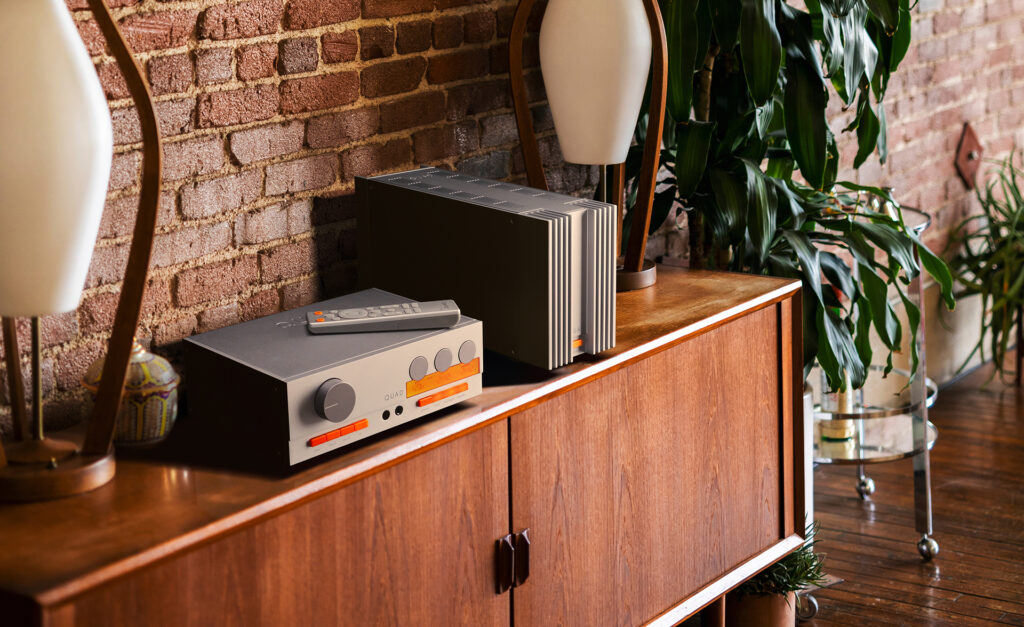
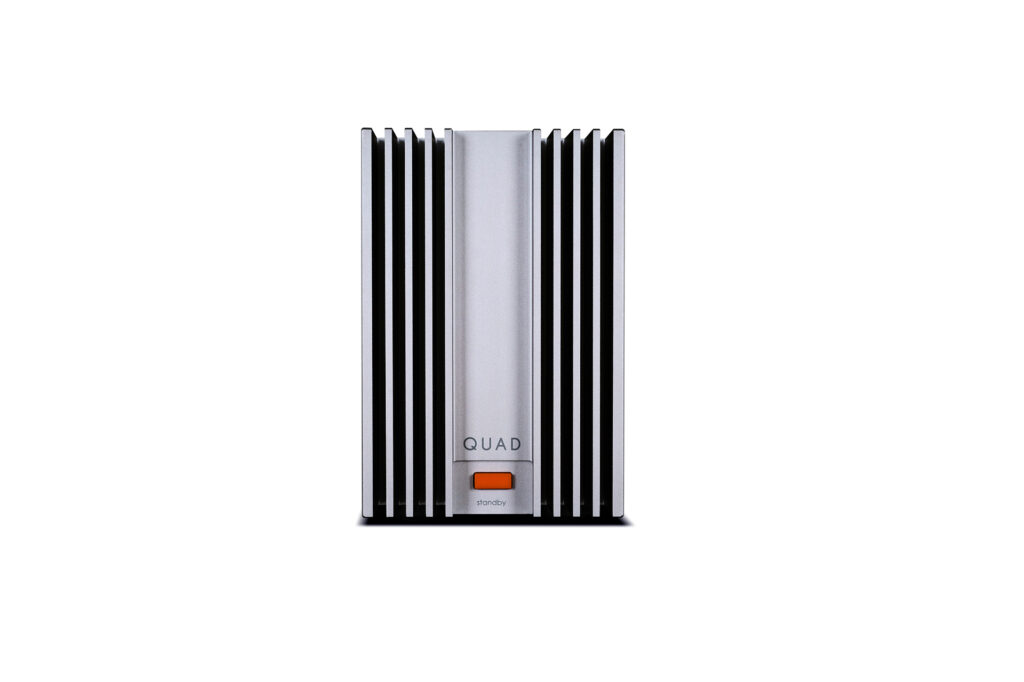
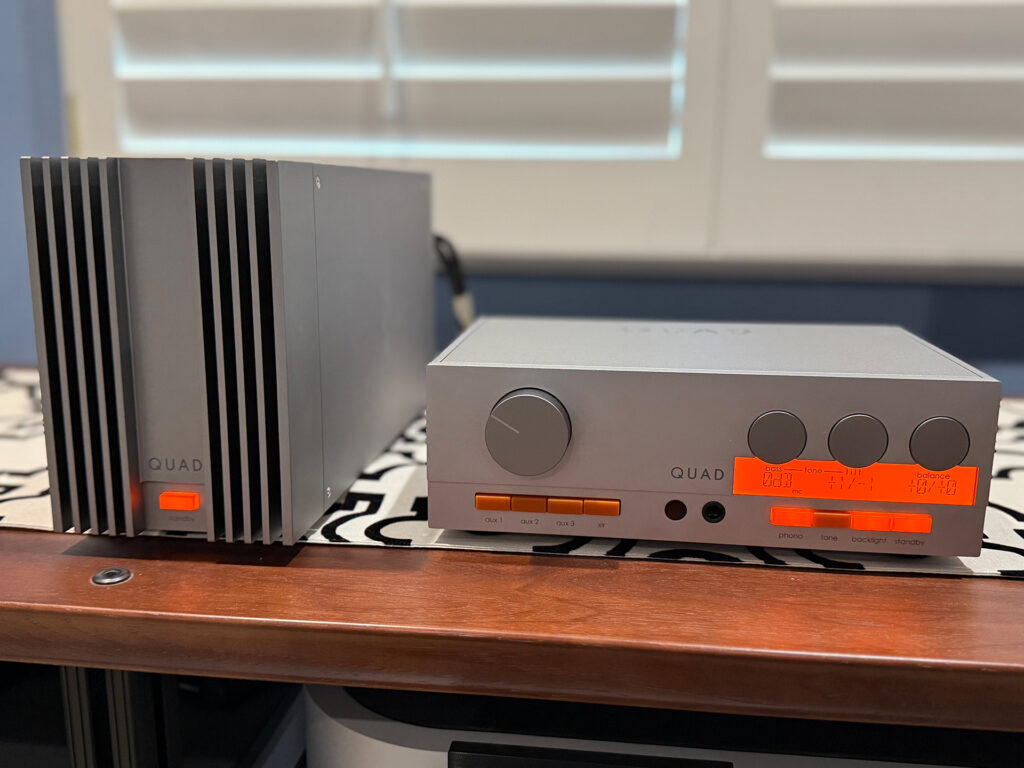
- The QUAD 303 amplifier provides a nod to the original, maintaining a similar compact size and shape, but completely updated throughout with contemporary technologies. The minimalist industrial design looks and feels solidly built, too, tipping the scales at nearly 19 pounds. It has a vertical form factor with the front panel sporting large CNC-machined heat sinks on each side and a single orange button with an LED that lights up when pressed to bring the unit out of standby mode. The amplifier has an energy-saving feature that automatically places the amp in standby mode after 30 minutes of inactivity. Or, if you prefer, the feature can be disabled.
- The QUAD 303 amplifier’s Class-AB design is powered by a custom low-noise 200-volt-ampere toroidal transformer, designed specifically for the new amplifier. And, while a Class-AB design, the QUAD 303 amplifier runs cool to the touch, even after hours of continuous use. So, if you’re a minimalist at heart, rest assured the QUAD 303 amplifier can be neatly tucked away in a cabinet without the usual concerns about heat buildup.
- The QUAD 303 amplifier employs a modern-day version of a unique output stage originally referred to as “symmetrical triples.” Designed by founder Peter Walker, it was QUAD’s solution to the significant problems of thermal instability that plagued a lot of early transistor amplifiers of the 1960s. It ensured a symmetrical output stage, crucial for reducing distortion. The original 303 amplifier produced impressively low distortion for its time, which led QUAD to market the original 303 amplifier as “the world’s first low-distortion transistor output.” According to QUAD, the reimagined modern-day version of the 303 amplifier retains and enhances this core “symmetrical triples” output circuit, what is essentially a “feedback amplifier within an amplifier.” Updating it with modern components for improved linearity and stability results in extremely low distortion, while staying true to the original design’s philosophy.
- With the flip of a switch on the rear panel, the QUAD 303 amplifier can be operated as a standard stereo amp, delivering 50 watts per channel into eight ohms, increasing to 70 watts per channel into four ohms, with a maximum current delivery of 10 amperes into difficult loads. Adding a second QUAD 303 amplifier and bridging the two amps to mono by changing the position of that same rear switch increases each amp’s power output to 140 watts per channel into eight ohms or 170 watts per channel into a four-ohm load. The original QUAD 303 amplifier had a reputation for having issues with lower-impedance loads. QUAD claims that even a single new 303 amplifier, operated in stereo mode, can drive most speakers without difficulty, including their own electrostatic speakers. I certainly had no issues driving my four-ohm-impedance Aerial Acoustics 7T floorstanding speakers to more than adequate volumes.
- The rear panel offers the option to connect to a preamplifier with either balanced XLR or single-ended RCA interconnects. In addition, there are 12-volt trigger input and output connections for synchronized power/standby control from compatible gear, such as the QUAD 33 preamplifier or a second QUAD 303 amplifier set up in bridged mode.
- Played in tandem with the QUAD 33 preamplifier, the resulting sound is a bit laid back with a touch of warmth, almost reminding me of a tube amp. However, that’s not to say there is a corresponding lack of detail, which I have found sometimes accompanies tube gear. While not overly analytical, I still heard plenty of musical detail. The slightly laid-back sound was welcome too, drawing listening sessions out longer than planned, due to its compelling sound delivered without a hint of listener fatigue.
Why Should You Care About the QUAD 303 Amplifier?
The QUAD 303 amplifier sets itself apart, filling a niche practically all by itself. Every other brand name compact-size amplifier I’m aware of tends to be some version of a Class-D design. Yes, there are some very inexpensive CHI-FI compact Class-AB amplifiers available through Amazon (the Fosi Audio HD-A1 is one example), but none of those amps I’m familiar with has anywhere near the same level of sophistication in terms of design components, circuitry design, features or performance as the QUAD 303 amplifier. I know there are still many audiophiles out there that, given a choice, prefer the sound of a Class-AB design over a Class-D design. For those who not only prefer Class-AB sound but also want or need a compact system due to space constraints, aesthetics or maybe just keeping the peace with a significant other, the QUAD 303 amplifier and its companion QUAD 33 preamplifier open up that possibility. The QUAD 303 amplifier and QUAD 33 preamplifier would be a great option in a small-to-medium-size room, or even as the centerpiece of a higher-end home office system. While I suspect most audiophiles opting for the QUAD amplifier will be mating it with stand-mount speakers, it’s certainly capable of driving most floor-standers as well, either as a single stereo amplifier or as two mono amplifiers in bridged mode.
Some Things You Might Not Like About the QUAD 303 Amplifier
- There’s not much to dislike about the QUAD 303 amplifier. It has both balanced and single-ended connections, can be operated as a single stereo amp or bridged to a second QUAD 303 amp for extra power, and can be synced to a QUAD 33 preamplifier via its 12-volt connection for ease of operation. In my opinion, the amplifier meets its intended purpose of being a very musical, compact Class-AB amplifier. It really comes down to sound preferences. For those looking for an analytical amplifier that is the last word in reproducing minute musical details at the expense of warmth, the QUAD 303 amplifier is probably not the right choice. However, for those who prefer Class-AB sound and want a compact system that sonically falls on the warm side of neutral to meet their listening pleasure in a small-to-medium-sized room, the QUAD 303 amplifier and its companion QUAD 33 preamplifier would be fine choices.

Listening to the QUAD 303 Amplifier …
I partnered the QUAD 303 amplifier with the QUAD 33 preamplifier as I expect most buyers of the amplifier will likewise be pairing them together. I was already quite familiar with the QUAD 33 preamplifier on its own as a part of my reference system, including my Classé amplifier. Following that extended evaluation period, I had a good grasp of the QUAD preamp. So, I replaced the Classé amp with the QUAD 303 amplifier in my system and got down to some serious listening sessions. Throughout the evaluation, the QUAD 303 amplifier was driving a pair of Aerial Acoustics 7T loudspeakers.
The QUAD 303 amplifier consistently delivered both musical emotion and dynamics accurately, without overly harsh highs or muddy bass. Initially, I listened to several stripped-back recordings by singer/songwriters with just a vocal and minimal instrumentation. On British singer/songwriter Etham’s (Etham Basden) track “I Won’t” from his Patterns EP (Nettwerk Music Group), all of the nuances in his vocals were reproduced with such realism that I felt like I was listening to a live performance instead of a recording. His falsetto was clear and bright, but never sounded harsh or sibilant. The layers of graininess and subtle rasp within his vocals were clearly evident throughout his performance. I could sense the real pain in his voice as he sang about his pledge to a close friend with addiction issues. The dynamics of the piano on this emotional ballad were rich and complex, as they should be, with the resonance and drawn-out decay of notes helping to create a believable sense of space within the recording environment. For me, the amplifier proved its mettle with plenty of volume and headroom to spare as it helped bring out all of the emotional details and musical nuances of the performance in a truly authentic way.
Switching from stripped-back ballads to more upbeat rock music, I listened to several tracks from the ‘70s and ‘80s to further explore the QUAD 303 amplifier’s ability to handle all the changes in dynamics of a proper rock and roll song before engineers started to apply compression for radio playback. One track I’ve used a lot the last couple of years to evaluate audiophile gear is “Crazy on You” from Heart’s iconic album Dreamboat Annie. This track has a little of everything, making it perfect for assessing a variety of aspects. It starts with Nancy Wilson’s intricate acoustic guitar riff intro, which is eventually joined about the 00:37 second mark by sister Ann Wilson adding her acoustic guitar to the mix. The electric guitars, bass, synthesizer and drums all join the sisters a few seconds later, instantly transitioning the song to true rock and roll. The QUAD 303 amplifier astutely handled the more subtle bits like the opening guitar riff, while also demonstrating its speed and ample headroom by accurately reproducing all of the big dynamic changes in the track with the proper slam and bass impact they required. The timbre and details of the vocals were reproduced realistically by the amp as well. Even after turning the volume way up, the QUAD 303 amplifier never seemed to be straining to do its job. It felt as though the amp still had plenty left in the tank if and when needed, making listening to this upbeat track, as well as several others, a lot of fun.
Will the QUAD 303 Amplifier Hold Its Value?
If the continuing demand for the original QUAD 303 amplifier is any indication, the new version of the QUAD 303 amplifier should certainly fetch a decent return on the resale market. That is, if any actually become available for resale. These compact QUAD components tend to be highly coveted by those who own them. Indeed, the company has actually had trouble keeping up with sales demand from a manufacturing standpoint, with units routinely being back-ordered during the first several months of production.
What is the Competition for the QUAD 303 Amplifier?
As I stated earlier, the QUAD 303 amplifier holds a unique place in the home audio amplifier ecosystem, being one of the very few, if not the only, compact Class- AB-design amplifiers anywhere near its price point currently on the market. So, comparable alternatives are almost exclusively full-size amplifiers.
The Rotel RB-1552 MkII (buy at Crutchfield for $1,699) is a full-size Class-AB stereo amplifier capable of delivering 130 watts per channel into an eight-ohm impedance load. It is a balanced design with both XLR and RCA connections. It also has 12-volt trigger connections for control from a connected preamplifier. The Rotel is full-size, rack-mountable, and has a robust industrial design with heat sinks. The Rotel RB-1552 MkII is the little brother to the Rotel RB-1582 MkII (read the review) Class-B stereo amplifier that our publisher Jerry Del Colliano recently reviewed so favorably. By spending a bit more, power capability steps up to 200 watts per channel into an eight-ohm impedance load.
The highly-regarded Parasound Halo A23+ stereo amplifier ($2,099) is also a Class-AB-design stereo amplifier. The Parasound delivers 180 watts per channel into an eight-ohm impedance load, has both XLR and RCA connections available, and has individual gain controls for each channel.
Stepping up a bit in price, another high-quality, full-size Class-AB stereo amplifier option available is the Eversolo AMP-F10 ($2,480 buy at Amazon). The Eversolo is a Class-AB design with Class-A bias, delivering 200 watts per channel into an eight-ohm impedance load, or 320 watts per channel into a four-ohm impedance load. The Eversolo AMP-F10 can also deliver up to 950 watts in bridged mode. It comes equipped with a 1000-watt dual-channel independent linear power supply for high dynamic audio. It is also a balanced design, with both XLR and RCA connection options available.

Final Thoughts on the QUAD 303 Amplifier …
The dimensions of the QUAD 303 amplifier may not be mighty in size, but that doesn’t prohibit the amplifier from having the power capacity necessary to cleanly reproduce loud, transient sounds without distortion. The QUAD 303 amplifier handled the dynamic peaks in the music I listened to, ensuring a clean, nuanced and powerful sound at higher volumes without any discernible distortion. I found the amplifier to be adept at handling the subtler moments in music with finesse, too, being silent when called for, as well as reproducing the finer details of quieter instruments and vocals. While I think that Class-D amplifiers have come a long way, I know that there are still audiophiles who prefer a Class-AB-sound amplifier to that of a Class-D amplifier. If that’s you, and compact-size components best fit your use, the QUAD 303 amplifier now provides a viable option rather than having to settle for full-size components in order to get Class-AB sound. The QUAD 303 amplifier (and its partner, the QUAD 33 preamplifier) can easily provide musical enjoyment for audiophiles in small-to-medium-size rooms with most loudspeakers, all at a pretty reasonable price to boot.




I’m glad cold are still around.I have a quad 303
I bought this amplifier in December 2025 based on reviews that claimed that the sound signature was on the warm side of neutral, as I am very sensitive in the 2khz to 6khz range. I paired it with a neutral sounding speaker: Tekton Design Dynamites. It sounds fine, but not really warm, but it is non fatiguing. All the details are there in my 14′ x 11′ room.
Overall, I am happy with my purchase.