
 By
By The REL Acoustics Serie S line, in second position to the Reference Line, has undergone a full revamp six years in the making. The Serie S line comprises four models featuring new amplifiers, drivers, and enclosure designs. The Serie S 212 Black Label, with an MSRP of $5,999, the topic of this review, is the only model within the Serie S line that features two active 12-inch drivers facing forward, two passive radiators, and a taller cabinet to house it all.
One of REL Acoustics’ signature concepts is a subwoofer line array six-pack: three stacked subs on each side of a stereo speaker system, for a total of six subwoofers. Clearly, a system like this is not for entry-level or even mid-tier audio enthusiasts, but rather for a serious audiophile with significant financial resources and ample space to house it all. But what if there was a more affordable and compact alternative with performance that approaches 70 percent of a full subwoofer line array? Enter the REL Acoustics Serie S 212 Black Label.
Follow along as I break down and test drive a pair of Serie S 212 Black Labels, set up in my dedicated room by REL Acoustics’ very own John Hunter, and let’s see if the REL Acoustics Serie S 212 Black Label lives up to the claims.
What Makes the REL Acoustics Serie S 212 Black Label Subwoofer So Special?
- The REL Acoustics Serie S 212 Black Label is similar in stature to two stacked subwoofers but made as one unit, with similar characteristics of a full six-pack line array of subwoofers. While each passive and active driver plays an important role, it is the rear-facing passive radiator mounted high in the cabinet that adds actual height to the audio image.
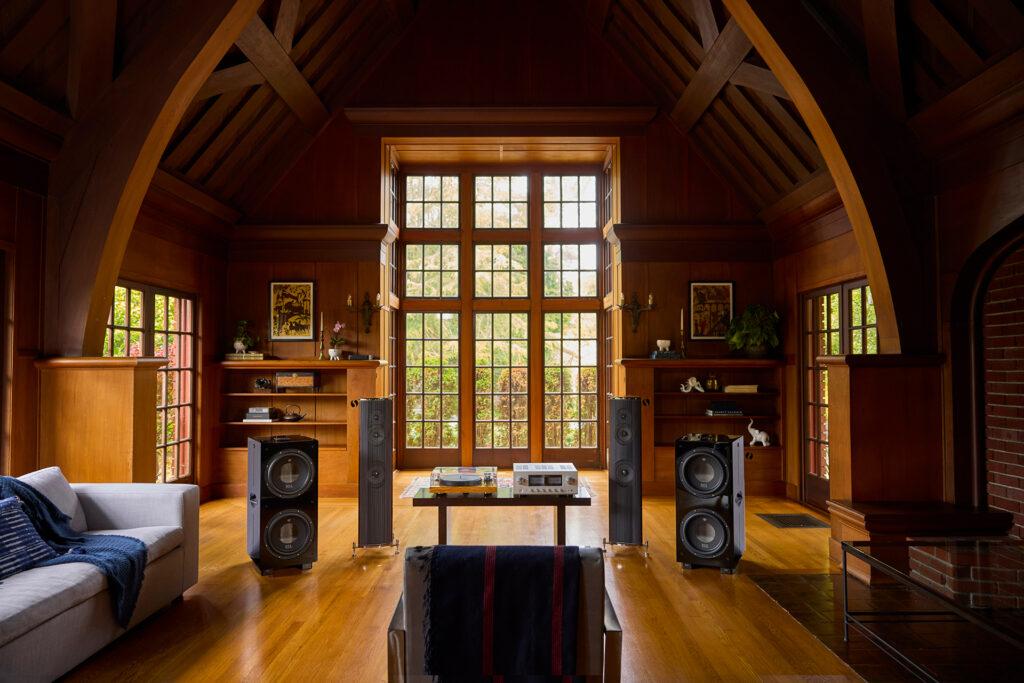
- At first, you may think the subwoofer is quite large, but in practice, the Serie S 212 Black Label integrated well in my smallish 14-foot-by-15-foot listening room. The Serie S 212’s 14.25-inch width falls between that of the REL Acoustics compact Serie T/7x and Serie T/9x subwoofer models. Yes, the Serie S 212 enclosure is deeper and taller but, relatively speaking, its footprint is comparable to that of a mid-sized subwoofer. In practice, the Serie S 212’s 33 inches of height became perceptibly normal in a short time, blending seamlessly into the room.
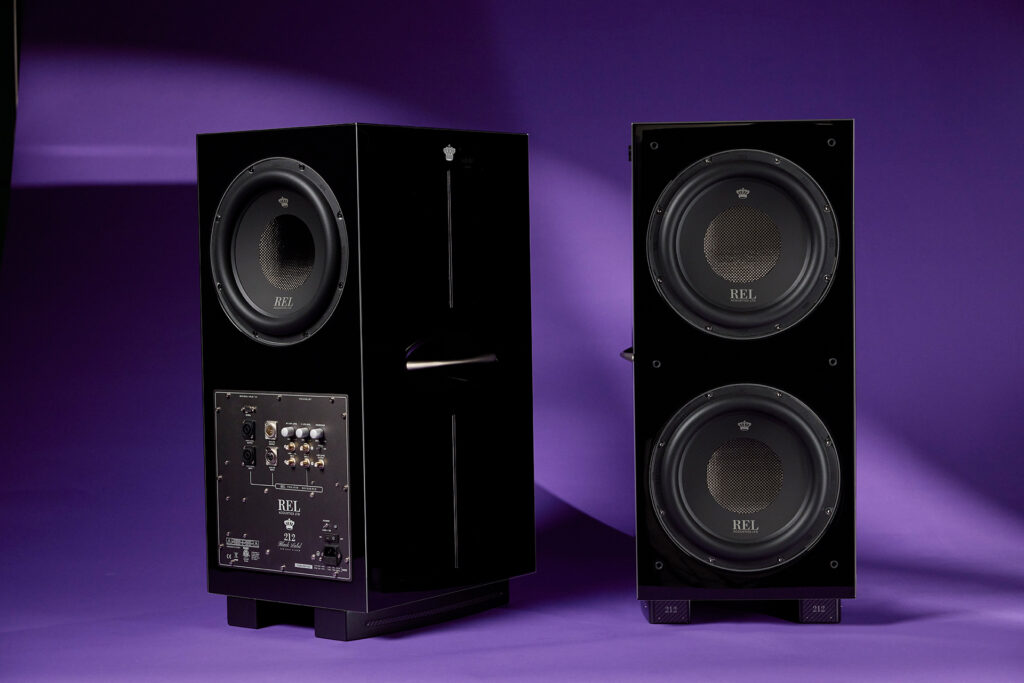
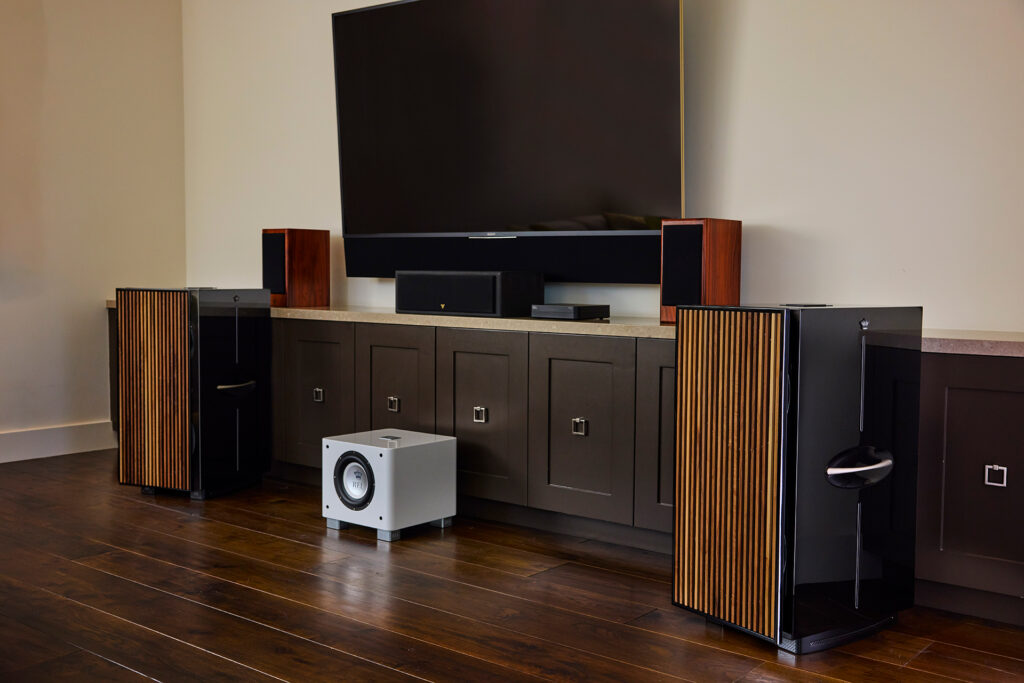
- The REL Acoustics Serie S 212 Black Label is stunning to look at, with an impressive finish, functional yet attractive silver polished REL T-304 handles on each side of the enclosure, and interesting carbon accents that step up the typical subwoofer appearance. My review samples were glossy black with cloth grilles. Optional slatted wood grilles look stunning online and are more functional, since they are less restrictive than a continuous cloth grille.
- There is a lot of hardware in the REL Acoustics Serie S 212 Black Label. Each Serie S 212 consists of two 12-inch active front-facing carbon alloy drivers and two passive radiators. The active and passive drivers feature the same aluminum and carbon fiber center caps, which produce more energy than the outgoing model. One passive radiator is downward-firing, while the other is mounted on the upper back of the enclosure. The passive radiators’ construction and suspension are intentionally specific and different from one another, as well as to the active drivers, for optimal performance.
- The amplifier within the Serie S 212 has a hefty linear power supply that adds to the overall weight of 134 pounds per subwoofer. The amplifier is no slouch, boasting 1,000 watts of power from a Class-D hybrid amplifier that utilizes a high-current linear power supply.
- The Serie S 212 Black Label offers a single high-level input, which REL Acoustics is known for. The high-level input utilizes the audio signal from an amplifier’s speaker outputs, drawing no power, which conveys the amplifier’s characteristics to the subwoofer for superior blending between the speakers and subwoofer. REL Acoustics includes the required cable. A single Serie S 212 Black Label (or any REL Acoustics Subwoofer with a high-level input) can be connected to both right and left channels of an amplifier’s speaker outputs, combining both channels into a single subwoofer. While two subwoofers are required for the line array effect, it is worth noting that the Serie S 212 can be used as a single subwoofer with room to grow into a second Serie S 212.
- In addition to the high-level input, the Serie S 212 Black Label includes all the low-level inputs and outputs one would need to connect the subwoofer in every conceivable way. Both low-level RCA and XLR balanced options are included to handle the bass frequencies of the main speakers, as well as a low-frequency effects (LFE) input.
- REL Acoustics offers wireless connectivity through its optional Airship Direct module for the Serie S 212 Black Label. Both higher-level and LFE.1 frequencies can be transmitted wirelessly. REL Acoustics claims its wireless system maintains the speed, transparency, and authority it is known for. I did not have the Airship Direct component to test, so I cannot comment on functionality or performance. However, I can see how some customers who cannot run an interconnect cable to the subwoofer(s) would find this feature indispensable.
Why Should You Care About the REL Acoustics Serie S Black Label Subwoofer?
For audiophiles who have experienced and appreciate the REL Acoustics line array six-pack performance but cannot commit to the size and expense, the Serie S 212 Black Label offers an alternative approach with similar performance. Such a product adds value for those who yearn for performance but cannot afford the larger investment. That is something to care about.
Some Things You Might Not Like About the REL Acoustics Serie S 212 Black Label Subwoofer …
- Many subwoofers today offer an app for either Apple or Android to control the subwoofers remotely from the seated listening position. However, REL Acoustics chose to omit this functionality to avoid software update issues from third parties on an app store, prioritizing reliability over convenience.
Listening to the REL Acoustics Serie S Black Label Subwoofer …
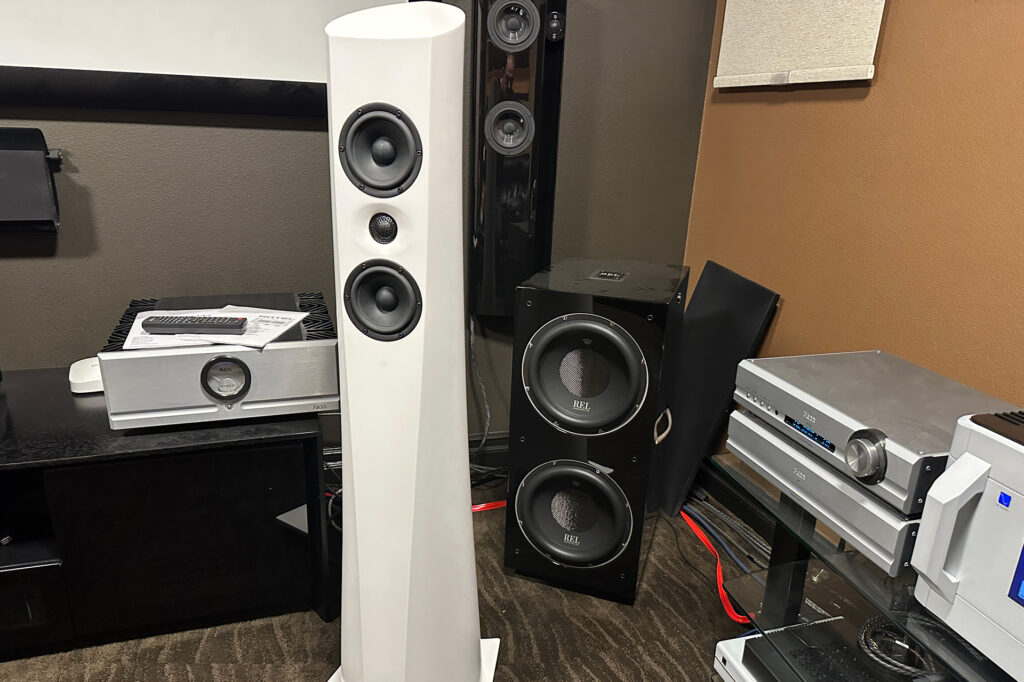
I connected the REL Acoustics Serie S 212 Black Label to my audio system via the speaker outputs of my monoblock amplifiers. But let us start from the top. The source for this review was the venerable HiFi Rose RS 130 network transport/streamer, working in tandem with a Roon Nucleus One server, connected to the HiFi Rose RD 160 digital to analog converter (DAC). To clarify, the RS 130 has no built-in DAC, which means it outputs a digital signal that is picked up by the separate RD160 DAC.
The remaining system consists of the Pass Labs XP 22 preamplifier, wired to a set of Pass Labs XA60.8 high current monoblock amplifiers. The amplifiers operate in full Class-A mode up to their full power rating of 60 watts at eight ohms, doubling power at four ohms, and again at two ohms.
Estelon Aura floorstanding speakers were the final stage of my system, creating a highly resolving platform. I own a set of REL Acoustics Serie T/7x subwoofers, which are often connected to this system. This model subwoofer is much smaller and lower-powered, compared to the incoming Serie S 212 Black Labels. Yet the Serie T/7xs kick butt with incredible blending performance, thanks to the high-level input described earlier, which backs up the Estelon Auras nicely.
Finally, my system in connected with various Wireworld cables, including Eclipse 8 speaker cables, interconnects, and Electra 7 power cables for the amplifiers.
As I mentioned earlier, John Hunter, the co-owner of REL Acoustics, performed the final tuning of the main speakers and the two Serie S 212 Black Label subwoofers, carefully adjusting the placement and positioning of all speakers within the system. He is a pro at such things and, even with the subwoofers off, my system’s sound improved due to adjustments in speaker placement. With the Serie S 212 Black Labels engaged, the difference was clearly noticeable. After Hunter left, I embarked on my own listening tests, running through a vast amount of material, both new and old, and experiencing the line array effect in my own home. I will summarize the experience with a few key points.
The first track comes from the recent rerelease of a relatively unknown album, initially recorded in 1973, Crying in the Night by Lindsey Buckingham and Stevie Nicks, before they joined Fleetwood Mac. The album was a commercial flop, but it caught the attention of Mick Fleetwood. The rest is history. Crying in the Night was rereleased in September of 2025 (Rhino Records) and remastered as a FLAC 24/192 format recording. As a Fleetwood Mac fan, I had to give it a good listen. Once you hear the album, it is obvious the impact that Buckingham and Nicks had on subsequent Fleetwood Mac albums. Overall, the recording quality is not bad, given its era, but it is not terribly dynamic either. The song “Don’t Let Me Down Again” (Qobuz FLAC 24/192) has a light bass line that is not pronounced, yet, the Serie S 212 Black Label was picking up the lower notes with finesse and speed, with excellent integration to the Estelon Auras. The balance was so lovely that it was impossible to tell if the subwoofers were on until I physically checked. I disengaged the subwoofers (turned them off) and the presentation changed dramatically for the worse. For me, the Serie S 212 Black Label transformed a lackluster recording into something better, which is nice if you like some of the classic rock recordings of yesteryear.
For fun, I moved to the Fleetwood Mac album Rumours (1976), with Buckingham and Nicks now in the band, which was a better recording, comparatively speaking, but still not great. On the track “Second Hand News,” remastered in 2001, (Qobuz FLAC 24/96kHz), the bass line was much more prominent in the recording and could be easily picked up and played nicely by the Estelon Auras. With the Serie S 212 Black Labels engaged, the bass line was further extended and still showed excellent integration. More enjoyable, for sure.
I moved on to a somewhat familiar track called “Jazz Variants” (Tidal FLAC 16/44.1) by the O-Zone Percussion Group, on their 1996 La Bamba album. I used this track in my last review of the Advance Paris Multi Cast 250 all in one (read the review) and, since it was fresh in my mind, and with the fantastic percussion work by impressive musicians, I had to give it a run with the Serie S 212 Black Labels. There are tons of deeper frequencies in this track, along with a good mix of mid and upper frequencies. With this track now running through the Serie S 212 Black Label, the soundstage was elevated, featuring more pronounced bass and a wider soundstage. The disappearing act, a characteristic of the Estelon Auras, was still intact, taking full advantage of the well-integrated and balanced bass response from the Serie S 212 Black Label. The presentation was improved in every way. With the 212 Black Labels off, this track still retained a substantial amount of bass, as the recording is more robust than the previous tracks. However, “Jazz Variants” did not have the same extension nor bass balance when the Serie S 212 Black Labels were not engaged.
While I recognize that FutureAudiophile.com focuses on two-channel audio, I felt the need to give these subwoofers a run on a robust movie soundtrack. After all, we are talking about subwoofers here. Engaging the room’s 5.1 surround system, via the home theater bypass on the Pass Labs XP 22, to an NAD M17 surround processor, and connecting its LFE output to the Serie S 212 Black Label would provide a good test of the Top Gun: Maverick soundtrack, specifically, the early scene of the test jet takeoff. As a reference point, for movies I usually have the pair of T/7xs connected. They are a psychologically confounding marvel, since the bass level from such a small package is astounding. Alternatively, when you see a pair of Serie S 212 Black Labels, you expect great things. And the 212 Black Labels delivered.
The impression was more than just realistic, deep bass. The subwoofers elevated the presentation with an uplifting sensation that was hard to ignore. We all know the lower bass frequencies are supposed to be omnidirectional – the human ear cannot tell the direction of lower frequencies. To an extent, that is true, but bass can have elevation, as demonstrated on the test jet takeoff scene. The rumble of the roaring jet engines started at ear level and progressively traveled higher, moving the aircraft through the room, providing an effect of Atmos channels where none exist, leaving me with the thought that there is nothing the Serie S 212 Black Labels cannot do.
Will the REL Acoustics Serie S 212 Black Label Keep Its Value?
Next to no one is selling their Serie S 212 Black Label after experiencing the thrill and performance of their system, which will limit supply on the resale market and therefore maintain high value. While all audio gear experiences its fair share of depreciation, the Serie S 212 Black Label will hold better than most.
What Is the Competition for the REL Acoustics Serie S 212 Black Label?
I included the JL Audio Fathom v2 ($9,999), since it can be constructed with two 12-inch active drivers, one above the other, front-facing, like the Serie S 212. Also, amplifier power is approximately the same. The similarities stop there. The Fathom v2 features a sealed box design with no ports or passive radiators, a hallmark of the Serie S 212. Alternatively, the Fathom v2 features a digital signal processing (DSP) room correction built into the subwoofer, which I am sure some enthusiasts will appreciate. Worth pointing out, with the Fathom’s V2 sealed box design, the Fathom 2 is missing the line array concept of the REL Acoustics Serie S 212 Black Label. With a retail price of $10,000 each, the JL Fathom v2 is significantly higher-priced than the Serie S 212 Black Label, and a pair of them is $8,000 more expensive. I do not have any firsthand experience with this subwoofer, so I cannot comment on its performance.
The MartinLogan BalancedForce 212 subwoofer (read the review) is another competing subwoofer, similar not only in price ($4,499) but also in the inclusion of 212 within the product name. It is not a coincidence, but rather refers to both subwoofers’ two 12-inch active drivers. I have some experience with this subwoofer, and it is indeed quite good; however, the line array effect is not part of this subwoofer’s offering.
While there are no shortages of subwoofers on the market today, I could not find a line array effect contender. With that in mind, an alternative path could be the line array-capable Serie S product offering: the S510 ($3,299) or S810 ($3,999) models. Either model would require the whole six-pack at $20,000-$24,000 to compete with a pair of 212 Black Labels at $12,000. The six-pack path would potentially offer higher performance, but it would come at a significantly higher cost and with a more imposing aesthetic. But it is an alternative.
Final Thoughts on The REL Acoustics Serie S 212 Black Label …
The REL Acoustics Serie S 212 Black Label was extraordinary at elevating the bass depth, height, and overall balance of the Estelon Auras for both music and movie soundtracks. One interesting characteristic of the line array effect for me was that I no longer needed to listen to music as loudly as I had. We all tend to pump up the volume a bit to get that low-bass sensation of a live event. It is widely known that low bass frequency volume tends to drop off relative to midrange and higher frequencies. We increase volume to compensate for the roll-off, and all the other frequencies increase in volume as well, maybe too much. Over time, this is not healthy for our ears. With the Rel Acoustics Serie S 212 Black Labels, I found myself naturally lowering the volume.
An additional thought comes to mind: if you have a set of main speakers that you like, but have developed an itch for more, instead of replacing them, consider adding a couple of Serie S 212 Black Labels. It could be the performance bump you are looking for. With their extraordinary ability to be an extension of a system’s main speakers, a set of REL Acoustics Serie S 212 Black Labels will elevate your entire system.
Lastly, and perhaps the most revelatory outcome of this review for me, is the special place the REL Acoustics Serie S 212 Black Label sits in the manufacturer’s product lineup and within the audio industry subwoofer category as a whole. The Serie S 212 is the only product I am aware of that provides a subwoofer line array effect without having to step up to a full six-pack. If you are considering such a setup, a pair of REL Acoustics Serie S 212 Black Label subwoofers should be at the top of your list for consideration.




Thanks. This looks like a very cool subwoofer. Two of them in your size room must have been a blast.
It most definitely was a blast. I enjoyed the experience immensely.
As the 1st Owner in Canada (also only review on RELS site for the Black Label 212 I can say that having a pair now for 3months they are a bargain compared to other improvements to your sound system . I have Boulder 866 , focal 2 , Roon Nucleus + and Siltech G9 classic 880 sp cables . These replaced a pair of s812 subs . Way more engaging, sounds richer and you actually can hear sound quality improvements. I also found them a lot easier to adjust the settings by the better description noted in the manual.
NICE SYSTEM
I owned Focal Sopra 2s. The stayed in my last house in Pacific Palisades and burned to the grown in the fires. They were good. I miss the old importer. The new ones are brutal. Daniels Jacques was GREAT
j