
 By
By In recent years the folks at Orchard Audio have grown a reputation for providing Class-D GaN amplifiers (learn more here) with value that far exceed their price, so when I had the opportunity to review a headphone amplifier that they have brought to market, I was excited to check it out. To my surprise, the headphone amplifier is using a Class-A/B design for power instead of their Class-D gallium nitride technology that they use in their other amplifiers. Now, that isn’t to say that this amplifier lacks power or delivers a lot of heat, because it doesn’t do either of those things in my extensive testing. The 17 watts of power that it delivers is going to be enough to drive even the most demanding headphones. Let’s take a closer look at this unique and powerful headphone amplifier, so we can see if it might make sense for your headphone setup.
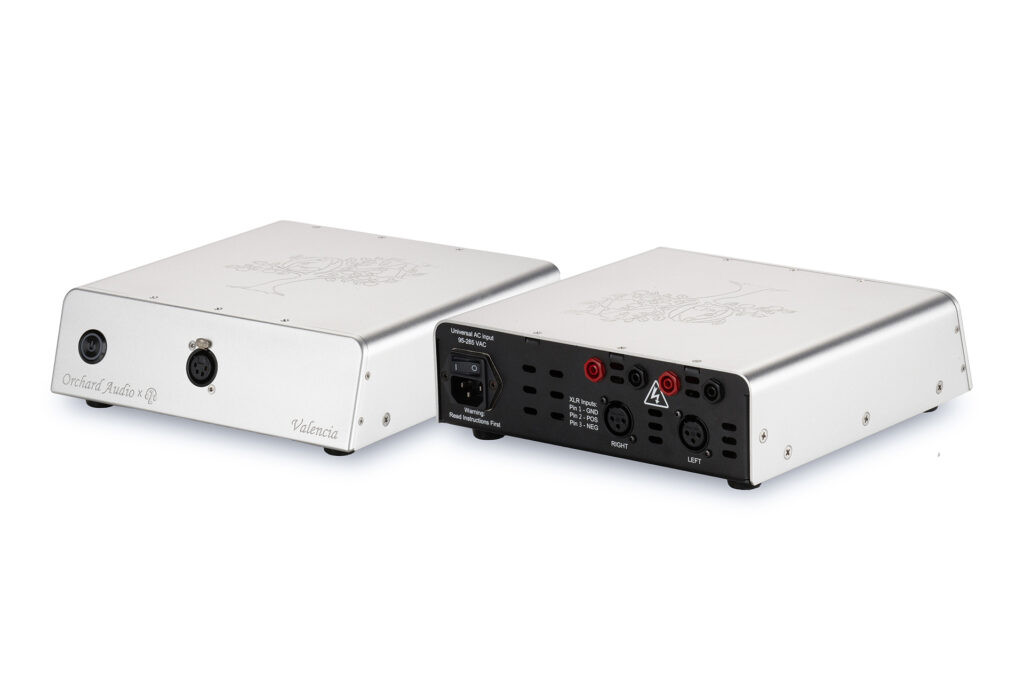
What Makes the Orchard Audio Valencia Headphone Amplifier So Special?
- The power provided by this amplifier is relatively unmatched. If you’re someone who loves high-impedance headphones, then this might be just the headphone amplifier you are looking for. I tested the Orchard Audio Valencia with a set of Mod House Audio’s Tungston headphones, with their double-sided drivers, which have a whopping 150 ohm average impedance, and the Valencia still had power to spare.
- You get balanced options. There will be a portion of the population who will look at the Orchard Audio Valencia and wish it had unbalanced inputs and outputs, but I would surmise that the Valencia simply was not built for those users. It was built for the audiophile who wants extreme high-end performance and that means using balanced inputs for your preamplifier and it means using balanced outputs for headphones.
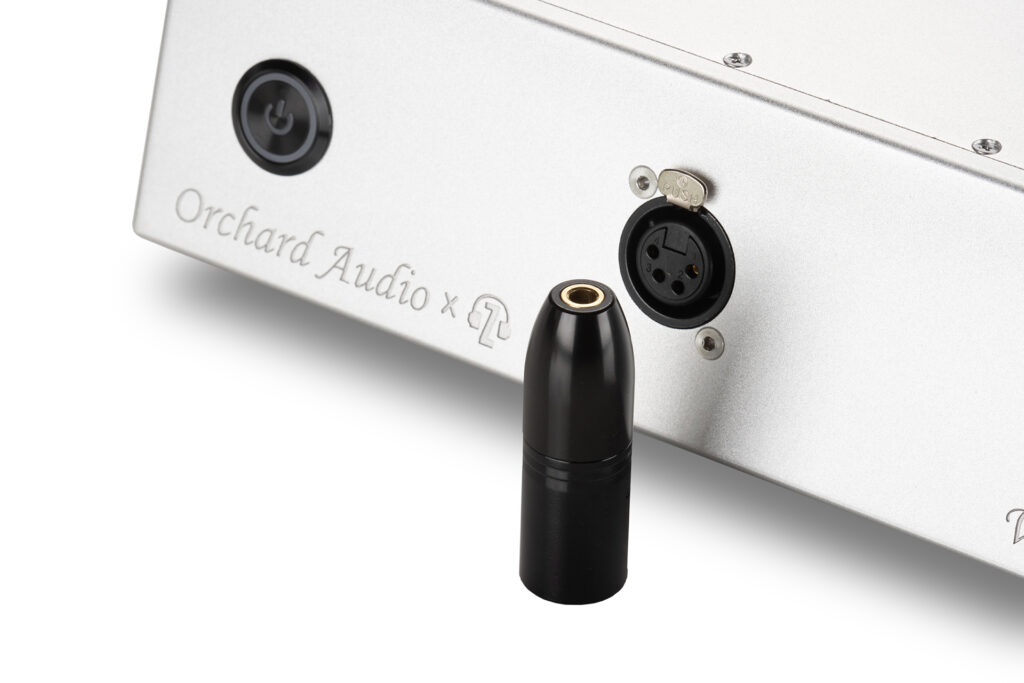
- You can use either XLR or 4.4-mm output for headphones. XLR is the native option for the Valencia, but Orchard Audio also includes a XLR to 4.4-mm option for folks who do not have headphones cables with XLR at the end point.
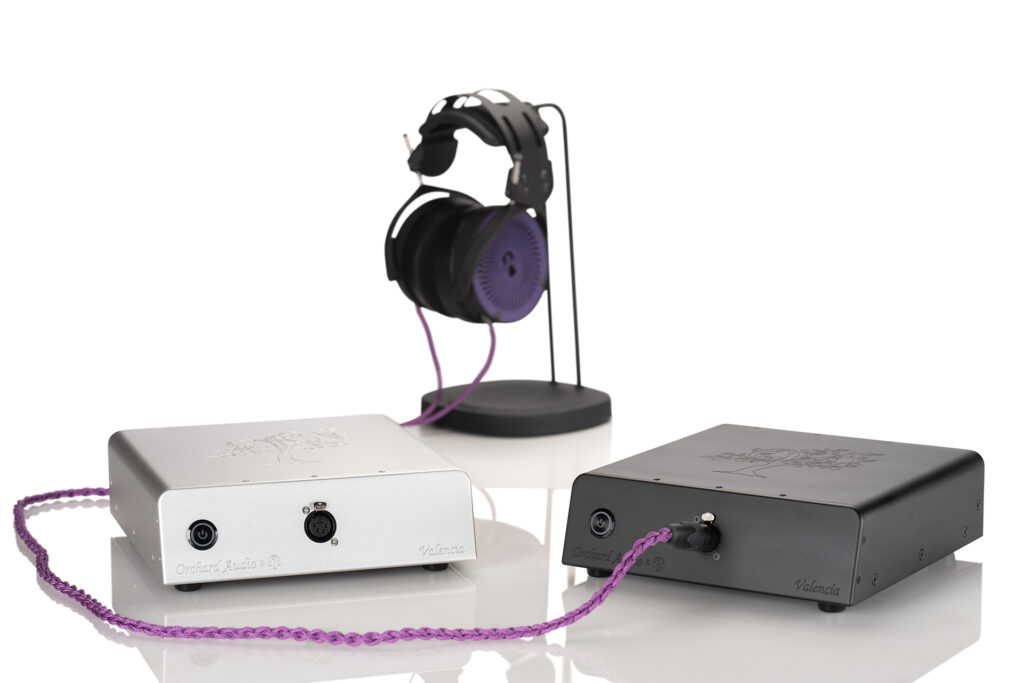
- The Orchard Audio Valencia offers two color options. While Silver and Black are far from exotic, they fit into the standard palette of audiophile gear, which will allow most people to fit it into their components’ color scheme.
Why Should You Care About the Orchard Audio Valencia Headphone Amplifier?
If you’re someone who wants a serious headphone listening station in your home, then you really need to consider the Valencia. The reason I note “serious headphone listening” is that the Orchard Audio Valencia fits into the signal chain in the same way that a traditional amplifier does when you use speakers. This means you will need to build out the rest of your setup with a preamplifier, DAC, and source. This comes with a lot of advantages, as you get to completely customize the sound to your taste. It just comes with a higher cost than many current setups that you see.
Some Things You Might Not Like About the Orchard Audio Valencia Headphone Amplifier
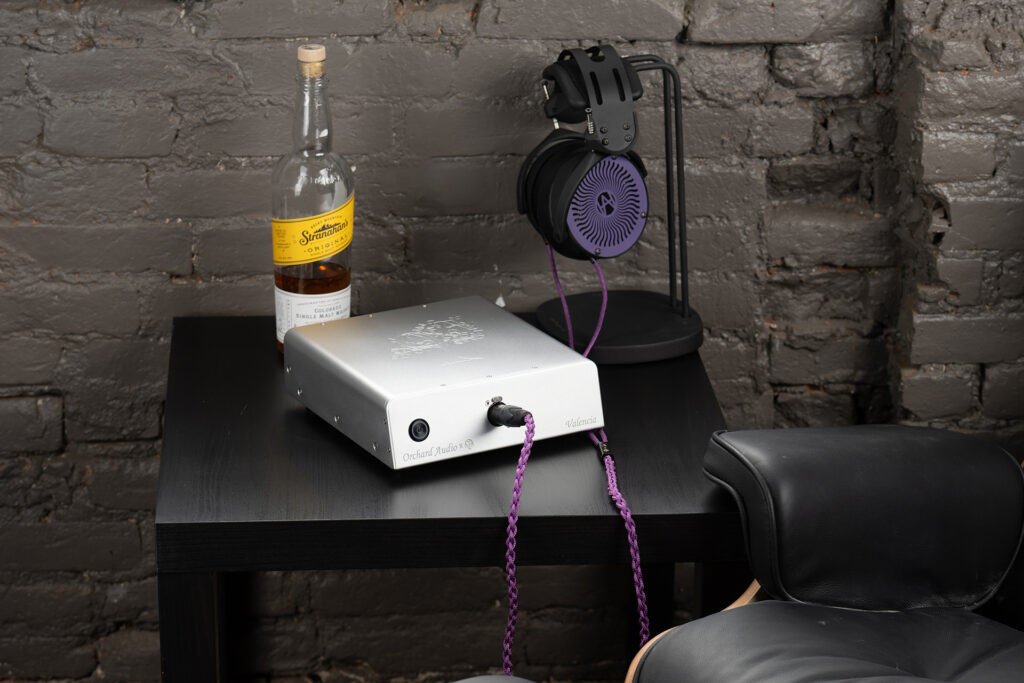
• The XLR input connection doesn’t have a locking device. Typically, with XLR inputs, there is some form of locking. In this case, it’s a small button that you use that locks the cable into place. For whatever reason, Orchard Audio only chose to use this feature with the headphone connection on the front, but not on the connection from your preamplifier at the back. This is a small matter, as I didn’t have any issues with the XLR cable losing connection to the Valencia.
• There was a very slight but detectable hum when music wasn’t playing through lower-impedance headphones. This is because the amp has a very low noise floor with a gain of 14 dB thus it can inadvertently amply a little noise from the world’s highest sensitivity wired headphones. This can take a higher noise/distortion source and amplify said noise thus you want to send a really clean signal into a device as sonically revealing as the Orchard Audio Valencia headphone amplifier.
Listening to the Orchard Audio Valencia Headphone Amplifier …
I tested the Orchard Audio Valencia headphone amplifier with the Benchmark DAC B (read the review) and the SPL Elector (read the review), using my MacBook Pro as the source. Audio was streamed from my Apple MacBook Pro, using Qobuz into the DACs, using a Wireworld Chroma 8 USB-B to USB-C cable. Additionally, I used the Meze Liric closed-back headphones (review pending) in all listening. As a basis of comparison, I used the FiiO K15 headphone amplifier (review pending).
When testing headphone amplifiers, one of the tracks I enjoy playing is “One” (Qobuz 44.1 kHz) from U2’s legendary album Achtung Baby. When I first put this track on, I felt like I was experiencing something sonically different. While I have listened to this track countless times, it had never sounded this revealing and engaging, ever. While I cannot give the Orchard Audio Valencia all the credit for this, it was certainly a major part of the equation. The timing and separation of the instruments made it sound as if I was in the studio for the final take. There wasn’t any noticeable coloration to the tone of the track, and I couldn’t help but listen to it a few times, as I was waiting for the goosebumps to subside.
Another track that is great for testing out speakers is Arcade Fire’s “Intervention” from their 2007 studio album Neon Bible (Qobuz 44.1 kHz). This album was the band’s sophomore release and was recorded in a converted church in southeastern Quebec. One of the most powerful parts of this track is the pipe organ that opens it. This is an area where I found that the Valencia really worked its magic. The organ felt so powerful when it was in the signal chain. I compared this with both the iFi Zen Can 3 (read the review) and the FiiO K15 (read the review) that I had on hand, and the difference was stark. Sometimes we are left wondering what the difference is at different price points in gear, and the Orchard Audio Valencia clearly showed what you could really do with a near-$2,000 headphone amplifier.
The last track I found really impactful was “It Never Goes Away (Woman)” by Jazz at Lincoln Center Orchestra (Qobuz 44.1 kHz). This is a track that I have used in the past to understand how well an amplifier can handle female vocals, as well as the dynamics of an orchestra. In my listening the Orchard Audio Valencia was able to handle both items with ease. The female vocals were reproduced stunningly well and placed centrally in the many sets of headphones used in my testing. The soundstage here was also very impressive. There was separation between each instrument, and you could place the different locations of the orchestra as well. It was like ear candy, as you just wanted to consume more and more the longer that you listened.
Will the Orchard Audio Valencia Headphone Amplifier Hold Its Value?
I would expect this product to hold its value very well in the market. There really isn’t anything in the market today that matches its power capacity or unique design. This likely also means that most consumers who buy this headphone amplifier won’t be looking to move on from it. So, finding an Orchard Audio Valencia in the used market could be challenging, and you likely won’t see a major discount.
What is the Competition for the Orchard Audio Valencia Headphone Amplifier?
The McIntosh MHA200 ($3,000 – buy at Crutchfield) is a strong contender if you’re looking for a headphone amplifier with a lot of power. It has four selectable settings to help you match the power output to your headphones. It also uses tubes, which will provide it with a very different sound signature than the Valencia has, and a lot more heat, too. Keep in mind the MHA200 is $1,000 more expensive, and pales in comparison to the Orchard Audio Valencia’s power output (500 milliwatts vs, 17 watts, which makes the Valencia 34 times more powerful.)
The Benchmark HPA4 ($3,499) is another headphone amplifier that is worth consideration. It has plenty of power to handle hard-to-drive headphones, delivering six watts of power. It differs from the Valencia in that it has the preamplifier built in, so you only need to add your DAC and a source. This again, though, comes at a higher initial price, but you are likely close once you add a preamp to the Valencia setup.
If you’re looking for an alternative at the same price point, you can consider the Rotel DX-3 ($1,699 – buy at Crutchfield). The DX-3 is an all-in-one option, with the DAC and preamplifier built in. If you’re looking for something that might fit only on a desktop, this could be a good option, while not being a direct competitor to the Valencia.
Final Thoughts on the Orchard Audio Valencia Headphone Amplifier …
Every now and then, a piece of stereo gear comes into your life and it changes how you think about being an audiophile. For me, the Orchard Audio Valencia was one of those rare pieces. While I was certainly aware of how good listening to music through headphones could be, I had never experienced it in quite this way. I found myself going back through some of my favorite tracks and remarking that they had never sounded this good to me before. I also recognized that, while what I was looking for was an upgrade for my desktop, as I am chained to a desk for many hours a day, I became lost in thought about how enjoyable it could be to have a location in my home dedicated to relaxing with a dedicated audiophile headphone setup. At the end of the day, the Orchard Audio Valencia might not be the right piece of gear for your life, but it might also be the missing piece that you have been searching for. If you’re looking for some seriously good amplification for your wired headphones, then you owe it to yourself to give the Orchard Audio Valencia a look and listen.




Thank you very much for your time and effort, Andrew.