
 By
By Most young audiophiles enjoy a period of their lives where they are not responsible for anything but themselves and their hobbies. During this period of life, you can pour every extra penny you have (as well as the pennies you don’t have) and feed the beast that is your audiophile habit. Sure, your total disposable income may not be what it will be in 10 to 15 years, but you can spend it all as you desire. When a significant other enters your life, you may know they are “the one” when they don’t complain about your giant-ass floorstanding loudspeakers, three monstrous power amps and the general chaos that is your audiophile listening room. Then you get married, have a couple of kids and priorities change. You don’t have as much space, your budget tightens and your audiophile addiction gets put on the back burner. This happened to me in the early 2000s. I had a solid but not spectacular NHT system, powered by a nice Pioneer Elite receiver. About 10 years later, my income increased, my house got much larger, I had a dedicated room again and I caught a bad case of upgrade fever. The object of my desire was a new speaker from Sandy Gross of Polk Audio and Definitive Technology fame. That speaker was ultimately from Gross’s third speaker company, the GoldenEar Triton 2. It was tall and slender, only came in black with a sock, but had built-in subwoofers, a huge soundstage, an AMT tweeter and, for the money, absolutely kicked ass. Gross grew GoldenEar into a major player in the loudspeaker space in a relatively short time period. In 2020, he sold GoldenEar to the Quest Group (parent company of AudioQuest Cables). Then, in January of 2025, the Quest Group sold GoldenEar to PML Sound International, parent company of Paradigm, Anthem and MartinLogan.
In truth, the Quest Group did very little with the GoldenEar lineup. The GoldenEar T66 (buy at Crutchfield) was their biggest speaker release and remains the flagship of their T series with the recent release of the T44. I suspect PML Sound International has big plans for the GoldenEar lineup, and I look forward to seeing where they take it. In truth, the Quest Group really didn’t seem to know what to do with GoldenEar, and I suspect the brand is in much better hands now. The GoldenEar T66 is a unique and great-looking speaker. I spent quite a bit of time with this one, so let’s get into it.
What Makes the GoldenEar T66 Loudspeaker So Special?
- The GoldenEar T66 has built-in subwoofers. I am a big fan of built-in subwoofers in speakers as part of an audiophile loudspeaker. My personal reference Paradigm Founder 120H (read the review) features built-in subs. It simply gives you more options in building your system. Want a sweet-sounding Class-A amp for extra open-sounding mids and highs? No problem, as your bottom end is fully covered. Want to have plenty of bass with a speaker that doesn’t offend your significant other from a size standpoint? A speaker with a built-in sub is your answer. Want to even out the bass response in your room and only buy one standalone sub? Again, having two main loudspeakers with built-in thumpers can go a long way in smoothing out your bass response.
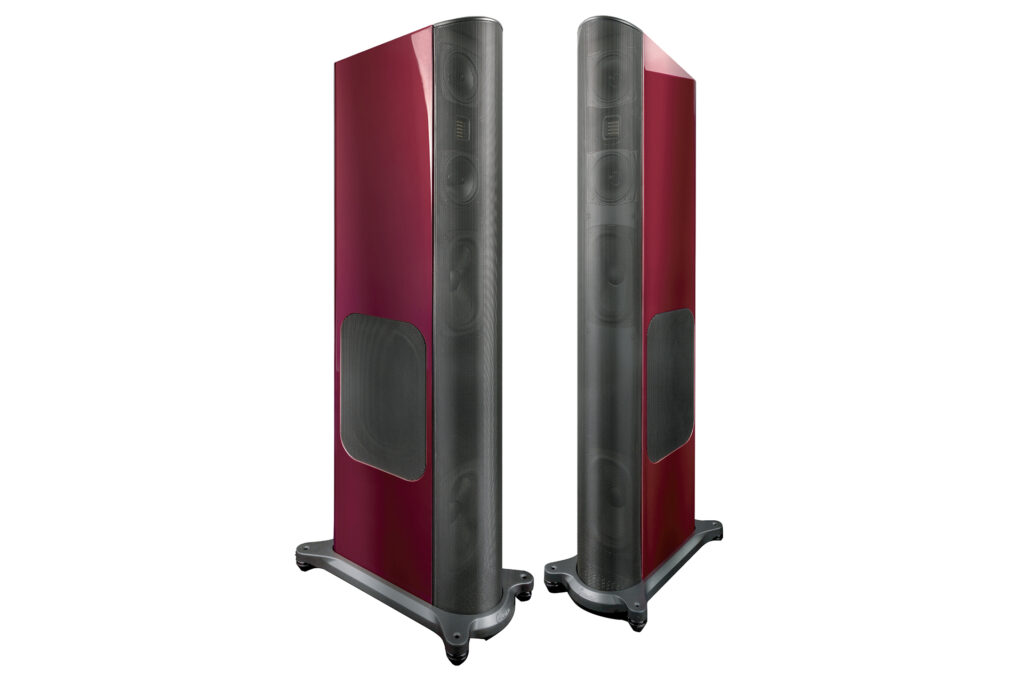
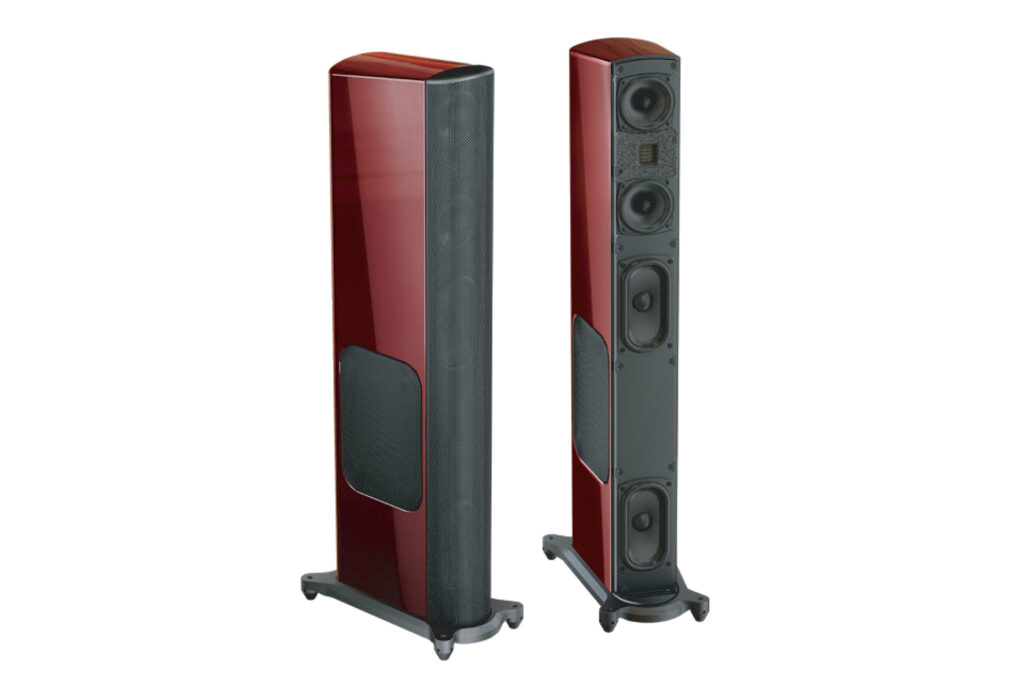
- The GoldenEar T66 has the ability to put out an absolutely huge soundstage in a compact, great-looking package. If you close your eyes while listening, you would swear you were listening to gargantuan speakers. Plenty of bass and a huge soundstage, yet these speakers are narrow, tall and slender. They can fit and look reasonable in even a moderately-sized room. They also look great. This is one area where the Quest Group made some great decisions. The fixed metal grille, aluminum base and feet, and high-gloss finish, in either black or Santa Barbara Red, look outstanding.
- Santa Barbara Red is stunning. My demo pair of GoldenEar T66 is in Santa Barbara Red. The pictures in this review and that you can find on GoldenEar’s website simply do not do these speakers justice. If you have ever seen a classic car like a 1970 Chevy Chevelle painted in Candy Apple Red and said, “DAMN! That looks good,” the GoldenEar T66 is here for you if you can’t quite afford a 1970 Chevelle to show off.
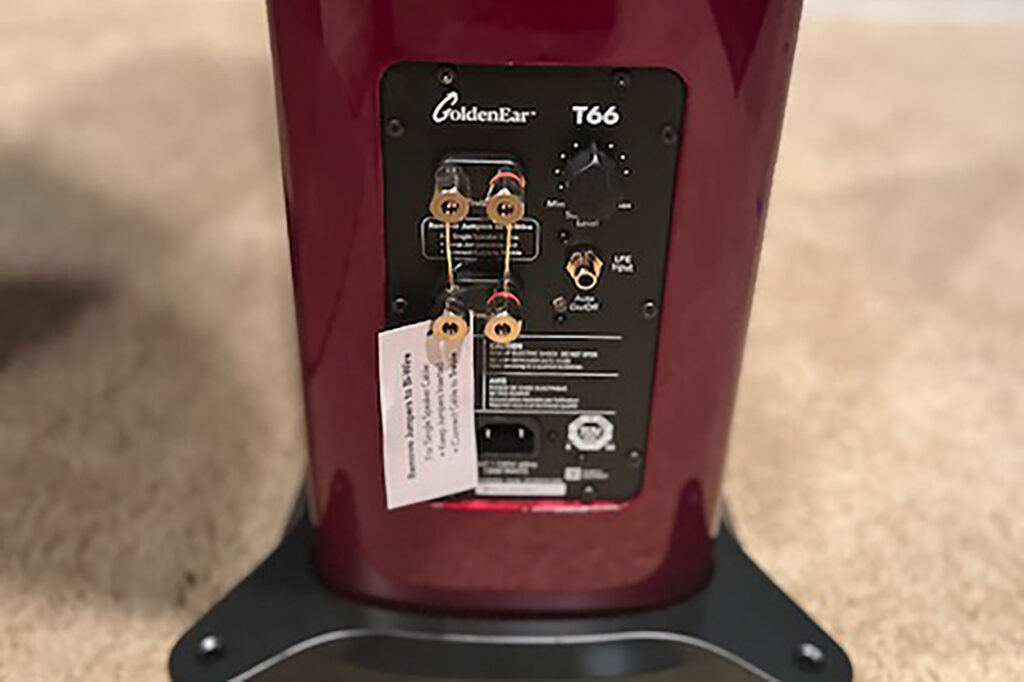
- A myriad of speaker hook-up options are offered. Do you want to run a single set of speaker cables? No problem. Do you want to bi-amp the speaker? Easy. Do you want to run a separate LFE out from your preamplifier or receiver? They have that also. Flexibility in hook-ups is nice, and the T66 has more than any speaker I can remember.
- You can adjust the bass output from the back of the speaker. My reference Paradigm Founder 120H relies on using the Anthem ARC software to get the bass output correct and the levels right. And it works great, but takes a little time and effort. With the GoldenEar T66, you can easily adjust your bass output on the back of each speaker. For instance, when listening at a lower volume, sometimes you may want to slightly bump up the low end, which is easy with the T66.
Why Should You Care about the GoldenEar T66 Loudspeaker?
The GoldenEar T66 packs a whole lot of technology into a slender, great-looking, easily-spouse-accepted package. At four feet tall, and 7.5 inches at its widest point, it really does pack a lot into a small package. The speaker narrows from back to front, giving it a slim profile. Packed into that package is a reference high-velocity folded-ribbon AMT tweeter, two 4.5-inch cast-basket mid/bass drivers, two five-by-nine-inch long-throw quadratic subwoofers, two eight-by-12-inch quadratic planer back-wave-driven radiators, AND a 500-watt RMS amplifier that can put out 1000 watts peak when called upon to do so.
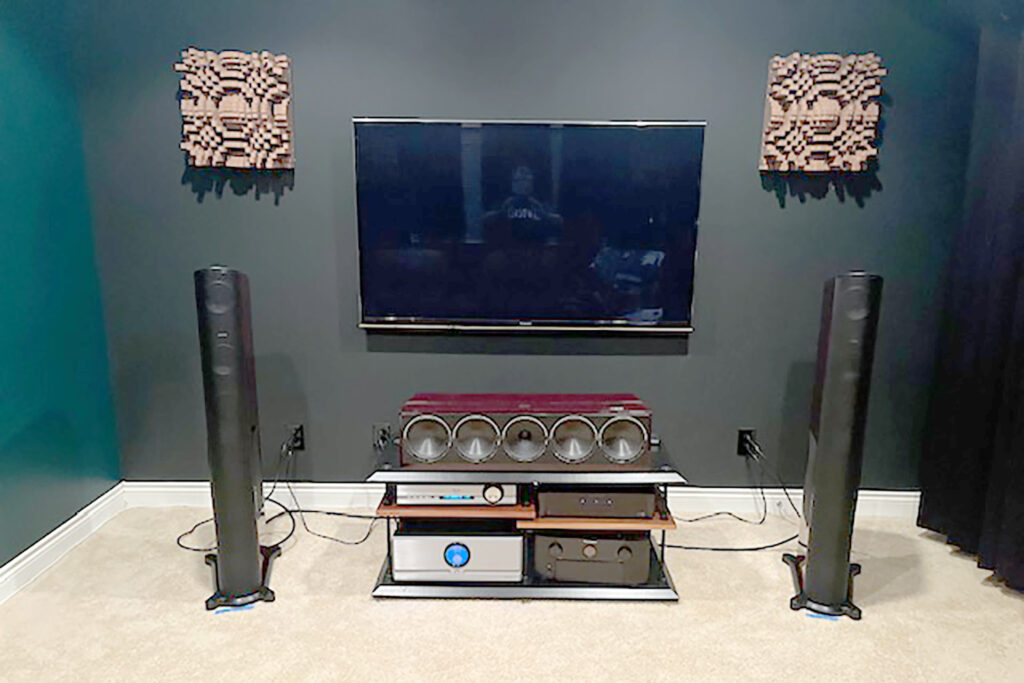
The GoldenEar T66 sounds great and allows the buyer an absolute ton of flexibility in building out their system. Need a smaller system with big output? Look no further than to pairing the T66 with one of many integrated streaming amplifiers that are on the market, like the HiFi Rose RS520 (read the review). Pairing the HiFi Rose RS520 with the GoldenEar T66 loudspeakers in Santa Barbara Red would be one hell of a good-looking, great-sounding, eye-catching system. A system like that doesn’t take up much space for right about $10,000. Pair these loudspeakers with a Class-A amplifier like the Pass Labs XA30.8 to squeeze that extra bit of midrange glory, and you don’t have to worry about losing your bottom end. Finally, if want to do home theater, and are limited on space and/or budget, the subwoofers in the GoldenEar T66 can get the job done.
Some Things You Might Not Like About the GoldenEar T66 Loudspeaker
- While I like built-in subwoofers, some audiophiles may not. There is the need to plug both speakers in, which may not always be possible, or require an ugly power strip that adds a bit of clutter to your room. You are also tied to the built-in amplifiers to drive the built-in subwoofers.
- The GoldenEar T66 has its own unique look. I really can’t think of another loudspeaker on the market that is this tall and slender and tapers from back to front. Fortunately, with the GoldenEar T66, they did not choose form over function, as it performs quite well. That said, its presence in your listening room does not scream “I have to hear those.” They look like they were designed to blend in with your décor (well, maybe only in basic black), rather than be the featured pieces in your listening room.
- The GoldenEar T66s weigh 60 pounds each. For some, this is a big deal. While not light, 60 pounds is still pretty manageable to move around. It’s a 60-pound speaker that packs the punch of a 100-pound speaker, no easy feat.
Listening to the GoldenEar T66 Loudspeakers …
In addition to being a heavy metal fan, I am an unabashed fan of “Yacht Rock.” Whether you love or abhor the term, there is no debating that Michael McDonald is one of, if not the top, key voices of the genre. “What a Fool Believes” from the Doobie Brothers’ 1978 release Minute by Minute won two Grammys and also happens to be an excellent track that I can listen to over and over, which is a great characteristic for reviewing speakers. The T66 absolutely excels at bringing well-recorded vocals to the front of your mix. McDonald, as we all know by now, has a distinctive wide range, from warm and buttery to climbing the ladder and remaining powerful. The GoldenEar T66 rendered the vocals as they should be out front, powerful and smooth. There is a lot going on with the keyboards/synths and rhythm section throughout the track. As most of us first heard this song on an AM radio station in the back of a station wagon, it’s so much fun to hear to this day on a great rig. Keyboard on one side, synths on the other, powerfully smooth bass line under all of it. The Golden Ear T66 did an absolutely spectacular job of allowing the bass notes to remain distinctive yet powerful with those built-in subs. Heck, the GoldenEar T66 even allowed me to pick out the congas played on the track.
I have always been a fan of a ripping guitar solo. Just about every heavy metal track has one, but Yacht Rock? Christopher Cross? Yes, indeed. For years I’ve told anyone who would listen that the outro on “Ride Like the Wind” by Cross on his Grammy-winning 1979 self-titled debut album has an absolutely killer guitar solo as part of the outro. At about the 3:20 mark, Cross takes off on an absolutely ripping guitar solo. The GoldenEar T66s do a great job of allowing you to hear the solo, even though it is a bit buried in the mix. They not only allow you to hear the solo, but also clearly and cleanly delineate distorted and bent notes. Most of us know the rest of the song pretty well, but when Cross gets a little gravelly during the track, it’s right there front and center. Of course, when the backing vocals of the aforementioned McDonald are a part of the track, he sounds powerful and smooth. There is a ton going on in the track, including a violin and a string section. It is a lot, but a real strength of the GoldenEar T66 is to bring the vocals a bit forward, while still separating and allowing you into the track to hear the strings. The four-on-the-floor drumbeat is greatly helped by those built-in subwoofers. A lot of credit goes to the AMT tweeter also, as it brings vocals forward loud and clear, but at the same time it’s blended well enough to allow for a bit of sparkle when it’s there, and keep the horns in the mix as they climb to the high end of their range.
Bonus Link! Here is one of the greatest SCTV sketches of all time.
McDonald has brought us this far in this review, but I needed a bit of a rocker to even things out. Fortunately, McDonald helped out Van Halen with “I’ll Wait” from their 1984 album. While far from their heaviest song (an understatement), there is still a killer guitar solo mid-track, which we will get to in a moment. The song begins with an opening synth riff, with a bit of Alex Van Halen’s cymbal work as he rolls his cymbals into a crescendo several times. The AMT tweeter paid real dividends, as so often speakers struggle with cymbals, they smear, they don’t sound right. The GoldenEar T66 does cymbals correctly. When the pounding rhythmic synth bass comes in that serves as the foundation of the song, I couldn’t help but grin as those built-in subwoofers pounded away with an immediate and consistent impact. I typically left the subwoofer volume knobs on the back of the speakers at 12 o’clock after setting them up, as they produced an accurate and fun foundation without becoming boomy. Finally, when Eddie Van Halen plays his guitar solo, the GoldenEar T66 allows you to hear each note and, truthfully, as the solo fades out, Eddie Van Halen is wailing away on the whammy bar, and the GoldenEar T66 did an excellent job of letting you hear each and every note as it bends.
Will the GoldenEar T66 Loudspeaker Hold its Value?
GoldenEar established itself rather quickly as a high-performance, high-value
loudspeaker during its early guidance under Sandy Gross. The Quest Group did one thing I like, and the solid finishes, with the attached grilles, along with a much more robust base, were all great ideas that give the GoldenEar T66 a higher-end look more appropriate to its performance. With GoldenEar now a part of the PML group, you can be confident in your investment for the long haul.
What is the Competition for the GoldenEar T66 Loudspeaker?
The most obvious is the Paradigm Founder 120H at $9,000, which is my personal reference loudspeaker, with both now under the same corporate umbrella. As such, I will do a bit more head-to-head comparison with these two. The Paradigm Founder 120H gives you built-in ARC which, if you don’t have an audiophile preamp or integrated amp with room correction, I believe to be a big benefit. On the flip side, the adjustable volume on the GoldenEar T66 is more flexible. You can set the GoldenEar T66 up without having room correction. For the Paradigm Founder 120H, I would highly suggest running the ARC. Without it, unless your room is cavernous, it will be boomy. With it, it is spectacular. I feel that vocals are more forward with the GoldenEar T66. The Paradigm Founder 120H is a bit fuller throughout the midrange. The GoldenEar T66 outputs a good deal of bass, really spectacular, given its size. The Paradigm 120H can likely shake the foundation of your home if you set it up to do so. Keep in mind, the Paradigm 120H also weighs 25 pounds more per speaker. The GoldenEar T66 and Paradigm 120H are also very different-looking loudspeakers. The GoldenEar T66 in ruby red is truly unique.
While more expensive, the Legacy Signature XDs also feature a built-in amplifier and use an AMT tweeter and upper midrange. They have an $11,200 price tag for the pair. Given the price, you can start to see the value that the GoldenEar T66 provides. It is a four-way speaker, featuring two 10-inch woofers, and an internal 650-watt ICE power amp that can be configured to power the whole speaker or, like the T66, the bottom half of the speaker. It does not have a built-in EQ option. Legacy does offer several finish options in a more traditional cabinet.
The Dynaudio Focus 30 is a fully active loudspeaker at $8,250 per pair. It offers a full streaming platform, along with many legacy connections to integrate your components. The Focus 30 also offers Dirac as optional room correction. It is a fully active speaker. However, it does not include a subwoofer like the GoldenEar T66.
Final Thoughts on the GoldenEar T66 Loudspeakers …
The GoldenEar T66 in many ways is a technical marvel. It is an incredibly slim and slick-looking loudspeaker. Even with the knowledge that it has built-in subwoofers, most listeners will be shocked by the immense output that the T66 is capable of, given its modest size. But a ton of deep bass is not it’s only calling card. The soundstage is large but proper in scale, and the AMT tweeter is capable of delicate detail without getting harsh. The AMT tweeter really shone with cymbals. For many of you out there, spouse or partner acceptance factor can be a challenge. The GoldenEar T66 (buy at Crutchfield) really shines in a situation like that. In black, they can be subtle, slim and blend more into your décor. In the Ruby Red, they are still slender and unobtrusive, but give you a bit more of a look-at-me factor. I’ll also go back to the fact that if you pair these with a solid $2,500 integrated streamer/amp, for $10,000, you will have a system that rivals most at twice the price. I am interested to see what PML does with the GoldenEar lineup. They have a unique look and spot in the marketplace with their slim-profile, high-value proposition. Will they add ARC room correction? Look to add a larger T88? I look forward to seeing what the future holds for GoldenEar. Fortunately for GoldenEar fans, the brand looks to be in good hands now with PML.




Great stuff, love the review as always!!! Very transparent can create a more 3D experience that is very engaging and goes beyond other speakers I have heard. They sound quite neutral and evenhanded amazing speakers get some!!!
Agreed.
I had dinner at Capital Audiofest with Sandy Gross (founder of Polk, Def Tech and GoldenEar) as well as young Lucca Chesky
The best of the old school AND the new.
We LOVE GoldenEar. Paradigm will undo the damage from Audioquest.