
 By
By In 2025, I have had a nice run of headphone amplifiers. I have had the opportunity to review a wide range, from the small and inexpensive up to the $3,500 and a bunch in between. This has provided me with an opportunity to really understand what the differences are between those price categories. If you’re not familiar with Benchmark, it was started by Allen H. Burdick as Benchmark Sound Company in 1983 in a garage in Garland, Texas, before moving to a larger operation, Benchmark Media Systems, in 1985 in Syracuse, New York, where their products are designed, assembled and tested today.
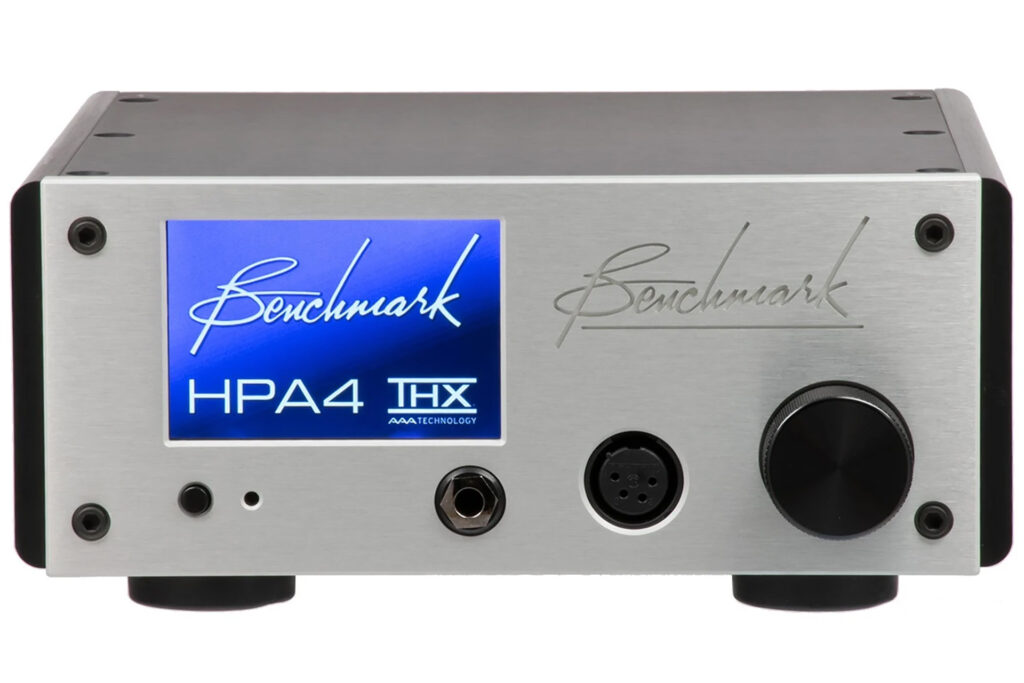
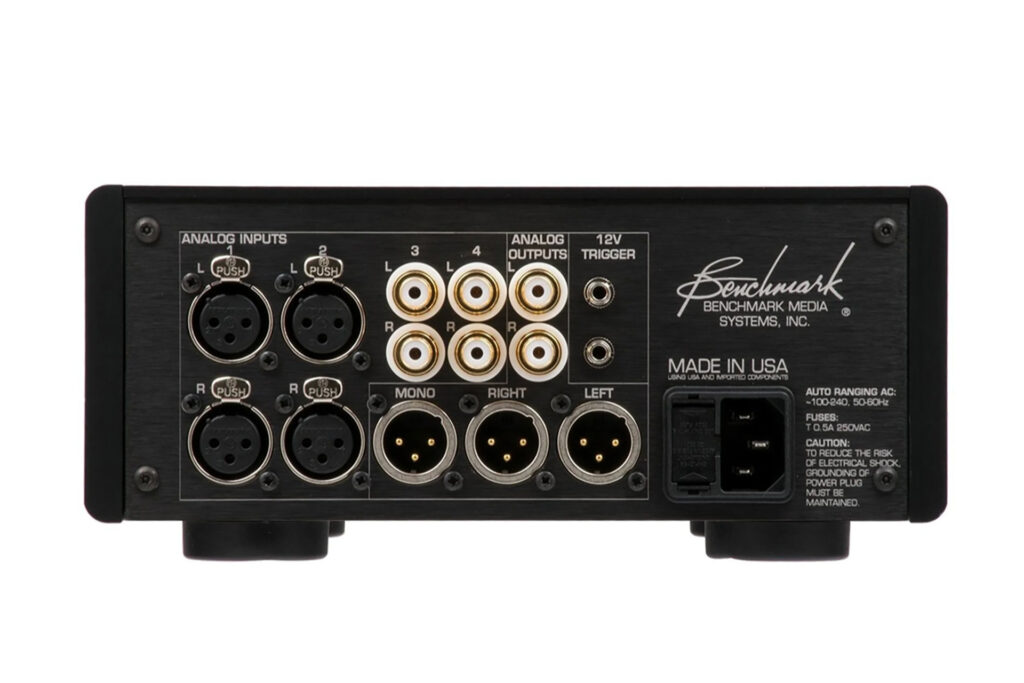
The Benchmark HPA4 represents what is the most expensive individual item that I was able to review in this category. The HPA4 can serve two functions for you. It can work as just a headphone amplifier that will require an added DAC, or it can work as a preamplifier, or it can do both should you choose (and ultimately get the best value). As a headphone amplifier, which is the primary focus of this review, it comes with one unbalanced and one balanced XLR headphone output. It produces six watts into 16-ohm headphones and 11.5 vrms into 300-ohm headphones. As a preamplifier, it features two balanced inputs and two unbalanced inputs, as well as a balanced and an unbalanced output. Both sides share a 256-step fully-balanced relay gain control (half a decibel per step) and a touchscreen for controls. Let’s jump into it and see if the Benchmark HPA4 is worth you taking a closer look.
What Makes the Benchmark HP4A Headphone/Line Amplifier So Special?
- As a headphone amplifier, it is ready to power any and all wired audiophile headphones. In this price category, it is important that your headphone amplifier is able to handle even the highest impedance headphones. With the HPA4 producing 11.5 vrms into 300 ohms, it will be able to do that with ease.
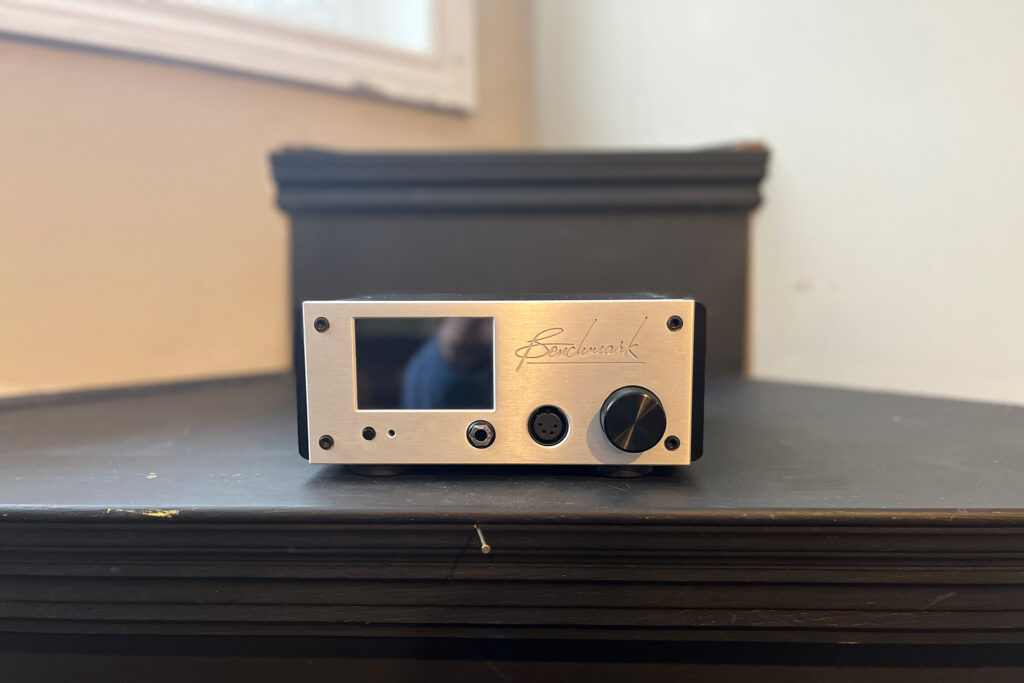
- The Benchmark HPA4 headphone amp will fit nicely on your desk. For me, audiophile component size matters when it comes to a headphone amplifier, as the primary place I use it is my desk, so knowing I can fit it there without it being in the way of either of my monitors is great.
- The Benchmark HPA4 is easy to set up and use. You just plug in your audiophile DAC and headphones, and you’re ready to go. The touchscreen is also implemented in a way that makes it easy to use. I have reviewed devices where the touchscreen proved to be a great annoyance, but Benchmark kept it simple and easy, and I am thankful for that.
- You get two headphone input options. There might be some who complain that there isn’t a 4.4-millimeter balanced option on the HPA4 but, for many, XLR is the preferred option, and there are plenty of adapters you can get from Amazon that will convert the XLR to 4.4-millimeter balanced inputs.
Why Should You Care About the Benchmark HPA4 Headphone/Line Amplifier?
Finding a headphone amplifier that doesn’t color the sound and is also capable of handling the highest-impedance set of headphones is going to be important for any headphone-loving audiophile, and the HPA4 from Benchmark does just that. This allows you to add color (should you want it) from your source, DAC or headphones.
Some Things You Might Not Like About the Benchmark HPA4 Headphone/Line Amplifier
• The Benchmark HPA4 isn’t an all-in solution. With the outstanding quality of the Benchmark DAC3 series, some would look for a DAC to be included in the HPA4. You can just as easily see its omission as an advantage, as you can also mix and match the headphone/line amplifier with any DAC of your choosing.
• The volume is a little susceptible to interference from other devices. I am not sure that I can blame this on the Benchmark HPA4 but as this can me more of a wireless device issue. I did find the issue pop up a few times thus the mention but I am not willing to make too big of a deal out of it in that this issue could be circumstantial or just plain random.
Listening to the Benchmark HPA4 Headphone/Line Amplifier …
I tested the Benchmark HPA4 headphone amplifier with my MacBook Pro as the primary audio source. Audio was streamed using Qobuz into a Benchmark DAC3 B DAC (read the review) using a Wireworld Chroma 8 USB-C to USB-C cable. Additionally, I used the Meze Liric closed-back headphones (you can find the review here), which are a 61-ohm impedance headphone, in all listening.
When testing headphone amplifiers, one of the tracks I like to use is Tom Petty and the Heartbreakers’ track “Refugee” (Qobuz 44.1 kHz) from their Live Anthology album. This is a six-minute live jam that shows off some of the magic that the band had live, which includes lots of Mike Cambell’s solos, and Petty singing along with the crowd. This album is cherry-picked off live recordings of the band made over a 30-year span. What stood out to me right away when I listened to this track via the Benchmark HPA4 was how stunningly clear all of the details sounded. You could easily pick out and place where the musicians are across the soundstage through the headphones from right to left. The crowd noise made you feel like you were at the show and the changes in Petty’s voice across the sound demonstrated how well-recorded this track was in a live environment.
Another favorite track of mine for testing out headphone amplifiers is Radiohead’s “Packt Like Sardines in a Crushd Tin Box” from their studio album Amnesiac (Qobuz 44.1 kHz). This is technically Radiohead’s fifth studio album, but I typically think of it more like 4.5, as a majority of the tracks come from their Kid A sessions back in 1999. The bass, when listening through the Benchmark HPA4, was remarkable. It was punchy and tight, and sounded a bit more out front in the mix than it did with other headphone amplifiers. You could also hear all the small details that are layers deep in all the electronic density. Even after listening to this track for 25 years now, it was still very enjoyable with the Benchmark HPA4 in the signal chain.
Whenever I want female vocals to test a headphone amplifier, I go to “It Never Goes Away (Woman)” by Jazz at Lincoln Center Orchestra (Qobuz 44.1 kHz). This is a beautiful track from Wynton Marsalis and his band, and the female vocal sounded soulful and beautiful, with the upper octaves never sounding harsh or distorted. The piano also stood out as full and realistic. The story being told through the music on this track becomes that much more coherent with how full the sound is, and can be tracked through the Benchmark HPA4 headphone amplifier.
Will the Benchmark HPA4 Headphone/Line Amplifier Hold Its Value?
With Benchmark Media Systems’ roots in pro audio, and their very well-regarded audiophile lines, I have very few concerns about the HP4A holding its value. There is not a lot of gear on the market that can do everything that this combination can, let alone do it as well as the HPA4 does. The only concern that you might have is that Benchmark is not a blue-chip brand. Still, fans of their gear will be happy to pick up these up used.
What is the Competition for Benchmark HPA4 Headphone and Line Amplifier?
The strongest competition for the Benchmark HPA4 is going to be from another company that has their roots in pro audio, SPL. The SPL Phonitor X ($2,250) fits into the same segment as both a headphone amplifier and a preamplifier built into one. The only real difference is that SPL allows you to add a DAC to the unit. I have the SPL Elector as my reference preamplifier, and I expect the preamplifier in the Phonitor X to be very similar with its open sound. Also add that this unit provides four watts into 300 ohms and 5.4 watts into 32 ohms, and you should have no problems powering any set of headphones.
Another option you can look at is the HPA-1C from Pass Labs ($4,045). Much like the Benchmark HPA4, the HPA-1C features a headphone amplifier and preamplifier section in the same unit, which allows it to pull double duty for you if you wish. Pass Labs is a blue-chip brand that you can count on to hold its value, which might help you spend the extra few hundred dollars to move to it instead.
Lastly, if you’re looking for another homegrown option, you might consider the McIntosh MHA200 ($3,000). What makes the McIntosh interesting here is that it is using tubes where the other options are solid state. This is strictly a headphone amplifier with no preamplifier options, but it is a unique item in the market, and MHA200 is also set up to go up to 1,000 ohms should you find a set of headphones with that much impedance.
Final Thoughts on the Benchmark HPA4 Headphone/Line Amplifier …
In my time listening to headphone amplifiers of different shapes, sizes and costs, the Benchmark HPA4 was as good as any combination that I got to experience, rivaling even the Orchard Audio Valencia with the SPL Elector as its preamp, which would have a higher cost. If you’re in the market for a headphone amplifier, I cannot recommend this unit enough. Its open sound and ability to drive any set of headphones is a fantastic combination. Now, if you will excuse me, I need to go and try to scrape together enough money so I can keep this review unit. Selling blood does get you free doughnuts, they tell me.




I still can’t wrap my head around the B in Benchmark. Who writes like that? 🤔
Also, would anyone using this have a rack in their listening space?
While certainly no one would put a headphone amplifier in a rack, the HPA-4 does also function as a preamplifier, which someone would rackmount.
Here is a photo of a rackmount HPA4 in a studio application.
nice!