
 By
By Audiophiles can be a fractious lot – if you doubt that, dip into any online discussion of MQA. Yet there’s one truth that almost all of us accept: in the pursuit of high fidelity, room acoustics plays a huge role, and addressing acoustics can be more important than changing components. Given a room with high ceilings, good proportions, and plenty of absorption from rugs and furniture, most systems will sound good, perhaps even great. Even so, bass is often the toughest part to get truly even: below the room’s modal region, low frequencies are dominated by room modes and boundary interactions, and typically benefit from bass trapping, placement optimization, and/or DSP. But in a space with bad proportions, a low ceiling, and hard surfaces, the result usually is some degree of missing or exaggerated bass notes, boominess, and harsh treble.
To address such issues, audiophiles generally use careful positioning, acoustic treatments (rugs, panels and bass traps) and, in the deep bass where physical treatments are less effective, maybe a digital room-correction (DRC) system, such as Dirac or Anthem’s ARC. Such measures usually pay large dividends in improving neutrality, imaging, and transient response of music playback.
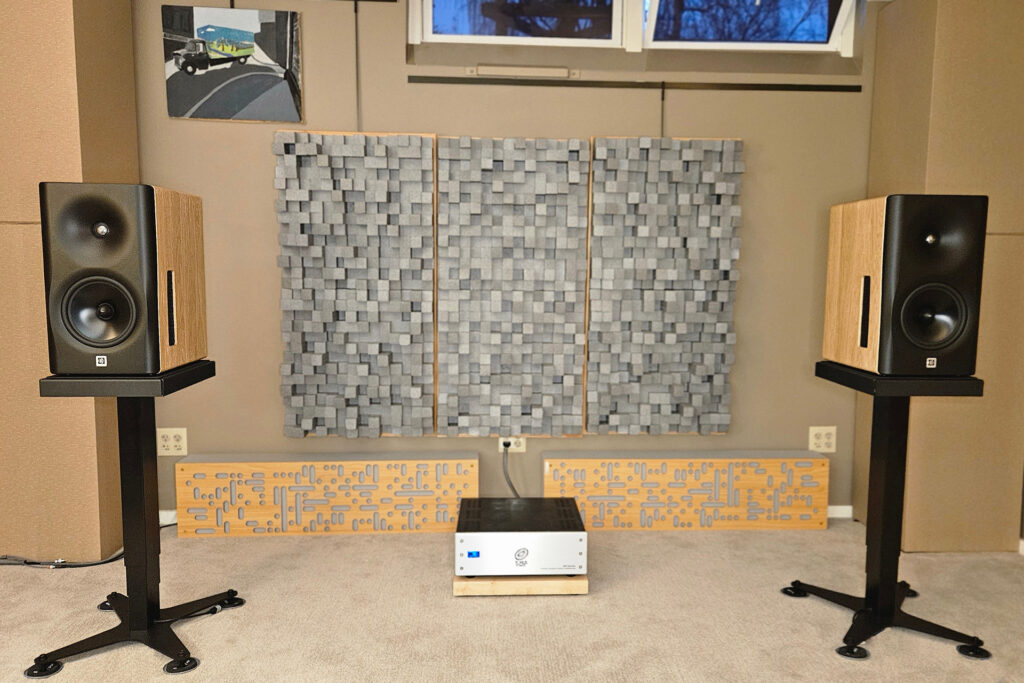
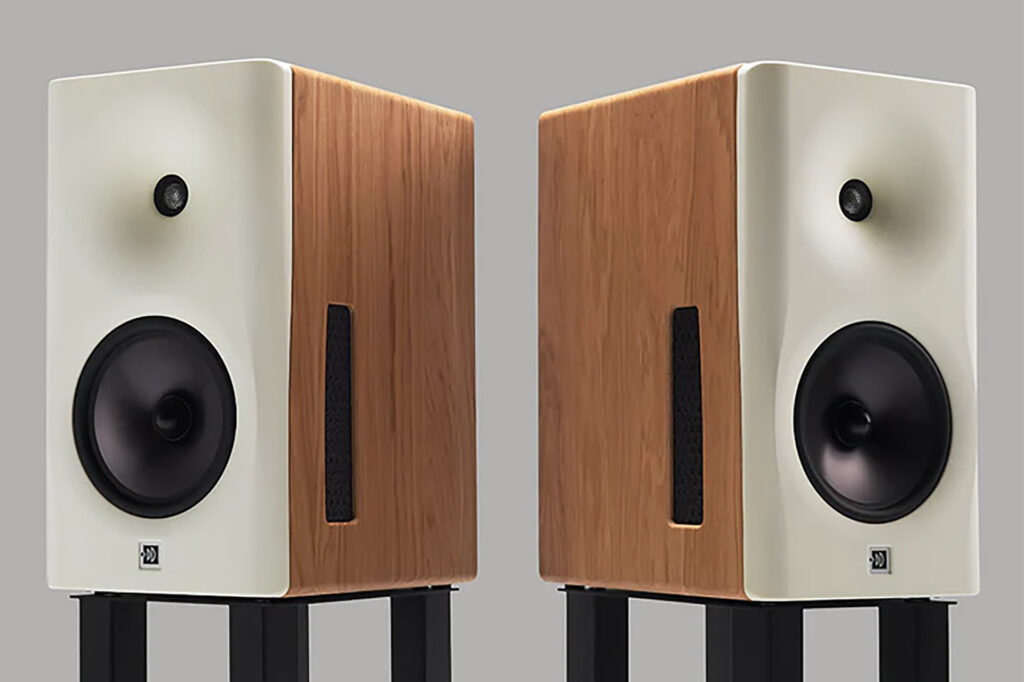
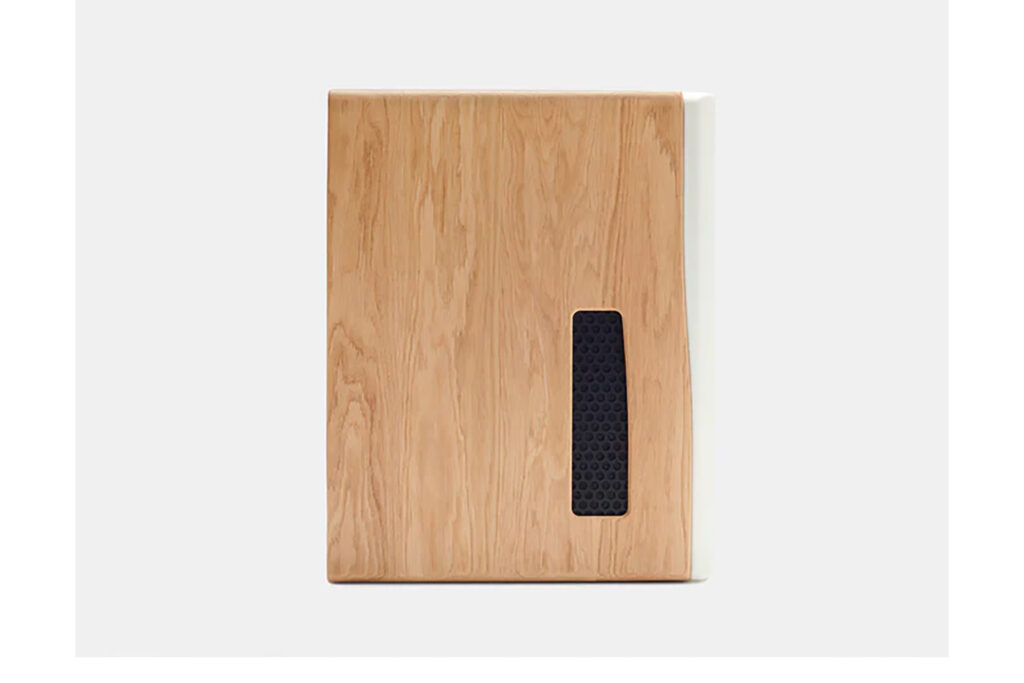
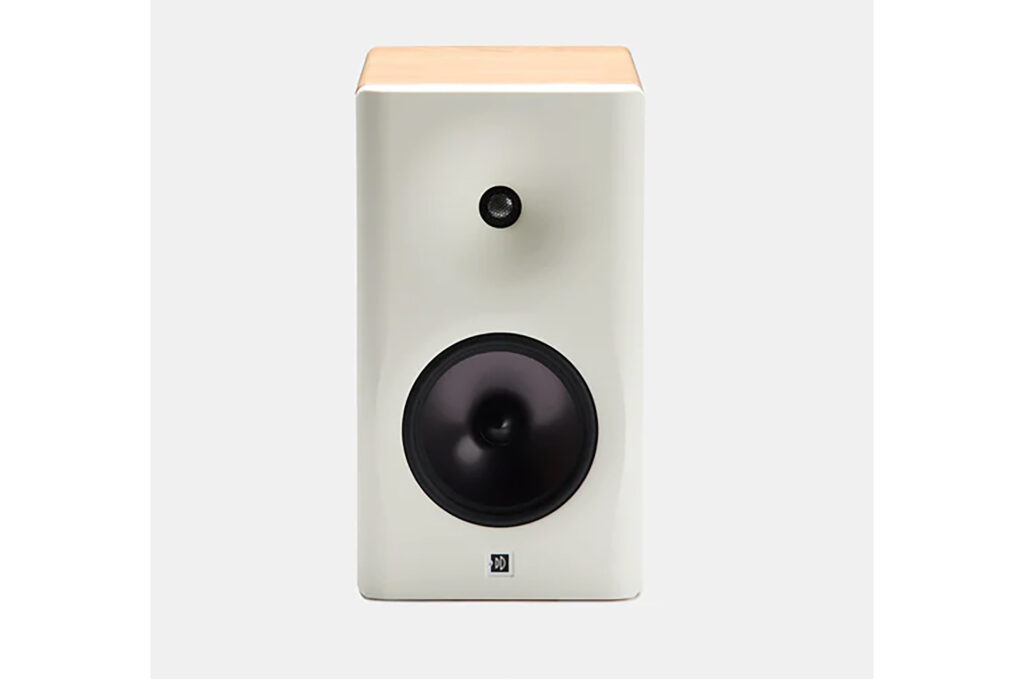
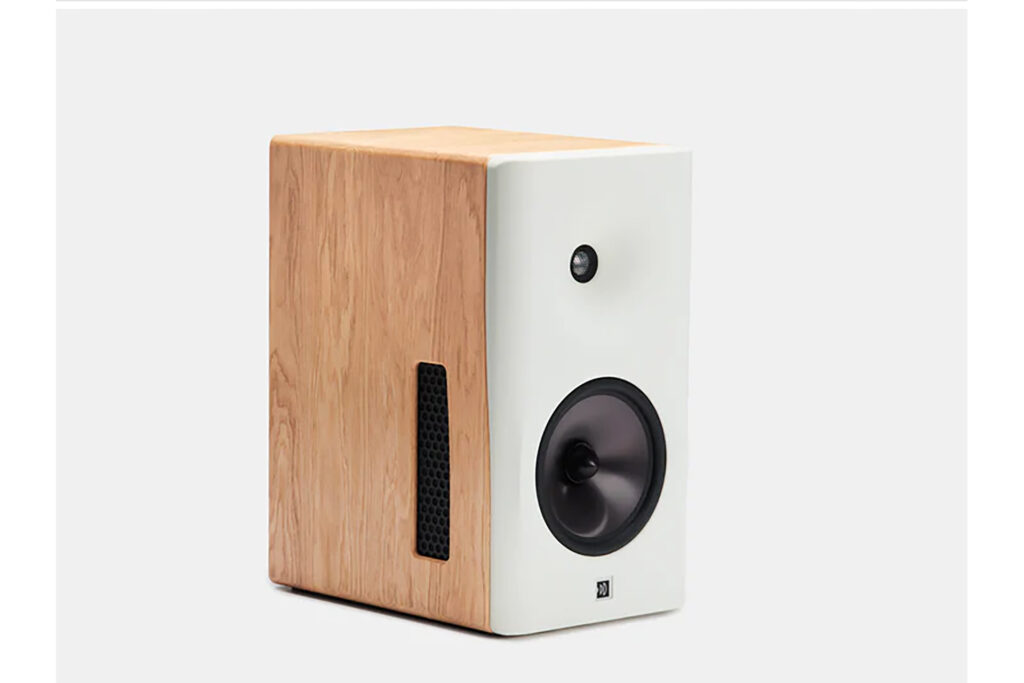
The Dutch & Dutch 8c loudspeaker ($16,500 per pair) is a three-way, active, stand-mounted studio monitor that not only provides full-range playback, but also addresses the acoustic issues described above. Each cabinet (19 inches high, 10.5 inches wide, 15 inches deep) carries a waveguided one-inch alloy tweeter, an eight-inch aluminum midrange/bass driver and, on the rear panel, two eight-inch aluminum bass drivers. Fourth-order Linkwitz–Riley linear-phase crossovers are at 100 and 1,250 Hz. to DSP crossovers use Linkwitz–Riley 4th-order target slopes at 100 Hz and 1,250 Hz, implemented with linear-phase filtering.
Each cabinet also includes analog-to-digital and digital-to-analog conversion (ADC and DAC), preamplification with volume control, a digital signal processing (DSP) engine to handle crossovers and equalization, tri-amplification and, to control and coordinate all this, a small single-board computer. The cabinet is cleverly designed to provide cardioid radiation from the midrange up, minimizing sidewall reflections and other negative room interactions. There is a cooling fan, but if it went on during my listening sessions, I didn’t hear it.
In summary, Dutch & Dutch (D&D) 8c uses cutting-edge engineering in service of art to address some of the most pervasive problems of audio reproduction today, namely, problems arising from the speaker’s interface with the room. How successful has D&D been in this venture? Let’s find out …
What Makes the Dutch & Dutch 8c Loudspeaker So Special?
- The Dutch & Dutch 8c is an all-in-one audiophile system. If you have Spotify or a Roon server available, you can play music simply by plugging the speakers into a wall outlet and connecting them by Ethernet to your home LAN. You can add one further source – balanced analog or AES3 digital – through the rear-panel XLR input.
- Line-level analog sources, like tape decks, CD players, or output from a phono preamp, are not forgotten, as they are handled through the speaker’s built-in ADC. To examine the quality of the ADC, I listened to several familiar high-res tracks by routing my Topping DX9 DAC into the 8c’s analog input. This arrangement produced excellent sound, with perhaps a slight reduction in ambience compared to the direct streaming input. I can’t say how much of that difference is from the Topping DAC and how much is from the 8c’s ADC. Either way, I would not hesitate to use the 8c with a mixture of digital and analog material.
- The Dutch & Dutch 8c has power to spare. Each speaker is tri-amped, with 250 watts feeding the tweeter, 250 watts the midrange driver, and 500 watts the low-bass drivers on the rear panel. According to D&D, maximum continuous output at one meter is 106 dB from 35 Hz up, which should be plenty, even in larger rooms at home. In practice, the 8c played louder than I ever needed.
- Frequency response of the Dutch & Dutch 8c varies little between on- and off-axis listeners, and even standing up causes little change in sound character. There’s no “head in a vise” listening here. The most significant difference I noted was that listeners out of the central spot avoided the typical mid-room bass null and thus heard a bit more bass.
- The Dutch & Dutch 8c uses controlled dispersion to reduce interactions with to reduce interactions with the ceiling, side walls, and the front wall, reducing harsh first reflections and slap echo. This design lessens or eliminates the need for acoustic treatments and, in my room, listening panels. I thought the 8c reached its highest performance after I had removed much of the room’s usual acoustic treatment.
- Front-wall bass cancellations are reduced with DSP. In the low bass, the 8c uses the wall behind the speakers for reinforcement, with direct and reflected sound time-aligned through DSP to avoid cancellations. This clever arrangement gives tighter, more even bass response.
- The Dutch & Dutch 8c includes digital room correction (which D&D calls Room Matching). To set this up, you use free Room EQ Wizard software (REW, available for most platforms) and a calibrated microphone, such as a mini-DSP UMIK-1 (about $150). I found this approach effective at smoothing out bass bumps, and I appreciated the wide control over the sound it gives to the user.
- To improve sonics of badly-recorded or -mastered material, additional equalization presets, which D&D calls Voicing, can be layered on top of the room correction. Voicing presets can include low bass, bass, and treble adjustments, as well as parametric equalization. This approach keeps your room correction setup unchanged while you re-equalize recordings that need a little help. I found the voicing feature a great way to improve otherwise unpleasant releases.
- The D&D 8c periodically receives new features through free firmware upgrades. Roon Ready certification and room correction with REW, for example, were added years after the 8c was first released. Qobuz Connect and Tidal Connect are currently in development. It’s a happy day when any manufacturer makes its products more capable at no cost to existing owners.
Why Should You Care About the Dutch & Dutch 8c Active DSP Loudspeakers?
The Dutch & Dutch 8c is a great choice for the audiophile who wants a full-range, high-performance audio system without a rack of components and associated cables, and who might appreciate being able to place the speakers near the front wall, as recommended by D&D for best bass reinforcement. The Ethernet input makes the 8c an especially attractive product for a streaming-based system, though it’s quite capable with analog sources. The 8c, then, is a visual, sonic, and value proposition: an easy-to-place loudspeaker without the clutter of audio equipment, an active speaker with low distortion, neutral response, and plenty of power, and a system that skirts most acoustical problems without requiring acoustic treatment. The value comes not just in the quality of sound for the price, but in the many items (e.g., speaker cables, streamer, amplifier) that the owner doesn’t need to buy. Just hook it up and enjoy music at a very high level.
Some Things You Might Not Like About the Dutch & Dutch 8c Loudspeakers
- A network connection and tablet or computer are needed to set up and operate the 8c. That doesn’t bother this Roon user and, in a time when you seemingly need an app for everything, it’s hard to see this bothering anyone interested in a DSP-based speaker like the 8c. Certainly, no one sold on the vast music libraries available through streaming will object to needing a network connection.
- There is no physical volume knob or remote. As expected, volume control through the Ascend app works well and, alternatively, Roon controls the 8c’s volume natively. I did, though, miss having a knob or remote at hand to adjust volume without navigating around a screen.
- The Dutch & Dutch 8c’s two inputs won’t be enough for everyone. Audiophiles with many source devices will need a separate preamp or switchbox. Single-ended analog sources are best connected through a preamp with balanced outputs or another method that will avoid hum-inducing ground loops from some adapters. Yet today’s audiophiles (like me) who value simplicity will be content with one or two inputs. I use only Roon, through which I easily access my rips and downloads and all of Qobuz.
- The 8c’s Ascend software can be quirky, and users will need time to use it efficiently. Ascend initially sent me into a software loop. U.S. distributor Bill Chi quickly steered me in the right direction and, once past initial setup, I used Ascend without problems. On the plus side, Ascend is responsive, capable, and frequently updated by D&D.
- Using room matching requires familiarity with REW, with its considerable learning curve. As an occasional REW user, I had a leg up, yet REW (on Windows) repeatedly failed to communicate with the 8c. Just as I was about to give up, a new version of REW appeared, and I could get room matching working as intended. Not much documentation on this is sent with the speakers; I recommend a web search on “REW Room Matching Guide” to find D&D’s guidance, both written and via YouTube.
Setting Up and Listening to the Dutch & Dutch 8c Loudspeakers …
The 8c pair I received developed a faulty speaker, perhaps from prior wear and tear. The replacement pair worked flawlessly. This is no concern, as things happen in the review process. They just do, and D&D handled the matter with aplomb.
To set up the speakers, I started with D&D’s recommendations, then experimented widely with positioning, including distance between the front wall and the speakers, distance between speakers, and distance between speakers and listener. In each layout tried, I put those distances into Ascend (which takes a few minutes), listened, and measured the response. If I thought the spot was a good candidate, I then did a full room-matching run, which involves taking several measurements with REW, averaging them, generating correction filters, and loading them into the 8c. This process took about 30 minutes the first time I did it, and considerably less as I gained experience.
The speakers wound up about 31 inches from the front wall, 86 inches from each other, and 105 inches from my ears. That’s further from the front wall than D&D considers ideal, but necessary because of the structural quirks of my room. While moving the speakers around, I gradually reconfigured the acoustic treatment in the room, aiming for the best imaging, staging, and tonality. When I had removed most of the treatment from the front wall and nearby side walls, the speakers really began to sing. After room matching, measured response was mildly sloping down with frequency and exceptionally smooth from 15 Hz to 20 kHz.
American singer-songwriter Eva Cassidy was considered by some to be among the best folk-pop-jazz vocalists ever, both for range and purity of her voice and for her expressive talent. When I put on “Ain’t No Sunshine” from the live album Nightbird (Qobuz, 16/44.1), I was impressed by how well the 8c responded. Cassidy’s voice, in a stable image, was presented cleanly and without strain, even when she belted it out in the upper octaves (and she could belt it). Though this is not a bass-heavy recording, the 8c’s solid, even bass response laid an excellent foundation for the track. Overall, the sound had a natural, unforced quality that I haven’t heard from all speakers playing this simple but demanding track.
Mozart wrote “Ave Verum Corpus” (K. 618) in 1791, the year of his death, for the feast of Corpus Christi. This brief motet, scored for choir, organ, and strings, is six-and-a-half minutes of contemplative true beauty. Its recording on the Chandos album “Neeme Järvi in Concert” is not an audiophile spectacular, but deserves the “audiophile” tag for conveying the feeling and sound of a live performance heard from the audience. The Dutch & Dutch 8c generated a magnificent sense of space behind the speakers and a strong impression of being in the performance hall. The organic quality of the recording was a delight, and I don’t know how the playback could have been better than through the 8c.
When I want to hear a song of vengeance and destruction, but I’m not in the mood for Italian opera, I put on Jazmine Sullivan’s “Bust Your Windows” (Qobuz, 16/44.1). The Dutch & Dutch 8c did a superb job with this highly-produced track, too, with every word of Sullivan’s vocals clear, despite the old-Hollywood-style strings in the center, what sounds like a tuba to the left, clap-like percussion to the right, and a strong bass drum line coming in partway through. The bass went low and loud, and I did not miss my subwoofer for even a moment. Unravelling all this clearly without sounding analytical is one mark of an exceptional speaker, and here the 8c hit a home run.
Will the Dutch & Dutch 8c Active Loudspeakers Hold Their Value?
As a rule, audio components lose value as underlying technology leaves them behind, a process considerably quicker for digital components than analog ones. Still, I expect the 8c to retain value better than most active speakers. The 8c has been a current model (with gradual price increases) since 2017, avoiding the immediate loss on the used market when a product is discontinued. During that time, D&D has added valuable new functionality through free firmware and software updates, including Roon Ready certification, the custom interface to REW, and soon Qobuz and Tidal Connect. It surely also helps resale that the 8c has been received enthusiastically in both the audiophile world and the recording industry, which has strong adoption in recording/mastering studios as well as home systems. All these factors suggest that the 8c will be in strong demand on the used market.
What is the Competition for the Dutch & Dutch 8c Loudspeakers?
Here are a few models that seem worth considering by anyone interested in the Dutch & Dutch 8c. I have not heard them, but each is from a well-respected manufacturer, and I would expect each of them to sound great in the right system. At any price point, speakers are a matter of taste, so, as always, I urge audiophiles to try before you buy.
Dutch & Dutch has announced a smaller model, the 6c ($10,600 in standard colors, $11,600 in premium colors), that includes the technology of the 8c, slightly less bass extension, and promises a simpler interface for room matching. The 6c should be available for delivery early in 2026. Later in 2026, the 6S cardioid bass module (price to be announced) will arrive, which transforms the 6C into a full-range floorstanding speaker.
A close competitor in both price and features is the Kii Three active DSP loudspeaker ($15,585 with control module, $31,875 with BXT bass modules, which converts the Three into a floorstanding speaker with extended bass). This model, reportedly another favorite in recording and mastering studios, addresses similar acoustics issues to the D&D 8c. The optional controller, needed for volume control, has a volume knob. The Kii has an excellent pedigree: the chief technology officer of Kii Audio is Bruno Putzeys, one of audio’s most innovative engineers. That Putzeys and D&D’s Martijn Mensink both come from the Benelux countries points to a serious concentration of audio talent in the Low Countries.
Active speakers are prevalent in the professional audio space, and that is where you might find a pair of ATC SCM50A Pro monitors ($21,000). This three-way ported monitor has a one-inch tweeter, three-inch midrange, and nine-inch woofer, all manufactured by ATC, and plenty of tri-amped power. The ATCs accept an analog signal, and they do not have the special acoustics engineering of the D&D 8c, so more care will be needed in room treatment and speaker positioning. Their reputation is for smooth frequency response, excellent dynamics, and low distortion.
Coming from an audiophile maker with several active speakers, the KEF LS60 Wireless ($5,999.99 a pair … buy at Crutchfield) offers network, single-ended analog, and coaxial and optical digital inputs. These floorstanders use the proprietary KEF Uni-Q driver; woofers are four 5.25-inch drivers per side, with DSP used to increase their output within safe limits. Some DSP presets are provided to shape the sound to the room, but the LS60 doesn’t have the degree of control found in the Dutch & Dutch speakers or the Kii Three. I think they provide a lot at their price point.
Final Thoughts on the Dutch & Dutch 8c Active DSP Loudspeakers …
When the 8cs arrived, I was eager for a first listen. Setting them near where my reference speakers go, I was impressed by how much smoother their bass response was with no DSP than that of most speakers I’ve tried. Engineering at work.
Since I particularly love acoustic music, from solo mandolin to symphony orchestra, I was pleased that the 8c’s tonal balance avoids two common quirks of audiophile speakers: a broad dip around 100-300 Hz and a boost around 10 kHz. The dip makes for seemingly tight bass, but detracts from warmth and fullness in piano harmony, bass guitar, and cello. Without it, the D&D 8c had a warm musical balance. The peak presents as clarity and sparkle, but ultimately can cause listening fatigue. In contrast, the 8cs sounded natural and on some tracks a bit dark, yet they were as musically detailed as any speaker I’ve heard. The occasional perceived darkness was, I think, just a reflection of those recordings’ own sound. Indeed, a member of my listening panel noted that, every time he thought he heard a coloration in the 8c, his perception changed when the next track played, leading him to conclude that the 8c gives an unusually accurate view of each recording’s own sonic flavor.
For those wanting to step off the upgrade merry-go-round, the Dutch & Dutch 8c seems a natural choice. Its adaptation to acoustic conditions without extensive room treatment or a separate DSP unit is remarkable. It simplifies the audio system, and it neither glosses over nor exaggerates anything. In my room, it went deep enough even for pipe-organ music. All in all, the 8c is one of the most engaging speakers I have heard – an engineering tour de force in service of music.




Decades ago, I attended CES in Vegas. I was listening to some fine speakers but the price was way out of my comfort zone. These were 5 figure speakers. Now, I don’t recall the vendor, but I asked the sales person, what made these speakers so expensive? “Do they have gold surrounds? Maybe magic zebra hair wrapped wires or something?”
He answered, “You asked the wrong question. You should be asking why we didn’t offer these speakers for 10x more.”.
I took the bait, “O.K. Why don’t these cost 6 figures?”.
He smiled and said, “ First off, It has nothing to do with the cost of the build materials. It is all about the consumer we target. We aim to sell to folks that don’t flinch at a 5 digit price but hesitate at 6 figures. We price for maximum profitability..”
It is nothing about the build price and all about the type of consumer. That conversation has stuck with me for decades.
I guess I’m living in the 4 digits world.
I am with you man.
Audio doesn’t have to be expensive to be good but there are companies who BAN US from their budgets because I question the value of a $500,000 DAC