
 By
By If there is an audiophile company that needs no introduction, it’s Bowers & Wilkins. Their legendary speakers are used in some of the most famous studios in the world, including Abbey Road and Skywalker Ranch. When I learned that I was going to have their top-of-the-line subwoofer, the DB1D, sent to me for review, I was excited. One of the great privileges of writing audiophile reviews is that you get hands-on time with all kinds of different gear, some from exotic small boutiques and sometimes others from legendary companies like Bowers & Wilkins.
This audiophile subwoofer, priced at $7,200, features dual 12-inch aerofoil cone drive units, has a frequency response between 10Hz and 350Hz, has a digital preamplifier built in with “Dynamic EQ,” and works with an app to configure the settings. A subwoofer isn’t a piece of equipment that anyone should move on their own, and this one is no different. It is 18.1 inches high by 16.9 inches wide by 16.1 inches deep, weighing a backbreaking 96 pounds.
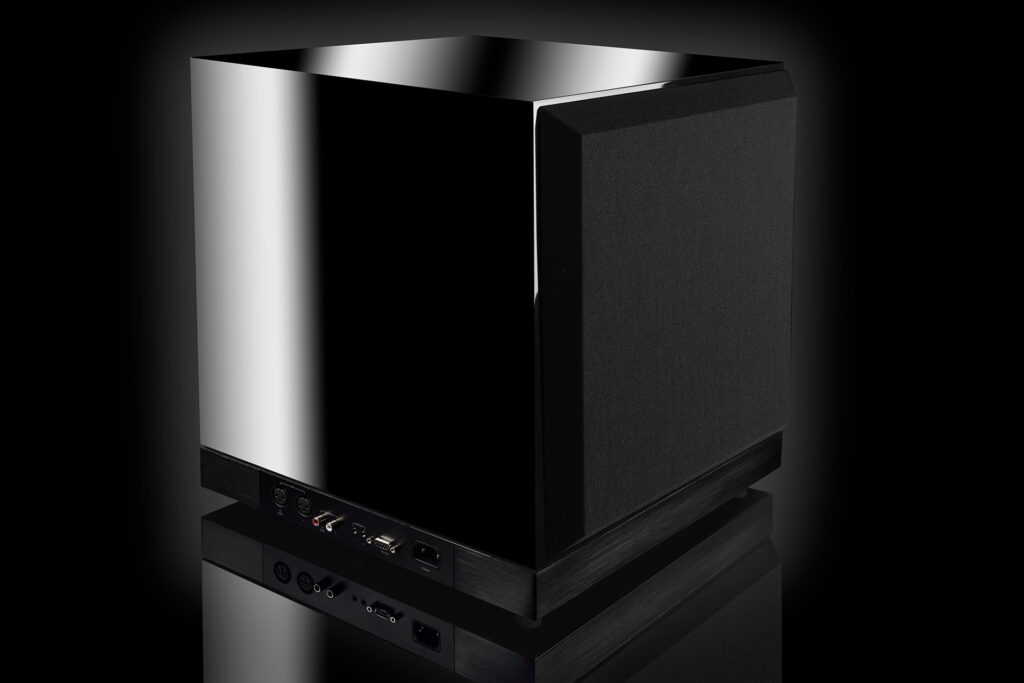
What Makes the Bowers & Wilkins DB1B Subwoofer So Special?
- The Bowers & Wilkins subwoofer app makes setup easy. One of the most daunting things about adding a new subwoofer to your system can be finding the right place for it. The app that Bowers & Wilkins use for their subwoofers makes it easy. It has room EQ built in, so you can place it and it will run room correction using your phone, just by placing your phone on the app and clicking a button. You can adjust the crossover from it and adjust the EQ as well.
- The Bowers & Wilkins subwoofer DB1B goes low. Not every subwoofer measures down to 10Hz, which is well into the subsonic region of frequencies that you can actually feel.
- The finish on the Bowers & Wilkins DB1D helps it blend into the room. At its base, the DB1B is a large box with two woofer cones in it, but the black gloss finish stays shiny and looks great.
- There are different feet options on the Bowers & Wilkins DB1D, which proved very useful. This is the first subwoofer I have reviewed that came with different options for the feet. You have spikes for carpet, or rubberized feet that you can use on non-carpeted surfaces. All of this is with the idea of reducing as much vibration as possible, so you can hear the bass without everything else in the room rumbling.
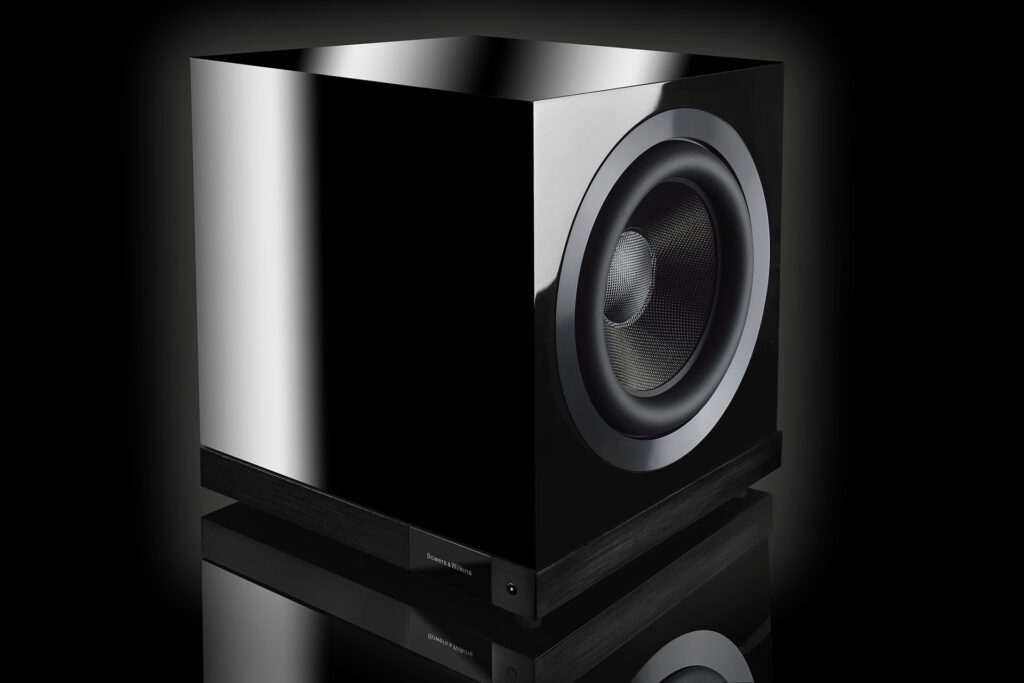
Why Should You Care About the Bowers & Wilkins DB1B Subwoofer?
When you have a large listening room, you’re going to need a large subwoofer (or two or three or four) to fill in the bass and sub-bass frequencies that your speakers won’t articulate quite as well. The Bowers & Wilkins DB1B, with its two 12-inch cones, can pressurize a large room in ways that some other subwoofers simply cannot. Also, with two cones inside the same box, it is more like you have two subwoofers instead of one.
Some Things You Might Not Like About the Bowers & Wilkins DB1B Subwoofer
• The Bowers & Wilkins DB1D subwoofer only features inputs. If you’re using an analog-only preamplifier, you might find yourself limited to only being able to use one of these subwoofers. As it only features inputs, you don’t have the ability to daisy-chain it with a second or third subwoofer.
• The grilles fall off this subwoofer a little too easily. Bowers & Wilkins chose to attach the two grilles using magnets but, in my usage, I found that the grilles fell off with just a nudge. Not a big deal, but it can be an annoyance to have to re-attach the grilles repeatedly.
• All configurations and setup details are handled in the Bowers & Wilkins app. To keep the look of the subwoofer simple and sleek, all the subwoofer’s configuration is handled by their app. This isn’t necessarily an issue, but if you lose connection between the app and the subwoofer, you have to troubleshoot the connection issue right away, instead of being able to just make a few adjustments from the back of the subwoofer. The plus side to this, though, is that you can adjust everything from the listening position, instead of having to run back and forth between the listening position and the subwoofer.
• Even more so than many other subs in its class, the DB1B is very heavy. This shouldn’t come as a surprise, but it is worth mentioning. The box that holds the woofers is very solid and, when you add in the 2,000-watt Class-D amplifier that is powering the woofers, you’re going to have some weight. Make your dealer install this sucker or hire someone from Thumbtack.
Listening to the Bowers & Wilkins DB1B Subwoofer …
I tested the Bowers & Wilkins DB1B subwoofer with my SPL Elector preamplifier (read the review) and the Anthem MCA 225 Gen 2 amplifier, with a Bluesound Node streamer as a source, paired with Paradigm Founder 80F speakers. With the SPL elector being an analog preamplifier, I used the line-out from it, and the Bowers & Wilkins subwoofer app to handle all of crossover and configuration of the subwoofer.
When testing subwoofers, one of the tracks I like to use is from Alexisonfire (pronounced Alexis on Fire), titled “This Could be Anywhere In the World” (Qobuz 44.1 kHz) from their 2006 album Crisis. This track is found on the Canadian post-hardcore punk band’s third album. It likely isn’t the typical track you would look to for testing a subwoofer, but what makes it unique is that there is a 34 Hz C flat note that hits regularly that goes along with the drums and the bass guitar. The DB1B was able to handle this regular low note with ease, and recovers to pick up the next incoming bass note immediately after it.
The next track that I used to test the Bowers & Wilkins DB1B subwoofer was The Prodigy’s “Breathe” from their 1996 studio album The Fat of the Land (Qobuz 44.1 kHz). This is The Prodigy’s third album, and the first one to have vocal tracks but features all of the electronics that the band became known for. What makes this track remarkable for a subwoofer is that so much of the sound on it is in the 40-60 Hz frequencies, which allows you to get an understanding of how tight the bass response is going to be from the subwoofer. Despite there being so much work for the DB1B to do on this track, the bass remained clean and never sounded muddy.
The last track I used to test was “One More Time” from Daft Punk (Qobuz 44.1 kHz). This track from the French pair is featured on their 2001 album Discovery (learn more on Wikipedia). This track marked the start of Daft Punk’s commercial success. At the time, it was a global hit and a regular in dance clubs around the globe. This track doesn’t seem to go as low as the previous two tracks that I used, but the groove produced by the bounce can prove to be a challenge for a subwoofer if it isn’t integrated properly. You get a bouncy bass sound that comes in around 40 Hz and goes nearly every second or so for the entirety of this five-and-a-half-minute track. Again, the Bowers & Wilkins DB1B handled this gracefully, as the groove stayed locked in.
Will the Bowers & Wilkins DB1B Subwoofer Hold Its Value?
The Bowers & Wilkins DB1B should without a doubt hold its value. This is a great product, coming from a blue-chip audiophile loudspeaker brand. Subwoofers can be tricky to sell, as they are very expensive to ship but, if you can find someone local, you should be able to move it quickly and get a solid return on your investment.
What is the Competition for Bowers & Wilkins DB1B Subwoofer?
The closest competition to the DB1B is the Carbon Special Black Label ($6,900 – sold at Magnolia and specialty dealer) from REL. Like the Bowers & Wilkins, the REL features two 12-inch drivers. While it and the DB1B are both side-firing, the REL Carbon Special Black Label has one forward-firing driver and one down-firing driver. This REL subwoofer is also designed to be able to be put into a series of equipment. One notable drawback to the REL is that it features significantly less power, with its amplifier at only 900 watts, which may matter to some audiophiles. That doesn’t bother me at all, nor should it bother you. It is important to note that REL sets up their subwoofers differently by using a feed from the amp – not a line-level preamp.
Another competitor to the Bowers & Wilkins DB1B Subwoofer is the Paradigm XR13 ($4,999). The Paradigm XR13 benefits from being able to leverage ARC Genesis room correction directly for the subwoofer, and it has a whopping 2,200 watts available to it for power for its singular 13-inch driver. This is a few thousand dollars cheaper than the DB1B. It comes in multiple colors, and it also features line-level inputs if you want to connect the subwoofers directly to your speakers instead of to your preamplifier or integrated amplifier.
If you are working with a much smaller budget but still want to plenty of bass, you can consider the SVS PB-17 Ultra ($2,999 buy at Crutchfield). While this subwoofer might be less than half the price of the Bowers & Wilkins, it features a 17-inch driver and an incredible 2,800 watts of power, which should make it well-suited to handle any dynamics you might want to throw at it. SVS is very well known for their subwoofers, and Brian Kahn raved about this subwoofer in his review, calling it a “system cornerstone.” Read his review of the SVS PB-17 subwoofer here.
Final Thoughts on the Bowers & Wilkins DB1B Subwoofer …
It is incredible how much adding a well-integrated subwoofer into your audiophile system can level up your enjoyment of your music across the entire sonic spectrum. You truly don’t know what you’re missing until you add one or even take one away (a great test, aka “the takeaway close”). With the DB1B, Bowers & Wilkins have taken all of the hard parts that come with integrating a subwoofer into your room and made those easy.
Bowers & Wilkins suggests the most likely locations for you to put the subwoofer, and then they add an automated EQ that will allow you to integrate it with the space you have chosen to help ensure that bass sounds the best it possibly can. There are times when bigger isn’t always better, but let me tell you firsthand, in this case, bigger was definitely better. I got all the bass I could possibly want for my room and never had to worry about anything rattling, as the DB1B controlled the bass with grace. If you are looking for a subwoofer and you can shop in this price range, you owe it to yourself to check this one out, as it is an absolutely worthy competitor.



