
 By
By I would imagine Harry Weisfeld’s initial main goal, when he started his company in 1978, was to make a turntable he could sell to a few enthusiasts in and around his Cliffwood, New Jersey home – not surprisingly, the current headquarters for VPI Industries. What emerged from his first product, ironically enough a record cleaner, has become one of the more globally respected manufacturers of audiophile turntables in business today. Recently retired, Weisfeld passed along his company to his son, Matt, who continues the traditions first adopted in 1978 with a youthful enthusiasm that is about as “Future Audiophile” as any company in the industry this side of Lucca Chesky.
VPI has audiophile turntable models that range from very affordable (a review of their more entry-level VPI Cliffwood is pending) to five-figure prices. For instance, the lineup includes the entry-level Traveler, retailing for about $1,500, up to the flagship Titan Direct, which retails for a cool $64,000. Needless to say, VPI is well-equipped to accommodate almost any budget. In this review, we will take a close look at the Signature 21 turntable. The VPI Signature 21, it should be noted, is an improved version of the Prime 21 and the Signature DS. All three turntables began as a similar product, with the DS one step above the Prime 21, and the Signature 21 the best of all three. There are also options for different tonearms and even cartridges across the entire VPI product line. Customization, therefore, exists to a certain degree among all VPI turntables.
What Makes the VPI Signature 21 Turntable Special?
- I was impressed, right out of the box, as it were, by the packaging. VPI not only has the turntable very intelligently packaged, they also provide a printed guide on how to repack the turntable as originally shipped. For a reviewer, this is highly welcome. This guide also makes repacking the turntable in case of a move very straightforward. Moving equipment is another reason the original packaging should always be saved.
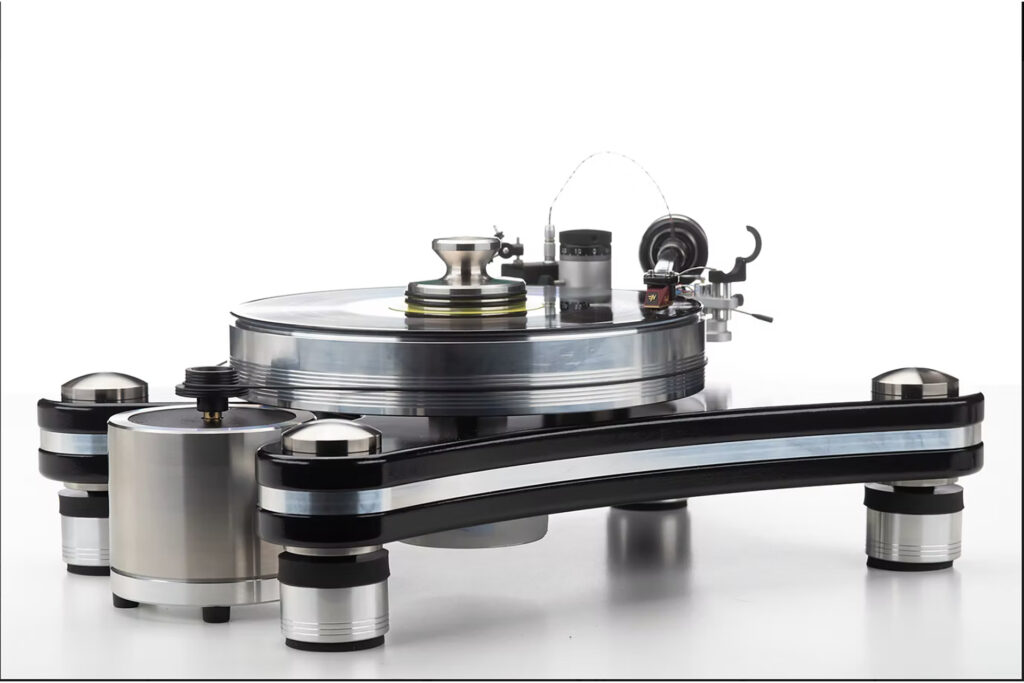
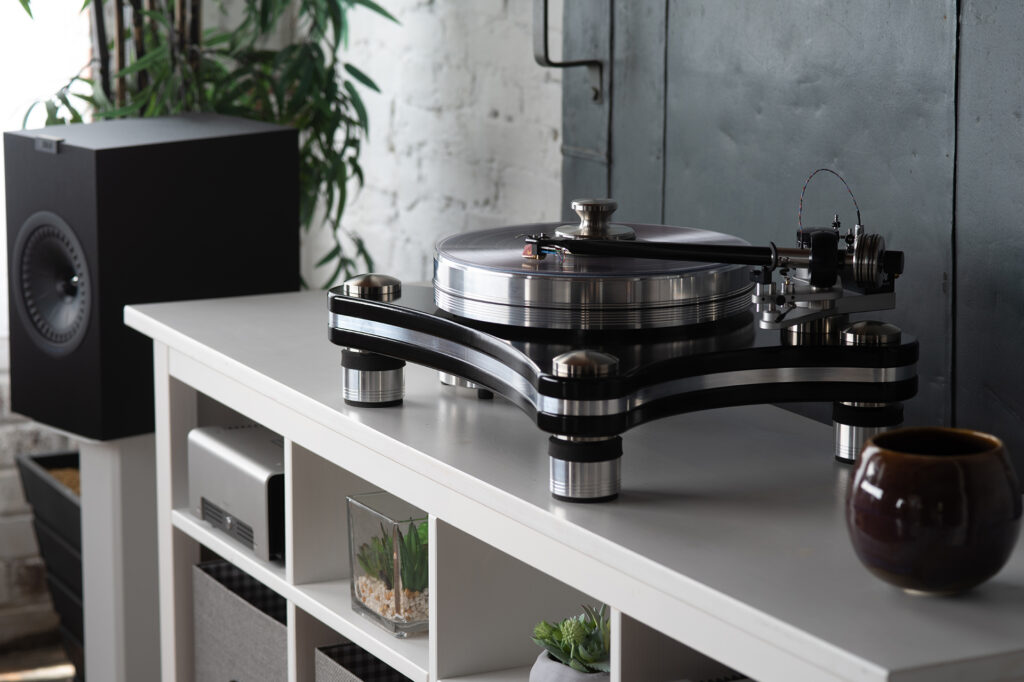
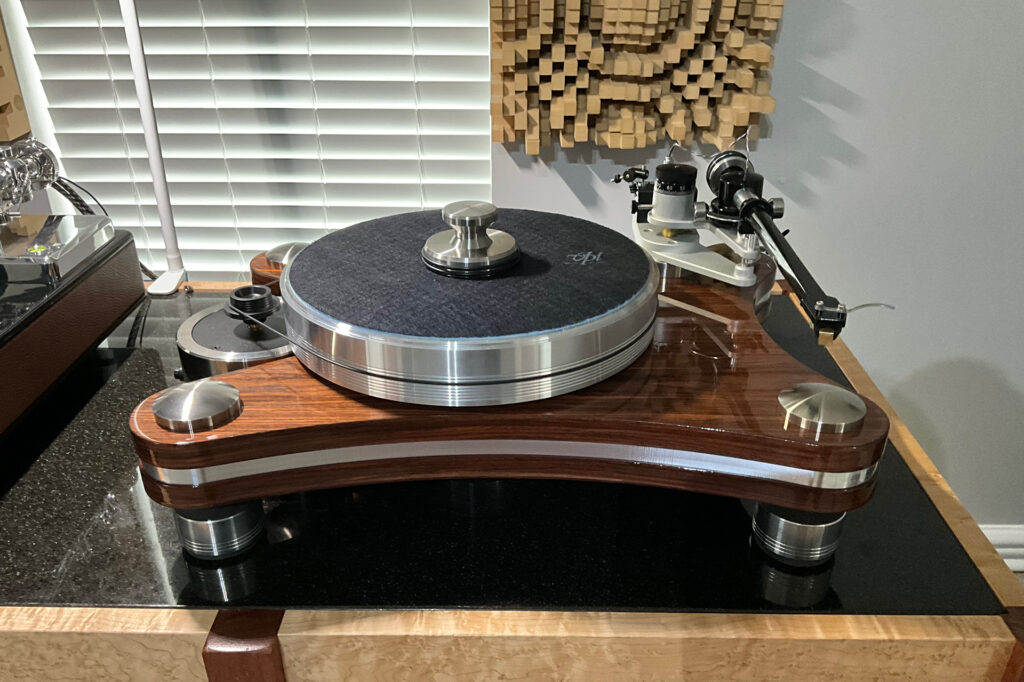
- The plinth on the standard version consists of two layers of vinyl-wrapped MDF on either side of a layer of stainless steel/. All three layers are then bonded together with silicone. This combination of materials, sandwiched together in a constrained layer-dampening configuration, serves to reduce vibrations from the turntable chassis to the cartridge. My review sample utilized a limited-edition rosewood finish which replaced the piano gloss, vinyl-wrapped MDF finish supplied as standard. The standard-edition piano gloss finish on the chassis retails for $8,700, as opposed to the thousand-dollar increase for the rosewood finish.
- Visually, the rosewood finish is absolutely stunning. I realize most audiophiles are predominantly concerned about sonics, and rightfully so, but this turntable in rosewood is an eye-catching thing of beauty.
- The main drive is by a 300-RPM, 24-pole, AC-synchronous motor with claimed accuracy of plus or minus 0.0005 inches. The motor housing is made from stainless steel to ensure noise is not transmitted to the chassis. Powering on the motor is accomplished by activating a side-mounted button on the motor housing.
- The motor is ingeniously contained in a separate enclosure and is not directly attached to the main body of the turntable. Heavy rubber feet provide a rigid base. These features translate to an appreciably decreased possibility for motor-induced vibrational distortion. For a turntable in this price class to offer a separate chassis for the motor is impressive.
- The turntable motor offers speeds of 33.3 RPM and 45 RPM. There are no provisions for 78 RPM. One thin, round belt connects the motor pulley to the platter.
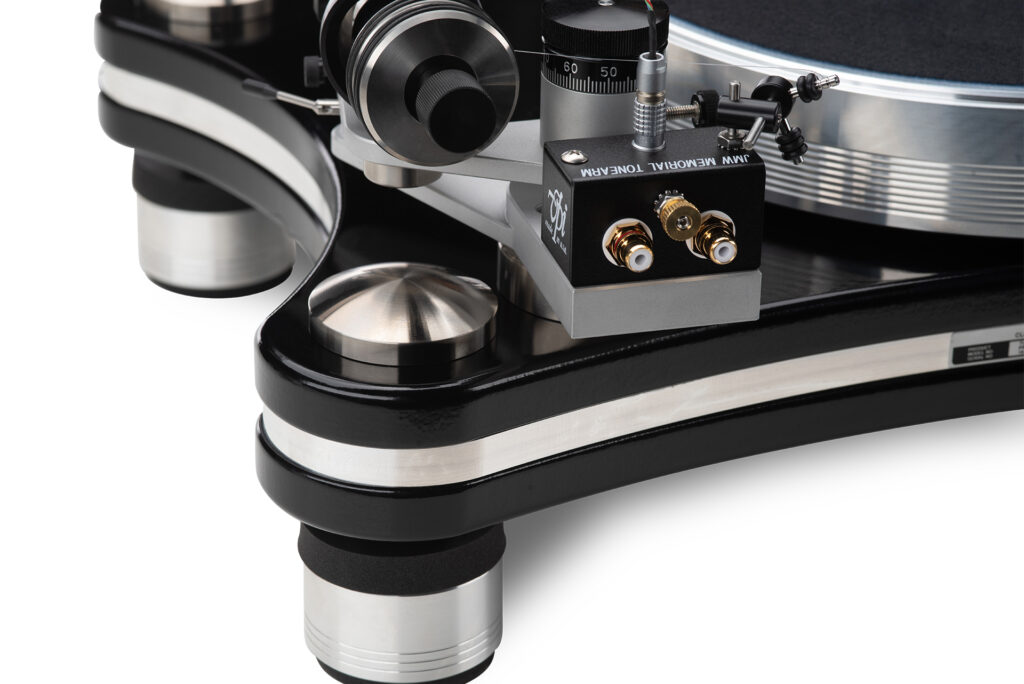
- The tonearm comes standard as a gimbaled design. This replaced the Unipivot design VPI used for many years. Personally, I prefer a gimbaled design because it basically eliminates azimuth settings. However, for those who prefer the design characteristics of a Unipivot tonearm, VPI offers it as well. My review sample was supplied with a Unpivot tonearm.
- Like most tonearms currently offered by VPI, both the gimbaled and the Unipivot designs are manufactured by a 3D printing process. Aluminum tonearms are also available. Sizes range from an eight-inch tonearm to a 12-inch version. VPI offers standard wiring in the arm tube or a premium Nordost Reference wiring option. My review sample was the 10-inch 3D-printed “Fat Boy” tonearm with Nordost wiring.
- The VTA, or vertical tracking, is accomplished by a dial calibration method. The dial is marked to provide a visual reference of where the settings were and should be. It is even possible to adjust the VTA during the playback of an LP. There are those enthusiasts who prefer to slightly alter the tonearm height of a standard-thickness LP, as opposed to a 180-gram version. This dial calibration method provides this adjustment.
- While VPI feels antiskating is not necessary on their turntables, a counterweight system is provided for those who believe it is needed. Because of my past history with VPI turntables, I did not use, or need, the antiskating counterweights for this review.
- Making the electrical connection from the tonearm to the turntable is very easily accomplished by plugging in a Limo connector. The connection of the tonearm to a phonostage is by means of an RCA cable.
- VPI very conveniently includes some setup tools, most notably an overhang protractor. It is very easy to use and makes setting the overhang relatively straightforward. For Unipivot tonearms, a thin steel rod is included to aid in visually checking the azimuth to ensure the cartridge is properly aligned to the record. This thin rod sits perpendicular to the headshell to allow for visually checking the tonearm balance. For a Unipivot design, I prefer to use my Clearaudio test record with left and right channel tones, and my trusty Fozgometer to ensure left and right channel balance. For those who prefer a gimbaled tonearm design, this is not necessary, since the azimuth is normally preset at the factory.
- For Unipivot tonearms, there are two independently adjusted side weights, one on each side of the tonearm body. These weights aid in zeroing in on the proper azimuth. These side weights are unnecessary on gimbaled tonearms.
- A stylus force gauge is also included. However, as might be expected, it is quite the utilitarian device. I used my preferred Ortofon DS-3 gauge.
- I was very happy to see a screw adjustment for the final calibration of the tonearm downforce. On my past VPI turntables, the only available tracking force adjustment was made by sliding a counterweight back and forth along the tonearm shaft. This could prove very frustrating, because even the slightest movement could make the tracking force too light or too heavy. The screw adjustment is far superior and allows for very precise and efficient calibration of the downforce.
- The platter, a 12-inch diameter, fully-machined aluminum construction, is precision-balanced. Weighing 20 pounds, it is sufficiently heavy to provide adequate mass and rotational stability. The total weight of the turntable is 66 pounds.
- A platter center weight, intended to flatten out a not-so-flat LP, is included as standard. A machined stainless-steel outer periphery ring, intended to completely flatten out an LP, is available as a separate option. The cost of this accessory is $1,300.
- While VPI does not wholeheartedly endorse one, a platter mat is included. As a matter of curiosity, I played LPs with and without the mat and did not find a significantly notable difference. However, when I tried my Herbie’s Way Excellent II platter mat, I actually discovered a marginally cleaner and clearer presentation. Emphasize “marginally.”
- The adjustable feet on the bottom of the chassis were recently redesigned to provide reduced noise. Each foot is independently adjustable to ensure a level plinth.
Why Should You Care About the VPI Signature 21 Turntable?
I see the typical vinyl LP enthusiast as being in one of several categories. One, someone who likes analog but is hesitant to make a significant investment. For this type of listener, a turntable must represent a significant value proposition. Then there are those who are attracted to analog equally as much as to digital and listen to both. This listener is likely more accepting of a slightly higher price point turntable. Lastly, there are the listeners who are almost strictly vinyl enthusiasts. They like digital, but what really warms their heart is a great-sounding LP. Budgets come and go, but the VPI Signature 21 could easily be a very attractive product for the latter two categories. Pricewise, this turntable is likely not so expensive as to cause a dedicated vinyl enthusiast to immediately look elsewhere. And, given the features and sonic performance relative to the retail price, I see this turntable as a real value. If you factor in the stunning good looks, then it is much easier to justify.
Some Things You Might Not Like About the VPI Signature 21 Turntable …
- In order to change the speed from 33.3 RPM to 45 RPM, the belt must be manually moved to a different-diameter pulley. A push button speed selection, particularly at this price point, would be very welcome.
- There are no provisions for fine calibration of the motor speed. There are several other turntables at or near this price point that offer this capability.
- There is no dustcover available. Personally, I feel it would be tragic to cover up the beautiful rosewood finish with a dustcover. For those who feel differently, the availability of a dustcover would be preferable.
Listening to the VPI Signature 21 Turntable
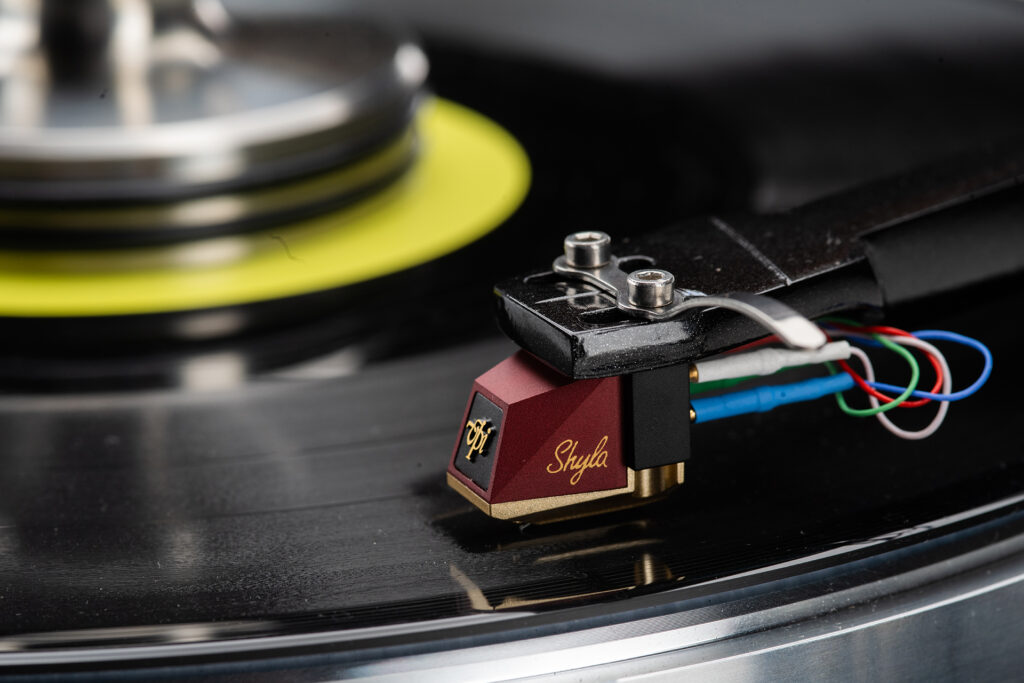
Unfortunately, I have some older LPs that, for one reason or another, are not especially flat. Chalk it up to youthful mishandling. So, despite my general preference for a gimbaled tonearm as opposed to a Unipivot design, I will often appreciate the sonically pleasing presentation, and the virtually unrestricted freedom of movement provided by a tonearm mounted on a sharp point. In fact, I found the sonics on this turntable sounded especially immersive. For the review, I used the Mobile Fidelity Ultra Gold MC cartridge, which retails for $1,495. This proved to be a very suitable cartridge for this turntable. My tonearm cable was my reference Nordost Valhalla 2, which carries a retail price of $4,999.
Overall, I found a very lively performance across a wide variety of LPs. The VPI Signature 21 proved to be a very revealing turntable. I was the very happy recipient of an impressively detailed presentation on most LPs I played. I was treated to wonderful sonic performances on especially excellent recordings. Likewise, poor recordings, not surprisingly, sounded dreadful. This dichotomy is something I expect and prefer.
I was somewhat taken aback at the impressive dynamic presentation. I was not essentially expecting a significant dynamic performance, so when it revealed itself, I was quite impressed. I was also really impressed by the imaging. Was it as wide and deep as my digital section? No, not really. Was it as impressive as my reference E. A. T. Fortissimo (read my review) with the F-Note tonearm and the Ortofon MC Verismo cartridge? Considering the almost $45,000 price tag of my current setup, should it be? I was surprised to discover the imaging on the VPI Signature 21 more than held its own against my reference. In fact, it surprised me with how well it did image. Overall, the VPI Signature 21 turntable was really listenable, with very little fatigue. It provided a very relaxed and enjoyable time spent with my LP collection. And of course, it provided glorious aesthetics in the dimly-lit listening session confines of my audio room.
On Mayhem, the newest release from Lady Gaga, the track “Garden of Eden” is representative of the musical style for which this accomplished artist is well known. Despite a somewhat demure beginning, and Lady Gaga’s vocals, which at times are barely above a whisper, this track is high-energy, bass-thumping, fast-moving, and basically raw in its production. On the VPI Signature 21, bass presentation was locked squarely in the middle and had a very notable level of punch and dynamic intensity. It was in fact quite natural-sounding. I suspect this track could do quite well in a dance club where electronica and pounding drums reign supreme. Now, needless to say, this type of environment left me behind years ago, but I have an audio system at home that is fully capable of all the drum and bass pounding I care to employ. And yes, I did some musical pounding of my own, and Garden of Eden, played back on the VPI Signature 21, did not disappoint. I didn’t get up and dance, but my feet were sure tapping to the music.
I first became intrigued by the Billie Eilish track “Lunch” from her newest release, Hit Me Hard and Soft, because of the driving drums, which are punctuated with really slick synthesizers. This is a synth-pop track that is also very much at home in an uptown club. I suspect in that venue, the lyrics might escape those who are predominantly concerned about a powerful bass line. I also found this track quite a departure from Eilish’s mostly ethereal catalog of music. “Lunch” is a full-blown fast-paced electronica-heavy track that just sizzles along. And helping it do so was the outstanding performance of the VPI Signature 21 turntable. It had no problems keeping up with the frenetic pace this track demands. The bass was tight and punchy. And despite being basically bass-heavy, as is most music in this genre, it still had respectable mids and highs. Lyrically, I suppose it is somewhat of a statement piece, given lines such as “I could eat that girl for lunch.” However the lyrics may be viewed, the VPI Signature 21 kept up with a track that is a difficult play and made it sound spectacular.
Will the VPI Signature 21 Turntable Hold Its Value?
Spend any time whatsoever looking through the available used gear websites and VPI is a brand in abundance. There will be VPI turntables available at most price points. Given the magnificent performance, the affordable cost of a turntable equipped with the Signature 21’s attributes, and how well VPI as a brand holds their value in the used marketplace, I would not hesitate to say it will offer a very respectable value relative to the retail price. An expected used resale price of about 50 percent of retail should not be a major issue.
What is the Competition for the VPI Signature 21 Turntable?
At a slightly increased retail cost of about $12,500 is the Luxman PD-191A turntable is available at a slightly increased retail cost of about $12,500. I once owned the Luxman PD-151A, so I can only imagine what an outstanding turntable its big brother must be. The PD-191A features a brushless DC motor, and has push-button selection of 33.3, 45 and 78 RPM speeds. It also utilizes a weighted platter for rotational stability and a high moment of inertia design. The platter has a strobe light to aid in the plus and minus fine adjustment of platter speeds. Visually, it features a rosewood lower base and a stainless-steel plinth, making it also visually appealing.
For some years now, Pro-Ject has had commercial success with their premium-level turntables. In this case, the Pro-Ject Signature 10 comes to mind. The piano gloss version retails for about $8,500, while a very beautiful burled walnut in a high-gloss finish will cost about $10,000, placing this turntable in a similar price point as the VPI Signature 21. The main features include a mass-loaded, mechanically-decoupled plinth, a magnetically-decoupled platter, and Unipivot tonearm, push-button speed selection. Perhaps most unique, the Pro-Ject Signature 10 is equipped to function in a balanced mode. Now, granted, to do so requires a moving coil cartridge, a DIN-to-XLR phono cable and a dual mono, balanced phonostage. How well this works cannot be confirmed here, but it is an interesting feature. The Signature 10 also has an optional dustcover available.
A turntable brand with which I am personally familiar is European Audio Team, or E. A. T. for short. The Forte S – “S” meaning small – will retail for about $9,000 to $9,500, depending on finish. In the case of the Forte S, the main features include a mass-loaded chassis and two motors, with one belt controlling the platter. The platter itself is somewhat large, in fact just over 14 inches in diameter, and is designed to have an increased moment of inertia for rotational stability. Neodymium magnets are placed inverted on the underside of the platter to decouple and provide extremely silent operation. Push-button speed selection of 33.3 RPM and 45 RPM are on the front of the plinth. The tonearm is a 10-inch gimbaled version.
Final Thoughts on the VPI Signature 21 Turntable …
I cannot describe this turntable as anything other than beauty meets performance. The stunning good looks of the rosewood finish correspond to the excellent sonics this turntable renders. From the moment I first played an LP until I packed it back up in the shipping carton, made easier by pictures on how to do so, the VPI Signature 21 was a joy to have in my audio system.
The features afforded on most turntables in this price class are not especially mainstream or even widespread, compared to those on the VPI Signature 21. Given the choices of tonearm configurations, the adjust-on-the-fly VTA, the overall mass of the platter and turntable, the separate and isolated motor, the multi-layered constrained layer-dampening chassis and the adjustable mounting feet, this turntable has an impressive array of features relative to the retail price.
At half the cost (minus a cartridge) of my reference E. A. T. Fortissimo turntable with the F-Note tonearm, I discovered to my surprise thatthe VPI Signature 21 will hold its own, both in stunning good looks and, more importantly, sonic excellence. I’ve had three VPI turntables in the past; the Signature 21 is the fourth to grace my audio room. In no instance was I disappointed. Yes, I had to repackage and return this impressive turntable back to VPI, but I can wholly endorse it for anyone interested in something in this price category. The VPI Signature 21 in a rosewood finish is visually stunning. It is also, most importantly, sonically excellent. I’m certain it will have a high level of pride in ownership. It should easily possess the welcome distinction of a product that will last for many years and thousands of LPs. It should readily meet the requisite goal of a valued part of an audio system. In summary, it is a superior turntable. Need I say more?



