
 By
By Paradigm has been in business now for close to 45 years and they have built a reputation based on blind testing and scientific measurements, historically leveraging the NRC (National Research Council of Canada) facilities to help actualize their philosophy and creating generations of excellent products.
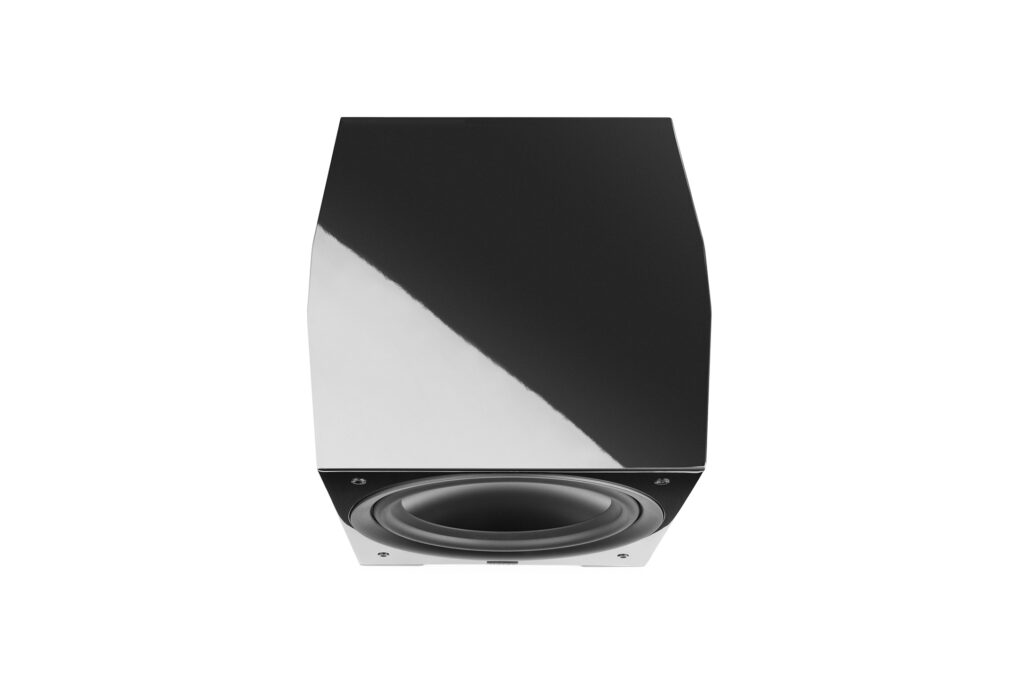
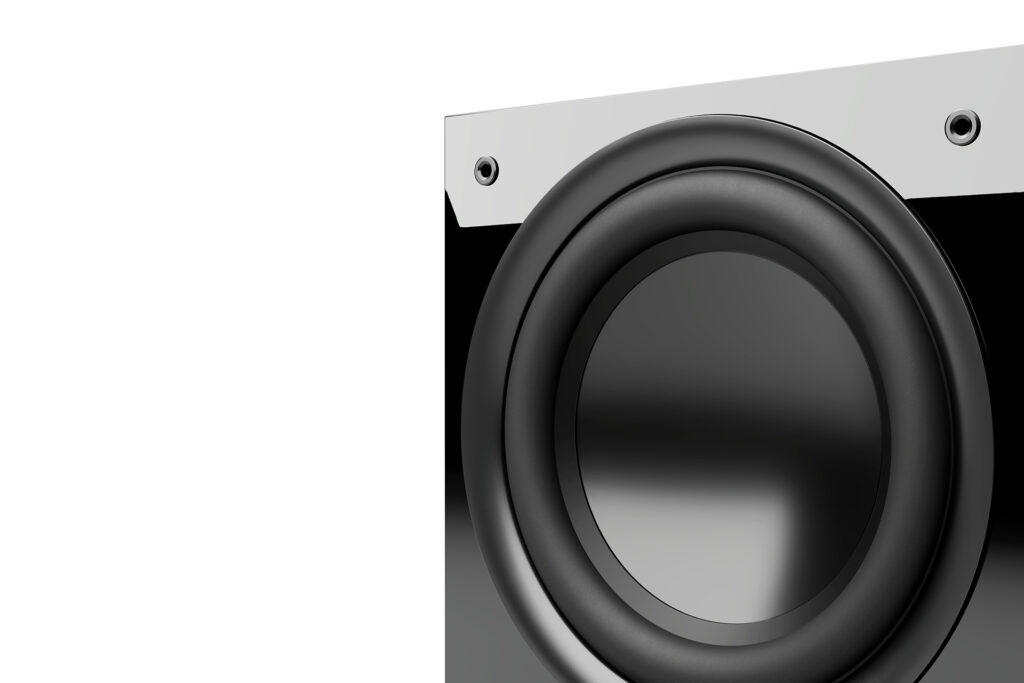
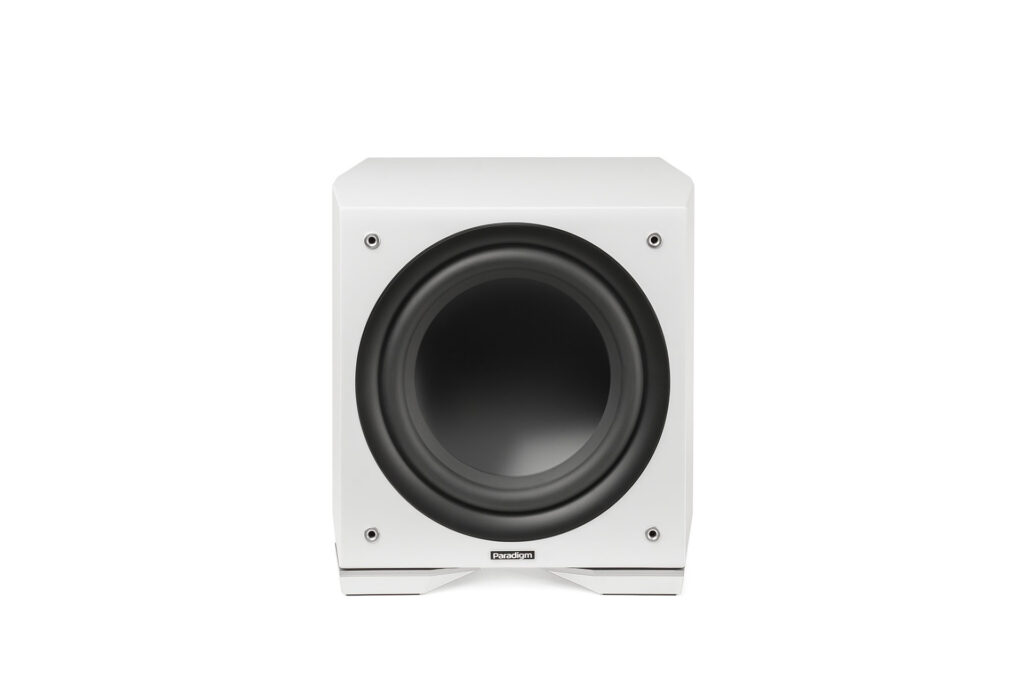
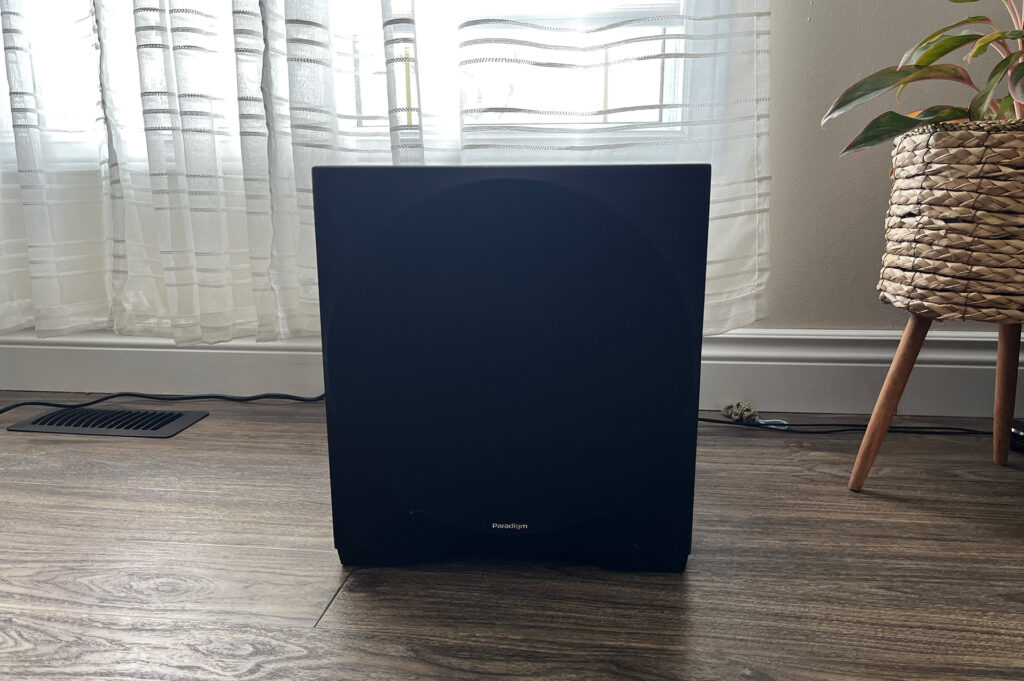
When we look at the Paradigm Defiance S12 subwoofer, priced at $1,500, it features a sealed box design that uses a 12-inch high excursion satin adonized pure aluminum bass driver, with 800 watts of Class-D power and a frequency response that goes all the way down to a measured 16 Hz of subsonic low-end sound.
Quite notably, Paradigm has chosen to include their ARC room correction technology that they use in their top-of-the-line Persona speakers in the subwoofer to make it easy to dial it in, as well as built-in wireless connectivity and a smartphone app that will allow you to adjust settings from the listening position. Paradigm has packaged a lot more into this 54-pound component than just the woofer itself, so let’s take a closer look to see if you should consider adding it into your audiophile system. Subs always help two-channel systems, even ones with pretty large floorstanding speakers. Is this the right sub for your setup? That’s what we are here to discover.
What Makes the Paradigm Defiance S12 Subwoofer So Special?
- ARC Room Correction is a big perk. Being able to get ARC room correction through the subwoofer is a great value add in this moderately-priced subwoofer. If you don’t already have room correction, ARC will allow you to set it up in less than 30 minutes with just a microphone and your laptop.
- The Paradigm Defiance S12 gets well into the subsonic frequencies. Not every subwoofer goes down to 16 Hz, which is well into the sub-bass region of frequencies that you cannot hear, only feel. While there are some who go lower, 16 Hz will serve most listeners quite well. Bring it with your EDM, Roland 808 synths and your pipe organ music.
- The Paradigm Subwoofer app is easy to use. I found it a simple process to employ the app to set up the subwoofer. Within minutes, I had set the low pass filters and the phase, added ARC, and I was ready to go.
- Paradigm decided to integrate their wireless kit into the subwoofer. Wireless kits can be very helpful in terms of making it so that you don’t have to run long wires in order to place the subwoofer in the best position possible. Having this technology integrated into the subwoofer is a real plus, too.
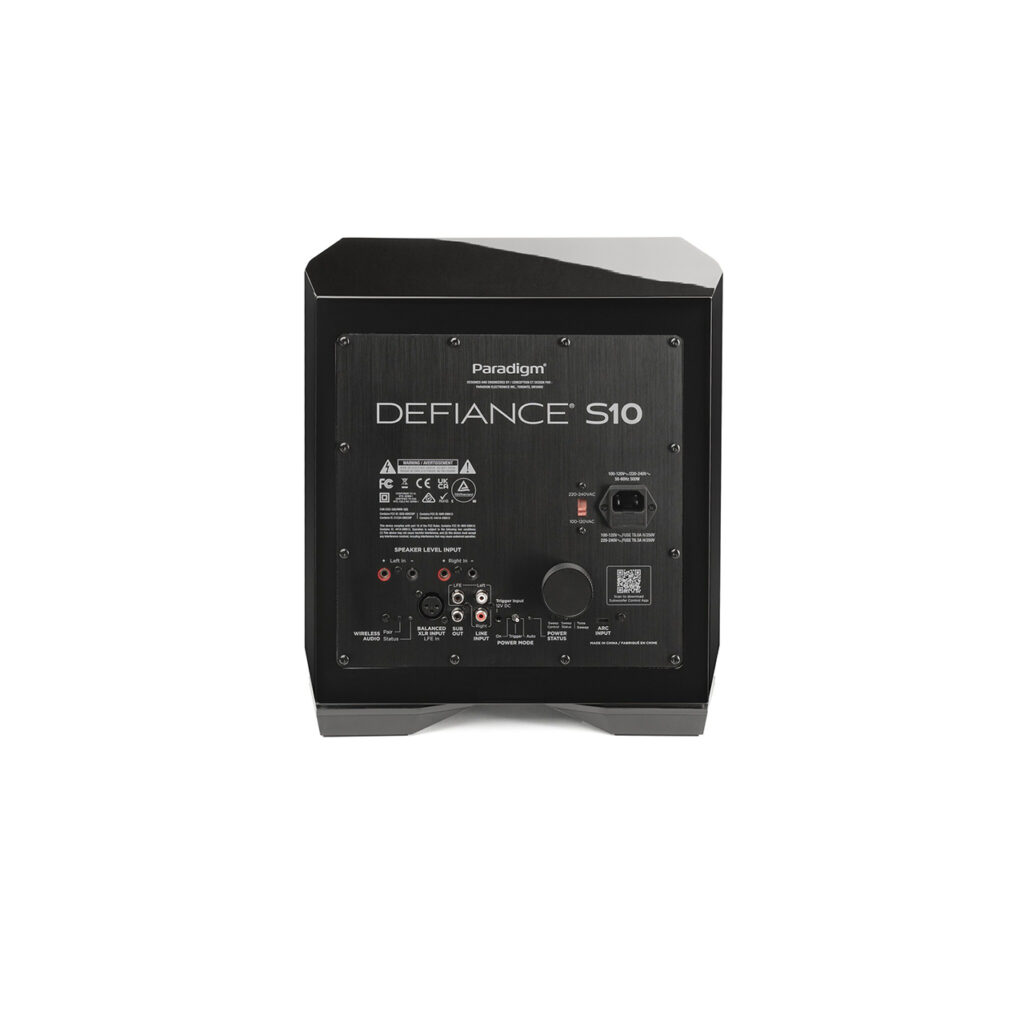
- A line-level Input is a nice feature. If you’re someone who runs an analog preamplifier, you will love having speaker-level inputs. These allow you to run your speakers into the subwoofer, so you can still set the subwoofer to take on the bass from your speakers, instead of having it only take on what is below what your speakers are rated to handle.
- The grille is secured on the front of the subwoofer. This is a small thing, but I found with other subwoofers that had their grilles magnetically held in place, that the grilles were constantly being knocked off. This won’t happen with the Paradigm Defiance S12.
- For a pretty serious subwoofer, the Defiance S12 isn’t THAT heavy. Only in the world of audiophile subwoofers would we consider 53 pounds not heavy, but when you consider there are many on the market that are 20 to 50 pounds heavier, this isn’t bad.
Why Should You Care About the Paradigm Defiance S12 Subwoofer?
Every audiophile system can benefit from having a subwoofer to take care of the frequencies that your speakers simply cannot reproduce with ease, at a relatively low cost. Paradigm, with the Defiance S12, has a product that handles both of those wants, but also goes further than that by adding their world-class room correction technology into this modestly-priced subwoofer. This creates an advantage that Paradigm offers that few other companies can, due to their access to ARC room correction technology.
Some Things You Might Not Like About the Paradigm Defiance S12 Subwoofer
• If you unplug the subwoofer, you will need to reset the app. If you decide that you don’t like the position of the Paradigm Defiance S12 in your listening room, or you end up unplugging it for some other reason, you will find yourself needing to perform a factory reset for the subwoofer so that you can connect the app again.
• This Paradigm Defiance S12 subwoofer doesn’t come with different feet. If you have carpet and you want to use spikes instead of rubber feet, you will need to look to the aftermarket, as the Defiance S12 doesn’t come with other feet. Don’t worry, there are plenty of options.
Listening to the Paradigm Defiance S12 Subwoofer
I tested the Paradigm Defiance S12 subwoofer with my SPL Elector preamplifier, the Anthem MCA 225 Gen 2 amplifier, and a Bluesound Node (2024) streamer as a source, paired with Paradigm Founder 80F speakers. With the SPL elector being an analog preamplifier, I used the line-out from it, and the Paradigm subwoofer app to handle all crossover and all the configuration of the subwoofer. I used the Bowers & Wilkins DB1B subwoofer (review pending) as a comparison for the Defiance S12. These two subwoofers are not true competitors, as the Paradigm subwoofer is in a very different price category, but they are pitted against each other to illustrate what you are getting at the lower price point than the higher one.
The first track I used to test the Paradigm Defiance S12 subwoofer was the Alexisonfire (pronounced Alexis on Fire) track titled “This Could Be Anywhere in the World” (Qobuz 44.1 kHz) from their 2006 album titled Crisis. This is one of my favorite tracks for testing a subwoofer. You can find this track on this post-hardcore punk band’s third album. One of the things I love about this track is that it likely isn’t the standard one most people would use when testing a subwoofer. What makes it unique is that there is a synth note that goes down to around 34 Hz that is accompanied by the drums and a bass guitar, which not only tests the depth of the bass but also how fast and tight it is. In my testing, the Defiance S12 was able to handle this low note easily, and it kept moving when the bass notes came in soon after. In this type of track, when I compared it against how it played with the Bowers & Wilkins DB1B subwoofer that I also had, the two were comparable, despite the DB1B subwoofer being about triple the price.
The next track that I used to test the Defiance S12 Subwoofer is The Prodigy’s “Breathe” from their 1996 studio album The Fat of the Land (Qobuz 44.1 kHz). For many people, The Prodigy was among the first purely electronic bands that they ever heard, and this track might have been their gateway into the genre. “Breathe” comes from the band’s third album, and the first one to feature vocal tracks but with all of the electronics that the band became known for. This track is notable due to the 40-60 Hz frequencies that are found throughout. This allows you to get an understanding of how tight the bass response will be from the subwoofer. The Paradigm Defiance S12 proved itself quite capable of handling this track and the consistent onslaught of sub-bass notes, without the sound getting loose or muddy.
The last track I used to test was “One More Time” from Daft Punk (Qobuz 44.1 kHz). This track from the famed French duo is on their Discover album from 2001. “One More Time” was one of the tracks that made Daft Punk a household name around the globe and was a teaser of what was to come for them. While the track doesn’t get as low into the sub-bass range as the other two tracks, it is a great test for a subwoofer, as the groove produced by the bouncy bass can prove to be a challenge for a subwoofer if it isn’t integrated properly. You get bouncy bass notes that hit around the 40-ish Hz mark and go nearly every second or so for the entirety of this near-six-minute electronic track. The Paradigm Defiance S12 was able to keep up, no doubt, but didn’t quite sound as tight as the Bowers & Wilkins did, and this is likely where the single woofer design can struggle when compared to one with dual woofers. Low bass versus control is a part of what you will be shopping for when it comes to a killer subwoofer for your setup.
Will the Paradigm Defiance S12 Subwoofer Hold Its Value?
The future value of a subwoofer can be difficult to assess, as the weight of a subwoofer often keeps it from hitting the bigger sites such as Audiogon, due to shipping costs being so high. With that said, the Paradigm subwoofers I could found looked to have retained more than half of their value years after they had been sold, and I would expect the Paradigm Defiance S12 to be no different, with its combination of inputs and technology that will continue to ensure it is sought after for years to come.
What is the Competition for Paradigm Defiance S12 Subwoofer?
When I think about subwoofers, one of the first brands that comes to mind is REL. The REL T/9x ($1,700 – buy at Crutchfield) is quite different from the Paradigm Defiance S12, in the sense that REL uses a Class-A/B amplifier instead of Class-D. REL also has chosen a 10-inch front-firing woofer and a 10-inch down-firing passive radiator. What it doesn’t have is the input options of the Paradigm subwoofer. Instead, it has a LFE connection, a low-level RCA connection, and a Neutrik Speakon connection, which is similar to the speaker level inputs that the S12 Defiance uses. Jerry Del Colliano reviewed this subwoofer and noted how much fun it was to listen to music with the T/9x in his system, so it is going to be worth consideration.
Another competitor to the Paradigm subwoofer is the SVS SB-3000 R/Evolution ($1,399 – buy at Crutchfield). SVS is often the go-to option for value with subwoofers, as their products are well-known for their ability to punch above their weight class. This is a new subwoofer from them and, like the version that Mike Prager reviewed, it features a 13-inch woofer, but SVS has upped their game by increasing the amplification power from 800 to 1200 watts. Quite notably, they have added their new “Auto EQ” technology, which allows you to use the microphone on your smartphone to do room correction.
If you are looking for a different design in the same price range, you might consider the GoldenEar SuperSub X ($1,499 – buy at Crutchfield). The GoldenEar design feels like a combination of some of the best elements of the REL and Paradigm designs. It has two eight-inch active woofers and two eight-inch passive radiators, while delivering 750 watts of Class-D amplification. I would be very interested to see how tight this collection of woofers is. As it is the same price as the Paradigm, it is certainly worth consideration.
Final Thoughts on the Paradigm Defiance S12 Subwoofer …
It is hard to overstate how much a high-performance subwoofer adds to your audiophile setup until you have either added one or, better yet, taken one out. Even in a completely analog setup like mine, the extra bit that gets added below 60 Hz adds so much depth to the music – a low-end foundation for your speakers.
I enjoyed having the Paradigm Defiance S12 in my system from the moment I took it out of the box until the moment I put it back in (if I don’t purchase it). Paradigm has done a simply fantastic job with this product. They have made it easy to set up with the wireless kit being built-in and given you lots of input options if you are someone who prefers to hardwire it into either your preamplifier or speakers. They have also made it easy to dial the sound in with the use of ARC room correction, and their app that lets you configure every aspect of the subwoofer. If you’re shopping in the $1,500 price range, you owe it to yourself to at the very least audition the Paradigm S12 Defiance subwoofer, as this is a top-level performer in its category and perhaps a little beyond.



