
 By
By Halo brands, which were once relatively rare, have become more and more common. Mercedes-Benz, which is already an ultra-premium brand, has Maybach, which takes performance, luxury and exclusivity to an even higher level. Toyota, which is known for reliability and practicality, has Lexus, which offers upscale sedans, convertibles and sport utilities to attract more affluent buyers. Appliance manufacturer General Electric offers their premium line Monogram to compete with brands such as Sub-Zero, Thermador and Miele. Audio manufacturers are no different, which brings us to the Michi line from Rotel.
Michi was created to showcase everything that Rotel has learned from their 55-year history to create a flagship line. Rotel is best known as an upper-tier, mid-fi brand, meaning it builds high-performance products to a specific price point. Michi engineers, however, are given more freedom to build true high-end products. The Michi S5 stereo amplifier promises to deliver performance that exceeds rival amplifiers costing two or even three times as much. That is a big claim. Are they crazy or just reporting the news about the value/performance of this audiophile power amp? That’s what we are here to find out.
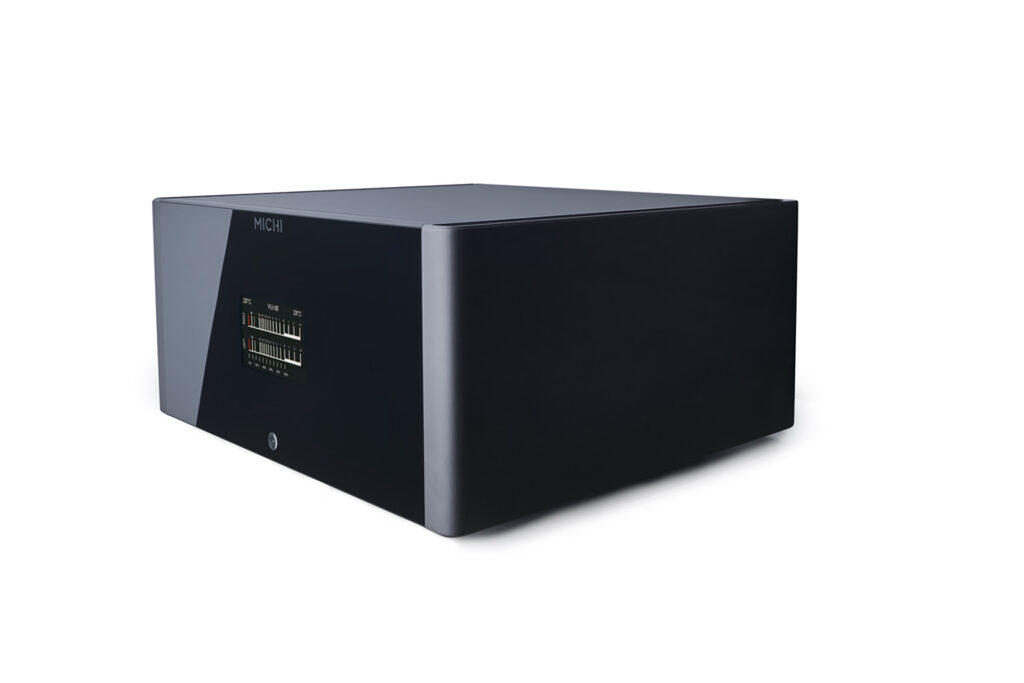
What Makes the Michi S5 Amplifier So Special?
- The Michi S5 stereo amplifier is an absolute beast, cranking out 500 watts per channel into eight ohms, and 800 watts per channel into four ohms. The Class-AB-design amplifier can drive basically any speaker without breaking a sweat. If that’s not enough power, Michi also offers a mono amplifier, the M8, which produces a staggering 1,080 watts into eight ohms and 1,800 watts into four Ohms.
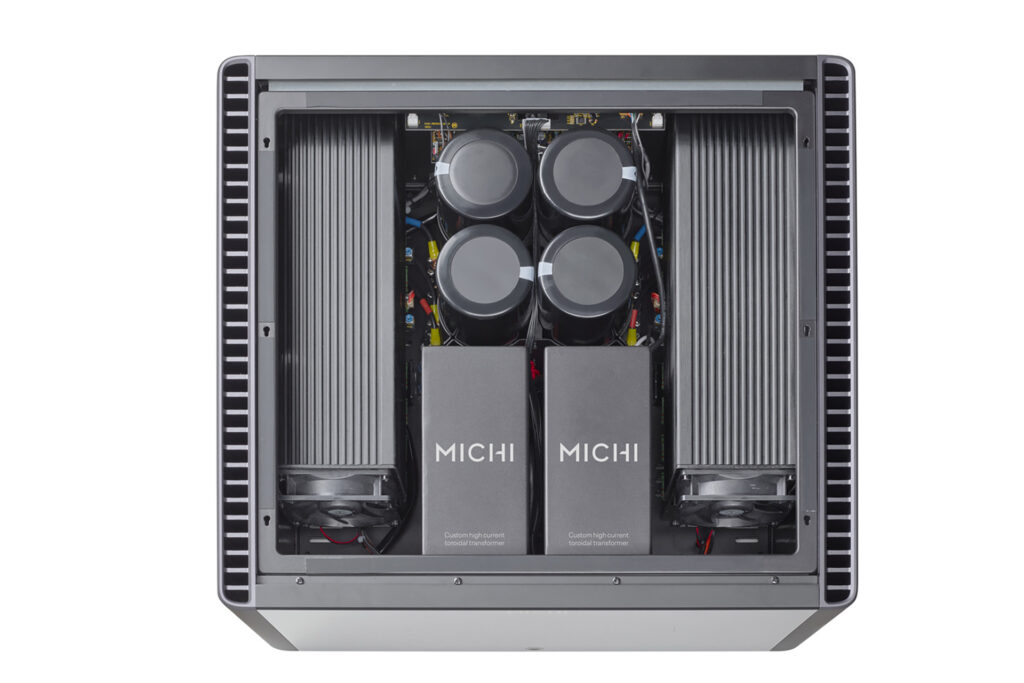
- The Michi S5 stereo amplifier is a true dual monaural design, incorporating a pair of 2,200 VA in-house-designed and manufactured toroidal transformers, one for each channel. Each of the transformers is enclosed in its own epoxy-filled enclosure to minimize vibration and noise.
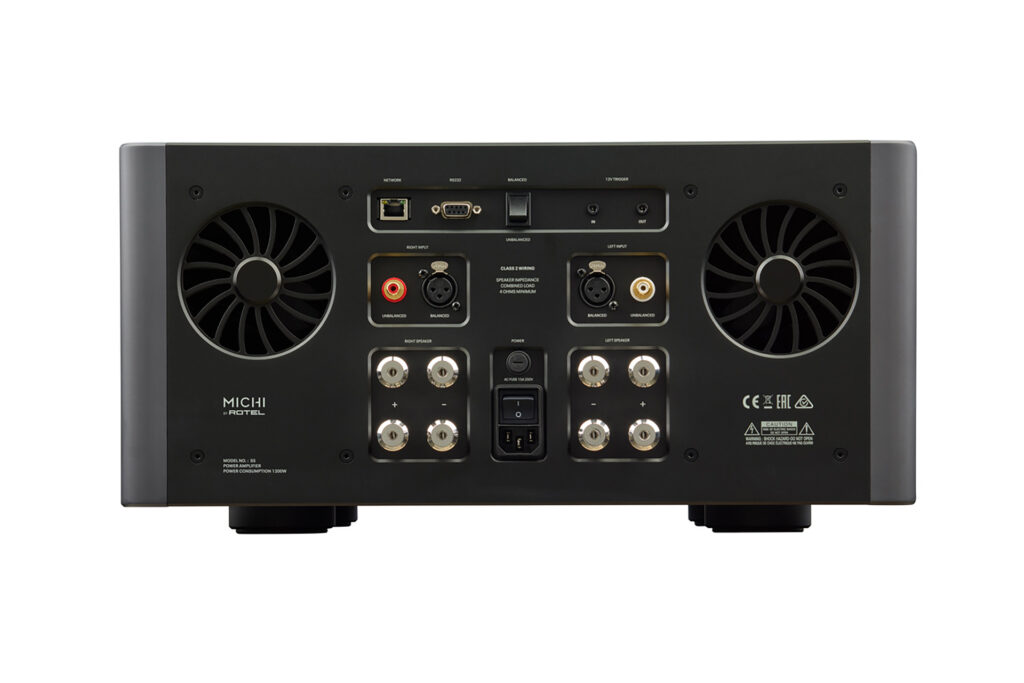
- The Michi S5 stereo amplifier uses 32 high-current output transistors, which are mounted between the large external heat sinks and an internal cooling tunnel. The tunnel uses fans to blow air through and out the back of the amplifier. For those who worry about noisy cooling fans, you can relax. I never once heard them turn on.
- The Michi S5 stereo amplifier has a bank of four British capacitors that deliver 188,000 µF of instantaneous energy. These capacitors offer additional energy when musical passages demand it: think large orchestral crescendos or heavy bass impacts.
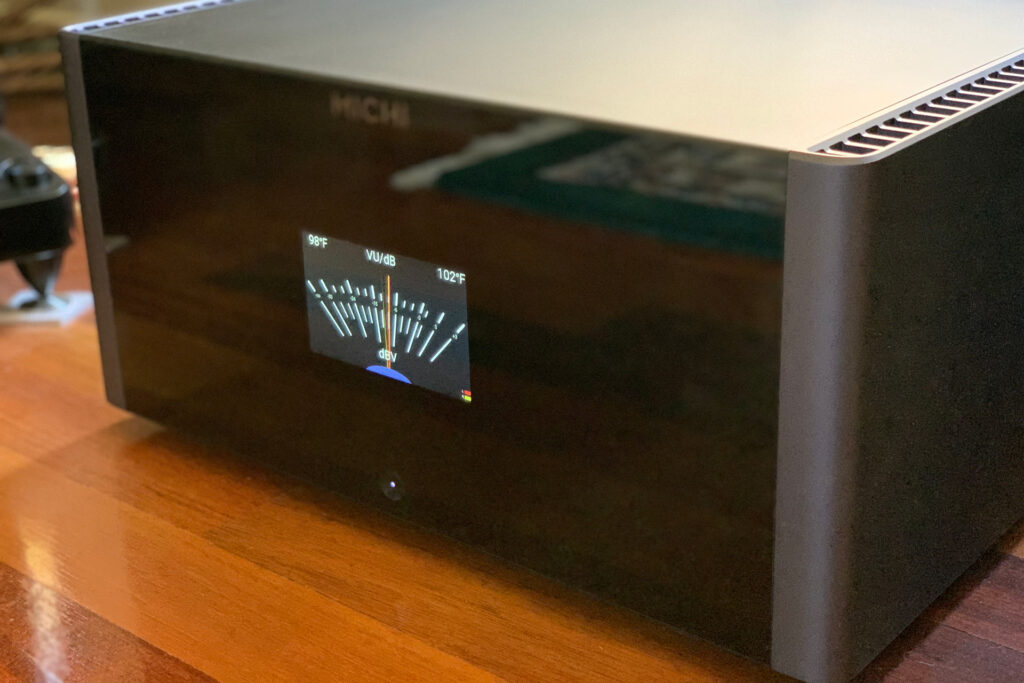
- A large front panel display on the Michi S5 stereo amplifier can show a variety of meters. These include classic VU/dB needle meters, a spectrum display and several others. The display also shows temperature of each channel. The review sample never went over 101 degrees Fahrenheit, no matter how hard it was pushed.
- Remote controls are not something I typically associate with amplifiers, but the Michi S5 stereo amplifier included a really nice one. The remote itself is nicer than most that come with components costing multiple times more than the Michi S5 amplifier. The aluminum remote has substantial weight and was very nicely machined. While many competitors offer cheap Apple TV-type remotes, Michi brings something that is worthy of a high-end component. Well done, Michi. The remote control is used to access the various menus of the amplifier and to make adjustments. Things like display information. meter type, and various timers to control when the display turns off are all accessible through the menus. Having a remote control to navigate made customizing the Michi S5 amplifier very easy. I much prefer this to having to press buttons to get around in the menu structure.
Why Should You Care About the Michi S5 Stereo Amplifier?
Who doesn’t love a big, really powerful Class-AB amplifier? I certainly do. The problem is that typically they come with a big price tag. While $7,499 is certainly not pocket change, I challenge you to find another amplifier with the pedigree and specifications that the S5 offers for less. I have little doubt they will all be over $10,000 and many far beyond.
Some Things You Might Not Like About the Michi S5 Stereo Amplifier
- The Michi S5 stereo amplifier is Class-AB, meaning it is not as efficient as some of the newer Class-D/Gan-FET designs, which are all the rage lately.
- The Michi S5 Stereo Amplifier is not bridgeable. However, Michi does build an even more powerful mono amplifier, the M8, if you need more muscle from your stereo amp.
- The Michi S5 stereo amplifier is manufactured in China, which may be problematic for some. Many prefer to support products made in a country with better human rights than China. There is also concern that tariffs may impact availability and/or pricing.
- The size of the Michi S5 stereo amplifier may be a problem if you have limited space.Also, at 132 pounds, it’s heavy, so moving it will require at least one friend for help.
- Styling is always subjective, but the Michi S5 stereo amplifier is decidedly modern in all black. The face is shiny and the display disappears when disabled, leaving a glass-like appearance with only the Michi logo visible. A single power switch at the bottom is either red or white, depending on state. It cannot be disabled. The heat sinks are rounded and made from the same brushed aluminum as the remote control. Overall, it’s a very understated but handsome design.
Listening to the Michi S5 Stereo Amplifier …
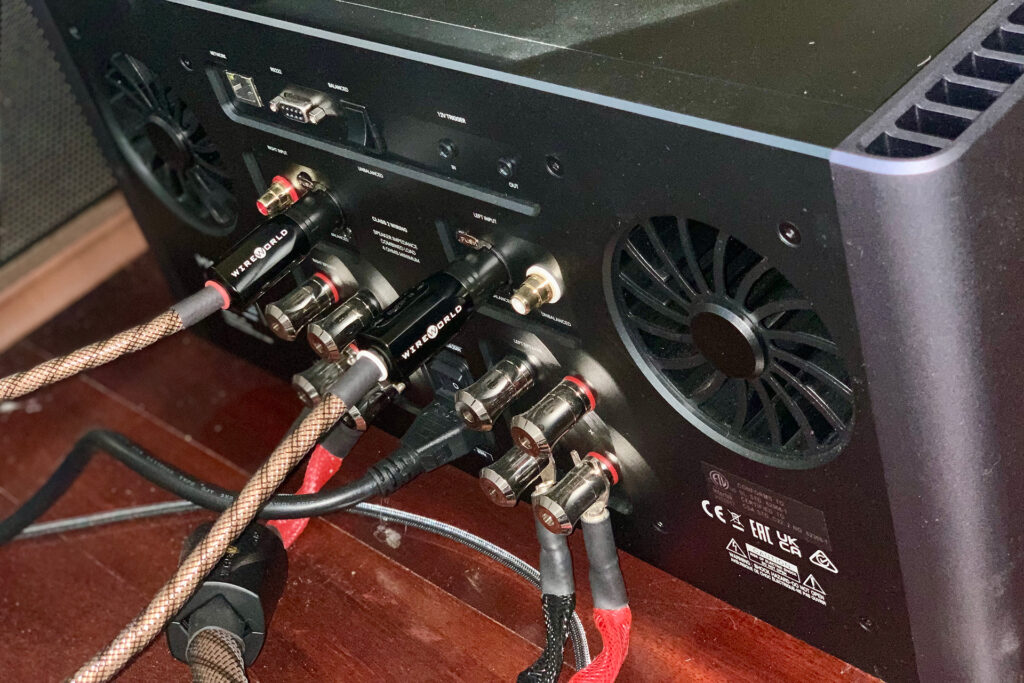
I connected the Michi S5 stereo amplifier to my CH Precision L1/X1 Preamp preamplifier, using Wireworld Series 10 XLR cables. The rest of my system consists of a Lumin U1 mini streamer, Weiss Helios DAC, and Rockport Avior II loudspeakers.
The smooth jazz anthem “Smooth Operator” by Sade is likely one of the most referenced tracks when evaluating audiophile systems. Lead singer Sade Adu is known for her silky-smooth vocals, overlayed on a Latin rhythm section. They come together in a magical way. Adu was absolutely everywhere in the 1980s and her music still sounds as fresh as ever. The track opens with a kick drum and various other percussions, but the kick drum is what draws your attention. It’s deep, quick and hard-hitting through the Michi S5, but not overpowering. It has a snap that I feel in my chest with every kick. I’ve heard kick drums through other amps that hit hard and deep, but tend to hang in the air longer than they should, and your ear knows something isn’t quite right. I heard none of that with the Michi S5 stereo amplifier. The kick percussion was there, then gone instantly. This is some of the best low-end performance I’ve heard in my system. Next, the saxophone comes in, which has a beautiful smooth tone counter to the drums. The saxophone is anchored center in the soundstage, as are Adu’s buttery vocals. Both have a sweetness that is reminiscent of a Class-A amplifier. I played this track many times, raising the volume more and more with each repetition, and the amplifier never got shouty or aggressive. Top to bottom, the Michi S5 stereo amplifier sounded great.
“Feels So Good” by Chuck Mangione is one of those songs that always takes me back to my childhood with good, melodic vibes. It feels like Sunday afternoon, with my mom in the kitchen making supper with the radio playing this song. I had not a care in the world, and life was just amazing. There’s a reason it is still a staple on smooth jazz stations around the world. It’s one of the biggest jazz fusion hits of all time, and also happens to be an excellent recording. The guitars in the intro section of the song completely filled my room from right to left. The soundstage was just massive, and the detail of every string was stunningly clear. There is no mistaking the sound of Mangione’s flugelhorn when it takes center stage. I noticed something new while listening to the track this time. I clearly heard a change in the soundstage. Once Mangione started to play, it sounded like the recording engineer put compression on everything other than the flugelhorn, which draws a spotlight to it. When Mangione was not playing, the soundstage opened back up. Cymbals had more shimmer rather than being shunted. The guitars spread out again. It’s a very on-target effect to showcase the star of the song, which is the flugelhorn. Again, I heard the same tight bass and sweet midrange as I did with Adu, but now the upper frequencies really caught my attention. The guitars had outstanding clarity and razor-like imaging.
Will the Michi S5 Stereo Amplifier Hold Its Value?
I think this is a no-brainer … yes, it will hold its value. Audio enthusiast buyers will be thrilled with the performance of the Michi S5. It’s an excellent value and an absolute steal at its asking price. Rotel has a long history of building excellent-sounding products that are extremely reliable over decades of use. I see no reason to expect anything different from the Michi S5 stereo amplifier.
What is the Competition for the Michi S5 Stereo Amplifier?
An obvious competitor is the Parasound JC5 stereo amplifier. Its price is virtually identical at $7,149 when purchased directly from the Parasound website. Designed by John Curl, one of the all-time greats from the audiophile world, the JC5 is essentially a pair of JC1and mono amplifiers in a single chassis. It generates a little less power than the Michi S5 at 400 watts into eight ohms and 600 watts into four ohms, and is bridgeable to 1200 watts into eight ohms. The Michi S5 stereo amplifier is not bridgeable. The JC5 also operates in Class-A mode up to 12 watts before shifting to Class-AB. Having owned a pair of Parasound JC1 mono amplifiers for many years, I can attest to Parasound’s well-earned reputation for excellent sound quality and reliability.
Another competitor to consider is the $4,599 Rotel RB-1590. Who wouldn’t cross-shop across brands when they come from the same parent company? Think Toyota and Lexus, or Audi and Volkswagen. The RB-1590 is also a stereo amplifier rated at 350 watts into eight ohms and 648 watts into four ohms. While that may seem like a lot less power, I doubt that most would be able to differentiate the difference at normal listening levels. Now, sound quality is a different topic that is readily identifiable in my experience.
If you’re like me, then you always look up the audiophile food chain and ask, “What if?” This sort of thinking would have me contemplating the considerably more expensive Pass Labs X350.8. The $16,000 X350.8 is a stereo amplifier that puts out 350 watts into eight ohms, doubling to 700 watts into four ohms. It is heavily biased, so it runs in Class-A up to around 18 watts, where it shifts back to AB operation. The X350.8 is also very heavy, weighing in at 145 pounds. Styling is typical Pass Labs, meaning it’s gorgeous. It has the trademark glowing blue analog meter in the center of the face and cheese-grater heat sinks.
Final Thoughts on the Michi S5 Stereo Amplifier …
To say I was impressed with the Michi S5 stereo amplifier is an understatement.
It had absolutely no problems bringing my somewhat difficult to drive loudspeakers to very high volumes without losing composure. Playing loud is easy, but it’s the subtleties that differentiate a good amplifier from a great one. The Michi S5 stereo amplifier did everything right from top to bottom. Treble was smooth and grain-free, with lots of sonic detail. The midrange had a touch of that Class-A sweetness and the bass just sounded outstanding. The soundstage wasn’t quite as deep as what I am accustomed to, but it was still excellent for an amplifier at this price point. What else can you ask from an amplifier?




What about the Bryston 4BSST/2? Amp of the year……..
That is a GREAT COMP for the Michi my friend. a GREAT ONE
Great and timely review. I just purchased 2 Benchmark ABH2’s to Monoblock. and seriously listened to this amp. It’s great! I had built my system for the ABH2’s but the Michi S5 gave me very serious pause.
The S5 REALLY impressed me. I have no need for another amp, but I was seriously tempted to keep it anyway! 🙂
Great review Jim. I looked at the Michi line when it was first introduced. I thought then, and your review confirmed it for me now, that the Michi products offer two very instrumental assets — excellent performance and affordable price. I’m sure you enjoyed it in your system!