
 By
By Wattson Audio is a relative newcomer to the high-end audio world that you likely haven’t heard of. However, like many recent quasi-start-ups, they have a long history of working with established ultra-high-end brands. The Wattson mission statement is to bring components that offer high-end performance at attainable prices. Many have tried this, and some actually succeed, but they are the exception rather than the rule in my experience. The original Audio Alchemy equipment from the early 1990s comes to mind. I know of none that come from Switzerland, the home of six-figure components. CH Precision, one of those aforementioned ultra-high-end brands, recently acquired Wattson, and now the two brands share engineering talent. Their products are at opposite ends of the cost spectrum.
The Wattson Madison Streamer DAC is extremely simple. It’s designed to be the primary source for your system and assumes that streaming is the main way users consume music. I cannot argue with that. It also offers a couple of digital inputs for connecting things like your CD transport and TV feed. Does it make good on the Wattson promise of high-end performance at the attainable price? Let’s find out …
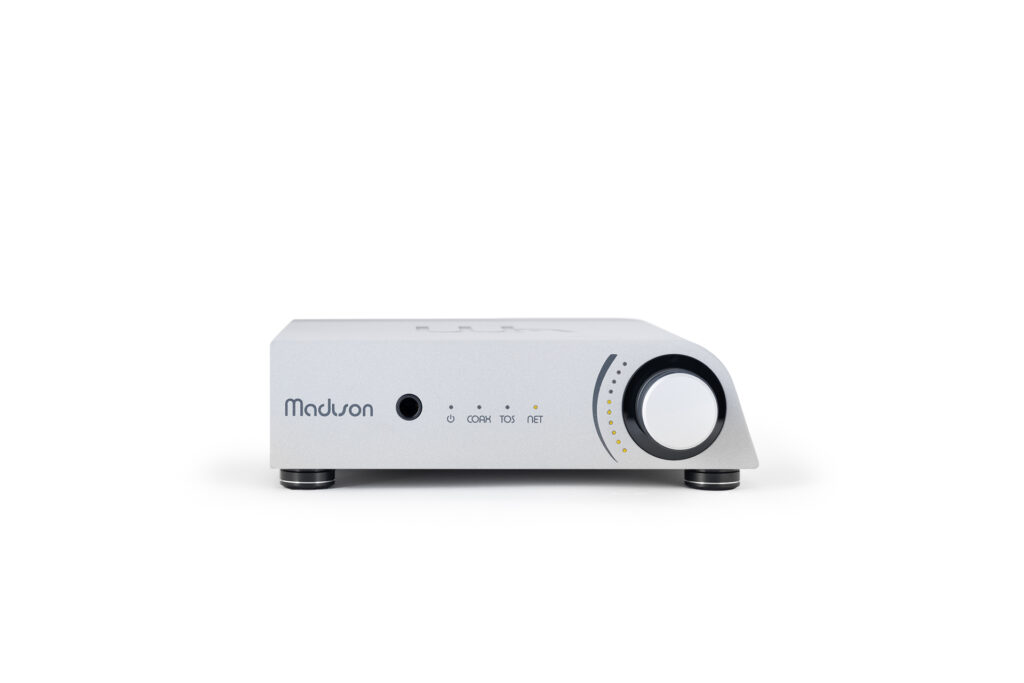
What Makes the Wattson Madison Streamer DAC So Special?
- The heart of the Madison Streamer DAC is the in-house-designed network bridge. The bridge is what handles the network interface and streaming responsibilities. The engineers at Wattson did such a good job designing this bridge that it is licensed to several competing uber-high-end digital products. A version of it also lives inside the $36,000 CH Precision C1.2 DAC.
- Every streaming service imaginable is supported with the Madison: Roon Ready, Qobuz Connect, Tidal Connect, Audirvana and others. You can also stream to it via Apple Airplay.
- The DAC architecture is DSP–based and uses advanced digital processing and a high-performance output stage.
- The Madison supports PCM playback up to 32-bit/384 kHz and DSD up to 256x via streaming. S/PDIF inputs are limited to 24-bit/192 kHz.
- The Madison Streamer DAC uses a proprietary spline filter, derived from the one used in the CH Precision C1.2 DAC. The filter algorithm is designed to preserve time-domain accuracy and minimize pre and post ringing.
- The Madison Streamer DAC does not require an external streamer. My experience is that the streamer is as important as, if not more important than, the DAC to which it is connected. While many will argue that point, my ears tell me it’s the truth. I’ve tried different streamers with my Weiss Helios DAC (read the review) and it’s obvious that better streamers result in better sound. I compared my trusty yet aging Lumin U1 Mini to my even older Esoteric DV-50 operating as a CD transport and it was clearly outclassed by the disc player.
- The Madison Streamer DAC includes basic room correction DSP functions. I am a proponent of DSP when done correctly, even if many audiophiles are not. The implementation of the DSP in the Madison is super-simple but remarkably effective. It offers three options for each speaker. First is free field for speakers that do not have walls near them, the second option is for speakers that are near a wall, and the third is for speakers in a corner. My room has one speaker near a corner and the other is free field. I experimented with various settings and found that the corner option helped reduce the bass from my corner speaker. Ultimately, I left it off most of the time for review purposes, but think most users will find significant value in it.
- The Madison Streamer DAC has a proprietary digital volume control. Most competitors in this class use LEEDH as their digital volume control implementation, as did Wattson until recently. Now Wattson has replaced it with something they designed in-house. It reportedly maintains exceptional accuracy and linearity by minimizing truncation and rounding errors. Wattson provides this upgrade free of charge with a firmware update. I love that.
Why Should You Care About the Madison Streamer DAC?
The Madison Streamer DAC comes from designers who have a long history of working with some of the most well-respected Swiss ultra-high-end brands in existence. Their engineering prowess allowed them to create products that punch well above their weight class, while not costing a fortune. While nobody is going to say that a $5,000 component is cheap, when you consider that it consolidates three components in one, you start to understand the value. Yes, there are lots of other streamer/DAC/preamp combinations on the market for less money, but the Madison Streamer DAC is in a different league in my experience.
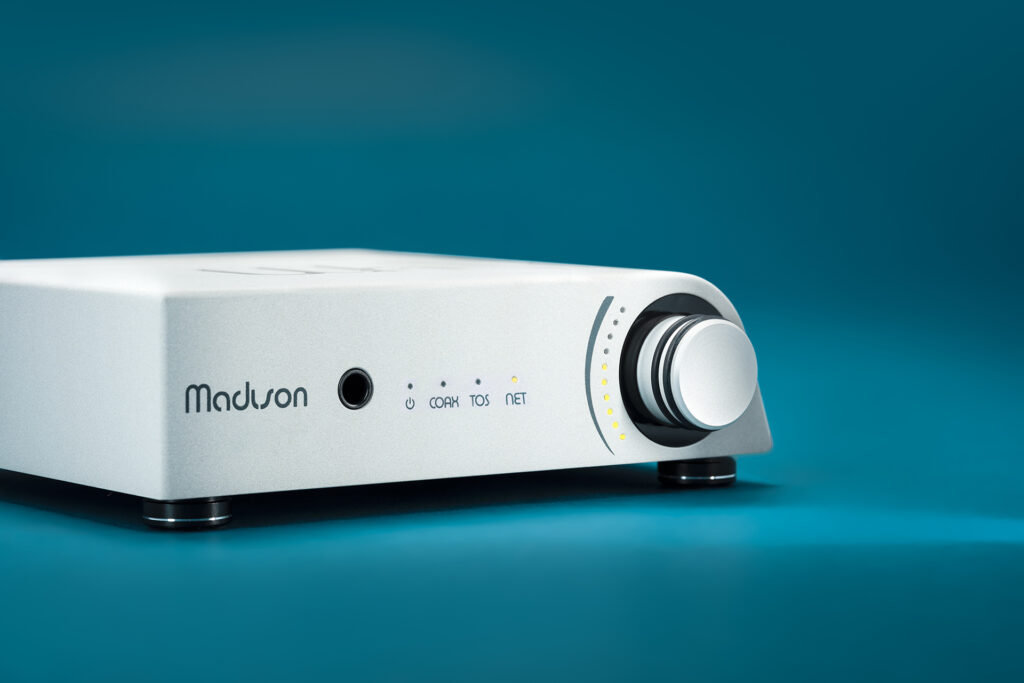
Some Things You Might Not Like About the Madison Streamer DAC
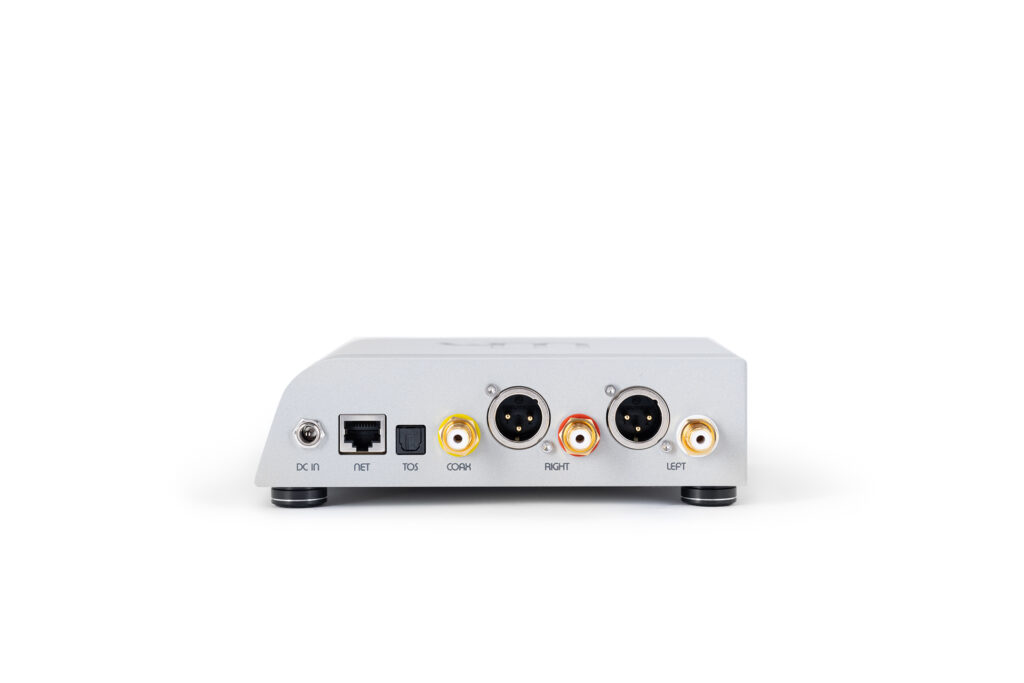
- The Madison Streamer DAC does not have a digital output. Luckily, the DAC in the Madison is so good that you likely will never want to use anything else. However, I wish it did offer that option.
- The network connection is hardwired only; there is no Wi-Fi support. A direct Ethernet connection to your router is best, but if that’s not available, you can always use a Wi-Fi/Ethernet adaptor like I do.
- The Madison Streamer DAC is not a full-sized chassis. FutureAudiophile.com publisher Jerry Del Colliano and I talk constantly about our disdain for the current trend of non-standard-sized equipment. The Wattson Madison Streamer DAC is a quarter the size of a standard component.
- The Madison Streamer DAC only has two external digital inputs, a coax and a TosLink optical. The concept of the Madison Streamer DAC is that most users will use the streamer function to listen to music. The coax input is provided for legacy devices, such as a transport for those who still enjoy their CD collection. The optical input will primarily connect to a TV. This is exactly the configuration I used and, while the input count might be sparse, I never wanted for more.
- The standard power supply for the Madison Streamer DAC seems like a little bit of an afterthought. While functionally the standard power supply worked fine, it felt a little weak. Think of a laptop power supply that is built into the power cord. Luckily, there is an optional upgraded power supply, the Power S, which is roughly twice the size of the DAC. I didn’t have a chance to hear it, but I have spoken to people who have, and they all agree it’s a big improvement.
- The Madison Streamer DAC does not have a remote control. This is another trend that I am not a fan of. Clearly, it’s a cost-saving measure, but frankly I hate using my phone to control everything. Even a cheap Apple TV-type remote would be welcomed over another app.
Listening to the Madison Streamer DAC …
I connected the Madison Streamer DAC to my CH Precision L1/X1 Preamp preamplifier using Wireworld Series 10 XLR cables. The rest of my system consists of a Lumin U1 mini-streamer,Weiss Helios DAC, and Rockport Avior II loudspeakers.
“Turn the Page (Live)” by Bob Seger was recorded at Cobo Hall in Detroit in 1975. One of my earliest memories is seeing the Ringling Bros. and Barnum & Bailey Circus there with my mom as chaperone to my first-grade class. It was probably about a year later that this album was recorded. Needless to say, it has special meaning to me. When I was a kid, Seger was always on the radio, since he was a Detroit native. This version of the track is easily my favorite. The Wattson Madison did an excellent job at recreating this live event. The gentle notes of the bass guitar backing Seger’s vocals have power, even though they aren’t being played loud. This is what a 10 kW stack of amplifiers at a concert can do. When that can be recreated in your living room, it’s magical. That’s exactly what I heard and felt through my system. The kick drum did the same thing, but with more power. What I noticed first with the Madison Streamer DAC is how quickly each kick stopped. “Overhang” is a term used when sounds linger longer than they should. Overhang reduces image clarity and makes drums less punchy. There was none of that. Live recordings always give you an opportunity to listen for acoustic artifacts like echoes and reflections. Great recordings and playback systems can come very close to tricking you into thinking you’re at the show. I heard Seger’s vocals pass me by, then reflect off the back of the concert hall. The yells and whistles from the crowd were easy to pinpoint. The Madison Streamer DAC made this track sound fantastic.
I have no connection to the next song, other than it’s another favorite of mine. “The Ride” by David Allan Coe is one of those tracks that tells a story and always puts a smile on my face. Again, the bass performance of Madison Streamer DAC grabs your attention with its speed, articulation and effortlessness. Coe’s vocals were centered and floated slightly in front of the rest of the band. I could hear the engineer put some reverb on it to make it bigger. I also was able to discover a new detail from the cymbal, which sounded like it was played with a brush, not a stick. The amount of detail the Madison Streamer DAC pulled from the track was impressive but never detracted from the overall presentation. The soundstage was well outside my speakers left and right with excellent depth.
Van Halen’s “Big Bad Bill” cover of the 1924 original is hardly what I would consider an audiophile recording, but it is better than a lot of the early David Lee Roth–era recordings.What’s unique about this track is that Eddie and Alex Van Halen’s father, Jan, plays clarinet on it. The clarinet has a purity through the Madison Streamer DAC that was more than I expected. Alex Van Halen playing brushes is a treat, as is Eddie simple guitar strumming. I chose this track to hear how the DAC would deal with less than perfect material, which I listen to a lot. It can’t perform miracles, but it did help it sound better than it deserves. Quite a feat for such a reasonably-priced product.
Will the Madison Streamer DAC Hold Its Value?
From my research on audiogon.com, I could not find any history of Wattson components being sold on the used market. This means either there just aren’t many out there, or people who own them hold onto them. I think it may be a combination of both, but mostly the latter. I haven’t heard any other Wattson products, but the Madison Streamer DAC is a total bargain at $5,000. I haven’t heard anything at this price point that comes close to the digital performance it brings.
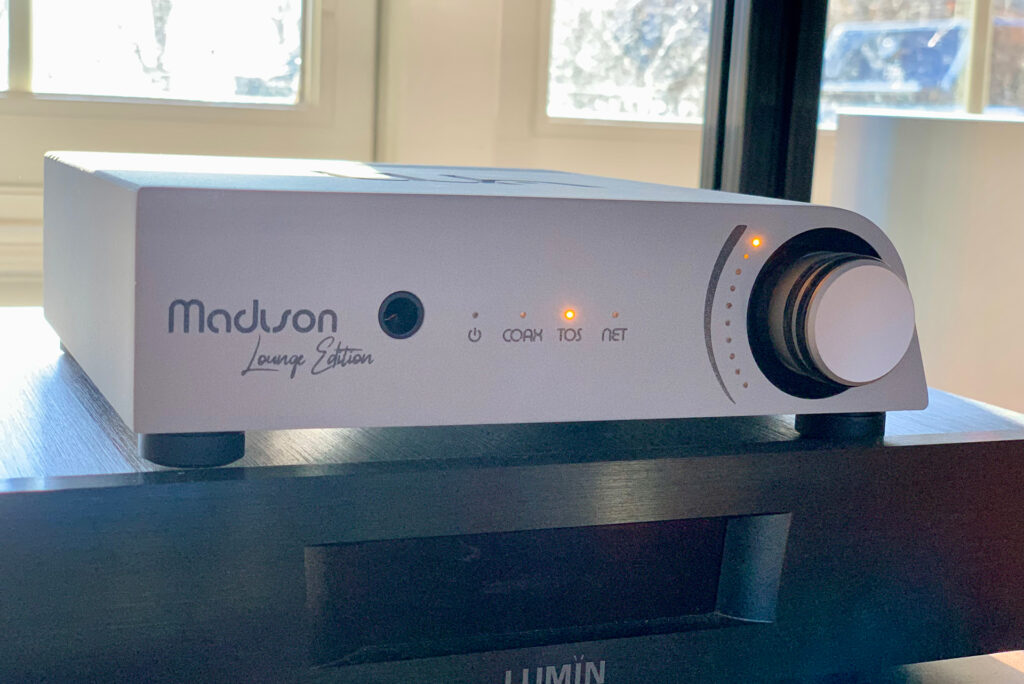
What is the Competition for the Madison Streamer DAC?
The first streamer/DAC competitor that comes to mind is the $6,000 Lumin T3X. The Lumin offers a digital output that the Madison does not. It also has two network connection options, the standard category RJ45 and an optical interface to eliminate electrical noise from the network. The Lumin supports resolutions up to DSD512 and 384 kHz 16-32 bit. It also has up-sampling options to DSD256 or PCM 384 kHz for all files. The Lumin uses dual ES9028Pro Sabre DACs in dual mono configuration. It offers native support for TIDAL, Qobuz, Spotify and Apple Airplay. The casework is very well done and it has a full-sized chassis.
Next, I would consider the $6,999 NAD M66 (read the review) as a worthy competitor. The NAD M66 (buy at Crutchfield) is a streamer DAC preamplifier and includes a host of additional features. Those include two types of Dirac room correction, live full frequency and bass control for advanced subwoofer management. Analog inputs, including phono, are converted into the digital domain, so the room correction can work its magic on them, too. Like the Lumin, the NAD uses Sabre DAC chips, but the M66 uses the ES9038PRO. Unlike the Lumin, the M66 has no digital output. The NAD is a very sophisticated digital processor that also includes streaming and DAC functions.
Final Thoughts on the Madison Streamer DAC …
Combining a streamer and DAC makes a lot of sense. You reduce the number of components and cabling required. The designers can also optimize the two functions to work together. However, most audiophiles eschew combining things and almost always subscribe to the axiom that more boxes mean better sound. Typically, I admittedly fall into this camp, but the Madison Streamer DAC may have convinced me that bringing these two functions together is the right path. The Madison Streamer DAC provided sound quality that surpasses the $5,000 asking price. To describe the sound is challenging, but my ears heard a rightness that I feel comes from the careful attention to timing by the Wattson engineers. The piston-like bass, the purity of vocals and ultra-focused soundstage simply don’t happen when things like jitter and noise are present in the circuit. I am sure the CH Precision spline filter has a lot to do with this as well. Tonally, it was very natural and neutral, maybe leaning a very slight touch warm. Music was presented with weight and power, but never at the expense of quickness. Think Manny Pacquiao or Floyd Mayweather Jr. The Wattson Madison Streamer DAC is quite an achievement and the Wattson team deserves lots of credit for succeeding at their quest of delivering high-end performance at a reasonable, though still expensive, cost.




How does it compare to your Helios dac?
I know Joe BOUGHT the Wattson. 🙂
I sure appreciate what you said about streamers making a difference. Your experience is the same as mine.
Apparently the Madison’s DAC section is a great performer, competing against a DAC at 5x its costs. The feature sets of other DAC/ streamers were mentioned, but, It would have also been helpful to have a had a sonic comparison to a dedicated streamer, connected to the Madison to determine the strength of it’s streamer section. Otherwise, it was a well written and comprehensive.