
 By
By Youngstown, OH-based SVS began in business with the idea of creating a high-performance yet affordable subwoofer long before the current regime made them into the industry player that they are today. Today’s SVS recognized the need for subwoofers in two-channel audiophile systems, in addition to the home theater market – traditionally, where subwoofers were being used at the time. What began in 1998 as a vision today features a lineup of very affordable subs, full-range bookshelf and floorstanding speakers, cables, wireless adapters, speaker stands and various other thoughtful audiophile accessories. Despite what was arguably a rather humble beginning, SVS has grown to become a recognized leader in the subwoofer category, a very popular manufacturer of full-range speakers and a brand enjoyed by music enthusiasts, not only in the United States, but also in other parts of the world.
Brian Kahn reviewed the SVS PB17-Ultra R|Evolution (read review here) ported sub. In fact, he gave it his highest recommendation. In this review, we will take a more up-close look at the ported version’s sealed brother, the SVS SB17-Ultra R|Evolution subwoofer.
What Makes the SVS SB17-Ultra REvolution Special?
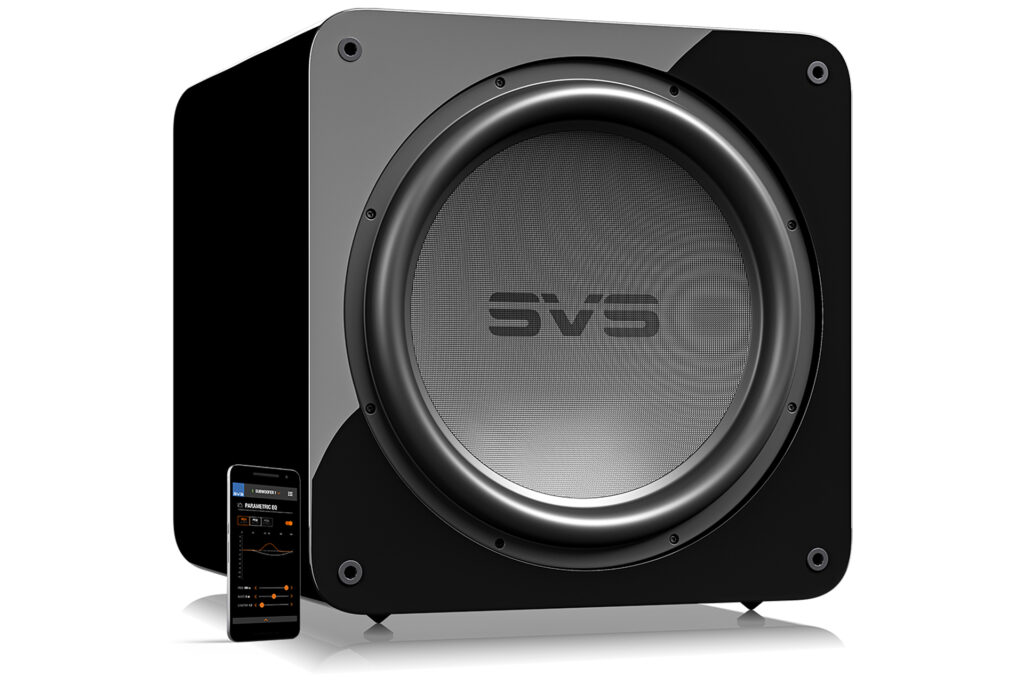
- SVS is using a front-firing 17 inch high-excursion driver in the SB17-Ultra. Of the 126-pound total weight of the subwoofer, this low-frequency driver alone is responsible for just under 64 pounds. It is one very few subs using dual voice coils for maximum acoustical delivery. These voice coils are claimed to provide a very stable and effortless transfer of power from the amplifier.
- Custom injection molded SBR rubber (a derivative of styrene and butadiene) surrounds allow for the high excursion of the driver and does not impede its pistonic movement.
- Powering the SVS SB17-Ultra (buy at Crutchfield) is a massively powerful, dual-mono, fully discrete MOSFET amplifier, capable of 2,800 watts RMS with 6,000 watts of peak intermittent power output. Suffice it to say this very high level of available wattage is easily sufficient for almost any musical passage imaginable.
- The SVS SB17-Ultra uses a switch mode power supply, which cleans up and stabilizes incoming voltage, thus enhancing performance. The AC current is time-aligned to the AC voltage and also includes a convection cooling system. This means less heat is created and the unit overall enjoys greater efficiency.
- While the SVS SB17-Ultra is designed with a forward-thinking amplifier technology, controlling all this power is accomplished with 295 MHz digital signal processing (DSP) capability. This DSP technology is claimed to deliver highly accurate in-room frequency response, along with increased headroom and an excellent signal-to-noise ratio.
- Frequency response is approximately 15 Hz to 320 Hz, plus or minus three dB. This frequency range on the low end goes beyond the capability of human hearing. On the upper end, it easily enters low midrange territory. This wide range of frequencies helps improve the overall bottom octaves, which a full-range floorstanding speaker may have trouble accomplishing.
- A downloadable smartphone app compatible with iOS, Android and Amazon Fire will provide control over all basic subwoofer functions. Using this app allows manual control of volume, low pass filter, parametric equalizer, phase and other functions. There are also three preset listening modes – specifically music, movies and night, which provide very easily-chosen listening settings.
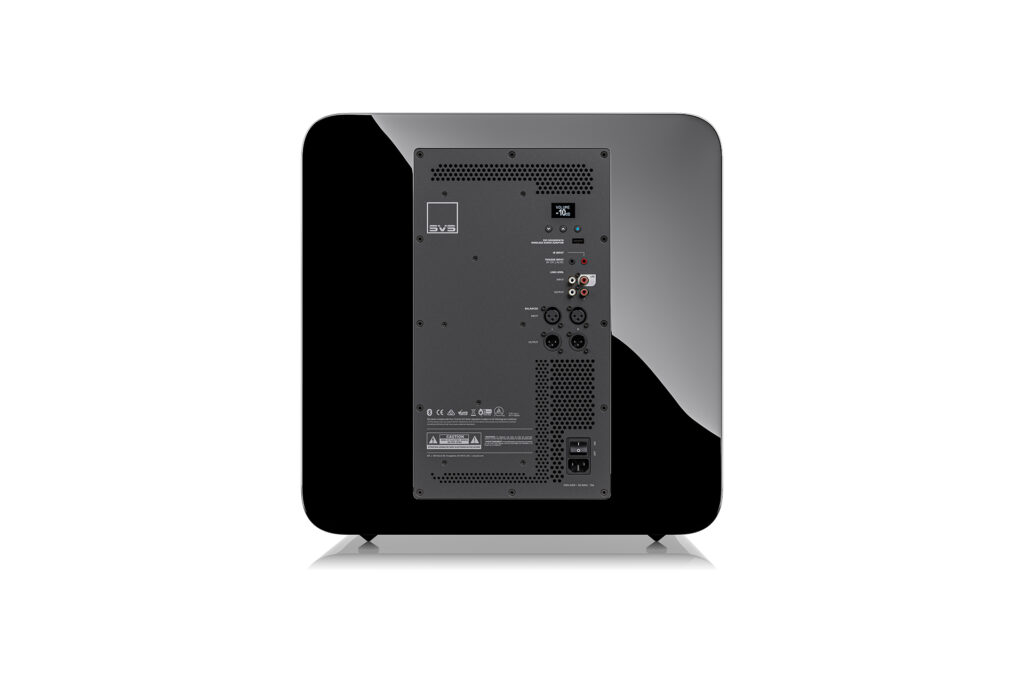
- There are also manual controls on the back of the sub, should the app not be wanted or for any reason unavailable. SVS very conveniently provides a “flip” feature, which allows the display to be turned upside-down for anyone trying to make adjustments while reading the screen from the top down. While I can read upside-down, at least to a point, being able to flip the display made seeing the screen very simple. I tried this during the review, and it did in fact make seeing the display much easier than trying to contort myself to read the display straight on.
- At some point in the future, SVS will take the DSP function one step further with onboard auto EQ room correction. When available, the SB17-Ultra will use the smartphone’s microphone and will automatically tune the subwoofer output to resolve acoustical deficiencies in the room. This feature is also intended to work with an external microphone. Purportedly, the app will take frequency sweeps and apply the optimal settings for increased performance at the main listening positions. At the time of the review, an estimation for when this feature will be introduced was not available.
- Connections are made with line-level inputs and outputs in both RCA and XLR connection methods. An LFE connection in a single-ended RCA terminal is also available. A speaker level connection, allowing the sub to be directly connected to an amplifier, is done with an adapter from SVS (click here to see).
- A separately purchased SVS SoundPath wireless adapter enables the SB17-Ultra to operate in a wireless mode, thereby eliminating the need for any audio cables. This enhances placement within the room, so long as a 120-volt electrical outlet is close by.
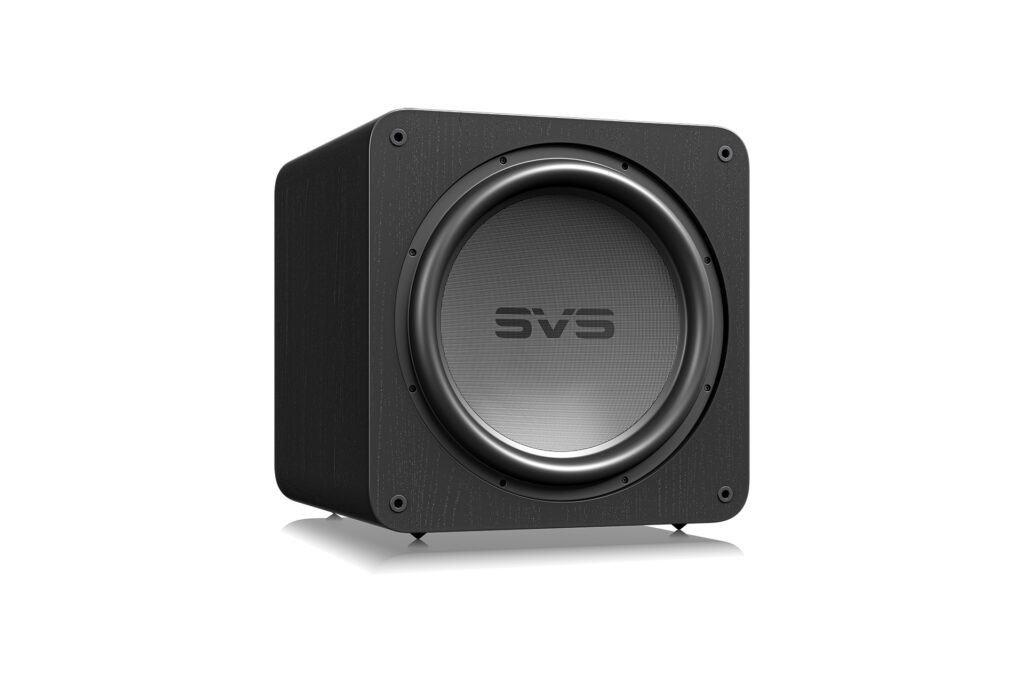
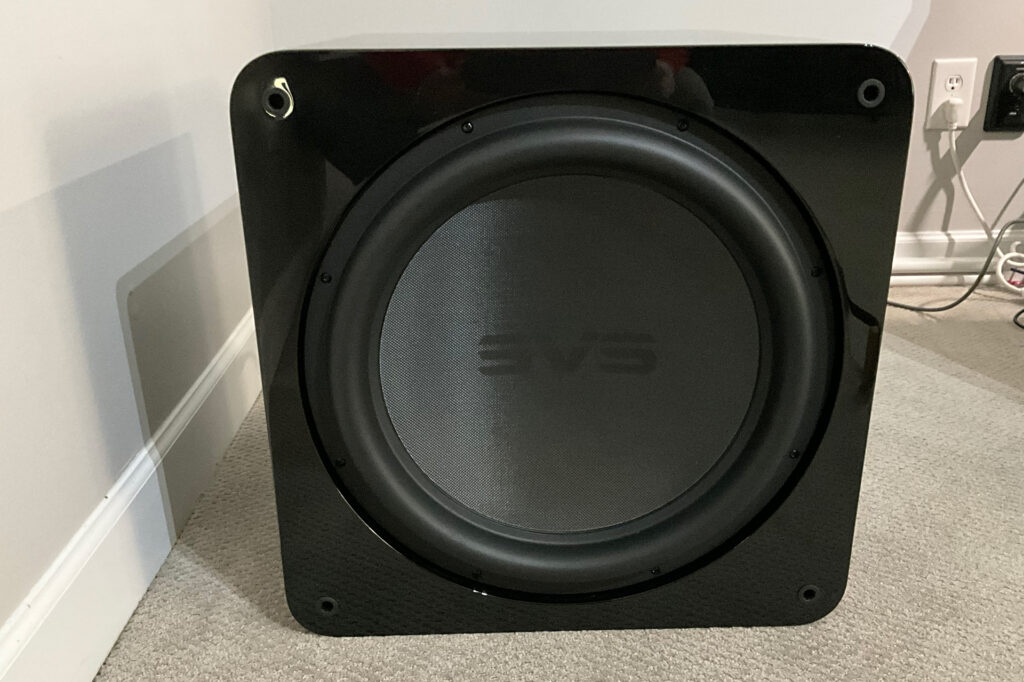
- This subwoofer weighs about 126 pounds (sub only, not shipping weight). There is also a removable cloth grille and, depending on whether this grille is used or not, the overall shape is about a 20- to 22-inch cube.
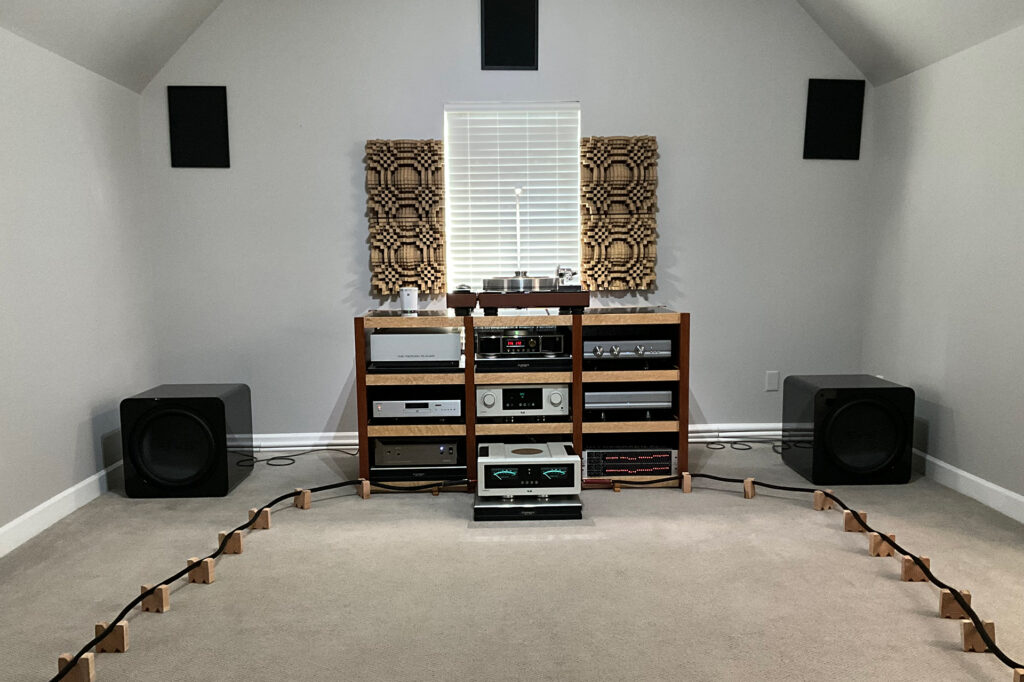
- While one subwoofer is traditionally used for both home theater and two-channel audio applications, SVS very graciously shipped me a pair of SB17-Ultra subs so I could use them in stereo mode. As good as one sub may be, in my opinion, having a stereo pair provides increased performance, and it is my overall preference for implementing a subwoofer in my audiophile system.
Why Should You Care About the SVS SB17-Ultra R|Evolution Subwoofer?
For those who believe a single subwoofer or, even better, a stereo pair provides a sonic improvement, the goal is to have one with the ability to enhance the low midrange down to the lowest audible levels of sub-bass. The SVS SB17-Ultra has the requisite design to seamlessly blend in with a system’s main speakers – the goal being to provide more natural-sounding delivery of a recording. There is a significant amount of technology packed into the subwoofer, as well as the ported version, which provides a definite enhancement of musical reproduction. To do so at the list price of $2,699 makes this subwoofer a feature-packed product at an affordable price. While certainly not a budget-priced component, there are any number of subwoofers with less technology and a higher price.
Some Things You Might Not Like About the SVS SB17-Ultra R|Evolution Subwoofer
- For those who prefer this particular connection method, there are no speaker-level, aka high-level, terminals on the rear of the cabinet. This means connecting the SVS SB17-Ultra subwoofer directly to an amplifier is not possible. Speaker-level input connections show both the subs and the main speakers the same audio signal, thereby delivering a more cohesive sound.
- Just like its ported big brother, the SVS SB17-Ultra is not a one-person-moveable, fit-anywhere product. Not only is it large enough to be highly unwieldy if carried by one person, at 126 pounds, it is even more difficult to move and place in the room. As such, two people are strongly suggested to transport this sub, and a medium-sized room at a minimum is highly recommended for its use.
- Most of us have by now completely accepted the use of apps on a handheld device, such as a phone or tablet. If, however, anyone still prefers a physical remote to control, well, anything, the SVS SB17-Ultra does not have a physical remote available.
Listening to the SVS SB17-Ultra REvolution Subwoofer
Generally speaking, I enjoyed my time listening to my favorite tracks, both analog and digital, with the SVS SB17-Ultra subwoofers in my system. I found the stereo pair more to my liking than what I would typically expect with only one sub. Placed in the front corners of my audio room, on the short wall, and well behind my mains, I never heard what I thought was a highly localized low bass sound. In fact, bass tones blended extremely well with the sound from my line array mains. On most tracks, I even noticed the lows were imaging with the mids and highs – something many subs cannot easily accomplish. This, of course, is dependent on the recording. The low frequencies produced were tight, controlled, and never sounded as if they were overpowering. I could have made these immensely powerful subwoofers consume most of the higher frequencies if I chose to do so, but increased volume was not necessary for quality and believable lows.
On the track “Dark Horse,” from the album Prism by Katy Perry, the artist delivers a mostly pop-oriented sound, which is also influenced by hip-hop and rap. Hip-hop star Juicy J even contributed to the track, which delivers a modern style. Perry makes heavy use of a steady low bass, which pulses through the entire track. Also weaving its way through the song is a rhythmic drumbeat that tends to anchor everything together, giving the track weight. All of these low-pitched instruments were completely separate in their presentation and reproduced cleanly with a certain amount of “pop,” thus making “Dark Horse” an easy track to enjoy.
Another song I have always enjoyed, “Fight Song” by Rachel Platten from the album Wildfire, begins with Platten’s vocals accompanied by a simple piano. This goes on for about 45 seconds, when suddenly a concussive drum beat noticeably begins. Add to that the bass guitar, and this track certainly gives the average subwoofer a lot to do. The SVS SB17-Ultra had no problems in reproducing a powerful drum line, while at the same time not destroying the midrange and drowning out the highs. When things are done correctly, lows are powerful, yet the immediacy of Platten’s voice remains easily recognizable. Manifestly, this is a pop song, and I never got the feeling the sonics were anything except exactly what they should sound like. Add in the upbeat never-give-in attitude the track embodies, and “Fight Song” was enjoyable from beginning to end.
Will the SVS SB17-Ultra R|Evolution Subwoofer Hold Its Value?
For those who do not believe in a subwoofer for a two-channel audiophile system this is a moot point. For those who do, technology for subs does not radically change on a frequent basis. Most subwoofers will last for quite a few years before new and improved tech renders them mostly obsolete. It is not uncommon for a properly implemented subwoofer to work well in a system for as many as 10 years, maybe more. Given the price versus performance metrics, the SVS SB17-Ultra should last for years before needing replacement. If so, having to purchase a new sub every year or so is simply unnecessary. Because SVS subwoofers, in general, enjoy a commanding presence in the used resale market, the value proposition is therefore excellent.
What is the Competition for the SVS SB17-Ultra R|Evolution Subwoofer?
My first thought is a subwoofer I recently reviewed, the Martin Logan Grotto 15 (read review here).Retailing at a cost of $2,799, it is just a scant hundred bucks more than its SVS competitor. The Grotto 15 has a 15-inch front-firing woofer and two 15-inch side-firing passive radiators. These side-firing drivers are intended to enable the subwoofer to mimic a bass reflex port, yet also deliver a very tight, controlled presentation for which sealed subwoofers are known. The Grotto 15 is very similar in size and, although its 1000-watt Class-D amplifier is less powerful than the SVS, I can attest firsthand how powerful this sub can sound. I was also impressed by the sonic performance of this eminently well-designed subwoofer.
While slightly more expensive at $3,299, the REL S/550 is a worthy competitor to the SVS SB17-Ultra subwoofer. The REL S/550 features a carbon alloy cone in a 10-inch driver, powered by a 550-watt (rated for continuous output with 600 watts intermittent output) Class-D amplifier. Also included is a 10-inch downward-firing passive radiator. This passive radiator is intended to enable the subwoofer to act like a ported version while preserving the sonic qualities of a sealed cabinet. A wireless connection is also available. At 68 pounds and with a smaller cabinet, the REL S/550 is more easily transportable. Adding to the smaller footprint and weight specification, the REL S/550 has two side-mounted handles to aid in mobility. And, in a feature most prominently promoted by REL, the S/550 may be stacked by as many as three subwoofers per side, for a total of six (REL calls this configuration a “six-pack”) in a line-array configuration. Spoiler alert: very soon now I will be reviewing a six-pack of REL S/550 subwoofers to see how this line-array configuration performs sonically.
JL Audio has long been a popular brand of subwoofer, especially their Fathom line of components. The JL Audio 12-inch E-Sub in ash wood is priced at $2,700 and features an extra-long Excursion driver, which is claimed to improve linearity and reduce distortion. The amplification in this sub is a Class-D switching amp, producing 1500 watts of continuous power. The frequency range at minus three dB is claimed to be 21 Hz to 120 Hz. The JL Audio 12-inch E-Sub also features speaker-level and line-level connections. Connecting to a preamp as well as a power amp is therefore not a problem. There are only RCA connections on the rear of the cabinet; XLR terminals are not offered. Likewise, there is no remote or downloadable app to provide control over the subwoofer’s settings without having to do so on the cabinet itself.
Final Thoughts on the SVS SB17-Ultra R|Evolution Subwoofer …
To be brutally honest, my original impression of SVS subwoofers as a whole was summed up by terms I had heard and read, such as “earthshaking” and “heart-pounding.” I had convinced myself that SVS subs were more appropriately oriented toward home theater than two-channel audio. I kept telling myself I had little interest in peeling the paint off the walls and breaking glass with low-frequency power.
Without question, having the level of power at one’s disposal this subwoofer possesses, any of these descriptors are certainly possible. Well, maybe not “earthshaking,” but you get the point. What I discovered, to my complete enjoyment, was that the SVS SB17-Ultra displayed remarkable finesse and did an excellent job of filling in those bottom octaves with the music with which full-range speakers so very often struggle. I noticed my low midrange sounded more full-bodied, which is a hallmark of a quality subwoofer. Let’s face it, creating overtly booming bass is profoundly simple. Producing quality bass, while not overpowering the adjacent frequencies, and at the same time improving the low mids, well, that is a thing of beauty.
I found the SVS SB17-Ultra R|Evolution Subwoofers highly effective, welcome additions to my audio system. They never struggled or strained in providing quality low frequencies. In fact, because my line-array main towers only go down to 50 Hz, a subwoofer is not only required, it is the sole source of any measure of low bass. And what I heard was not some booming, cacophonic, jumble of low-frequency explosions bouncing around my audio room, but instead what I expect a subwoofer to sound like in an audio system on the level of mine. I wanted quality bass, and the SVS SB17-Ultra R|Evolution delivered. I can therefore easily and heartily recommend this subwoofer to anyone who is considering one in this class of product and also at this price point. I know you will not be disappointed.



