
 By
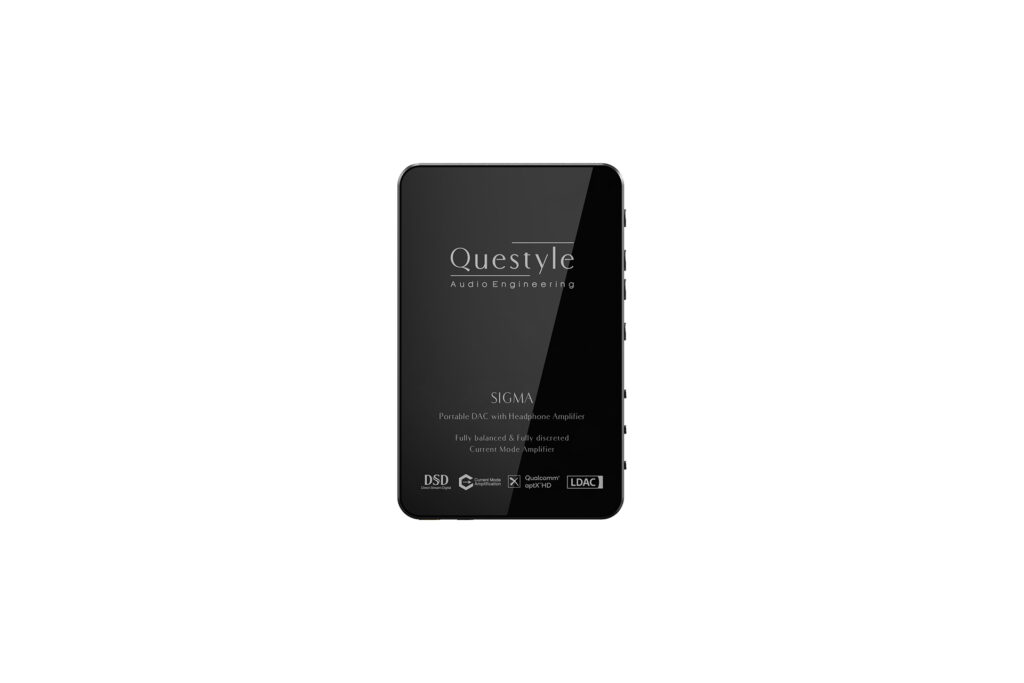
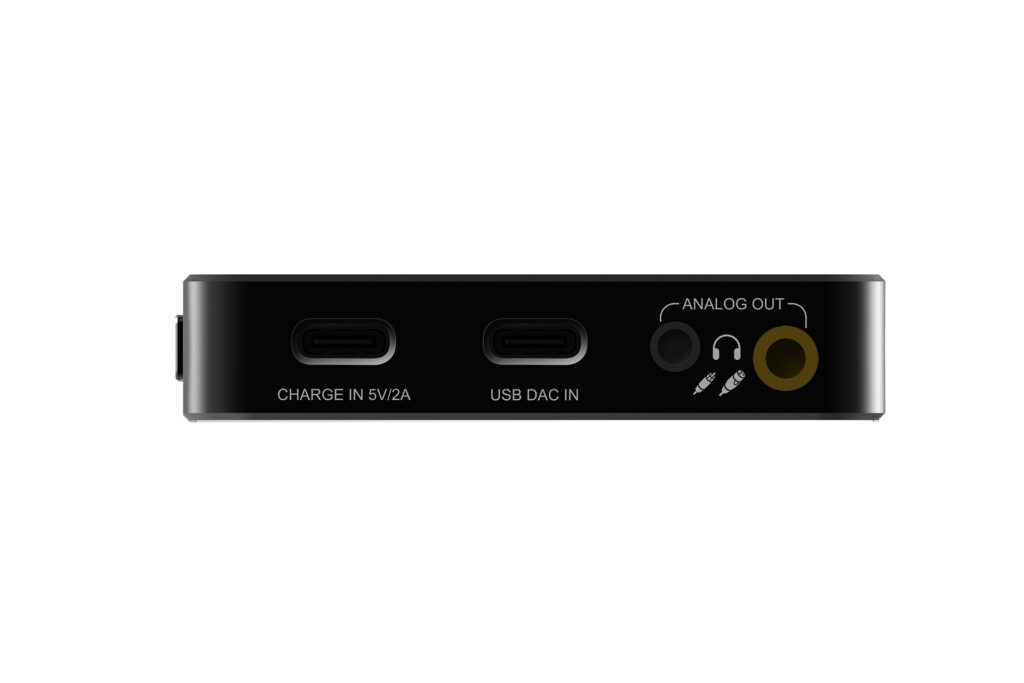
By One of the most amazing things about the audiophile business is that, at times, it can feel like there are an endless number of companies that make and sell the various types of gear and, at other times, it can feel like there are only a handful. Questyle is a Chinese audio company that has been around for 13 years, and the Questyle Sigma was my introduction to this company. The Questyle Sigma, a portable DAC with a built-in headphone amplifier, is a product that sells for $549, uses the AKM AK4493 DAC chip, and has 3.5- and 4.4-mm headphone inputs built into it, as well as two USB-C ports: one for charging and one to connect to an external device. In the specs of the amplification for the headphones, Questyle advertises the max output power at 1200 milliwatts at 32 ohms and the total harmonic distortion at 0.0002 percent at 300 ohms. The portable DAC and headphone amplifier is one of my favorite products as a person who still prefers wired headphones, as this allows me to bring my music anywhere without having to compromise sound quality from the incoming music stream. Let’s look closer at the Questyle Sigma to see if it is worth you taking a closer look at it as well.
What Makes Questyle Sigma DAC with Headphone Amplifier So Special?
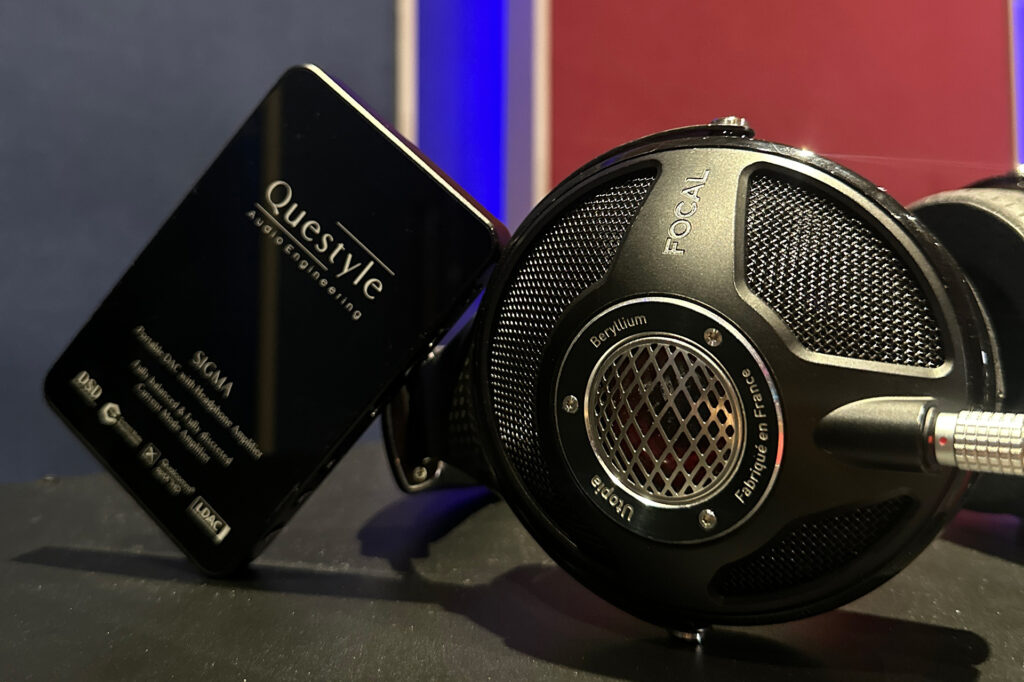
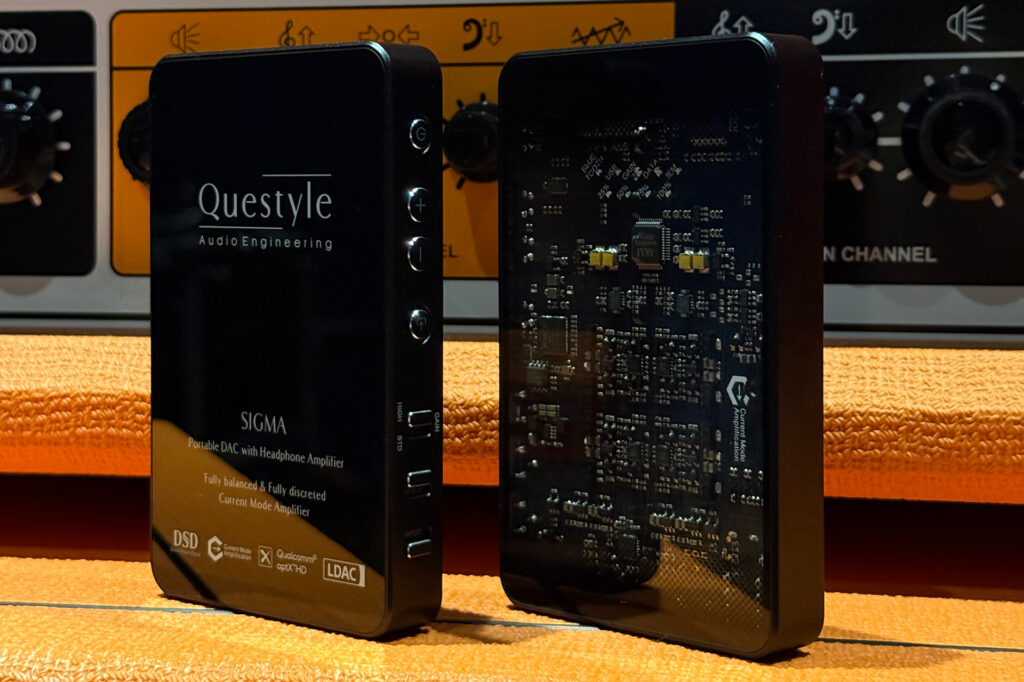
- The industrial design is simply striking. Often, audiophile components can feel bland. They are black or gray, and often they never really stand out. The Questyle Sigma, however, does something different. Questyle has chosen to use optical-grade transparent glass to allow you to see the internal chipboard and use LED lights on the board to act as indicators of different configurations you have in use with the device. This is a long-winded way of saying it looks really cool!
- The headphone input was well thought-out. Not only did Questyle provide 3.5mm unbalanced and 4.4mm balanced connections, but they also added a setting specifically for in-ear monitors (IEM). When that mode is enabled, the signal path is minimized and a 64-step volume control is put into place so that it can handle sensitive IEMs.
- If you prefer wireless headphones, the Sigma has you covered there, too. With the Questyle Sigma being Bluetooth 5.4-compatible and having the use of LDAC, as well as Qualcomm AptX adaptive and AptX HD, you will be also able to use the Sigma with wireless headphones.
- You can use the component as just a portable audiophile DAC. Questyle has set the device up so that you can use the 3.5-mm output to RCA cable to connect it unbalanced to a preamplifier, or the 4.4-mm output to XLR to connect it balanced. This is a great feature if you are trying to get the most bang out of your buck and you are primarily connecting through a source device that allows USB out, such as all new cell phones, as well as most tablets and laptops.
- The Questyle Sigma will easily fit into your pocket. With the device being only 4.33 x 2.75 x 0.59 inches and weighing less than half a pound, you shouldn’t have any issues putting this portable DAC and headphone amplifier into your pocket or purse or anything else you might carry around with you when you’re out of the house.
- You can charge the Sigma while you use it. As a person who works from home, and has five other people in my house, using headphones is ideal. What isn’t ideal is when battery-powered parts of your audio setup run out of charge. With the Questyle Sigma allowing you to charge it while you use it, it can be a regular part of your everyday listening setup without you having to worry if you have charged the device recently.
Why Should You Care About the Questyle Sigma DAC with Headphone Amplifier?
If you’re someone who likes to get out of the house for walks or uses public transportation, but you don’t want to give up high-resolution audio, then having a portable DAC and headphone amplifier to go with your favorite headphones is ideal. The Questyle Sigma also adds the versatility to allow you to use the device with wireless headphones or as just a DAC, so you have a device that you should be able to find a use for in almost any situation.
Some Things You Might Not Like About the Questyle DAC with Headphone Amplifier
• The Questyle Sigma doesn’t charge quickly. With 12 hours’ worth of battery life, you might not find this to be too big of an issue, but in my experience, charging the battery from zero to 100, by plugging it into a wall outlet, took a few hours. Trying to charge it from my laptop took much longer than that.
• You cannot determine the frequency of the music being played. It would have been nice to have some sort of indicator as to whether you are playing at 44.1, 96 or 192 kHz. To some of you this may seem trivial, as the streaming provider often shows it, but you sometimes must update configurations on your phone, tablet or laptop to ensure that you are getting the highest-quality audio, and the DAC can be a great way to validate the quality of your stream.
• There are no filters (EQ) available. The Questyle Sigma DAC is a straightforward unit. There are no filters for you to try to add bass or alter its basic sound. For some, this won’t be a problem, but certainly there is a crowd who like to be able make adjustments as they listen to different genres of music
Listening to the Questyle Sigma DAC with Headphone Amplifier …
I tested the Questyle Sigma DAC and headphone amplifier with my MacBook Pro as the primary audio source. Audio was streamed using Qobuz. Additionally, I used the Meze Liric closed-back headphones (read the review here), which are a 61-ohm-impedance headphone, in all listening. As a form of comparison, I used the iFi Audio xDSD Gryphon (read the review) as a reference.
When testing headphone amplifiers, one of the tracks I enjoy playing is “The Chain” (Qobuz 96 kHz) from Fleetwood Mac. This is a six-minute live version of a classic Fleetwood Mac track found on the band’s Rumours Live album, which features one of their shows from their 1977 tour at the fabulous Forum in Inglewood, California. When I closed my eyes and listened to this track, it was easy to differentiate the various noises coming from the crowd at the Forum, and the Sigma allowed the recording to do exactly what it was designed to do, which is let the listener feel like they were at the show. You can place Lindsey Buckingham’s guitar to the left of the stage and Christine McVie’s keyboard to the right. The harmonizing of Buckingham and Stevie Nicks sounds great and you can easily hear each of them in their own place on stage with Nicks to Buckingham’s left.
Another track that is great for testing headphone amplifiers is Radiohead’s “Packt Like Sardines n a Crushd Tin Box” from their fifth studio album Amnesiac (Qobuz 44.1 kHz). This is the opening track on an album made up of compositions that the band chose to not use on Kid A, but the selections are certainly no slouches. One of the first things that I noticed when listening to this track with the Questyle Sigma is how much the bass did. When the bass really kicks in at around the 15-second mark of the track, you could feel it through the headphones. The DAC was also competent in separating all the different sounds that appear in this dense track and overall provided an enjoyable listen to a piece that I have been enjoying since its 2001 release.
The last track I used was “It Never Goes Away (Woman)” by Jazz at Lincoln Center Orchestra (Qobuz 44.1 kHz). If you’re not familiar the Jazz at Lincoln Center Orchestra, it is a New York City staple dedicated to the preservation and advancement of jazz, lead by Pulitzer Prize-winning Wynton Marsalis. The band tours the United States and provides one of the most available tickets you can find, with student tickets available under $20 and the most expensive ticket often still going for less than $100, which is a value that is hard to match today. When I listened to this track with the Questyle Sigma in the signal chain, the soundstage sounded very wide. I was easily able to pick out the different instruments and their placement across the stage, and the female vocal felt full, but never harsh. When I compared this to the iFi xDSD Gryphon, the Sigma placed the vocal performance a little bit more out in front, but the xDSD Gryphon had an extra layer of detail and refinement that the Sigma didn’t have, as the percussion to open the track was much more noticeable.
Will the Questyle DAC and Headphone Amplifier Hold Its Value?
Quality products will always find a following that will aid their resale value. With the Questyle Sigma DAC and headphone amplifier, first, you are only putting out $550 to start, so you would likely expect to get half of that value back in the resale market. One of the things that will strongly influence resale, though, is the relative scarcity of portable DAC and headphone amplifiers, which could really help it maintain a strong value in what is a bit of a niche market.
What is the Competition for Questyle Sigma DAC with Headphone Amplifier?
One of the first competitive options that comes to mind is the Chord Mojo 2 ($650 – Buy at Amazon). Chord has a very good reputation for making high-quality products, even if they aren’t always the most pleasing to the eye. The Mojo 2 uses a proprietary DAC, so it will have a unique sound, as it isn’t using an off-the-shelf DAC chip like the Sigma does. With that said, it does come with its quirks. It is $100 more expensive, it uses a micro-USB charge port, which is certainly less convenient than USB C, and it only supports single-ended 3.5-mm headphones, so if you plan to use 4.4-mm balanced headphone cables, you are out of luck.
Another option you can look at is the iFi Audio xDSD Gryphon ($600 – buy at Crutchfield). I have had this portable DAC and headphone amplifier for a few years now, and I continue to use it today. The xDSD Gryphon has a solid build quality and provides a great sound, while supporting both 3.5- and 4.4-mm headphone jacks. It comes with a few filters and a LED screen that shows you the quality of your stream, which filter options you have enabled, and how much battery you have left. It is slightly more expensive, but worthy of your consideration.
Lastly, if you’re looking for another Chi-Fi option, you might consider the FiiO Q15 ($400). FiiO has built a solid reputation for itself of providing great value for the price. Like the Questyle, it uses AKM DAC chips and seems to have been built with a similar design philosophy, as it has nearly the same features, from dual USB C inputs, so you can charge it while you use it at your desk, to both 3.5- and 4.4-mm headphone jacks. Where it is different is the visual style, and the FiiO comes with a full digital coax input, which is rare.
Final Thoughts on the Questyle Sigma DAC with Headphone Amplifier …
Portable DAC and headphone amplifiers are among my favorite categories to review right now. It is one of the audiophile components that best fits my often complicated Millennial life. Being able to take the music I love, in the quality that I love, with me, whether I’m moving around the house or walking around the neighborhood, is a boon.
Overall, the Questyle Sigma provides an enjoyable listening experience and it is comparable to my reference iFi xDSD Gryphon, with some advantages, as it had better vocal placement. So, if you’re in the market for a portable device like this, you owe it to yourself to give the Questyle Sigma a listen. It is a rock-solid performer at a very fair price.



