
 By
By The Metronome DST Compact Disc transport is a product that is a bit of an anomaly in a world where so much of today’s audiophile content is consumed by streaming services. Why build something to play antiquated Compact Discs, you ask? The simple answer is lots of audiophiles have massive CD collections that they still very much enjoy. There is something different about having to open a jewel case, insert the disc into a player and enjoy the album from start to finish. There are also many who believe that a digital stream from a physical medium just sounds better. The Internet, after all, is a hectic and noisy and often nasty sonic place which can and does affect system performance.
The Metronome DST CD Transport is part of the company’s Digital Sharing (DS) product line, which is essentially a high-performance-component-based lifestyle system. The DS line has a streamer and DAC, which checks the boxes for those who want to stick to streaming. I was glad to see a CD transport offered so people can rediscover the aging but still sexy silver disc.

What Makes the Metronome DST CD Transport So Special?
- The Metronome DST CD Transport is built around the JPSL-33 drive from StreamUnlimited. StreamUnlimited was founded in 2006 by engineers who worked at Philips, designing transports that were used in countless high-end players. While the slot-loading transport may look like a standard PC drive, it is not. This was designed specifically to read Redbook CDs only; no Super Audio or DVD-Audio discs are supported.
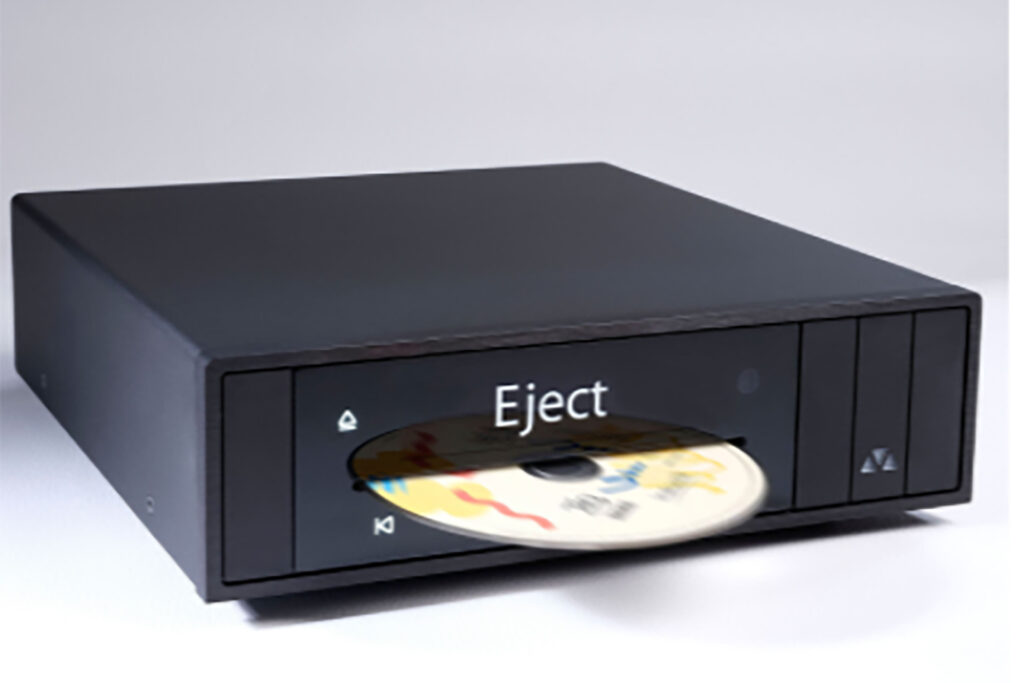
- The Metronome DST CD Transport utilizes the same cool form factor of the rest of the digital sharing product line. The chassis is solid and chunky, with considerable heft for such a small package. The metal case is thick and covered with a durable matte finish. The face plate is a three-eighths-of-an-inch-thick piece of solid aluminum, with interesting vertical bars machined into it. Overall, it looks like a blend of science fiction and industrial design themes, which work well together to my eye.
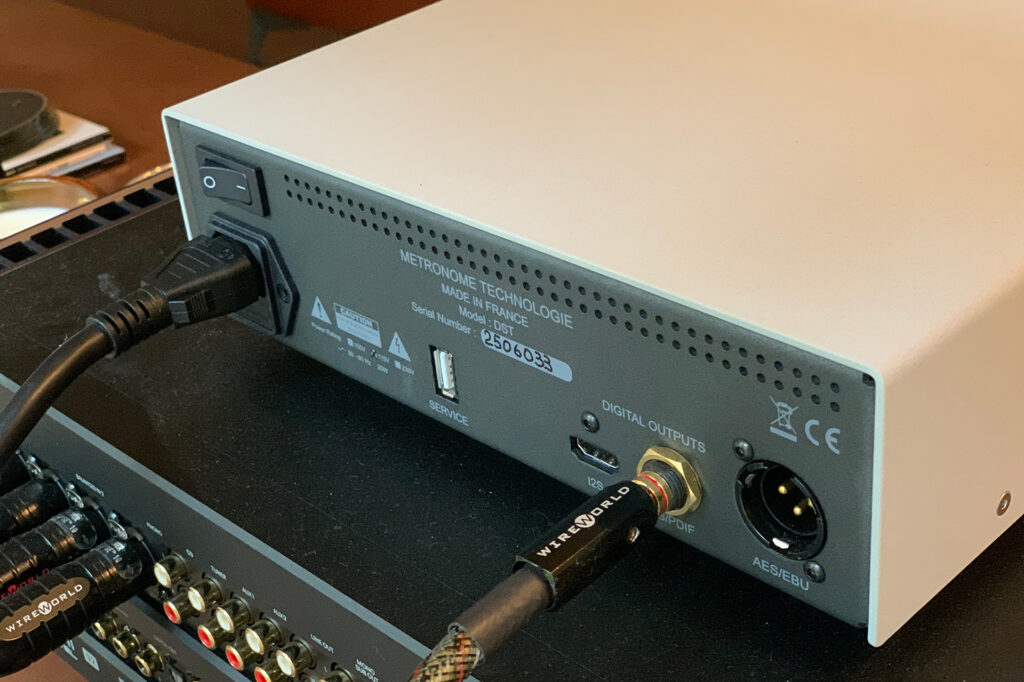
- The Metronome DST CD Transport supports a wide range of up-sampling options. The XLR AES/EBU and coaxial S/PDIF outputs support PCM 44.1kHz/16-bit all the way up to 384kHz/32-bit and DSD64 to DSD 128. The HDMI I2S output adds DSD256 capability.
- The Metronome DST CD Transport has a large display that is easily read from across the room. As an aging Gen-Xer whose eyes were never great, I have come to appreciate well-executed displays that don’t make me squint to see. Thank you, Metronome.
- The Metronome DST CD Transport is 100 percent made in France, like the rest of the digital sharing products. Metronome builds things close to home to ensure quality control, which is becoming more and more rare, as everything seems to be assembled in China these days. I hope this trend continues with other manufacturers.
Why Should You Care About the Metronome DSC DST CD Transport?
The Compact Disc, which was all but forgotten not long ago, is having a resurgence. Enthusiasts have large catalogs of CDs and are finding that streaming, while infinitely convenient, doesn’t have the same magic as physical media. The Metronome DST CD Transport is designed to breathe new life into your old CD collection with precise data retrieval and upscaling. Pair this with the Metronome DSC Mini DAC, which I recently reviewed, or your DAC of choice for an outstanding digital front end.

Some Things You Might Not Like About the Metronome DSC Mini DAC
- The Metronome DST CD Transport is a Redbook 44.1kHz/16-bit-only player. This means if you have a large collection of SACD or DVD-Audio content, the DST will not play them. However, most SACDs do have a Redbook layer, which this transport had no problems reading.
- The Metronome DST CD Transport track buttons operate in a strange manner. Every other disc player I have owned or used allows you to start the current track over by pressing the previous track button. Not so with the Metronome DST CD Transport. If you are near the end of Track Four and press the back arrow once, Track Three will start playing. You then must press the next track button to get to Track Four. This is a minor nuisance, but worth mentioning. One other frustration I had was with the operation of the capacitive buttons. I am not a fan of these; I prefer real push buttons every time. I had no problems with the buttons, with the exception of the disc eject button, which simply didn’t work. I tried every one of my fingers, in every orientation, and could not get it to eject. I was forced to use the eject button on the remote. What’s bizarre is that the eject button is also the power button, which did turn off the transport with a long press. I suspect this is an isolated issue with my demo sample.
- The Metronome DST CD Transport does not have an optical output. For some, this may be a big deal, but I prefer the AES/EBU (XLR connector and a favorite pro audio format).
- The remote control for the Metronome DST CD Transport was underwhelming. I expect something at this price point to have a more substantial remote than my Apple TV, which is exactly what it felt like. With that said, it worked just fine.
Listening to the Metronome DST CD Transport …
My current reference system consists of an aging Lumin U1 mini-streamer, a Weiss Helios DAC, a CH Precision L1/X1 preamp, a CH Precision M1.1 amplifier and Rockport Avior II loudspeakers. The Metronome DST CD Transport was connected to the Weiss Helios DAC using a Wireworld Platinum Eclipse 10 XLR digital cable. While the Lumin U1 mini has served me well, it is admittedly nowhere near cutting-edge at this stage, but will be my reference for comparing the sound of the Metronome DST CD Transport to streamed material.
The Cars’ “Drive” is a smash hit from the 1986 Heartbeat City album and still sounds great nearly 40 years later. Immediately, what I noticed was the separation of sounds across the soundstage. Benjamin Orr’s vocals stood out as if laser-etched in space. This sounded different than I remembered and, out of curiosity, I synched the CD to a Qobuz stream and switched back and forth to compare. The difference was clear and the Metronome DST CD Transport easily won sonically. What I heard on the streamed track was a significant downgrade in the focus and separation that I heard from the CD transport. The Metronome transport seemed to paint a blackness around Orr’s voice and the drum percussions that are to the right and left of him. There was excellent three-dimensionality as well. When streaming, the soundstage was flatter and images were slightly smeared in comparison. Bass was tighter and quicker with the Metronome DST CD Transport, too.
“Mother” from Danzig starts with a few simple chords from a guitar and a lone cymbal.Uncluttered sequences like this are a favorite for really learning the nuances of what a new piece of gear brings. In this instance, while listening to it from my college days CD, I heard a razor-sharp precision in the cymbal stage right and an angry guitar stage left, with lots of reverb. The decay of each guitar chord was realistic, and I was able to detect some reflections from the recording area. When the kick drum finally appeared, it did so with power and quickness. My review notes were filled with the word “timing,” which jibes with what I experienced with the previous song. Comparing the CD to a streaming version, I found the same slight fuzziness in the image quality, proving, at least in my system, that a CD with a high-end transport such as the Metronome DST is superior. Maybe I need to review a new streamer soon.
Will the Metronome DST CD Transport Hold Its Value?
This is a difficult question, as it has more to do with demand than the quality of the transport. While it does seem that more people are wanting to play CDs, it’s still a niche market within an already niche market of audiophiles. Personally, I don’t know if any transport is a good investment, due to the popularity of streaming. However, that doesn’t mean you shouldn’t own one if you have or want to start a collection of CDs. I still use my CD player on occasion and am very happy to have it when the Internet is out. All this is to say that one should buy the Metronome DST CD Transport for its capability and performance, as resale is going to be difficult to predict for any transport.
What is the Competition for the Metronome DST CD Transport?
The first transport that comes to mind is the $5,000 Jays Audio CDT3 MK3 CD Transport (read the review). Like the Metronome DST CD Transport, the CDT3 MK3 is a Redbook-only player. However, it only has one up-sampling choice of 176.4 kHz, whereas the Metronome has eight different PCM options and three DSD. The CDT3 MK3 is a full-size chassis with a top-loading mechanism, complete with clamp. That pegs the coolness meter in my mind. The CDT3 MK3 has more outputs than the Metronome, adding BNC and RJ45.
Next on the comparison chart would be the $3,299 Teac VRDS-701T CD transport. Like the Jays Audio CDT3 MK3, it’s a full-sized unit with a solid aluminum chassis. The heart of any transport is the drive, and nobody has more experience building high-end silver disc drives that Teac. You may be familiar with Teac’s ultra-high-end brand Esoteric, which competes for the top spot on the audio food chain. Their $58,000 Grandioso P1X SE SACD/CD transport utilizes their in-house-designed VRDS-ATLAS drive. VRDS stands for Vibration-free Rigid Disc-Clamping System. The reason I mention this is that Teac states that the drive inside the VRDS-701T transport shares some DNA with their top-of-the-line VRDS Atlas drive. It also includes high-end features, such as dual master clocks running at 44.1kHz and 48kHz. Dual toroidal transformers are used to separate the digital control section from the drive mechanism. It does not do any up-sampling, but it can decode MQA CDs. Digital output is only coaxial or optical.
Final Thoughts on the Metronome DST CD Transport …
The Metronome DST CD Transport is designed to work hand in glove with the Metronome DSC Mini DAC, which I also reviewed. It shares the same form factor, and they sound great together. However, the Metronome DST transport is just as comfortable with any DAC, such as my Weiss.
Sound quality was excellent, and it was a lot of fun experimenting with different re-sampling rates. Typically, I found that staying with the native rate sounded best. In my limited experience, everything I listened to through the transport sounded better than my admittedly aging Lumin streamer and less than optimized LAN. Focus and timing were all clearly improved, and I enjoyed the physical act of feeding discs into the front of the Metronome.
To say I will miss the Metronome DST CD Transport is an understatement. It transported me, no pun intended, back to a simpler time. It let me rediscover my dust-covered Compact Disc collection, and even inspired me to buy a few new ones. If you don’t have a CD transport, I recommend you consider one in your rig, and would put the Metronome on your list to audition.




Why does it have dual clocks if it only plays CD? What purpose does the 48 kHz clock serve?
Upsampling reference clocks.
The clocks are for the various upsampling frequencies.